Ethical decision making
This refers to the process of making informed choices about ethical dilemmas based on a set of
standards differentiating right from wrong.
Bioethical standards
1) autonomy-the right to choose
...
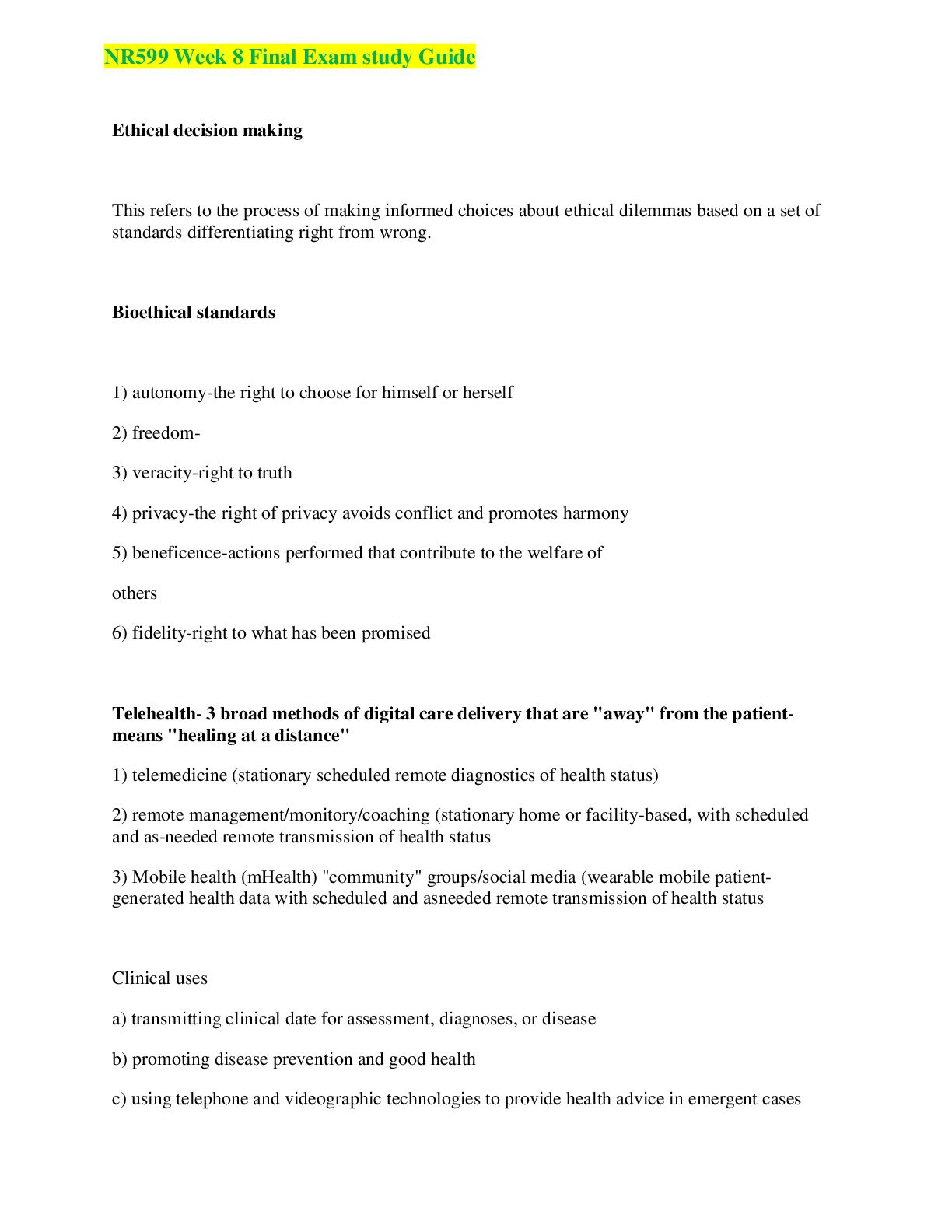
Ethical decision making
This refers to the process of making informed choices about ethical dilemmas based on a set of
standards differentiating right from wrong.
Bioethical standards
1) autonomy-the right to choose for himself or herself
2) freedom3) veracity-right to truth
4) privacy-the right of privacy avoids conflict and promotes harmony
5) beneficence-actions performed that contribute to the welfare of
others
6) fidelity-right to what has been promised
Telehealth- 3 broad methods of digital care delivery that are "away" from the patientmeans "healing at a distance"
1) telemedicine (stationary scheduled remote diagnostics of health status)
2) remote management/monitory/coaching (stationary home or facility-based, with scheduled
and as-needed remote transmission of health status
3) Mobile health (mHealth) "community" groups/social media (wearable mobile patientgenerated health data with scheduled and asneeded remote transmission of health status
Clinical uses
a) transmitting clinical date for assessment, diagnoses, or disease
b) promoting disease prevention and good health
c) using telephone and videographic technologies to provide health advice in emergent cases
This study source was downloaded by 100000852290574 from CourseHero.com on 01-23-2023 14:34:02 GMT -06:00
https://www.coursehero.com/file/52788009/NR599-Week-8-Final-Exam-study-Guideediteddocx/
d) using real time video i.e: exchanging health services or video conferencing
Medical Applications
Apps Providing Access to Electronic Copies
Apps for General Patient Education
Generic Aids or General Purpose Apps
Apps as Educational Tools
Apps Automating Office Operations
Medical Devices
Some mobile apps may meet the definition of a medical device but because they pose a lower
risk to the public, the FDA intends to exercise enforcement discretion over these devices
(meaning it will not enforce requirements under the FD&C Act). One example is a mobile app
that makes a light emitting diode (LED) operate. If the manufacturer intends the system to
illuminate objects generally (i.e., without a specific medical device intended use), the mobile app
would not be considered a medical device. If, however, through marketing, labeling, and the
circumstances surrounding the distribution, the mobile app is promoted by the manufacturer for
use as a light source for providers to examine patients, then the intended use of the light source
would be similar to a conventional device such as an ophthalmoscope.
This study source was downloaded by 100000852290574 from CourseHero.com on 01-23-2023 14:34:02 GMT -06:00
https://www.coursehero.com/file/52788009/NR599-Week-8-Final-Exam-study-Guideediteddocx/
FDA Oversight for Medical Devices
The Food and Drug Administration (FDA) (2013) recognizes the extensive variety of actual and
potential functions of mobile apps, the rapid pace of innovation in mobile apps, and the potential
benefits and risks to public health represented by these apps. The FDA intends to apply its
regulatory authorities to select software applications intended for use on mobile platforms. Given
the rapid expansion and broad applicability of mobile apps, the FDA is issuing this guidance
document to clarify the subset of mobile apps to which the FDA intends to apply its authority.
Many mobile apps are not medical devices, meaning such mobile apps do not meet the definition
of a device by the Federal Food, Drug, and Cosmetic Act (FD&C Act); therefore, the FDA does
not regulate them.
Privacy
According to Healthit.gov (2014) Protecting Your Health Information, the privacy and security
of patient health information is a top priority for patients and their families, health care providers
and professionals, and the government. This was also previously discussed under HIPAA. It also
requires that "key persons and organizations that handle health information to have policies and
security safeguards in place to protect your health information whether it is stored on paper or
electronically."
Confidentiality
Hard to maintain due to social media and use of mobile devices such as smartphones, they are
being utilized in treatment rooms around the globe, Providers need to be aware of institutional
policies regarding audio/video recordings by patient and families, requires two-party consent,
sometimes enthusiasm for patient care and learning can lead to ethics violations.
[Show More]