1. What are the recommendations for nurses that are published in the IOM's report The future of nursing? What is Magnet recognition?
a. IOM emphasizes the need for nurses to take the leadership role.
b. Professional nu
...
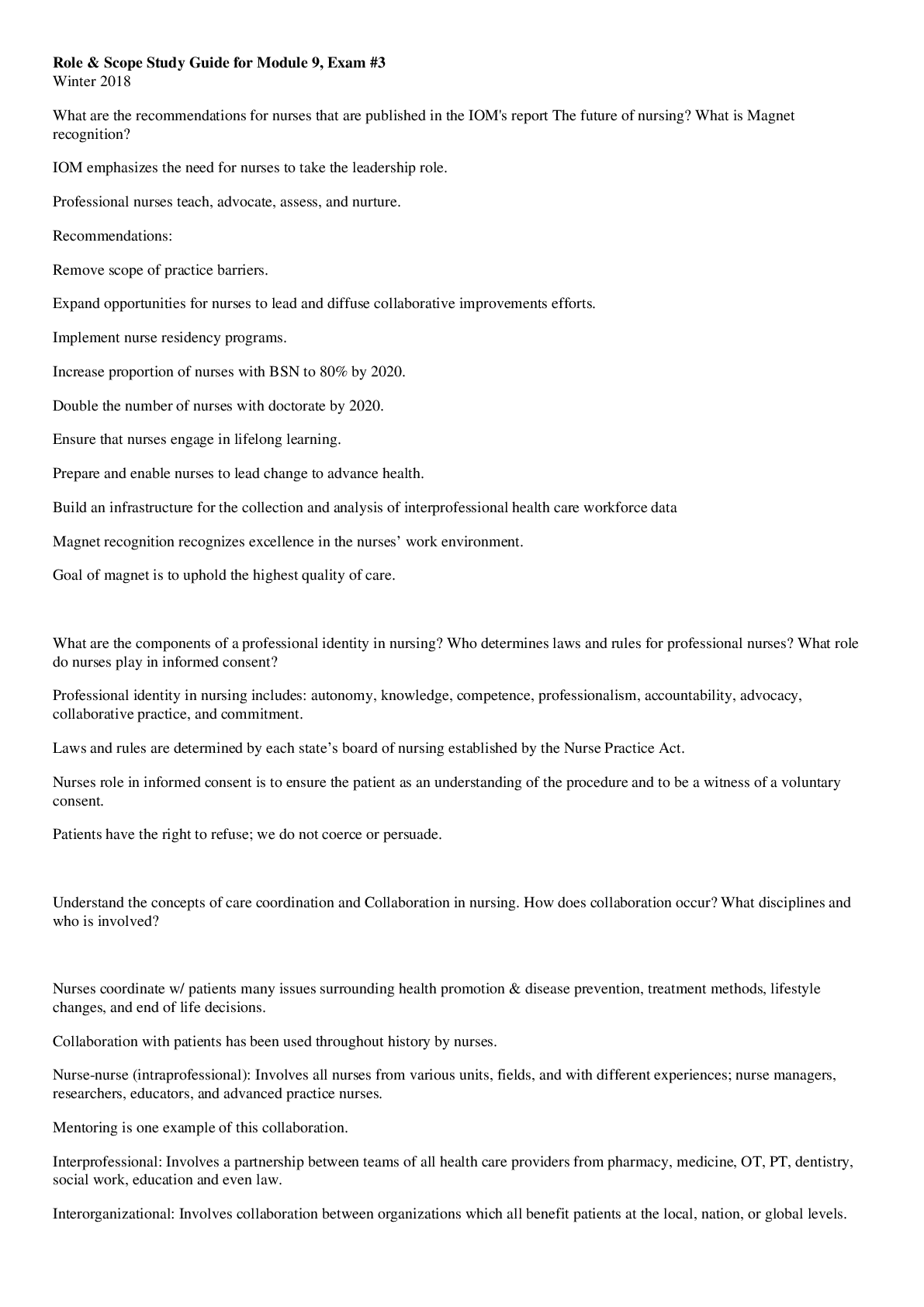
1. What are the recommendations for nurses that are published in the IOM's report The future of nursing? What is Magnet recognition?
a. IOM emphasizes the need for nurses to take the leadership role.
b. Professional nurses teach, advocate, assess, and nurture.
c. Recommendations:
i. Remove scope of practice barriers.
ii. Expand opportunities for nurses to lead and diffuse collaborative improvements efforts.
iii. Implement nurse residency programs.
iv. Increase proportion of nurses with BSN to 80% by 2020.
v. Double the number of nurses with doctorate by 2020.
vi. Ensure that nurses engage in lifelong learning.
vii. Prepare and enable nurses to lead change to advance health.
viii. Build an infrastructure for the collection and analysis of interprofessional health care workforce data
d. Magnet recognition recognizes excellence in the nurses’ work environment.
e. Goal of magnet is to uphold the highest quality of care.
2. What are the components of a professional identity in nursing? Who determines laws and rules for professional nurses? What role do nurses play in informed consent?
a. Professional identity in nursing includes: autonomy, knowledge, competence, professionalism, accountability, advocacy, collaborative practice, and commitment.
b. Laws and rules are determined by each state’s board of nursing established by the Nurse Practice Act.
c. Nurses role in informed consent is to ensure the patient as an understanding of the procedure and to be a witness of a voluntary consent.
i. Patients have the right to refuse; we do not coerce or persuade.
3. Understand the concepts of care coordination and Collaboration in nursing. How does collaboration occur? What disciplines and who is involved?
a. Nurses coordinate w/ patients many issues surrounding health promotion & disease prevention, treatment methods, lifestyle changes, and end of life decisions.
i. Collaboration with patients has been used throughout history by nurses.
b. Nurse-nurse (intraprofessional): Involves all nurses from various units, fields, and with different experiences; nurse managers, researchers, educators, and advanced practice nurses.
i. Mentoring is one example of this collaboration.
c. Interprofessional: Involves a partnership between teams of all health care providers from pharmacy, medicine, OT, PT, dentistry, social work, education and even law.
d. Interorganizational: Involves collaboration between organizations which all benefit patients at the local, nation, or global levels.
i. Hospice care and Health Care Consortiums are examples.
e. Effective collaboration results in fewer errors.
4. How is informatics used to promote interdisciplinary care? How do nurses utilize informatics?
a. Three core concepts to informatics are data, information and knowledge.
b. Nurses utilize informatics by knowing how to operate a computer, comparing data across time, and looking for patterns in client responses to treatments.
c. Concerns for informatics:
i. High technologies are very expensive
ii. Creates a learning curve among older nurses
iii. Power outage issues
iv. Privacy issues
5. Consider all the forms of communication in nursing practice: nurse-patient, nurse-nurse, etc. Know the different styles of communication: assertive, aggressive, conflictual, & educational.
a. Assertive communication is honest and direct; expresses person’s feelings, beliefs, ideas, and opinions.
i. Example of assertive: ‘You have made some good points, but I have another suggestion.’
b. Aggressive: Disregards the other person’s feelings or opinions; bullies the other person.
c. SBAR focuses on a system in which information is provided and shared in an honorable way.
6. Understand teamwork in healthcare. What does an effective team need?
a. Effective teams need:
i. A common goal which includes working together
ii. All team members should be included in decision making and feel valued
iii. Members work together in a civil manner
iv. Strong team spirit
v. Team leader who asks the ideas/opinions of others
b. Effective teams participate in problem solving, increased creativity, and safe and improved health care.
c. Authoritarian/autocratic leadership would not make an effective team nurse leader.
[Show More]








.png)


.png)