Religious Studies > Quiz > REL 134 All Weekly Quizzes 1-5 Complete. (All)
REL 134 All Weekly Quizzes 1-5 Complete.
Document Content and Description Below
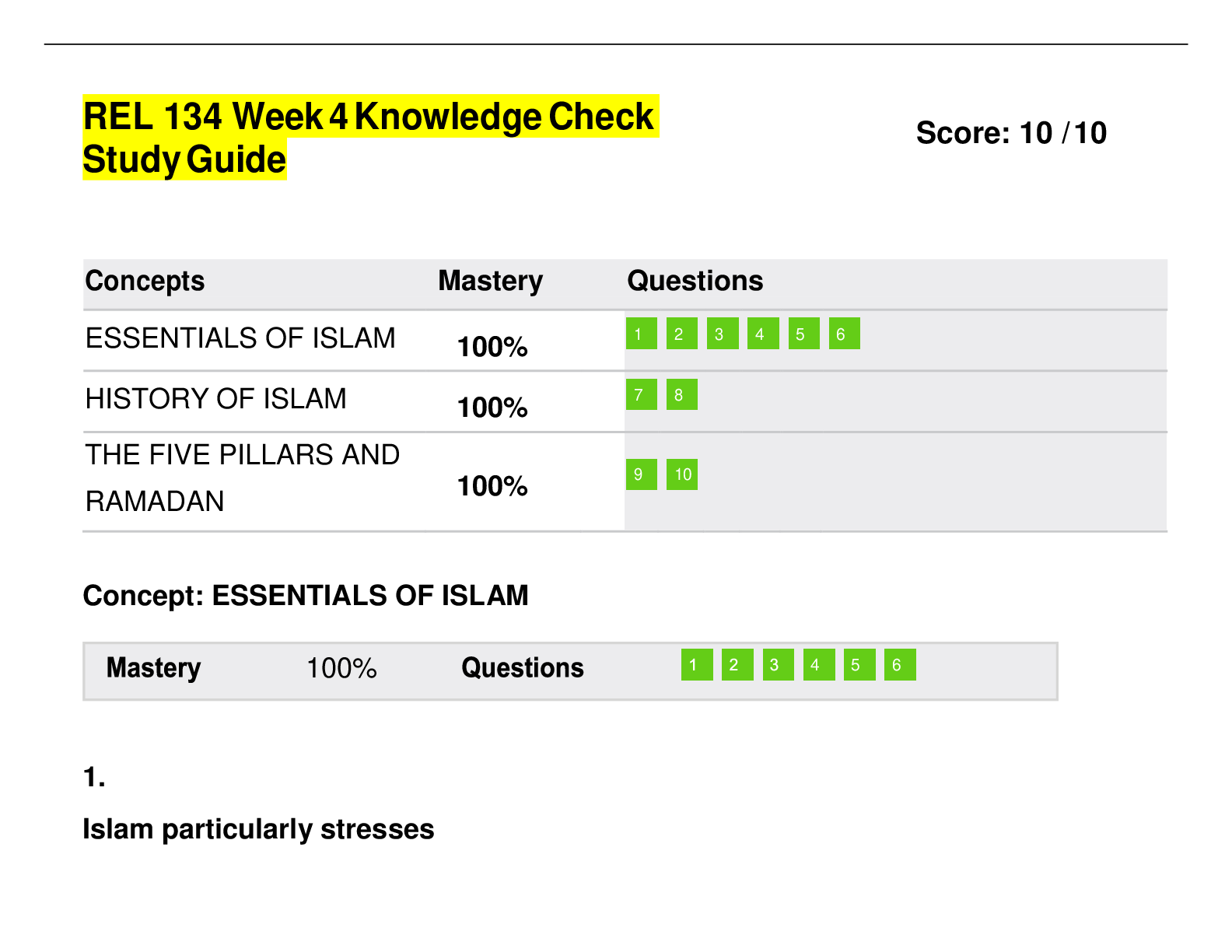
REL 134 Week 1 Knowledge Check » Assignment The prophetic orientation in religion emphasizes • A. ceremonies. • B. feelings of oneness with the universe. • C. traditions. • D. ... beliefs and moral codes. A mystical orientation in religion is characterized by • A. an emphasis on mysterious happenings. • B. the seeking of a union with something greater than oneself. • C. the extensive use of holy water and statues. • D. a belief in alien origins of life forms. A sacramental orientation in religion is characterized by • A. daily prayer. • B. the use of silent meditation. • C. the extensive use of bells and powders. • D. a belief that certain rituals and ceremonies help one achieve salvation. Pantheism is the belief • A. that all reality is divine. • B. in the ancient Greek religion that believed the god Pan was the source of cosmic order. • C. in endless reincarnation. • D. in a timeless realm of happiness at the top of the universe. Among many reasons for the existence of religions, religions exist to help people • A. deal with the certainty of death. • B. find ways to express themselves in art. • C. select careers that are socially redeeming. • D. have valuable texts to study. Which of the following has been of special value in the new appreciation for and understanding of indigenous religions? • A. the study of newly discovered sacred texts • B. the use of electricity and battery power • C. the ready availability of cameras and recorders • D. the worldwide spread of television The teachings of indigenous religions are typically conveyed by all of the following except • A. sand paintings. • B. sacred scripture. • C. masks and dance. • D. memorized chants. In a holistic culture, • A. written manuscripts have a special place. • B. children play a prominent role in ritual. • C. religions express truths through symbolism. • D. virtually every object and act may have religious meaning. In religious studies, the word myth means • A. a story that is historically true. • B. a story that is historically untrue. • C. a story that is psychologically meaningful and may be either historically true or not. • D. a story that is found in similar form in many religions. The early anthropologist who saw religion as rooted in a belief in spirits and the worship of them was • A. E. B. Tylor. • B. James Frazer. • C. Sigmund Freud. • D. Carl Jung. Week 2 Knowledge Check 1.The Jewish view of God is best expressed as • A. God is an impersonal force. • B. God is creator and judge. • C. God is the pattern of nature. • D. God created the world but does not interfere in it. 2.The Jewish Day of Atonement, the most sacred day of the Jewish year, is • A. Rosh Hashanah. • B. Hanukkah. • C. Passover. • D. Yom Kippur. The Jewish Sabbath is kept from • A. sunset Friday to sunset Saturday. • B. sunrise Saturday to sunrise Sunday. • C. sunrise Saturday to sundown Sunday. • D. sunrise Sunday to sunrise Monday Judaism traces itself back to what legendary patriarch who is written about in the book of Genesis? • A. Moses • B. David • C. Abraham • D. Nehemiah “Covenant” means • A. restoration. • B. overthrow. • C. vision. • D. contract. The biblical book that describes the origins of the human race is • A. Proverbs. • B. Genesis. • C. Isaiah. • D. Psalms. The three categories of the Hebrew Bible are • A. Torah, Prophets, and Proverbs. • B. Psalms, Chronicles, and Proverbs. • C. History, Prophets, and Psalms. • D. Torah, Prophets, and Writings. According to the Book of Exodus, what disaster was the last to strike the Egyptians? • A. plague of frogs • B. hail • C. darkness • D. death of firstborn male children Another name for the Torah is • A. Nevi’im. • B. Tanakh. • C. Pentateuch. • D. Ketuvim Contemporary Judaism has split into four parts. The part which encourages non-literal, individual interpretation of traditional beliefs is called • A. Reform Judaism. • B. Reconstructionist Judaism. • C. Orthodox Judaism. • D. Conservative Judaism. Week 3 Knowledge Check In Jesus’ time, what power controlled Israel? • A. Greece • B. Egypt • C. Persia • D. Rome The Protestant Reformation was started by • A. John Calvin. • B. Martin Luther. • C. John Wesley. • D. Meister Eckhart Which of these books is found in the New Testament? • A. Genesis • B. Samuel • C. Psalms • D. Hebrews Perhaps the most important ritual of Christianity is a sign of entry into the church, or • A. baptism. • B. anointing. • C. ordination. • D. infallibility. Easter, as a celebration of the resurrection, is associated with the color • A. red. • B. green. • C. violet. • D. White The major Christian rituals, such as baptism and Eucharist, are often called • A. confessionals. • B. rosaries. • C. indulgences. • D. sacraments. The view that the end of the world is near is called • A. messianism. • B. apocalypticism. • C. adoptionism. • D. monophysitism. Literally, “gospel” means • A. preparation. • B. repentance. • C. contract. • D. good news. . In 1054, what happened between the Eastern and Western Church? • A. They compiled a Bible on which all Christians could agree. • B. Their leaders differed on the official date of Easter. • C. Their leaders excommunicated one other. • D. .They moved the capital of the empire to Constantinople. “Orthodox” literally means • A. guided tradition. • B. correct belief. • C. one nature. • D. eastern side. Week 4 Knowledge Check Islam particularly stresses • A. oneness of God. • B. having only one wife. • C. pilgrimage to Jerusalem once in a lifetime. • D. prayer twice each day. Islam literally means • A. submission. • B. tradition. • C. purity. • D. devotion. Observant Muslims do not allow • A. interracial marriage. • B. alcohol. • C. pilgrimage. • D. divorce. Muslims trace themselves back ultimately to what great patriarch? • A. Paul • B. Abraham • C. Moses • D. Isaac A remembrance of what Muhammad said or did is called • A. caliph. • B. hadith. • C. Shia. • D. Hajj. Regarding the afterlife, Muslims believe • A. in reincarnation until one reaches perfection. • B. in heaven and hell. • C. the soul ascends to the top of the universe. • D. the individual dissolves into the divine essence. Muhammad was born and raised in • A. Marrakesh. • B. Medina. • C. Mysore. • D. Mecca. Which country had a large Muslim population for almost 800 years? • A. Italy • B. Kenya • C. Poland • D. Spain The Islamic month of fasting is called • A. Lent. • B. Hajj. • C. Ramadan. • D. Nisan. The chanter who calls people to prayer is called • A. muezzin. • B. salat. • C. qiblah. • D. sawm. Week 5 Knowledge Check The founder of which of these Christian denominations was female? • A. Christian Science and the Foursquare Gospel Church • B. Unitarianism and the Church of Jesus Christ of Latter-day Saints • C. Unity and Scientology • D. Quaker (Society of Friends) and Unification Church The founder of which of these Christian denominations was female? • A. Christian Science and the Foursquare Gospel Church • B. Unitarianism and the Church of Jesus Christ of Latter-day Saints • C. Unity and Scientology • D. Quaker (Society of Friends) and Unification Church The word pagan comes from pagus, a Latin word that means • A. nature. • B. unbeliever. • C. circle. • D. countryside Literally, Theosophy means • A. deep insight. • B. internal theory. • C. eternal philosophy. • D. divine wisdom. Baha’i emerged from • A. Christianity. • B. Judaism. • C. Islam. • D. Zoroastrianism. In Scientology, the state of full mental liberation is called • A. infinite. • B. open. • C. moksha. • D. clear. The desire for a separation of church and state came about as the result of • A. religious wars in Europe during the sixteenth and seventeenth centuries. • B. greater travel as a result of mapmaking. • C. contact between Europe and non-Western cultures. • D. the thought of Chinese and Japanese philosophers. The view of religion as an outdated method for providing solutions to life’s problems was espoused by • A. technologism. • B. consumerism. • C. nationalism. • D. Communism. Living and thinking without reference to a religion is called • A. rationalism. • B. transcendentalism. • C. ecotourism. • D. secularism. The Catholic Church has worked to accommodate itself to the modern world, as shown by • A. the Second Vatican Council in 1965. • B. the Council of Trent. • C. the refusal to ordain women as priests. • D. the continued use of traditional clothing. It is possible to see in the comic-book figure of Superman an underlying • A. pessimism. • B. cynicism. • C. messianism. • D. multiculturalism. [Show More]
Last updated: 11 months ago
Preview 5 out of 16 pages

Loading document previews ...
Buy this document to get the full access instantly
Instant Download Access after purchase
Buy NowInstant download
We Accept:

Reviews( 0 )
$14.50
Can't find what you want? Try our AI powered Search
Document information
Connected school, study & course
About the document
Uploaded On
Feb 25, 2020
Number of pages
16
Written in
All

Additional information
This document has been written for:
Uploaded
Feb 25, 2020
Downloads
0
Views
140