C790 Nursing Informatics (WGU)
THEORIES AND MODELS, Exam Review
sections, Verified.
Open System (Systems Theory)
Open systems take input (information, matter, and energy) from the environment, process the
input,
...
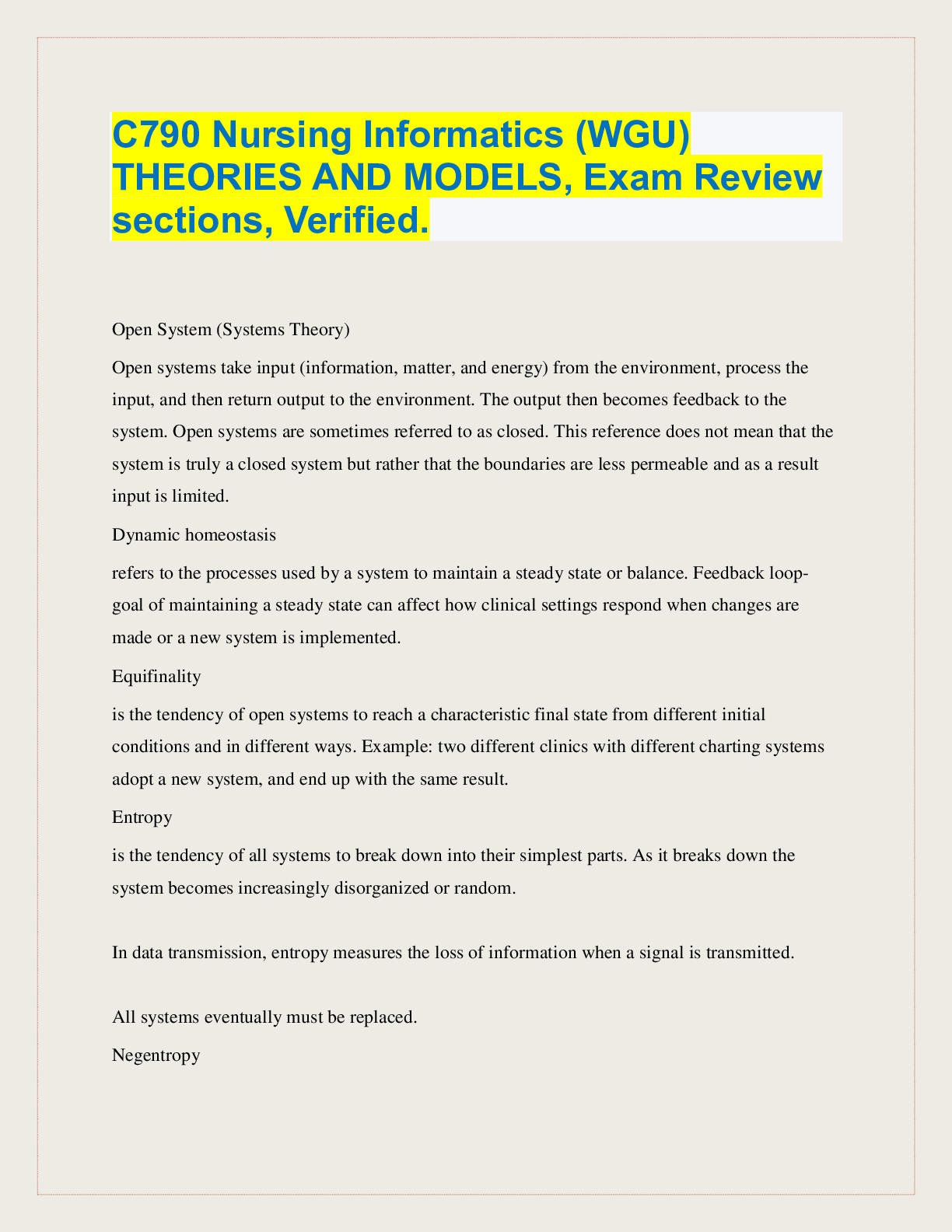
C790 Nursing Informatics (WGU)
THEORIES AND MODELS, Exam Review
sections, Verified.
Open System (Systems Theory)
Open systems take input (information, matter, and energy) from the environment, process the
input, and then return output to the environment. The output then becomes feedback to the
system. Open systems are sometimes referred to as closed. This reference does not mean that the
system is truly a closed system but rather that the boundaries are less permeable and as a result
input is limited.
Dynamic homeostasis
refers to the processes used by a system to maintain a steady state or balance. Feedback loop�goal of maintaining a steady state can affect how clinical settings respond when changes are
made or a new system is implemented.
Equifinality
is the tendency of open systems to reach a characteristic final state from different initial
conditions and in different ways. Example: two different clinics with different charting systems
adopt a new system, and end up with the same result.
Entropy
is the tendency of all systems to break down into their simplest parts. As it breaks down the
system becomes increasingly disorganized or random.
In data transmission, entropy measures the loss of information when a signal is transmitted.
All systems eventually must be replaced.
Negentropy
is the opposite of entropy. This is the tendency of living systems to grow and become more
complex.
Reverberation
is reflected in the intended and unintended consequences of system change. Chaos theory was
developed in the 50s to explain the phenomena of unintended consequences.
dynamic systems
chaotic systems. While chaotic systems vary in their state of stability, they are in a constant state
of change. The change is nonlinear. In a nonlinear system the output of the system is not
proportional to the input.
reiterative feedback loop
major impact on how imput affects output. A minor change in input can cause a major change in
output (butterfly effect).
fractal-type patterns
while the output or behavior of a chaotic system will appear unstable, aperiodic, and even
random, these systems are deterministic. Their output is determined by the initial input,
reiterative feedback loops, and the dynamic changes that occur over time. Out of chaos comes
order: snowflake
chaos theory
Both chaos and complexity theory involve the study of dynamic nonlinear systems that change
with time and demonstrate complex relationships between inputs and outputs due to reiterative
feedback loops. "The quantitative study of these systems is chaos theory. Complexity theory is
the qualitative aspect drawing upon insights and metaphors that are derived from chaos theory."
complexity theory
Both chaos and complexity theory involve the study of dynamic nonlinear systems that change
with time and demonstrate complex relationships between inputs and outputs due to reiterative
feedback loops. "The quantitative study of these systems is chaos theory. Complexity theory is
the qualitative aspect drawing upon insights and metaphors that are derived from chaos theory."
(complexity theory=pseudoscience ?)
information theory
refers to more than one theory, such as Shannon-Weaver information-communication model and
the Nelson data-information-knowledge-wisdom model
Shannon Weaver information communication model
The sender is the originator of the message or the information source.
The transmitter is the encoder that converts the content of the message to a code. The code can
be letters, words, music, symbols, or a computer code.
The telephone or cable line is the channel, or the medium used to carry the message. Each
channel has its own physical limitations in terms of the size of the message that can be carried.
Noise is anything that is not part of the message but that occupies space on the channel and is
transmitted with the message.
The decoder converts the message to a format that can be understood by the receiver.
Blum Model
In his analysis he identified three types of healthcare computing applications. Blum grouped
applications according to the objects they processed. The three types of objects he identified are
data, information, and knowledge.
Blum defined data as uninterpreted elements such as a person's name, weight, or age.
Information was defined as a collection of data that have been processed and then displayed as
information such as weight over time.
Knowledge results when data and information are identified and the relationships between the
data and information are formalized. A knowledge base is more than the sum of the data and
information pieces in that knowledge base. A knowledge base includes the interrelationships
between the data and information within the knowledge base.
Graves Model
used Blum's concepts and added Barbara A. Carper's four types of knowledge: empirical, ethical,
personal, and aesthetic. Each of these represents a way of knowing and a structure for organizing
knowledge.
"The Study of Nursing Informatics," by Graves and Corcoran
This article is considered the foundation for most definitions of nursing informatics.
Nelson Model
Nelson extended the Blum and Graves and Corcoran data-to-knowledge continuum by including
wisdom.
data, information, knowledge, wisdo
[Show More]