NCE Exam Questions and answers,
100% Accurate, rated A+. Graded A+
Standard Deviation - ✔✔-a measure of variability; It tells you how tightly your data is clustered around
the mean
Maslow's Hierarchy of Needs - ✔✔-
...
NCE Exam Questions and answers,
100% Accurate, rated A+. Graded A+
Standard Deviation - ✔✔-a measure of variability; It tells you how tightly your data is clustered around
the mean
Maslow's Hierarchy of Needs - ✔✔-physiological, safety, love/belonging, esteem, self-actualization
Androgyny - ✔✔-is something that has both female and male traits, or something that is not clearly
either masculine or feminine
Erikson's Stages of Psychosocial Development - ✔✔-
Social Learning Theory - ✔✔-is the view that people learn by observing others. Associated with Albert
Bandura's work in the 1960s. Explains how people learn new behaviors, values, and attitudes For
example, a teenager might learn slang by observing peers.
Core features of depression - ✔✔-diminished interest or pleasure
Core features of bipolar disorders - ✔✔-mania; hypomania
Hypomania - ✔✔-abnormally, persistently elevated mood, expansive mood, irritable mood
Difference between mania and hypomania - ✔✔-mania lasts more than 1 week and hypomania lasts 4
days
Key features of schizophrenia and psychotic disorders - ✔✔-delusions, hallucinations, disorganized
thinking, grossly disorganized or abnormal motor behavior, negative symptoms
Symptoms of PTSD - ✔✔-Re-experiencing the trauma through flashbacks, nightmares, and intrusive
thoughts
Five Factor Model of Personality - ✔✔-O- openness vs. tradition/convention
C- conscientiousness vs. negligence
E- extraversion vs. introversion
A- agreeableness vs. antagonistic
N- neuroticism vs. emotional stability
3 P's of personality disorder - ✔✔--Persistent (over time)
-Pervasive (across situations)
-Pathological (clearly abnormal)
Cluster A personality disorders - ✔✔-odd/eccentric:
paranoid, schizoid, schizotypal
Cluster B personality disorders - ✔✔-dramatic/emotional/erratic:
antisocial, borderline, histrionic, narcissistic
Cluster C personality disorders - ✔✔-Anxious/fearful
avoidant, dependent, obsessive-compulsive
Paranoid Personality Disorder - ✔✔-type of personality disorder characterized by extreme
suspiciousness or mistrust of others
Schizoid Personality Disorder - ✔✔-a psychological disorder characterized by little interest or
involvement in close relationships, even those with family members (socially and emotionally detached)
Schizotypal Personality Disorder - ✔✔-a psychological disorder characterized by several traits that cause
problems interpersonally, including constricted or inappropriate affect; magical or paranoid thinking;
and odd beliefs, speech, behavior, appearance, and perceptions
Antisocial Personality Disorder - ✔✔-a personality disorder in which a person exhibits a lack of
conscience for wrongdoing, even toward friends and family members; may be aggressive and ruthless or
a clever con artist
Borderline Personality Disorder - ✔✔-a personality disorder characterized by lack of stability in
interpersonal relationships, self-image, and emotion; impulsivity; angry outbursts; intense fear of
abandonment; recurring suicidal gestures
Histrionic Personality Disorder - ✔✔-excessive emotionality and attention seeking
Narcissistic Personality Disorder - ✔✔-a personality disorder characterized by exaggerated ideas of self�importance and achievements; preoccupation with fantasies of success; arrogance
Avoidant Personality Disorder - ✔✔-a personality disorder characterized by inhibition in social
situations; feelings of inadequacy; oversensitivity to criticism
Dependent Personality Disorder - ✔✔-a personality disorder characterized by helplessness; excessive
need to be taken care of; submissive and clinging behavior; difficulty in making decisions
Obsessive-Compulsive Personality Disorder - ✔✔-a personality disorder characterized by preoccupation
with orderliness, perfection, and control
Multiple Regression Analysis - ✔✔-An analysis of association in which the effects of two or more
independent variables on a single, interval-scaled dependent variable are investigated simultaneously.
Analysis of Covariance - ✔✔-Compares 2 or more groups and controls for the effects of an intervening
variable
Z-Scores - ✔✔-indicates how far away any given score is from the standardized deviation
Correlation - ✔✔-A measure of the relationship between two variables
Piaget Moral Development - ✔✔-he believes young children 4 to 7yrs see their moral world through the
eyes of justice and rules which are unchangeable. As they get older they understand rules are made by
people. Many variables to what is right and wrong. 10yrs old when children view each dilemma and
consider the consequences before making moral decision.(cooperation)
Philosophical Principles that Define the Client's Role - ✔✔-the client must be involved, recognize their
own beliefs and feelings and how they affect their ability to function, and willing to accept help
What is the purpose of anti psychotics - ✔✔-used to treat psychiatric conditions by altering the
chemistry of the brain
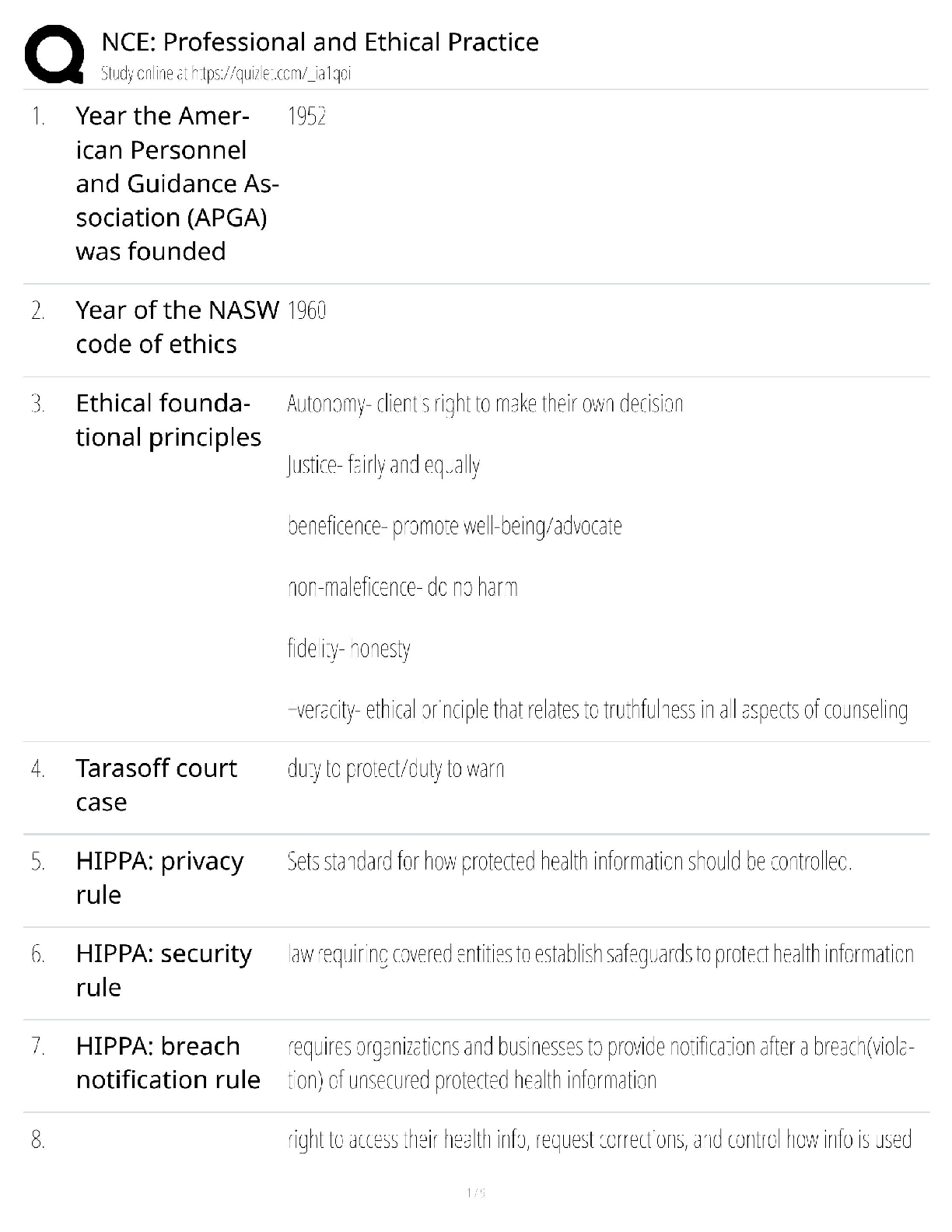
5 Principles of Ethical Behavior - ✔✔-1) Autonomy 2) Beneficence 3) Non-maleficence 4) Justice 5)
Fidelity
Autonomy - ✔✔-independence; self-determination; right to personal choice
Beneficence - ✔✔-intending to do good and act in the best interest of the client
Nonmaleficence - ✔✔-Do no harm; physician has responsibility to avoid treatments or interventions in
which the potential for harm outweighs the potential for benefit
Justice - ✔✔-fairness towards all clients and not letting "favorites" or biases influence the service
provided
Fidelity - ✔✔-faithfulness; not making insincere statements or impossible promises
Treatment Protocol for Alzheimer's - ✔✔-No cure but exercise, nutrition, physical therapy can help.
Need visual monitoring to stay safe and need frequent reminders and queues to reduce anxiety
Huntington's Disease - ✔✔-Genetic disorder that causes progressive deterioration of brain cells. Causing
anxiety and physical weakness as well as psychiatric and cognitive issues. Symptoms do not appear until
about the age of 30.
Muscular Dystrophy - ✔✔-group of inherited muscle disorders that cause muscle weakness without
affecting the nervous system
Antidepressants - ✔✔-drugs that combat depression by affecting the levels or activity of
neurotransmitters in the brain
4 Etiologies of Medical Disorders - ✔✔-1) Congenital Defects
2) Degenerative Disorders
3) Acquired Disorders
4) Unknown Origin
Physiatrists - ✔✔-a physician who specializes in physical medicine and rehabilitation with the focus on
restoring function
Principles of Treatment Planning - ✔✔-a) Tailor treatment to the specific needs of client
b) Treat ALL factors that affect the overall well-being of the client
c) Ensure that treatment lasts as long as the client needs it
d) Give the client the information needed to create and implement the treatment plan
Functional Capacity - ✔✔-the ability to perform necessary tasks; what a person is actually capable of
doing
Functional Assessment Evaluation - ✔✔-(FCE): the assessing of client skills and the performance of
certain tasks
Interventions - ✔✔-any technique, strategy, or service that is intended to treat/diminish a specific
problem
Philosophical Principles that Define the Counselor's Role - ✔✔-a) recognition of and focus on client's
strengths
b) recognition and development of client potential
c) working with others to provide necessary services
d) recognition that the client is part of system (family/community) and that the system may affect the
rehabilitation process
e) ensure that the client continues to make progress towards goals
Steps for Strategic Planning - ✔✔-1. identification of goals
2. assessment of counselor ability to meet these goals
3. outlining of specific techniques that can be used to achieve
4. carry out the chosen intervention
5. evaluate progress on continuous basis
Identified Patient - ✔✔-The family member whose symptoms or behaviors are stated by the family as
the reason for coming to therapy.
Conservation - ✔✔-the principle (which Piaget believed to be a part of concrete operational reasoning)
that properties such as mass, volume, and number remain the same despite changes in the forms of
objects. Acquired between 7-11 yrs of age
Kohlberg - ✔✔-theorist who claimed individuals went through 3 stages in the process of moral
development.
Preconventional - ✔✔-1st stage of moral development in which children seek to avoid punishment or
gain reward when determining right from wrong
Pavlovian Methods in the Military - ✔✔-The use of transmarginal inhibition (TMI) techniques are used to
re-program solider responses to discomfort of pain, fear
Transmarginal Inhibition - ✔✔-An organism's response to overwhelming stimuli, first detailed by Pavlov
Erik Erikson - ✔✔-stages of human growth and development: 8 states that refer to how a person
interacts with their environment. Each stage is a "crisis" which needs to be resolved before a person can
successfully move to the next stage
Myers-Briggs Type Indicator - ✔✔-a test according to Carl Jung's personality types in an attempt to
figure out one's personality within 4 categories
[Show More]