NCMHCE Top Exam Questions and
answers, 100% Accurate. Verified.
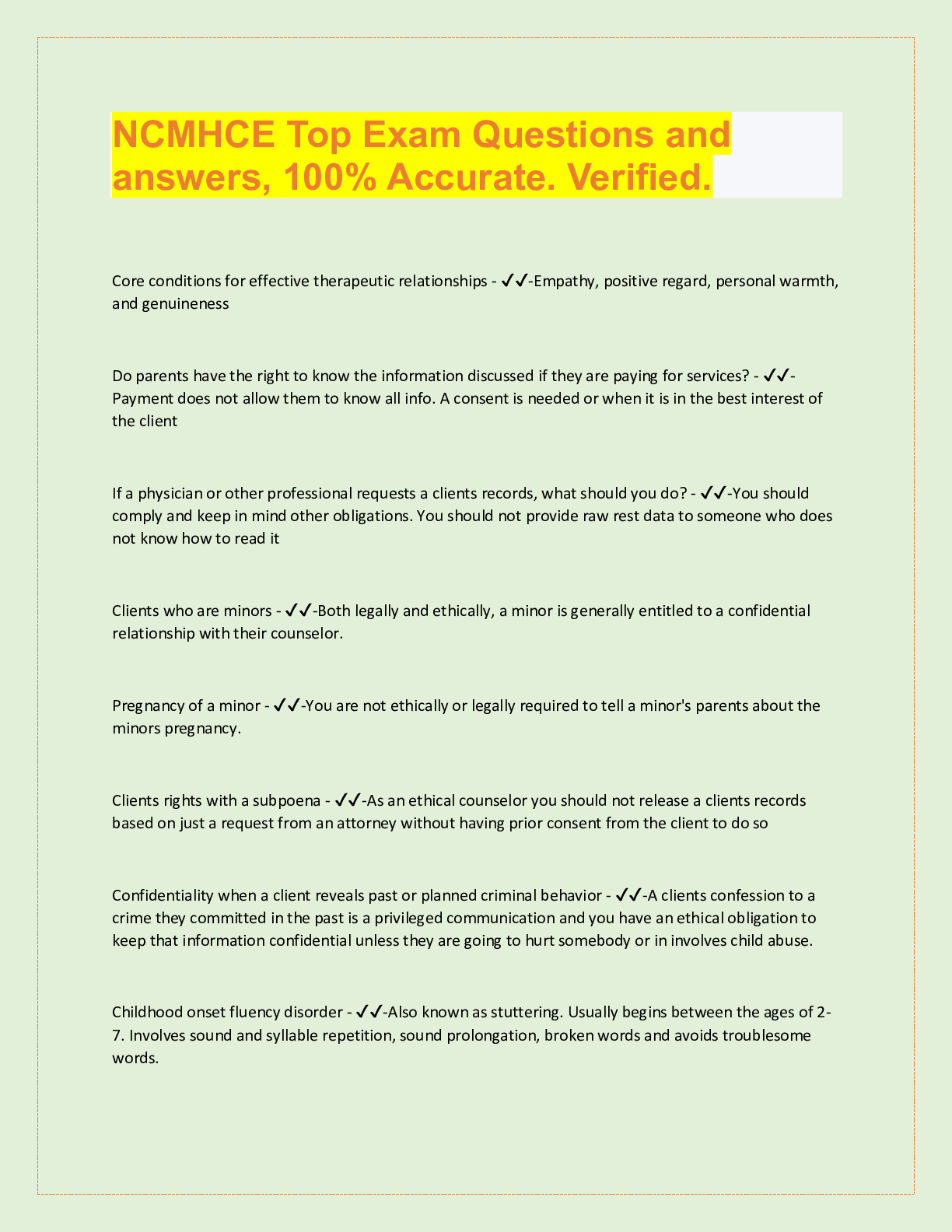
Core conditions for effective therapeutic relationships - ✔✔-Empathy, positive regard, personal warmth,
and genuineness
Do parents have the right to k
...
NCMHCE Top Exam Questions and
answers, 100% Accurate. Verified.
Core conditions for effective therapeutic relationships - ✔✔-Empathy, positive regard, personal warmth,
and genuineness
Do parents have the right to know the information discussed if they are paying for services? - ✔✔-
Payment does not allow them to know all info. A consent is needed or when it is in the best interest of
the client
If a physician or other professional requests a clients records, what should you do? - ✔✔-You should
comply and keep in mind other obligations. You should not provide raw rest data to someone who does
not know how to read it
Clients who are minors - ✔✔-Both legally and ethically, a minor is generally entitled to a confidential
relationship with their counselor.
Pregnancy of a minor - ✔✔-You are not ethically or legally required to tell a minor's parents about the
minors pregnancy.
Clients rights with a subpoena - ✔✔-As an ethical counselor you should not release a clients records
based on just a request from an attorney without having prior consent from the client to do so
Confidentiality when a client reveals past or planned criminal behavior - ✔✔-A clients confession to a
crime they committed in the past is a privileged communication and you have an ethical obligation to
keep that information confidential unless they are going to hurt somebody or in involves child abuse.
Childhood onset fluency disorder - ✔✔-Also known as stuttering. Usually begins between the ages of 2-
7. Involves sound and syllable repetition, sound prolongation, broken words and avoids troublesome
words.
Autism disorder - ✔✔-Deficits in social communication, repetitive behaviors, interests in specific
activities, the presence of symptoms in early development period, and impairment in social functioning.
ADHD - ✔✔-Characterized by a pattern of in attention and or hyperactivity-impulsivity that has persisted
for at least six months and had an onset prior to 12 years of age and is present in at least two settings. It
interferes with social, academic, or occupational functioning.
Specific learning disorder - ✔✔-Impairment in reading, written expression, and mathematics. Symptom
that persists for at least 6 months
Motor disorders - tic disorders - ✔✔-Sudden, rapid, recurrent, nonrhythmic motor movement or
vocalization
Tourette's disorder - ✔✔-The presence of at least one vocal tic and multiple motor tics that have
persisted for more than one year and began prior to age 18
Delusional Disorder - ✔✔-Presence of one or more delusions that last at least one month. Functioning is
not impaired or Bizzarre or odd.
Bender visual motor bender visual gestalt test - ✔✔-Used to measure the motor and cognitive
development in minors over the age of four. The test may provide information regarding a subjects
developmental and Neuro psychological functioning.
Schizophrenia - ✔✔-Requires the presence of at least two active phase symptoms. For at least one more
with at least one symptom being delusions, hallucinations or disorganized speech for at least 6 months.
The onset is between late teens and early 30's.
Schizophreniform disorder - ✔✔-The disturbance is present for at least one month but less than six
months and impaired social or occupational functioning may occur but is not required.
Brief psychotic disorder - ✔✔-Characterized by the presence of one or more of the characteristic
symptoms with at least one symptom being delusions, hallucinations, or disorganized speech. Symptoms
are present for at least one day but les than one month. The onset follows exposure to an overwhelming
stressor.
Schizoaffective disorder - ✔✔-Characterized by an uninterrupted period of illness which there are at
times concurrent symptoms of schizophrenia and symptoms of a major depressive or manic episode
with a period of at least two weeks without prominent mood symptoms.
Cyclothymic disorder - ✔✔-Characterized by numerous periods with hypomanic symptoms that do not
meet criteria for hypomanic episode and numerous periods. With symptoms lasting for at least two
years in adults or one year in children and adolescents.
Disruptive mood dysregulation disorder - ✔✔-Has to be diagnosed before the age 10. Comes out
through frequent temper outbursts with severe irritability. Requires a 10 month duration. Negative
mood stay all day every day
Bipolar 2 - ✔✔-Requires at least one hypomanic episode and one major depressive episode. It lasts for
at least four consecutive days and is present most of the day, nearly everyday. The major depressive
episode lasts for at least two weeks and involve five or more characteristic symptoms.
Cyclothymic disorder - ✔✔-Characterized by numerous periods with hypomanic symptoms that do not
meet criteria for hypomanic episode and numerous periods. With symptoms lasting for at least two
years in adults or one year in children and adolescents.
Major depressive disorder - ✔✔-Requires the presence of at least five symptoms of a major depressive
episode nearly every day for at least two weeks. Symptoms include loss of interest pleasure or activities.
Significant weight loss, not dieting or wating insomnia agitation fatigue or loss of energy feelings of
worthlessness and death.
Persistent depressive disorder - ✔✔-Characterized by a depressed mood on most days for adults for two
years or at least one year in children.
Separation anxiety disorder - ✔✔-Excessive fear or anxiety related to separation from home or
attachment figures as evidenced by at least three characteristics symptoms. Must last at least four
weeks in children or at least six months in adults
Specific phobia - ✔✔-Intense fear of or anxiety about a specific object or situation such as Heights,
flying, or receiving an injection. Is persistent and typically lasting for at least six months and causes
clinically significant distress or impairment in functioning
Social anxiety disorder - ✔✔-Intense fear or anxiety about one or more social situations in which the
individual may be exposed to scrutiny by others typically lasting for at least six months.
Panic disorder - ✔✔-Characterized by recurrent unexpected panic attacks with at least one attack being
followed by one month of persistent concern about having additional attacks or about their
consequences and or involving a significant maladaptive change in behavior related to the attack
agoraphobia - ✔✔-Fear or anxiety about at least two of the following situations. Using public restrooms,
public transportation, being in open spaces, being an enclosed spaces, standing in a crowd. Typically last
for at least six months
Generalized anxiety disorder - ✔✔-Involves excessive anxiety and worry about multiple events or
activities which are relatively constant for at least 6 months.Must include feelings of restlessness or
feeling keyed up or on the edge being easily fatigued difficulty concentrating irritability muscle tension
and sleep disturbance.
Obsessive compulsive disorder - ✔✔-Persistent thoughts or urges with repetitive behaviors
Body dysmorphic disorder - ✔✔-Characterized by preoccupation with a defect or fly in appearance that
appears minor or is an observable to others.
Hoarding disorder - ✔✔-Persistent difficulty discarding or parting with possessions, regardless of their
actual value.
Reactive attachment disorder - ✔✔-A consistent pattern of emotionally withdrawn behavior toward
caregivers as manifested by a lack of seeking or responding to comfort when distressed and persistent
social and emotional disturbance occur. The diagnosis requires that the child has experienced extreme
insufficient care. Symptoms must be present prior to five years of age.
Post dramatic stress disorder. - ✔✔-the diagnosis of PTSD requires exposure to actual or threatened
death, serious injury, or sexual violence in at least one of the following ways. Symptoms must have a
duration of more then one month and less cause clinically significant distress or impaired functioning.
Acute stress disorder - ✔✔-Requires exposure to actual or threatened death severe injury or sexual
violation. Symptoms must have a duration of three days to one month and cause clinically significant
distress or impaired functioning.
Adjustment disorder - ✔✔-Involves the development of emotional or behavioral symptoms in response
to one or more identifiable psychosocial stressors within three months of the onset of the stressor. The
stressors must remain within six months after termination of the stressor or its consequences
Dissociative disorder - ✔✔-A disruption and or discontinue in the normal integration of consciousness,
memory, identity, emotion, perception, by representation, motor control, and behavior.
Dissociative identity disorder her - ✔✔-Characterized by the existence in one individual of two or more
distinct personality
Somatic symptom disorder - ✔✔-Presence of one or more somatic symptoms that caused distress or a
significant disruption in daily life accompanied by excessive thoughts, feelings, or behaviors. The
disorder usually last more than six months. The individual is usually authentic
Illness anxiety disorder - ✔✔-Worries about illness. Tends to think the worst about their health.
Preoccupied with having or acquiring a serious diagnosis. Extensive worry but no symptoms. The
preoccupation has been present for at least six months
Conversion disorder - ✔✔-Alters voluntary, motor, or sensory, weakness, paralysis or slurred speech.
Factitious disorder - ✔✔-Two different kinds, imposed on self and imposed on another. Imposed on self
means they lie about certain tragedies within their life. Impose on others is deceptive behavior towards
other individuals.
Pica - ✔✔-Persistent eating of a non-nutritive substance for at least one month.
Anorexia nervosa - ✔✔-Restriction of energy intake that leads to significantly low bodyweight for the
persons age, gender, developmental, and physical health. Individuals may engage in excess of exercise,
use of laxatives and or diuretics.
Bulimia nervosa - ✔✔-Characterized by recurrent episodes of binge eating that are accompanied by a
sense of lack of self-control. Self-induced vomiting, miss use of laxatives or diuretics, fasting, or
excessive exercise.
Oppositional defiant disorder - ✔✔-A reoccurring pattern of an angry or irritable mood, argumentative
or defiant behavior, or vindictiveness. Often loses temper, often argued with authority figures, often
actively refuses to comply with requests from authority figures or with rules. Symptoms have persisted
for at least six months.
Intermittent explosive disorder - ✔✔-Characterized by recurrent behavior outbursts. Verbal aggression
or behavioral outbursts. Only three months of active symptoms. Does not require persistent disruption
in mood
Conduct disorder - ✔✔-Violates the basic rights of others. Symptoms last during the past 12 months and
at least one symptom in the past six months. symptoms are destruction to people and animals,
distruction of property, deceitfulness or theft, and serious violation of rules. This disorder cannot be
assigned to individuals over the age of 18 who meet the diagnostic criteria for antisocial personality
disorder her.
Substance use disorders - ✔✔-Impaired control, social impairment, risky use, pharmacological criteria
Substance induced disorders - ✔✔-Substance intoxication, substance with drawl, and substance
medication induced mental disorder.
Delirium - ✔✔-A disturbance in attention and awareness that develops over a short period of time.
Symptoms must not be due to another neurocognitive disorder and must not occur in the context as a
severely reduced level of arousal
Paranoid personality disorder - ✔✔-Entails interpreting the motives of others as malevolent. The
diagnosis requires that the person have at least four of the following symptoms. suspects that others are
exploiting harming or deceiving him or her without a sufficient basis for doing so.
Schizoid personality disorder - ✔✔-Doesn't desire or enjoy close relationships, almost always chooses
solitary activities, has little interest in sexual relationships, takes pleasure in few activities.
Schizotypal personality disorder - ✔✔-Has strange beliefs or magical thinking that influence behavior,
has bodily illusions and other unusual perceptions, exhibits are thinking and speech, suspicious or has
paranoid ideation, has inappropriate or constricted affect, has strange behaviors, lax close friends and
relationships.
Antisocial personality disorder - ✔✔-Characterized by a pattern of disregard for any violation of the
rights of others that has occurred since age 15 and involves three characteristics symptoms. For the
diagnosis the person must be at least 18 years of age and have a history of contact is order before the
age of 15.
Borderline personality disorder - ✔✔-Pervasive pattern of instability and interpersonal relationships, self
image, and affect, and marked impulsivity that began by early adulthood and as a parent in multiple
contacts.
Histrionic personality disorder - ✔✔-pattern of emotionality and attention seeking. Discomfort when
not the center of attention, inappropriately sexually seductive or provocative, rapidly shifting and
shallow emotions, consistent use of physical appearance to gain attention, excessively impressionistic
speech that is lacking in detail.
Narcissistic personality disorder - ✔✔-Involves a pervasive pattern of grandiosity as indicated by an
important sense of self, preoccupied with fantasies of success, power, beauty, love,. The pattern of
behavior began by early adulthood and is a parent in various contexts. Lacks empathy
Avoidant personality disorder her - ✔✔-pattern of social inhibition, feelings of inadequacy, and
hypersensitivity. Is inhibited in new relationships due to feelings of inadequacy, view self as socially
inapt, inferior, or an appealing to others. Is usually reluctant to engage in new activities because they
may be embarrassing
Dependent personality disorder - ✔✔-Displays excessive need to be taken care of, which leads to
submissive, clean behavior and a fear of separation.requires the presence of at least five symptoms, has
difficulty making decisions, needs others to assume responsibility, fears disagreeing with others because
it might lead to loss of support.
Obsessive-compulsive personality disorder - ✔✔-Preoccupation with orderliness, perfectionism, and
mental and interpersonal control that severely limits his/her flexibility, openness, and deficiency.
Acute stress disorder treatment - ✔✔-CBT, hypnosis, psychodynamic therapy
adjustment disorder treatment - ✔✔-CBT, family therapy, group therapy, multisystemic therapy, parent
management training, psychodynamic therapy, psychoeducational, supportive therapy
anorexia nervosa treatment - ✔✔-Behavioral therapy, cognitive therapy, family therapy, group therapy,
psychodynamic therapy
Antisocial Personality Disorder treatment - ✔✔-Children with conduct disorder use family therapy,
nonpsychotic adults use family, CBT, or psychodynamic therapy
ADHD treatment - ✔✔-Client education, group, individual counseling, parent counseling, school
intervention
Atypical eating disorders treatment - ✔✔-CBT, psychodynamic,!interpersonal
bipolar 1 disorder treatment - ✔✔-CBT, interpersonal, psychodynamic therapy, rational emotive,
pharmacology, psychoeducational
body day morphic disorder treatment - ✔✔-CBT
Borderline personality disorder treatment - ✔✔-CBT, dialectical behavioral therapy, supportive therapy
Breathing related sleep disorder - ✔✔-Behavioral therapy
Brief psychotic disorder treatment - ✔✔-Psychoeducational approach, CBT
bulimia nervosa treatment - ✔✔-CBT, family therapy, interpersonal psychotherapy, psychodynamic
therapy, psychoeducational approached
Circadian rhythm wake disorder treatment - ✔✔-Behavioral therapy
Conversion disorder treatment - ✔✔-Behavioral therapy, biofeedback, hypnosis, physical therapy,
speech therapy, supportive therapy
Cyclothymic disorder treatment - ✔✔-CBT and psycho educational approach
Delirium treatment - ✔✔-Cognitive therapy and psycho educational approach
Delusional disorder treatment - ✔✔-Cognitive therapy and psychotherapy
Major neurocognitive disorder treatment - ✔✔-CBT, psychodynamic therapy, and psycho educational
approach
Dependent personality disorder treatment - ✔✔-Cognitive behavior and psychodynamic therapy
Depersonalization derealization disorder treatment - ✔✔-Anti-anxiety agent's, CBT, psychodynamic
therapy
Depression and elderly treatment - ✔✔-Antidepressants and supportive psychotherapy
Dissociative amnesia treatment - ✔✔-CBT, group, hypnosis, pharmacologic agent, supportive
Dissociative identity disorder treatment - ✔✔-CBT, family therapy, hip gnosis, pharmacologic agent
antidepressants, psychodynamic therapy, psychotherapy
Persistent depressive disorder treatment - ✔✔
[Show More]