WGU 785 Final Exam Questions and
answers, 100% Accurate, graded A+
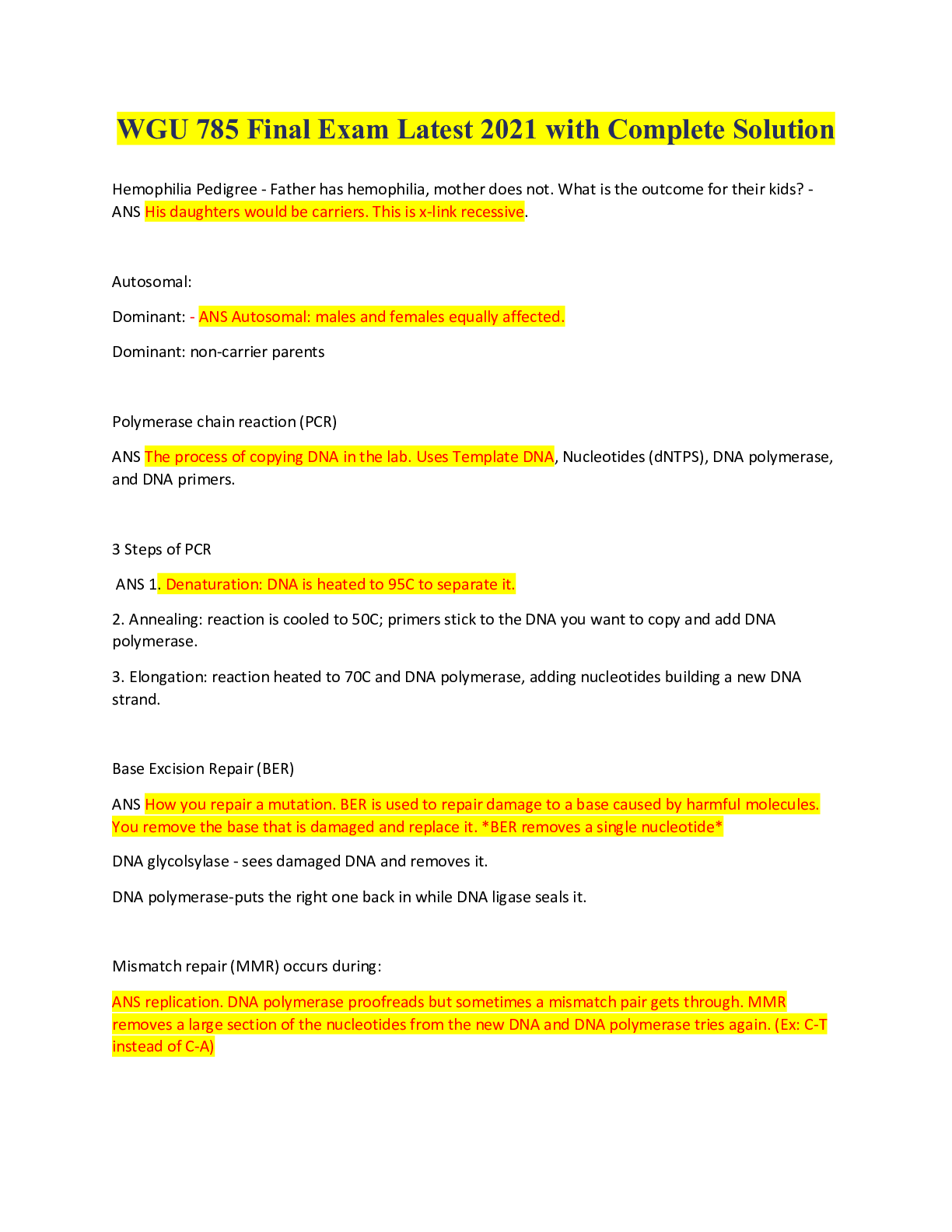
Hemophilia Pedigree - Father has hemophilia, mother does not. What is the outcome for their kids? -
✔✔-His daughters would be carriers. This is x-lin
...
WGU 785 Final Exam Questions and
answers, 100% Accurate, graded A+
Hemophilia Pedigree - Father has hemophilia, mother does not. What is the outcome for their kids? -
✔✔-His daughters would be carriers. This is x-link recessive.
Autosomal:
Dominant: - ✔✔-Autosomal: males and females equally affected.
Dominant: non-carrier parents
polymerase chain reaction (PCR) - ✔✔-The process of copying DNA in the lab. Uses Template DNA,
Nucleotides (dNTPS), DNA Polymerase, and DNA primers.
3 Steps of PCR - ✔✔-1. Denaturation: DNA is heated to 95C to separate it.
2. Annealing: reaction is cooled to 50C; primers stick to the DNA you want to copy and add DNA
polymerase.
3. Elongation: reaction heated to 70C and DNA polymerase, adding nucleotides building a new DNA
strand.
Base Excision Repair (BER) - ✔✔-How you repair a mutation. BER is used to repair damage to a base
caused by harmful molecules. You remove the base that is damaged and replace it. *BER removes a
single nucleotide*
DNA glycolsylase - sees damaged DNA and removes it.
DNA polymerase-puts the right one back in while DNA ligase seals it.
Mismatch repair (MMR) occurs during: - ✔✔-replication. DNA polymerase proofreads but sometimes a
mismatch pair gets through. MMR removes a large section of the nucleotides from the new DNA and
DNA polymerase tries again. (Ex: C-T instead of C-A)
Mismatch Repair corrects what kind of DNA damage? - ✔✔-When a base is mismatched due to errors in
replication. Such as G-T instead of G-C. DNA polymerase comes by and fixes it.
What happens when DNA polymerase binds to DNA to make RNA? - ✔✔-TRANSCRIPTION! DNA
polymerase takes the individual nucleotides and matches them to the parental sequences to ensure a
correct pair. It must bind with RNA primer to work.
What is needed for DNA replication? - ✔✔-DNA polymerase
Nonsense Mutation - ✔✔-Change in 1 nucleotide produces a STOP codon Stop= nonsense because it is
no more.
Silent Mutation - ✔✔-Change in 1 nucleotide but codes for the same amino acid. Silent= the change
doesn't change the name of the protein
Missense Mutation - ✔✔-Change in 1 nucleotide leads to a code for a different amino acid. Missense =
mistake was made.
What happends during RNA splicing? - ✔✔-During RNA splicing introns are cut out, the remaining exons
are joined together.
5'ATG AGT CTC TCT 3'
Find the DNA template strand. - ✔✔-3'TAC TCA GAG AGA 5'
The DNA template strand is complimentary. So start with the opposite number, then go L-R with the
complimentary letter.
5'ATG AGT CTC TCT 3'
What is the corresonding mRNA sequence? - ✔✔-5'AUG AGU CUC UCU 3'
This sequence is the same as the coding strand except T changes to U because it is RNA. RNA doesn't
have T.
How would a mutation from CTC to ATC affect the protein sequence? (CTC/ATC - coding strand, AUC -
mRNA strand) - ✔✔-This will make a missense mutation because it changes the name of the protein.
(look at the chart provided.) missense = mistake
DNA replication process - ✔✔-DNA ->Transcription -> RNA -> Translation -> Polypeptide
Describe how you would find what ionized Alanine looks like. - ✔✔-This is an amino acid. Look for the
"R" group. Alanine is a hydrophobic amino acid that has CH3. It is a weak interaction. An ionized acid will
have a + or - charge.
Describe what causes the misfolding of protein in Alzheimer's Disease. - ✔✔-Protein misfolding is
caused by intracellular tangles and extracellular plaques (senile plaques) caused by abnormal protein
aggregation.
TAU is fibrous material inside cells where the connections are lost. This becomes defective and forms
filaments in the neuron.
Amyloid-Beta is a large precursor protein in the cell. Excess amyloid-beta creates senile plaques. This
starts in the hippocampus and moves up.
Describe the process of neurodegenerative protein aggregation. - ✔✔-Alzheimer's is the most common
neurodegenerative disease. The formation of aggregated amyloid-beta fibers is another characterisitc of
Alzheimer's. However, neurodegeneration and memory loss can be detected before amyloid fibers
accumulate in the brain.
What are the molecules that help denatured proteins with folding? - ✔✔-Molecular chaperones are
protein helpers. They bind to the newly made polypeptide and enable proper folding. Proper protein
folding is vital b/c proteins that do not fold properly can lead to a variety of diseases. Normally, the
chaperones that help new proteins fold can also help misfolded proteins refold into the correct
structure.
Genetic mutations that substitute one amino acid for another can cause incorrect folding.
What are the 4 levels of protein structure? - ✔✔-1. Primary-chain of amino acids. PEPTIDE bonds form a
polypeptide chain. This is a covalent bond (very strong) and does not denature.
2. Secondary-alpha helix and beta sheet. HYDROGEN bonds that contain the carboxyl group and amino
groups. Denatured by salt and pH change.
3. Tertiary-side chain interaction (R group). Changes are seen with high temp, salt, change in pH, and
reducing agents. (ex: sickle cell, arthritis, hemophilia)
4. Quarternary-more than 1 polypeptide. Change seen with increased temp. (Ex: Hgb)
Hydrogen bonds are formed from - ✔✔-2 polar amino acids.
(Contains Oxygen and nitrogen-OH, NH, NH2. On exterior surface)
What structure would be unaffected by complete denaturation of its multi-subunit? - ✔✔-PRIMARY.
Peptide bonds are strong and covalent. The primary structure is located at the backbone and does not
denature.
What is the simplest way to denature a protein? - ✔✔-Heat it up. The tertiary structure is hydrophobic.
The tertiary structure is a protein structure stabilized primarily by the hydrophobic effect.
What is the secondary structure made up of? - ✔✔-Alpha helixes and beta sheets
Describe what is meant by "induced fit" of a substrate and enzyme. - ✔✔-The substrate and active site
are somewhat complementary prior to substrate binding. Many enzymes will adjust their active site
conformation slightly as the substrate binds to improve the fit. When the molecule is recognized as the
substrate, the enzyme will adjust to form itself around the substrate more tightly to facilitate the
reaction it catalyzes.
Describe the Substrate-enzyme complex. - ✔✔-Each substrate binds to an active site, producing an
enzyme-substrate complex. The geometric and chemical complement between the enzyme and
substrate depend on noncovalent forces.
Describe how the substrate and enzyme react with each other. - ✔✔-Substrate- molecule that an
enzyme will bind to preferentially to any other molecule. Each enzyme is specific for that substrate. It
will not react with molecules that are not its substrate.
Active site- serves as the binding platform on the enzyme for its specific substrate and acts as the site of
the chemical reaction.
Competitive vs Non-competitive Enzyme Inhibition - ✔✔-Competitive inhibitor-usually a molecule
similar in structure to a substrate that can bind to an enzyme's active site even though the molecule is
unable to react.
Non-competitive-attach to the enzyme at an ALLOSTERIC site, which is a site other than the active site.
Feed back inhibition - ✔✔-Non-competitive inhibition. Once the end product builds up, it will bind to the
alloteric site on the first enzyme and stop the pathway. It binds to the enzyme, slowing the product.
How would you find which amino acid is non-polar? - ✔✔-It will contain carbons and hydrogens (CH,
CH2, CH3) These are weak interactions that tend to aggregate in the middle of the protein. They will be
affected by temperature change.
What part of the phospholipid is hydrophobic? - ✔✔-The tail
Describe peptide bonds. - ✔✔-Peptide bonds form between 2 amino acids by a dehydration reaction.
During dehydration, a water molecule forms from the oxygen of a carboxyl group and 2 hydrogens from
an amino group. As water forms, the carbon atom of the carboxyl group and the nitrogen atom of the
amino group become bonded together. It is the bond b/w 2 amino acids.
How does cooperative binding on hemoglobin occur? - ✔✔-The four subunits of hgb work together.
When one molecule of oxygen leaves, the other 3 tend to leave too. When one picks up oxygen, the
others tend to pick it up also. (Think of the table and chairs.) This is how oxygen is picked up in the lungs
and dropped off in the tissues.
Oxygen will bind quicker to hgb when... - ✔✔-there is another oxygen molecule already binding. This is
known as Cooperative Binding.
Explain Carbon Monoxide's affinity for hgb. - ✔✔-CO binds to the same group as oxygen, but binds more
strongly. If CO is there, it will pick up the O2 but it will not drop it off. This is why CO poisoning is so
harmful. The pt will be very pink in color. CO stabilizes the R-state by binding to the same iron in Hgb
and changing the heme shape.
Describe fetal 2,3 BPG and oxygen affinity. - ✔✔-The fetus has a higher affinity for oxygen than mom.
The mother's 2,3 BPG is higher so their afinity for oxygen is lower. The mom becomes deoxygenated.
Affinity-stickiness for oxygen.
How is a HGB structure affected by the absence of oxygen? - ✔✔-The structure becomes tense. The
heme is dome shaped. pH will be lower. This is found in the muscles.
Describe Hemoglobin - ✔✔-1. Low affinity for oxygen.
2. Transports oxygen to the tissues.
3. Acts as a buffer and controls pH by binding to H+ ions.
4. 4 protein, 4 Iron/Heme, 4 Oxygen
5. Binds to oxygen at high pH and releases at low pH
6. High affinity for CO
7. Quarternary structure
Describe Myoglobin - ✔✔-1. High affinity for oxygen
2. Stores oxygen in muscle and releases it when oxygen levels get low
3. Not affected by change in pH
4. 1 protein, 1 iron/heme, 1 oxygen
5. Tertiary structure
How does pH influence the oxygen saturation of hemoglobin? - ✔✔-Left shift: increased affinity for
oxygen, increased pH (acidic), weak bond
Right shift: decreased affinity for oxygen, decreased pH, strong bond
Bohr Effect: increase in pH->increased affinity for oxygen->increased Hgb saturation->reach 100%
sooner. Oxygen will be distributed better, delivering more or less where we need it.
Cholesterol - ✔✔-1. 4 Ring structure
2. AKA sterols (cholesterol, cortisol, testosterone)
3. Needed for membrane fluidity (expansion)
4. Increases temp to solidify
5. Needed to synthesize Vitamin D in the skin, cholic acid (component of bile), and steroid hormones.
Steroid Hormones - ✔✔-synthesized by cholesterol;
testosterone and estrogen-promote growth and development of sex characteristics;
cortisol-released in response to stress and promotes glucose synthesis in liver.
How could myoglobin indicate an MI? - ✔✔-Myoglobin is a protein with a single subunit containing both
heme and iron. While myoglobin is normally contained only in the muscles, it can be released into the
bloodstream if there is muscle damage. For this reason, measuring the levels of myoglobin in the blood
can provide evidence of rhabdomyolysis, a mild heart attack, or a muscular degenerative disease.
Describe the Anabolic/Anaerobic Pathway. - ✔✔-Occurs when there is no oxygen. The ETC cannot work.
Requires energy to synthesize larger molecules.
NAD+ runs out->fermentation regenerates the NADH to NAD+ ->small amounts of ATP and lactate are
made->Cori Cycle in liver
*Ends in -GENESIS-*
Describe the Catabolic Pathway. - ✔✔-generates energy by breaking down larger molecules.
*Ends in -LYSIS-*
What do the Anabolic and Catabolic pathways have in common? - ✔✔-They are both required for
maintaining the cell's energy balance.
Describe the Cori Cycle. - ✔✔-The Cori Cycle is part of the anabolic pathway. It uses the lactate made by
fermentation in the liver and uses gluconeogenesis to convert 2 lactate to glucose. 2 ATP are made with
each cycle, but it uses 6. The net loss is -4 ATP.
Describe fermentation. - ✔✔-Fermentation is the formation of lactate by regenerating the NAD+ from
NADH that was used during glycolysis to make small amounts of ATP and lactate. It allows glycolysis to
continue in the absence of oxygen.
[Show More]


.png)