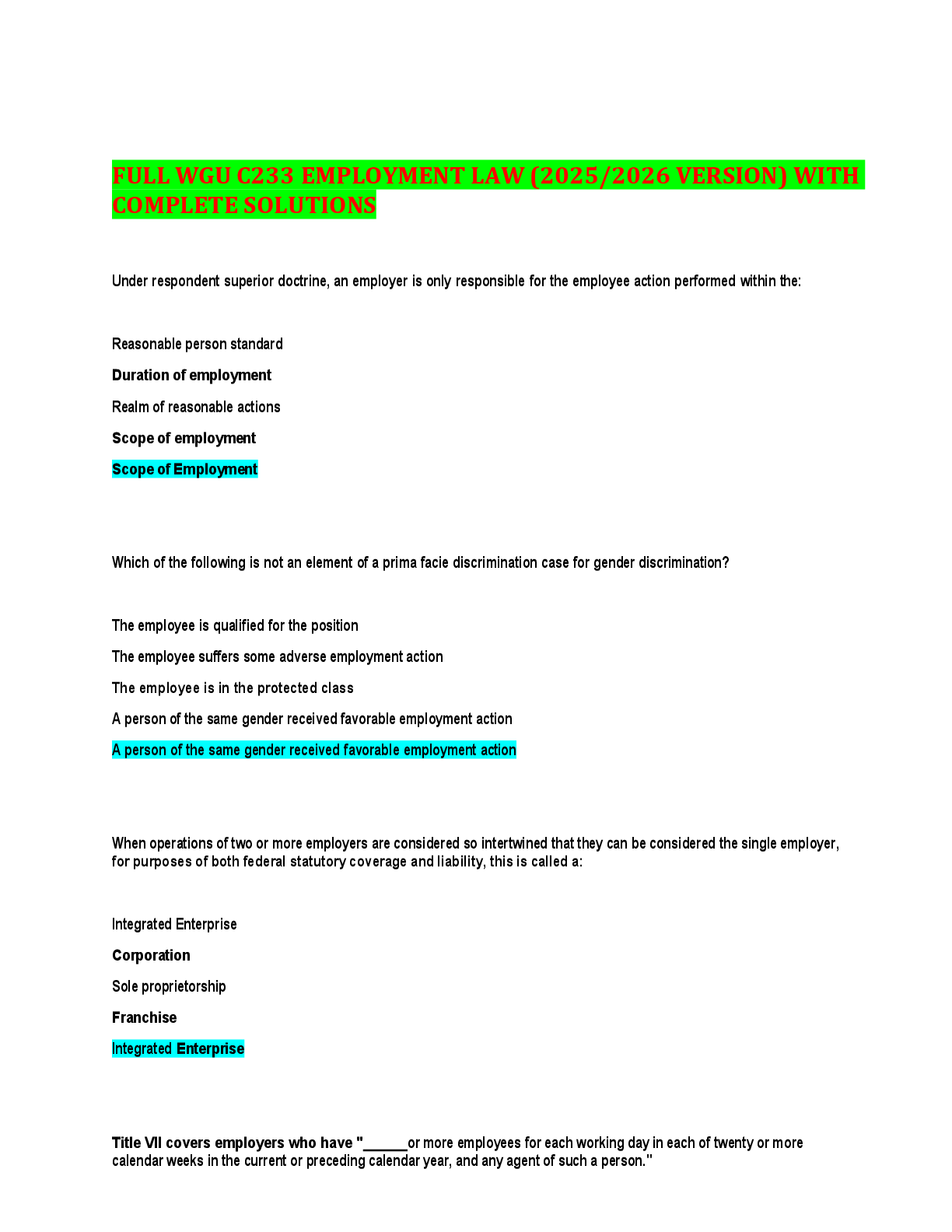
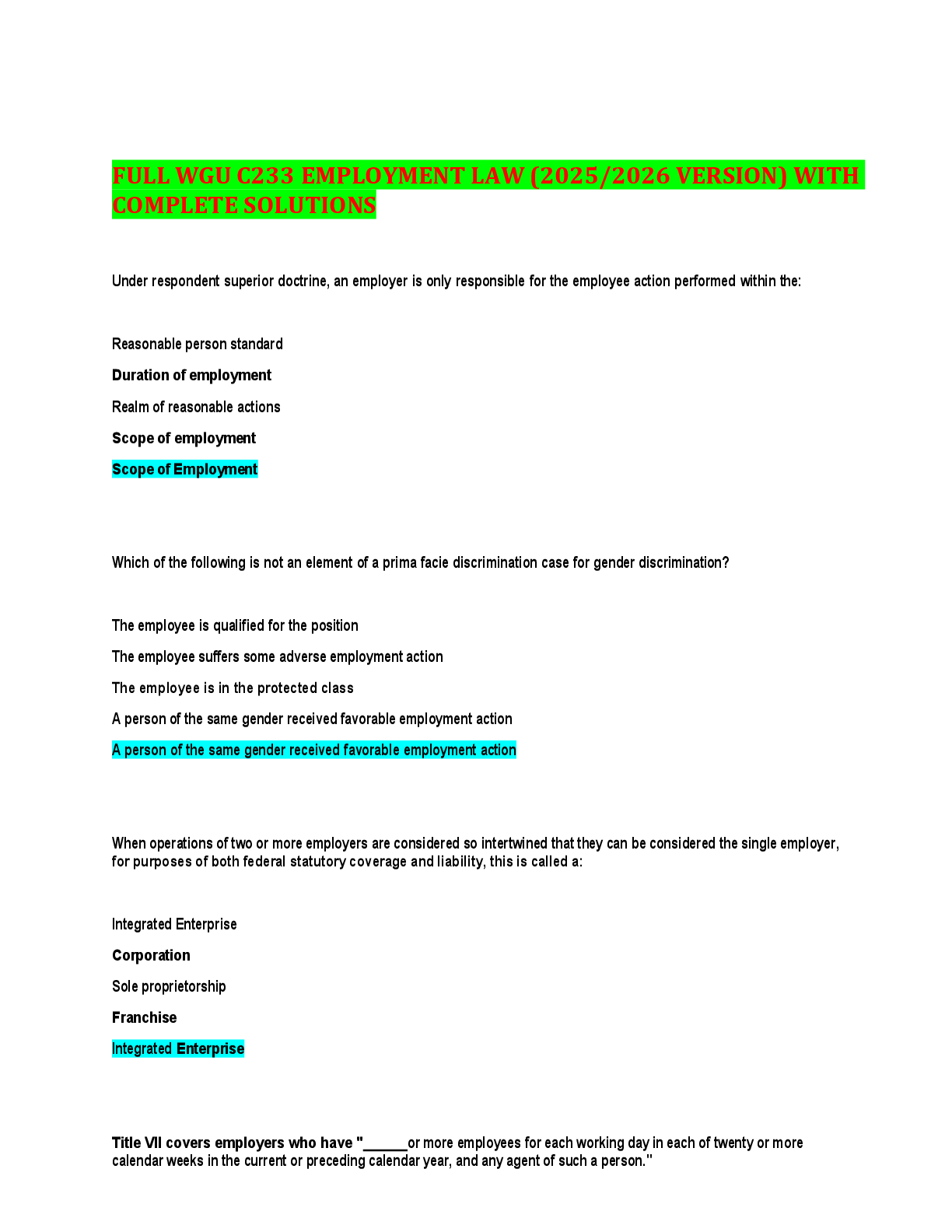
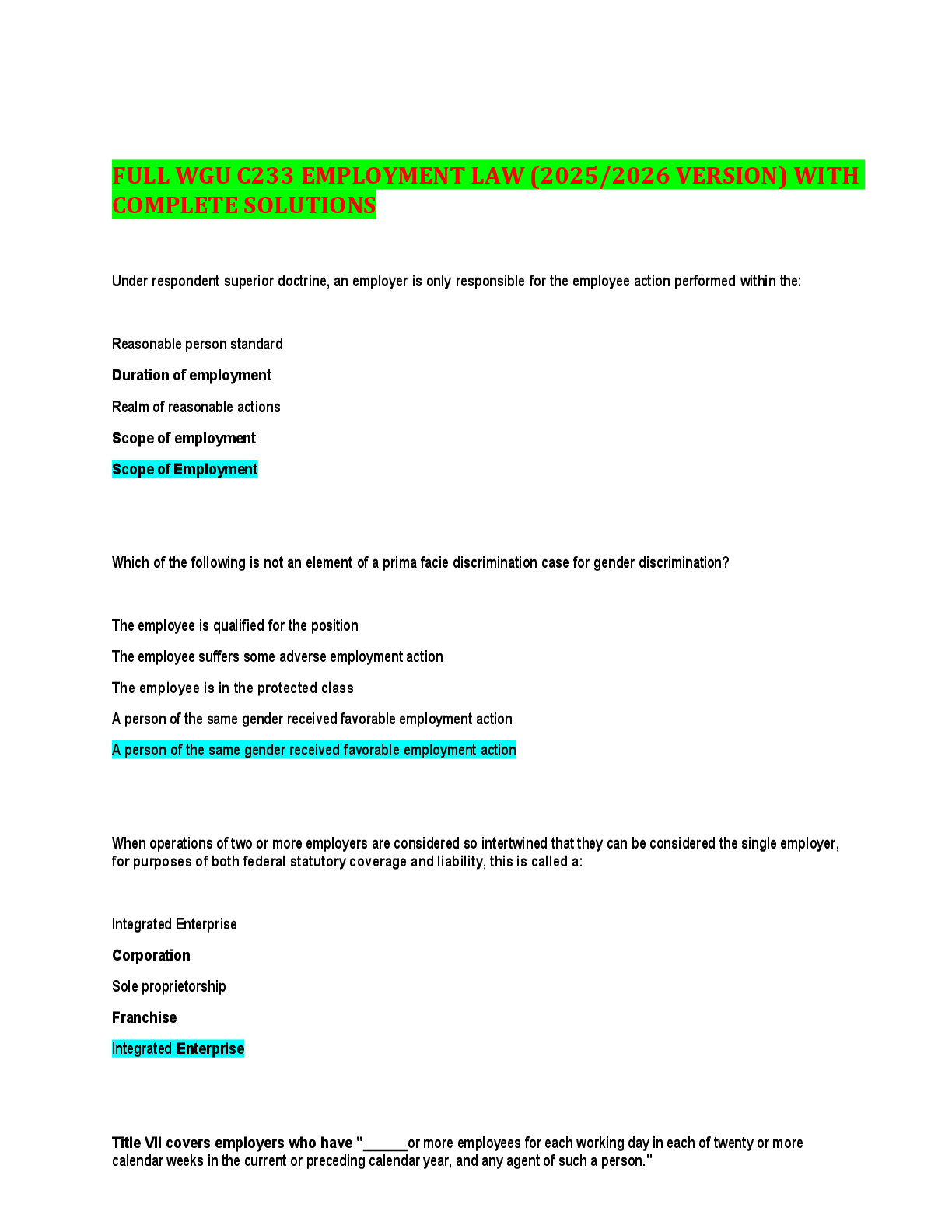
WGU C233 Complete Study Guide, Exam
Questions with accurate answers, rated
A+
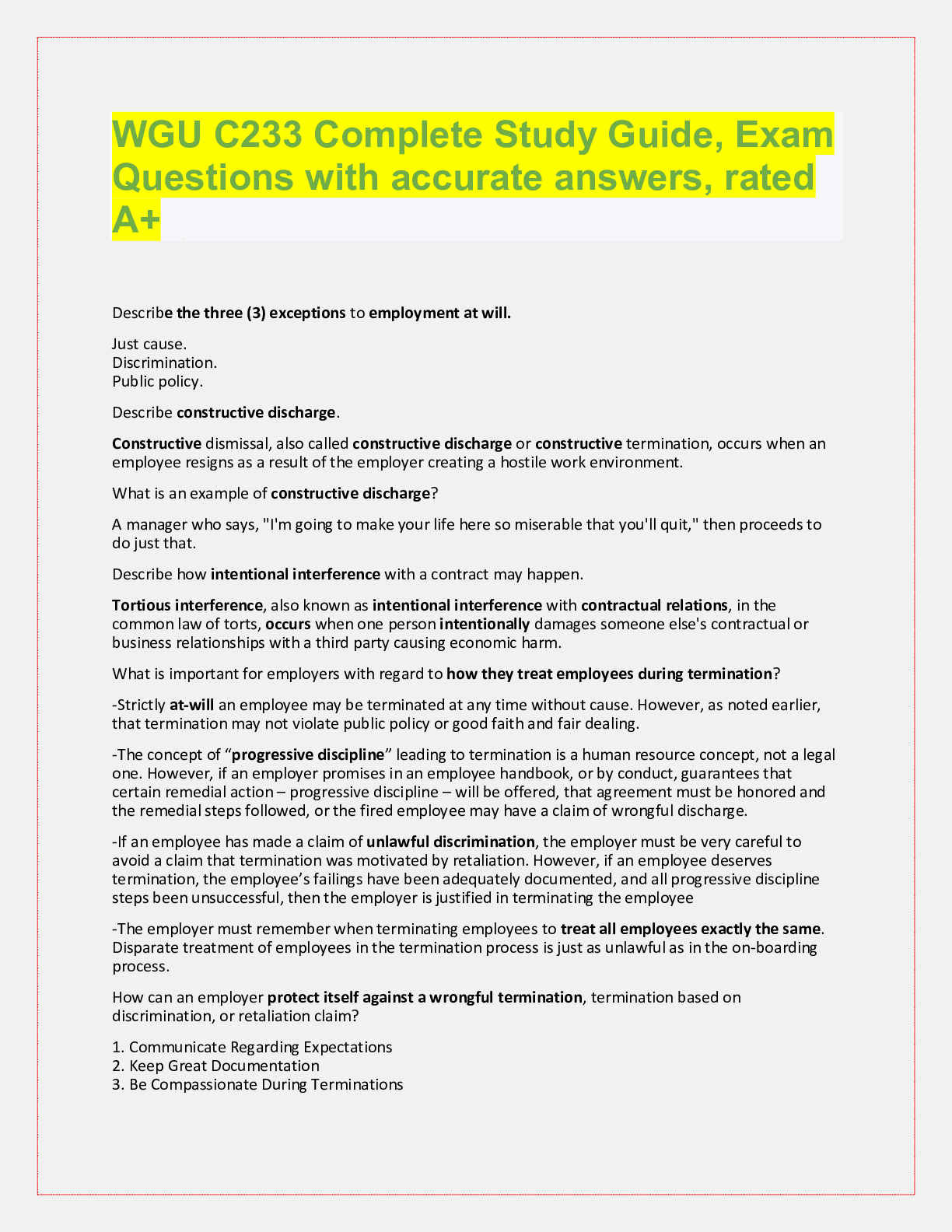
Describe the three (3) exceptions to employment at will.
Just cause.
Discrimination.
Public policy.
Describe constructive discharge.
...
WGU C233 Complete Study Guide, Exam
Questions with accurate answers, rated
A+
Describe the three (3) exceptions to employment at will.
Just cause.
Discrimination.
Public policy.
Describe constructive discharge.
Constructive dismissal, also called constructive discharge or constructive termination, occurs when an
employee resigns as a result of the employer creating a hostile work environment.
What is an example of constructive discharge?
A manager who says, "I'm going to make your life here so miserable that you'll quit," then proceeds to
do just that.
Describe how intentional interference with a contract may happen.
Tortious interference, also known as intentional interference with contractual relations, in the
common law of torts, occurs when one person intentionally damages someone else's contractual or
business relationships with a third party causing economic harm.
What is important for employers with regard to how they treat employees during termination?
-Strictly at-will an employee may be terminated at any time without cause. However, as noted earlier,
that termination may not violate public policy or good faith and fair dealing.
-The concept of “progressive discipline” leading to termination is a human resource concept, not a legal
one. However, if an employer promises in an employee handbook, or by conduct, guarantees that
certain remedial action – progressive discipline – will be offered, that agreement must be honored and
the remedial steps followed, or the fired employee may have a claim of wrongful discharge.
-If an employee has made a claim of unlawful discrimination, the employer must be very careful to
avoid a claim that termination was motivated by retaliation. However, if an employee deserves
termination, the employee’s failings have been adequately documented, and all progressive discipline
steps been unsuccessful, then the employer is justified in terminating the employee
-The employer must remember when terminating employees to treat all employees exactly the same.
Disparate treatment of employees in the termination process is just as unlawful as in the on-boarding
process.
How can an employer protect itself against a wrongful termination, termination based on
discrimination, or retaliation claim?
1. Communicate Regarding Expectations
2. Keep Great Documentation
3. Be Compassionate During Terminations
4. Purchase Liability Insurance
5. Help Employees with Next Steps
Implied Contract Exception
an exception available in at-will employment. Under the implied contract exception, an employer may
not fire an employee in a situation where an implied contract has formed between an employer and
employee. A written instrument expressing the employment relationship will not exist.
Implied Good Faith and Fair Dealing
This duty requires that neither party will do anything that will destroy or injure the right of the other
party to receive the benefits of the contract.
Collective Bargaining Agreement
A contract negotiated by the employer and representatives of the labor union, and it covers issues
related to employment.
Constructive Discharge
Constructive dismissal, also called constructive discharge or constructive termination, occurs when an
employee resigns as a result of the employer creating a hostile work environment. Since the resignation
was not truly voluntary, it is, in effect, a termination.
What are the six steps in filing a discrimination complaint with the EEOC?
1. Employee believes a discriminatory act occurred
2. Employee files compliant with EEOC
3. EEOC examines employee's claim to determine whether a prima facie case exists
4. EEOC sends complaint to employer
5. Employer responds to EEOC addressing employee's assertion of events
6. EEOC decides to pursue further with more investigation and pursuit of settlement or issuance of a
"Right to Sue" letter, which gives employee the right to seek private counsel and sue the employer
What is the National Labor Relations Board (NLRB) and what are its main functions?
The National Labor Relations Board is an independent federal agency vested with the power to
safeguard employees' rights to organize and to determine whether to have unions as their bargaining
representative.
1. Conduct Elections
2. Investigate Charges
3. Facilitate settlements
4. Decide Cases
5.Enforce Orders
6. National Labor Relations Board Rulemaking
List unfair labor practices perpetrated by an employer.
1. Interference, restraint, or coercion.
2. Employer domination or support of a labor organization.
3. Discrimination on the basis of labor activity.
4. Discrimination in retaliation for going to the NLRB.
5. Refusal to bargain.
List unfair labor practices perpetrated by unions.
1. Restraining or coercing the employer or employees in exercising the rights provided by the NLRA.
2. Causing the employer to discriminate again employees.
3. Refusing to bargain in good faith.
4. Inducing strikes for forbidden reasons such as secondary benefits.
5. Forcing the employer to make certain work assignments.
6. Forcing the employer to bargain with an uncertified union.
7. Changing excessive initiation fees.
8. Forcing or attempting to force employers to pay for workers the employer does not need.
9. Forcing or attempting to force employers to pay for work that is not or will not be done.
List and describe the FIVE steps of the union organization process.
1. The union will spread its message inside the workplace.
2. The union informs the NLRB of interest in unionizing.
3. The union runs an organizing drive.
4. Union representation election is held.
5. Collective bargaining between the employer and the union.
What are some strategies for resolving labor disputes?
-Collective bargaining mediation: Mediation is a tool through which the federal government supports
sound and stable labor management relations. As neutrals, FMCS mediators provide a third-party
perspective and leverage the expertise of the skilled negotiators at the table to address the core
interests of the negotiating parties.
-Alternative Bargaining Processes: The FMCS can conduct collective bargaining facilitation or mediation
by alternative bargaining models for labor and management parties who wish to apply a joint problem
solving approach in contract negotiations.
-Grievance Mediation: FMCS grievance mediation is a means of helping labor and management improve
their relationships by more quickly resolving contractual disputes and improving workplace
communications.
What happens if there is a competing union that has 30% interest as well?
Vote is held for no union, union #1, or union #2
What happens if the parties cannot agree on election specifics?
Election is set according to NLRB rules
What happens if either the employer or union interfere with employees' freedom of choice?
Election results are set aside
Mandatory Bargaining Subjects
Those that directly impact – wages, hours or working conditions (or terms and conditions of
employment). These are subjects over which the parties must bargain if a proposal is made by either
party.
EX. Wages, hours, annual bonus, shift premiums, pension plans, employer controlled pricing in vending
machines.
Permissive Bargaining Subjects
Those over which bargaining is neither compelled nor prohibited. Neither party is required to agree to
proposed language that is a permissive subject, and the matter cannot be pursued to the point of
impasse.
EX. Union procedure for ratifying contracts, attempts to modify the union certification, corporate social
or charitable activities, strike settlement
Prohibited Bargaining Subjects
Those subjects that, if included in a collective bargaining agreement, are unenforceable as a matter of
law.
EX. Union attempt to negotiate a closed shop agreement, discriminatory employment practices,
specifying when workers may strike, changes to NLRA standards.
Closed Shop Agreement
Specified workers had to be members of a union before being hired for a job.
Wildcat Strike
A strike not approved by the strikers' union.
Boycott
A group's refusal to have commercial dealings with some organization in protest against its policies.
Impasse
When the two sides negotiating an agreement are unable to reach an agreement and become
deadlocked.
Economic Strike
A strike in which workers seek a change in wages, hours, and/or conditions of employment.
Unfair Labor Practice Strike
A strike aimed at protesting illegal conduct by the employer.
Lockout
A work stoppage or denial of employment initiated by the management of a company during a labor
dispute. In contrast to a strike, in which employees refuse to work, a lockout is initiated by employers or
industry owners.
Describe how the U.S. Constitution affects employment law.
Every individual shall have the right to work under equitable and satisfactory conditions, and shall
receive equal pay for equal work.
What is common law and how does it get created?
Common law, also known as case law, is a body of unwritten laws based on legal precedents established
by the courts. Common law draws from institutionalized opinions and interpretations from judicial
authorities and public juries. Common laws sometimes prove the inspiration for new legislation to be
enacted.
List and describe the three tests used to determine independent contractor status
IRS 20 Factor Test The common law test; and The economic realities test
Conglomerate
A group of diverse companies under common ownership and run as a single organization
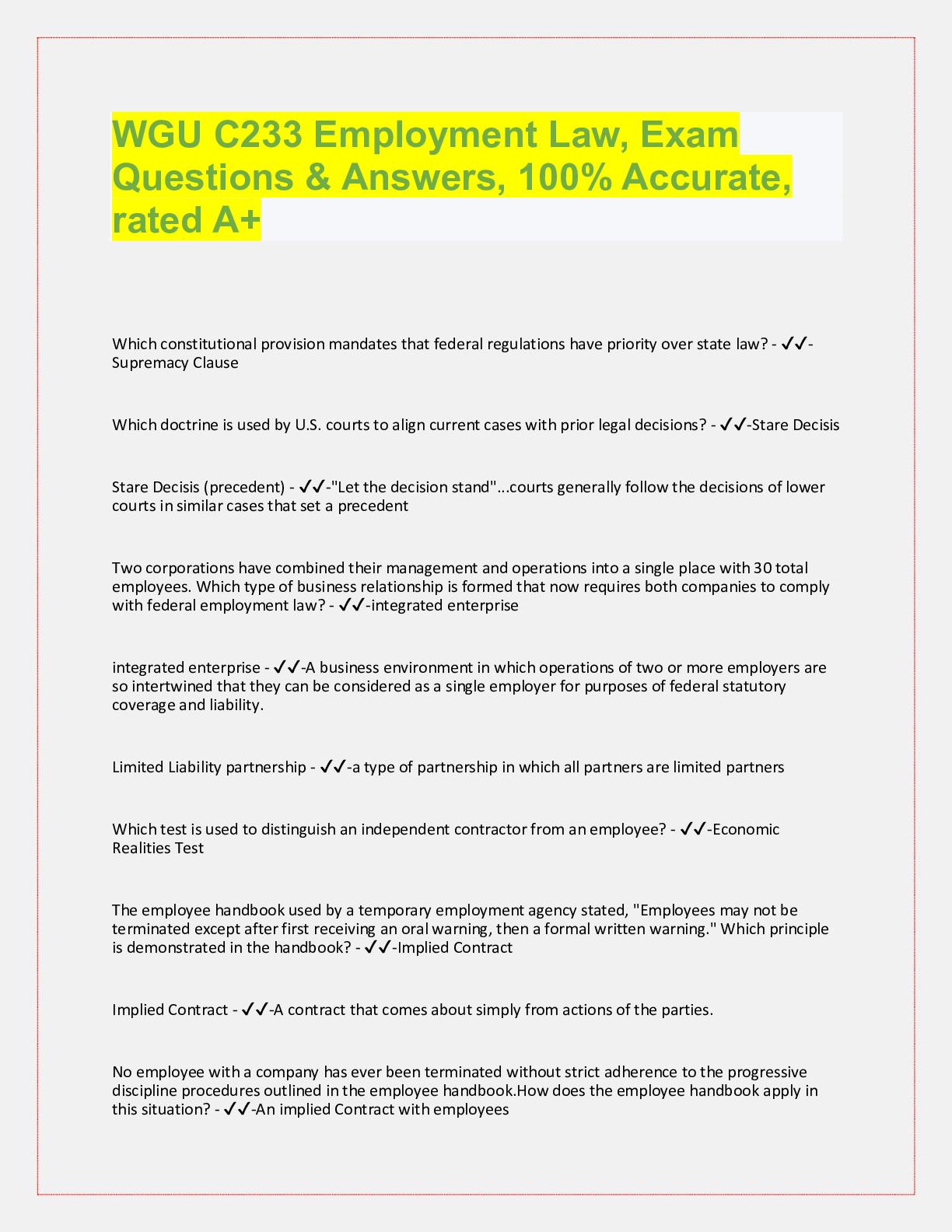
Integrated Enterprise
A business environment in which operations of two or more employers are so intertwined that they can
be considered as a single employer for purposes of federal statutory coverage and liability.
What is the purpose or function of the law?
1. Regulates conduct- acts as a deterrent i.e. if you do “x” you face punishment “y”.
2. Avoids or Settles disputes – Contract law sets out rules for making & enforcing agreements.
3. Set out rights and obligations- for example the Charter of Rights limits the government’s authority
over citizens.
4. Provides remedies- if your rights have been violated under the law, the law provides a system of
recourse.
5. Maintains Order & provides protection- prohibits certain acts & provides for an authority-(police) to
protect us.
6. Sets up the structure of government- The Constitution Act assigns power & duties to the various
levels of government.
7. Directs how to make laws- The Parliament.
What is the main purpose of the economic realities test?
The goal of the economic realities test is to determine whether a worker is economically dependent on
the employer -- and is therefore an employee -- or is really in business for him or herself --and is
therefore an independent contractor.
What are the 20 factors in the IRS 20-Factor Test?
1. Amount of instruction
2. Amount of training
3. Degree of business integration
4. Extent of personal services.
5. Control of assistants
6. Continuance of relationship
7. Control over schedule
8. Demand for full-time work
9. On-site requirements
10. Order of work
11. Reporting requirements
12. Method of payment
13. Compensation for business or travel expenses
14. Use of tools and materials
15. Level of investment
16. Share in gain or loss
17. Ability to work elsewhere
18. Availability to general public
19. Control over discharge
20. Right to terminate
Retaliatory Discharge
Retaliatory discharge refers to an employer terminating an employee for anything other than a work�performance related reason. The term most commonly refers to an employee being terminated for
reporting the employer's wrongful conduct.
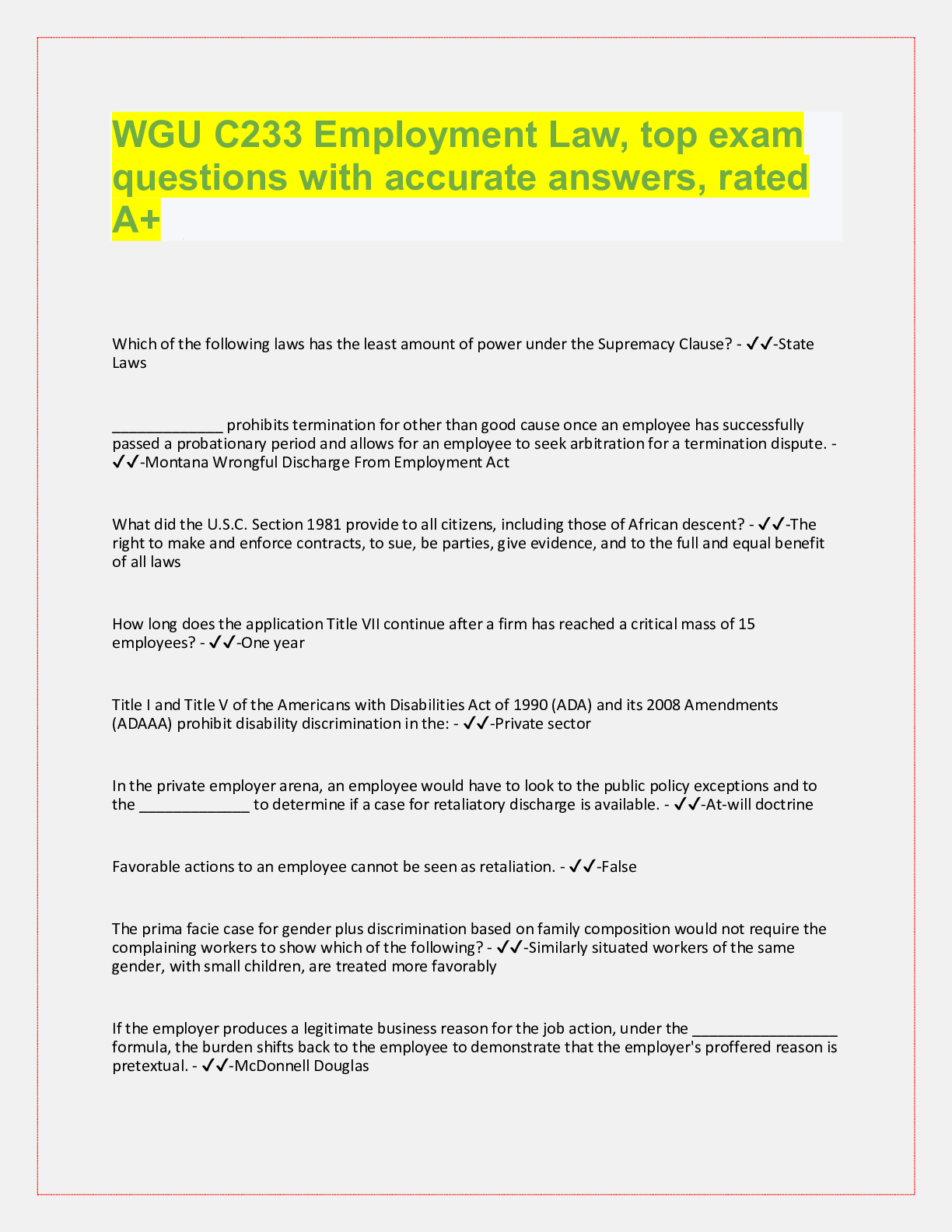
Montana Wrongful Discharge from Employment Act
Montana Wrongful Discharge From Employment Act of 1987 prohibits termination for other than good
cause once an employee has successfully passed a probationary period and allows for an employee to
seek arbitration for a termination dispute.
Explain why it is important for an organization to correctly identify which workers are "employees"
versus independent contractors?
Worker classification is important because it determines if an employer must withhold income taxes
and pay Social Security, Medicare taxes and unemployment tax on wages paid to an employee. ... The
earnings of a person working as an independent contractor are subject to self-employment tax.
List the FOUR factors used to determine whether two or more firms are considered an integrated
enterprise
1. The degree of interrelation between operations, such as sharing management services, payroll, and
office space.
2. The degree to which the entities share management, as in having a common slate of managers,
officers, and directors.
3. The degree of common control of labor relations, as in human resources administration or personnel
policy development.
4. The level of shared ownership.
Define employment at-will doctrine.
The predominant rule governing employer-employee relations that states that an employer may
terminate an employee at any time, for any legal reason, without incurring liability..
Describe and give examples of the following types of employment contracts:
Agency
Implied Contracts
Explicit Contracts
Union Contracts
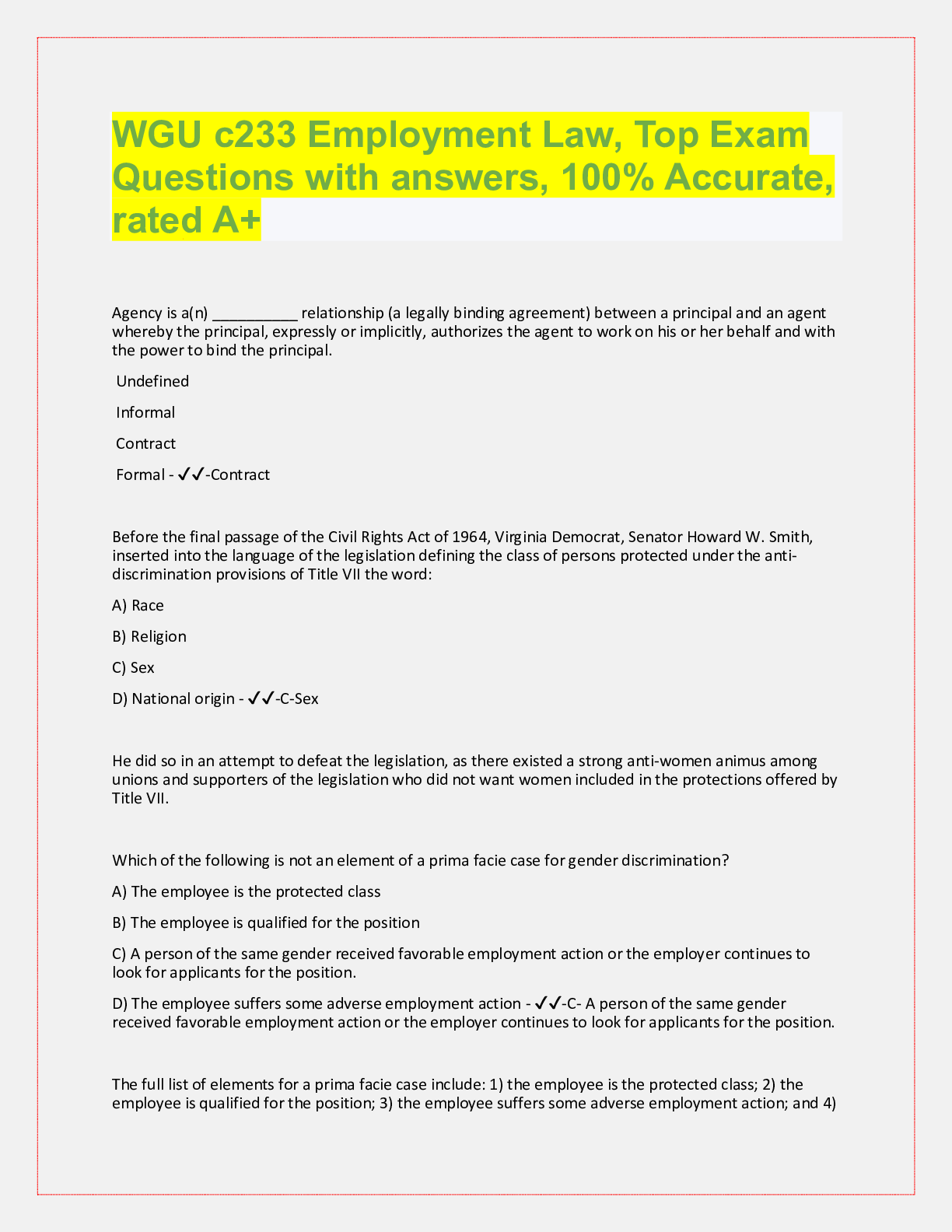
Agency-A contract relationship between a principal and an agent whereby the principal authorizes the
agent to work on his or her behalf and with power to bind the principal.
Implied Contracts-A legally binding agreement which is created, not through formal contract
negotiation and documentation, but by the actions of the employer and the employee.
Explicit Contracts-(Also known as "express contract") A verbal or written agreement in which the parties
state exactly what they agree to do.
Union Contracts- Labor union contracts are multiyear, bilateral agreements between the labor union
and the employer
How might the employee handbook affect the employment contract?
The handbook, coupled with established procedure, creates an implied contract upon which the
employee may rely.
Freedom of Speech
the right to express any opinions without censorship or restraint.
Fourth Amendment
The right of the people to be secure in their persons, houses, papers, and effects, against unreasonable
searches and seizures, shall not be violated, and no Warrants shall issue, but upon probable cause,
supported by Oath or affirmation, and particularly describing the place to be searched, and the persons
or things to be seized.
Respondeat Superior Doctrin
[Show More]