WGU C233 Exam Questions and
answers, 100% Accurate, graded A+
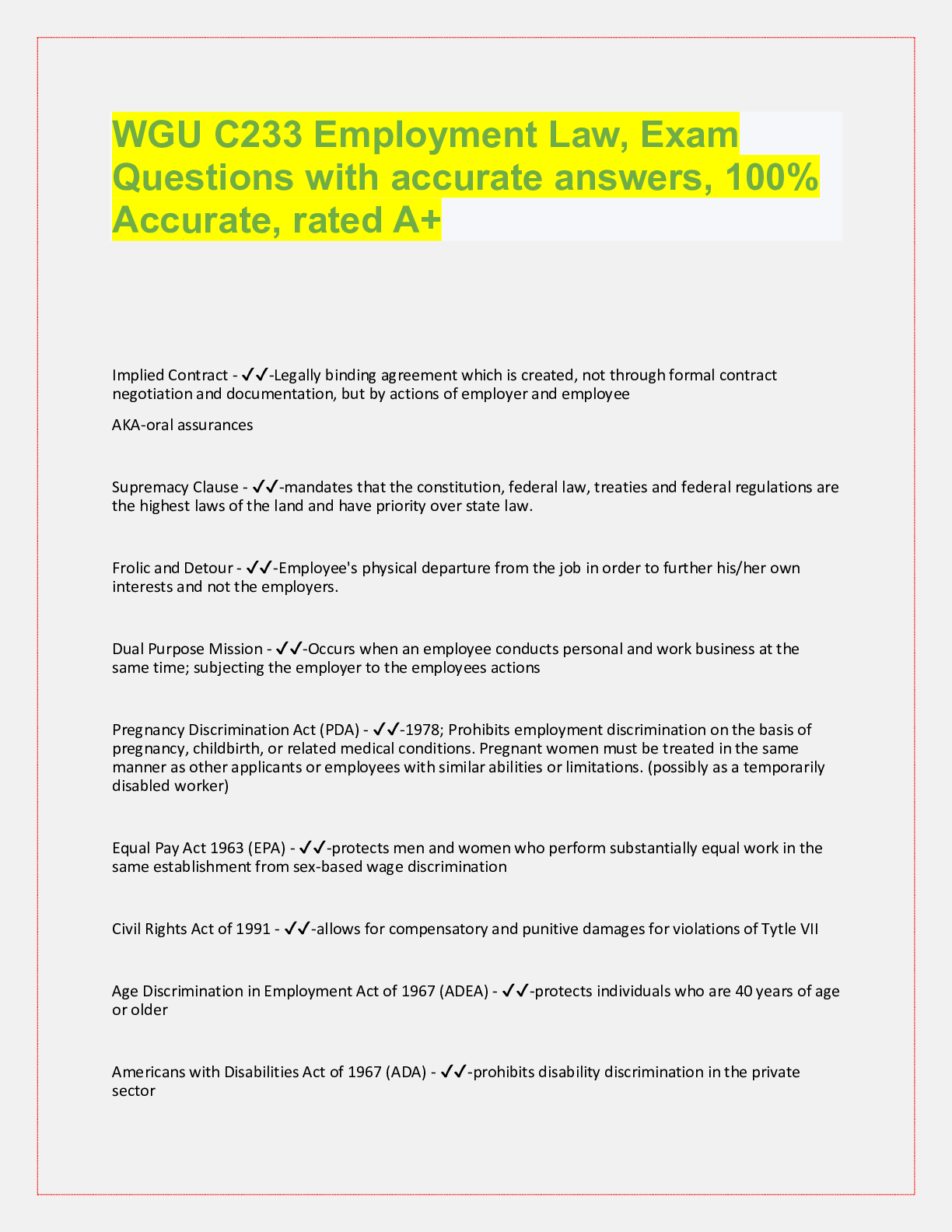
Agency - ✔✔-A contract relationship between a principal and an agent whereby the principal authorizes
the agent to work on his or her behalf and with pow
...
WGU C233 Exam Questions and
answers, 100% Accurate, graded A+
Agency - ✔✔-A contract relationship between a principal and an agent whereby the principal authorizes
the agent to work on his or her behalf and with power to bind the principal.
Appropriation of Image of Likeness - ✔✔-A type of tort in which an employer uses the name, image, or
likeness of an employee for commercial purposes in a way that is not described in the job description.
Assumption of Risk - ✔✔-An employer defense that states an employee knows and accepts the risk of
potential injury in a certain position
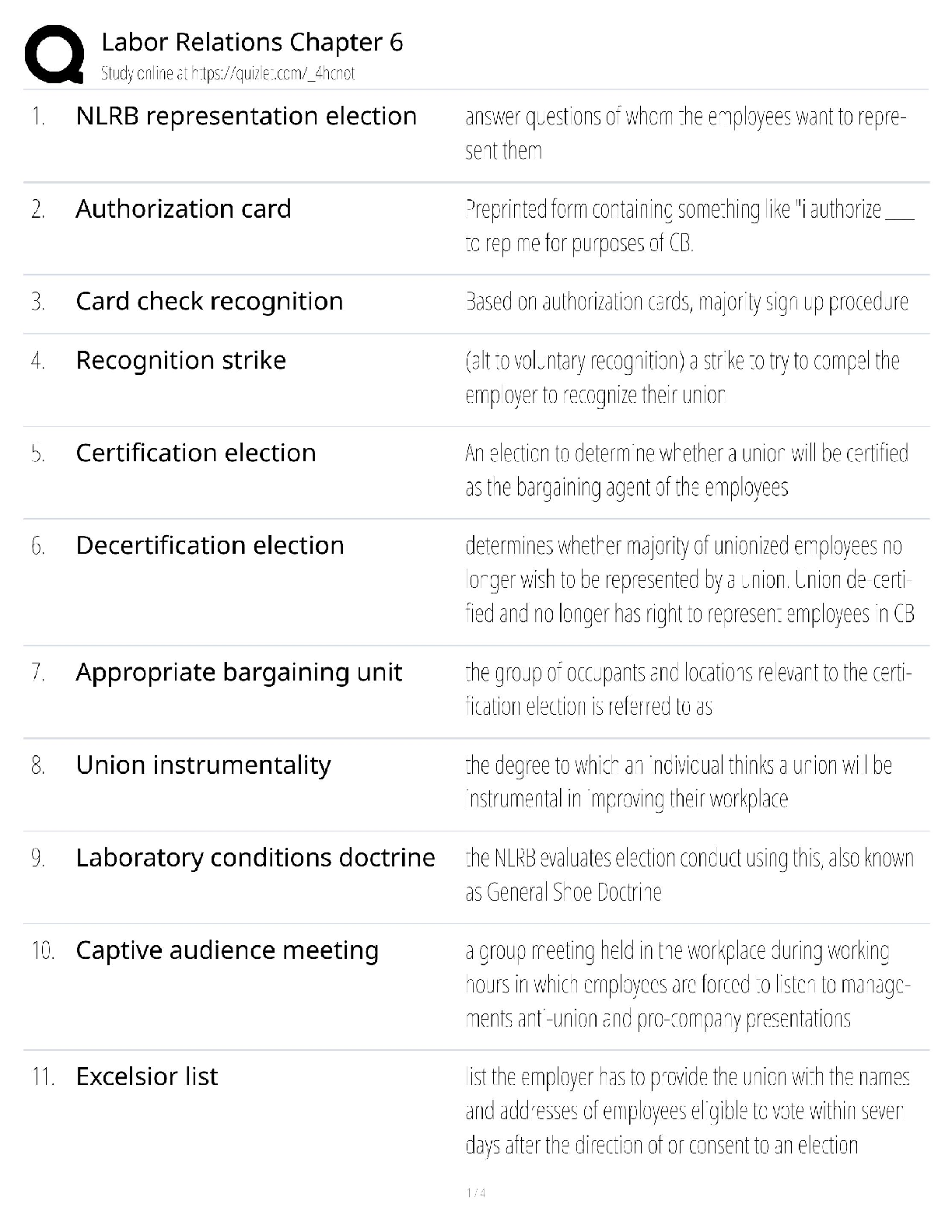
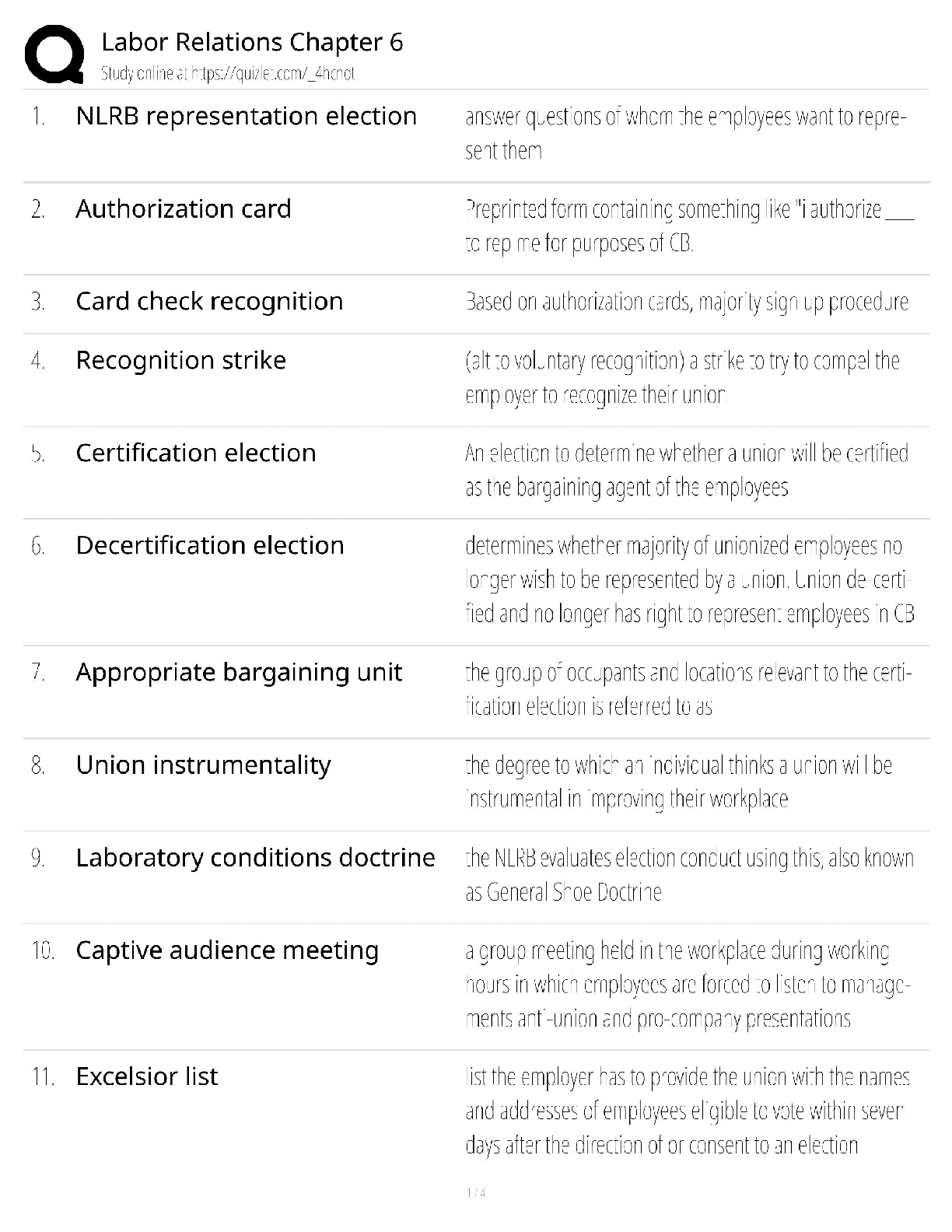
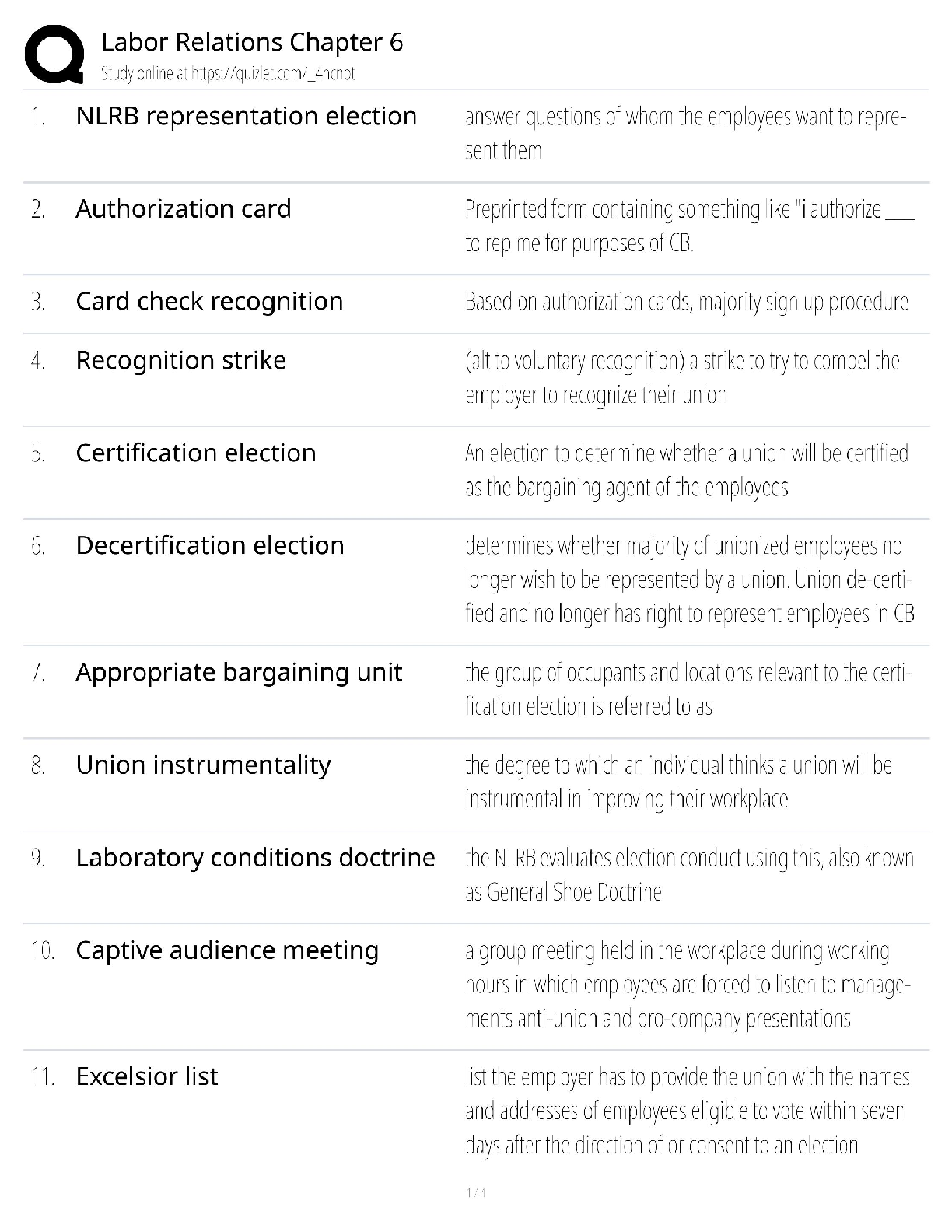
Authorization cards - ✔✔-Individual forms in which a worker states a wish to be represented by the
union .
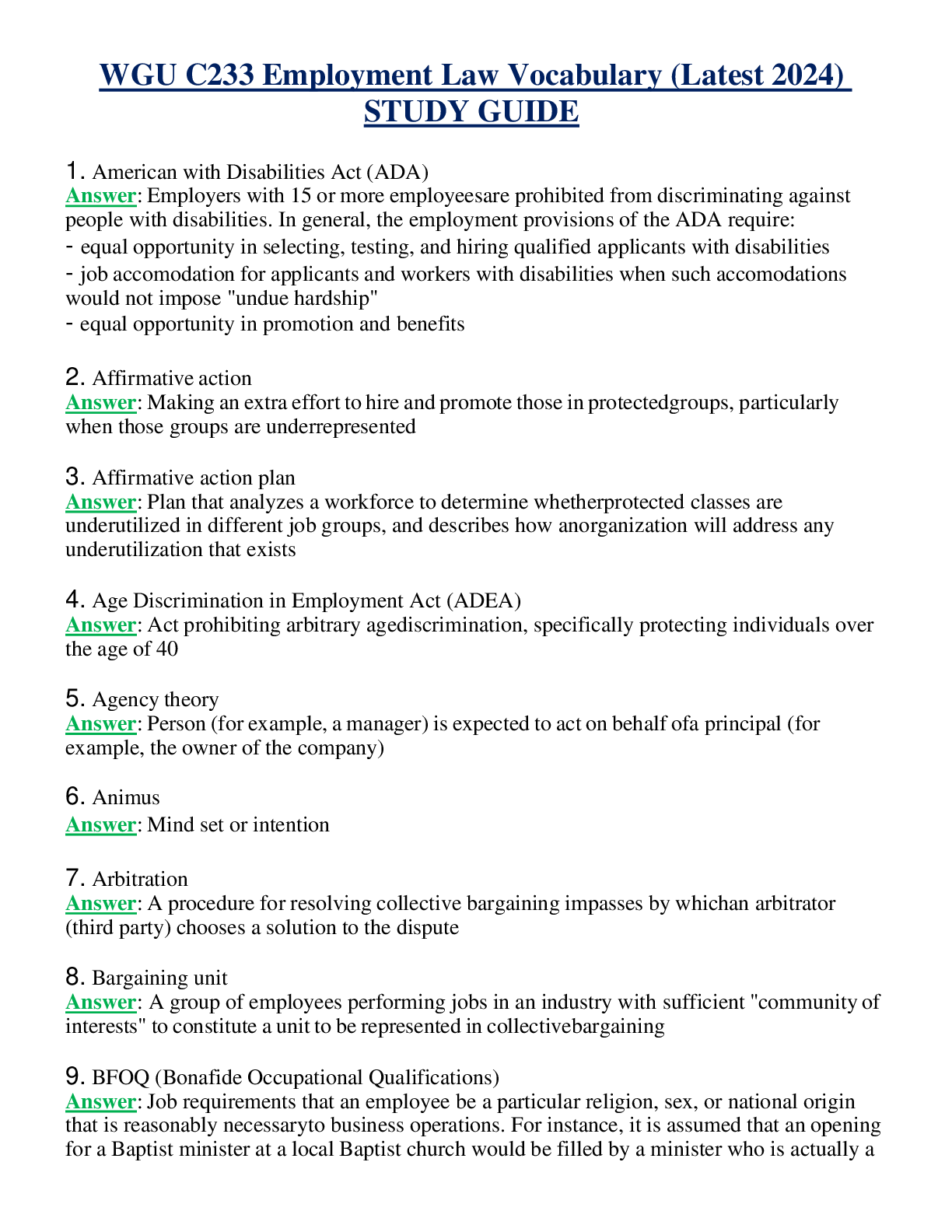
Bargaining unit - ✔✔-Individual forms in which a worker states a wish to be represented by the union .
Bona Fide Occupational Qualification (BFOQ) - ✔✔-A reasonable employment qualification that an
employer is allowed to consider when making decisions about hiring and retaining employees.
Breach of Duty - ✔✔-Also called negligent referral. A claim in which an employer has provided an untrue
reference that omits information about an employee's dangerous and/or criminal behavior.
Business Necessity - ✔✔-A legitimate business purpose that justifies an employment decision as
effective and necessary.
Closed shop - ✔✔-An illegal requirement that an employee be a union member.
Collective bargaining - ✔✔-The negotiation process between unions and employers
Compensatory Time under FLSA - ✔✔-An option for public employers to allow time off for employees
instead of payment.
Compliance Requirement under OSHA - ✔✔-A mandate that all employers comply with all safety and
health requirements issued by the Department of Labor.
Concerted Activity under NLRA - ✔✔-Any effort by employees to join together to seek improvement in
working conditions.
Contributory Negligence - ✔✔-The worker's errant conduct that contributes to the injury.
Defamation - ✔✔-Communicating false statements that harm a person's reputation.
Defined Benefit Plan - ✔✔-A type of pension plan that provides a fixed amount payment upon
retirement
Defined Contribution Plan - ✔✔-A type of pension plan in which an employer sets aside a certain
amount each year for the employee, to be distributed upon retirement.
Dual purpose mission - ✔✔-Occurs when an employee conducts personal and work business at the same
time; subjecting the employer to liability for the employee's actions
Due Diligence - ✔✔-Reasonable steps taken by an employer to ensure that applicants are eligible to be
hired
Due process - ✔✔-Notice and an opportunity to be heard.
Duty to bargain in good faith - ✔✔-Includes an affirmative obligation to supply the union with
information that is "relevant and necessary" for the union to bargain intelligently and effectively and
failure to do so is considered an unfair labor practice.
Employer - ✔✔-One who employs the services of others in exchange for wages.
E-verify - ✔✔-An internet-based system operated by the federal government which allows an employer
to determine the eligibility of an employee to work in the United States using information reported on
that employee's Form I-9, employment eligibility verification.
Exempt Employee - ✔✔-Employees who are fully or partially free from FLSA provisions.
Fellow Servant Rule - ✔✔-An employer defense that another employee, not the employer, caused a
workplace injury
Fiduciary - ✔✔-An entity that acts as a guardian or caretaker
Free-riders with regards to bargaining units - ✔✔-An employee who does not belong to a union, but
benefits from union representation.
Frolic and detour - ✔✔-An employee's physical departure from the job in order to further his or her own
interests and not the employer's.
Gender Plus Discrimination - ✔✔-Discrimination that results when an employer classifies employees on
the basis of gender, plus another characteristic.
General Duty Clause under OSHA - ✔✔-Requires employers to provide their employees with a safe and
hazard-free place of employment.
Going and coming rule - ✔✔-A legal principle that removes an employer's liability from employees'
actions going to and from their place of employment.
Illegal bargaining subjects - ✔✔-A bargaining subject that cannot legally be implemented into a
collective bargaining agreement.
Impasse - ✔✔-A deadlock reached by two bargaining parties whereby an issue cannot be resolved.
Integrated enterprise - ✔✔-A business environment in which operations of two or more employers are
so intertwined that they can be considered as a single employer for purposes of federal statutory
coverage and liability.
Intrusion Upon Seclusion - ✔✔-A type of tort in which an employer intrudes upon an employee's private
information.
"Key Employee" defined by FMLA - ✔✔-a salaried, FMLA-eligible employee who is among the highest
paid 10 percent of all the employees employed by the employer within 75 miles of the employee's
worksite.
Lock out - ✔✔-An employer's temporary work stoppage initiated during a labor dispute.
Major Life Activity defined by ADA - ✔✔-A daily activity that an average person can perform with little or
no difficulty.
Mandatory bargaining subjects - ✔✔-A required bargaining subject that involves wages, benefits, hours,
and layoff procedures.
Mass Layoff under WARN Act - ✔✔-A workforce reduction at a single employment site during a 30-day
period which is not caused by a plant closing.
Negligent Hiring - ✔✔-A claim in which the employer knew or should have known about an employee's
history of violence or untrustworthiness.
Negligent Retention - ✔✔-A claim in which an employer has provided an untrue reference that omits
information about an employee's dangerous and/or criminal behavior.
NLRB - ✔✔-National Labor Relations Act-Enacted in 1935, it establishes workers' rights to form unions,
collectively bargain, and strike.
Non-exempt Employee - ✔✔-Are eligible for overtime pay and hourly wages. Once they work over 40
hours per week, an employer must pay overtime.
Permissive bargaining subjects - ✔✔-A bargaining subject that either party may bring to the table, but
over which the other party is not required to bargain.
Placement in a False Light - ✔✔-A type of torte in which an employer publishes statements about an
employee that are untrue and hurt the employees reputation.
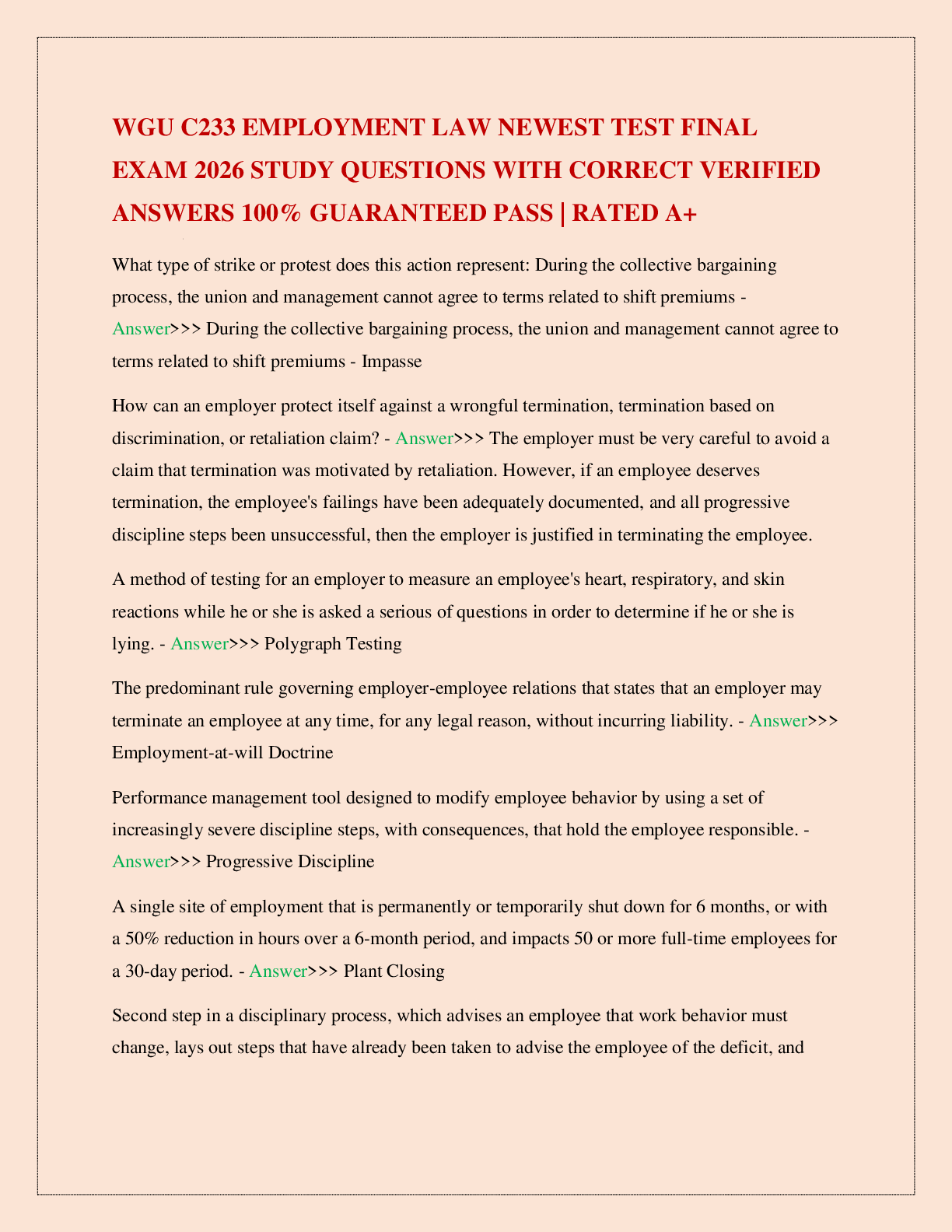
Plant Closing under WARN Act - ✔✔-A single site of employment that is permanently or temporarily
shut down for 6 months, or with a 50% reduction in hours over a 6-month period, and impacts 50 or
more full-time employees for a 30-day period.
Precedent - ✔✔-A controlling rule, example, or guide established by a judge that provides a framework
for other judges to follow in later cases
Prima Facie Case - ✔✔-(Latin for "at first sight") Evidence based on the first impression.
Progressive Discipline - ✔✔-Performance management tool designed to modify employee behavior by
using a set of increasingly severe discipline steps, with consequences, that hold the employee
responsible.
Public Disclosure of Private Facts - ✔✔-A type of tort in which an employer negligently or intentionally
discloses an employee's private information.
Reasonable Accommodation - ✔✔-A reasonable change to the work environment that allows an
individual with a disability to perform job functions.
Retaliation - ✔✔-A complaint filed by an employee who feels he or she was discriminated against in
violation of the law.
Reverse Discrimination - ✔✔-Discrimination that occurs when an employer, acting under an affirmative
action plan, favors one race or gender in an employment decision.
Respondeat Superior Doctrine - ✔✔-"let the master answer for the servent" an employer is only
responsible for the employee action performed within the scop of employment.
Scope of employment - ✔✔-Employee conduct that is reasonably relative to a job description.
Serious health condition under FMLA - ✔✔-An incapacitating illness, injury, or impairment that requires
overnight care or continuing treatment from a health care provider.
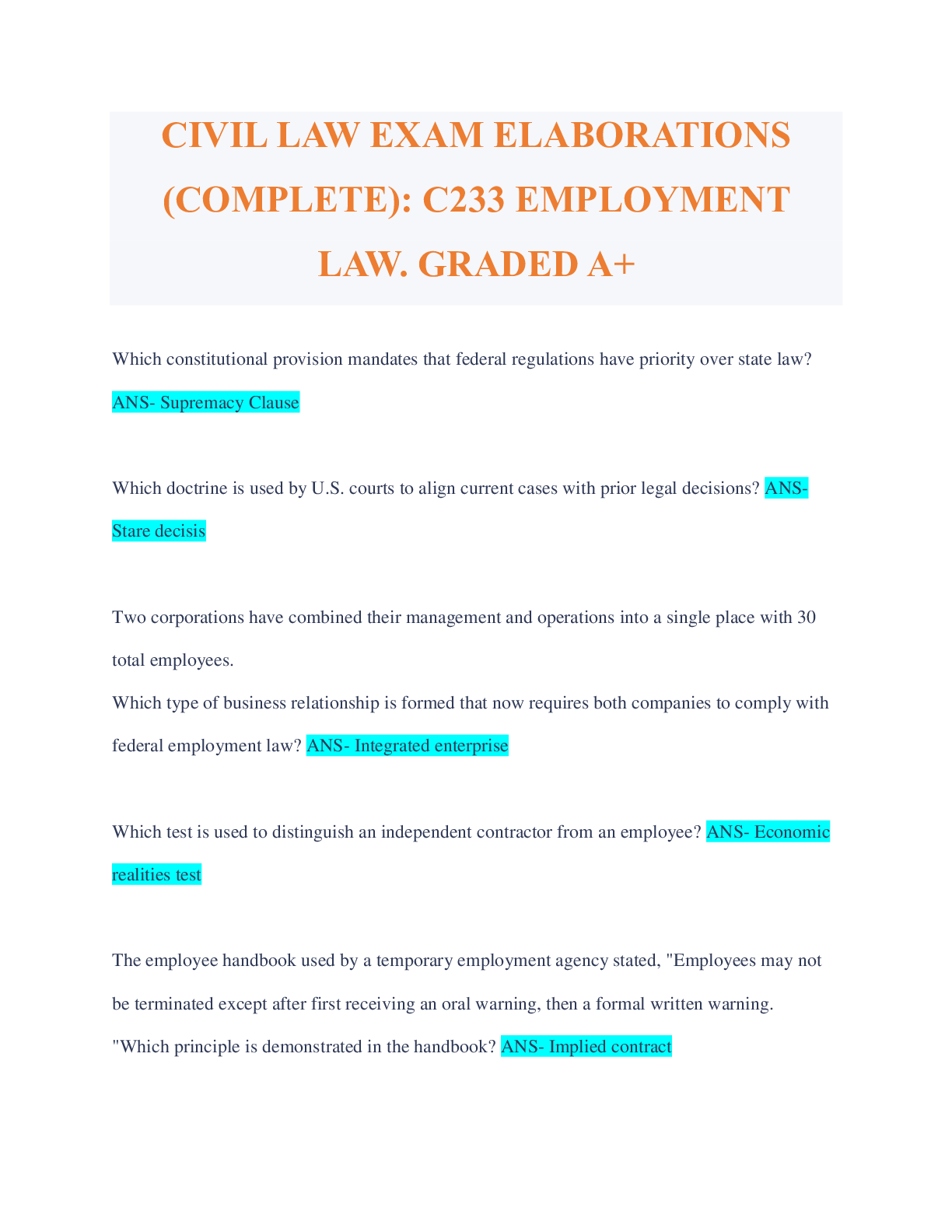
Supremacy Clause - ✔✔-Article VI, Paragraph 2 of the Constitution is commonly referred to as the
Supremacy Clause. It establishes that the federal constitution, and federal law generally, take
precedence over state laws, and even state constitutions.
Tort - ✔✔-An accommodation to the work environment that places a significant burden or expense on
the employer.
Undue Hardship - ✔✔-An accommodation to the work environment that places a significant burden or
expense on the employer.
Right to work laws - ✔✔-Laws that give employees the option to not join a union.
Unfair labor practice under NLRA - ✔✔-Action by an employer or a union that restrains or coerces
employees from exercising their rights to organize and bargain collectively or to refrain from doing so.
Vesting (in terms of pension plans) - ✔✔-The conveying of an employee's rights to benefits or
contributions after a certain amount of time.
Vicarious liability - ✔✔-A form of secondary liability that comes from the doctrine of respondeat
superior - "let the master answer for the servant".
Wildcat strike - ✔✔-A strike by a portion of workers that is not authorized by the union.
Worker's Compensation - ✔✔-A form of insurance that provides wage replacement and medical
benefits for employees injured while at work in exchange for relinquishment of the right to sue the
employer for negligence.
Workweek defined in FLSA - ✔✔-Any consecutive seven-day period.
Yellow dog contract - ✔✔-A document whereby an employee agrees not to organize or join a union.
Describe three exceptions to employment at will. - ✔✔-1) public policy; 2) implied contract; and 3)
implied covenant of good faith
Describe Constructive Discharge - ✔✔-Resignation of an employee because an emplouyer allows
working conditions that are no longer otlerable for any reasonable employee.
What is an example of constructive discharge? - ✔✔-Failure to accommodate a disability, or excessive
pressure to retire.
Describe how intentional interference with a contract may happen. - ✔✔-A co-worker or client,
pressures the employer to terminate an employee without cause. The idea is that, while the
employment relationship is not expressly contractual, the meddling of the third party in an otherwise
healthy employer/employee relationship has the same effect as an interference with contract.
What is important for employers with regard to how they treat employees during termination? - ✔✔-
Employers must be careful that in the termination process, an employee is not defamed. The best
strategy is for employers to protect the privacy and dignity of any terminated employee as much as
practicable.
How can an employer protect itself against a wrongful termination, termination based on
discrimination, or retaliation claim? - ✔✔-The concept of "progressive discipline" leading to termination
is a human resource concept, not a legal one. However, if an employer, either by collective bargaining
agreement with a union, in express promises in an employee handbook, or by conduct, guarantees that
certain remedial action - progressive discipline - will be offered, that agreement must be honored and
the remedial steps followed, or the fired employee may have a claim of wrongful discharge. Moreover, if
the termination violates a collective bargaining agreement it will be considered by the NLRB to be an
unfair labor practice. The employer must remember when terminating employees to treat all employees
exactly the same. Disparate treatment of employees in the termination process is just as unlawful as in
the on-boarding process.
What is the National Labor Relations Board (NLRB) and what are its main functions? - ✔✔-The National
Labor Relations Board is the federal agency given power to safeguard employees' rights to organize and
to determine whether to have unions as a bargaining represen
[Show More]