WGU D075 Information Technology
Management Essentials, Questions and
answers, 100% Accurate
Adware
Programs that automatically display or download advertising to a computer.
Application Software
Software that is
...
WGU D075 Information Technology
Management Essentials, Questions and
answers, 100% Accurate
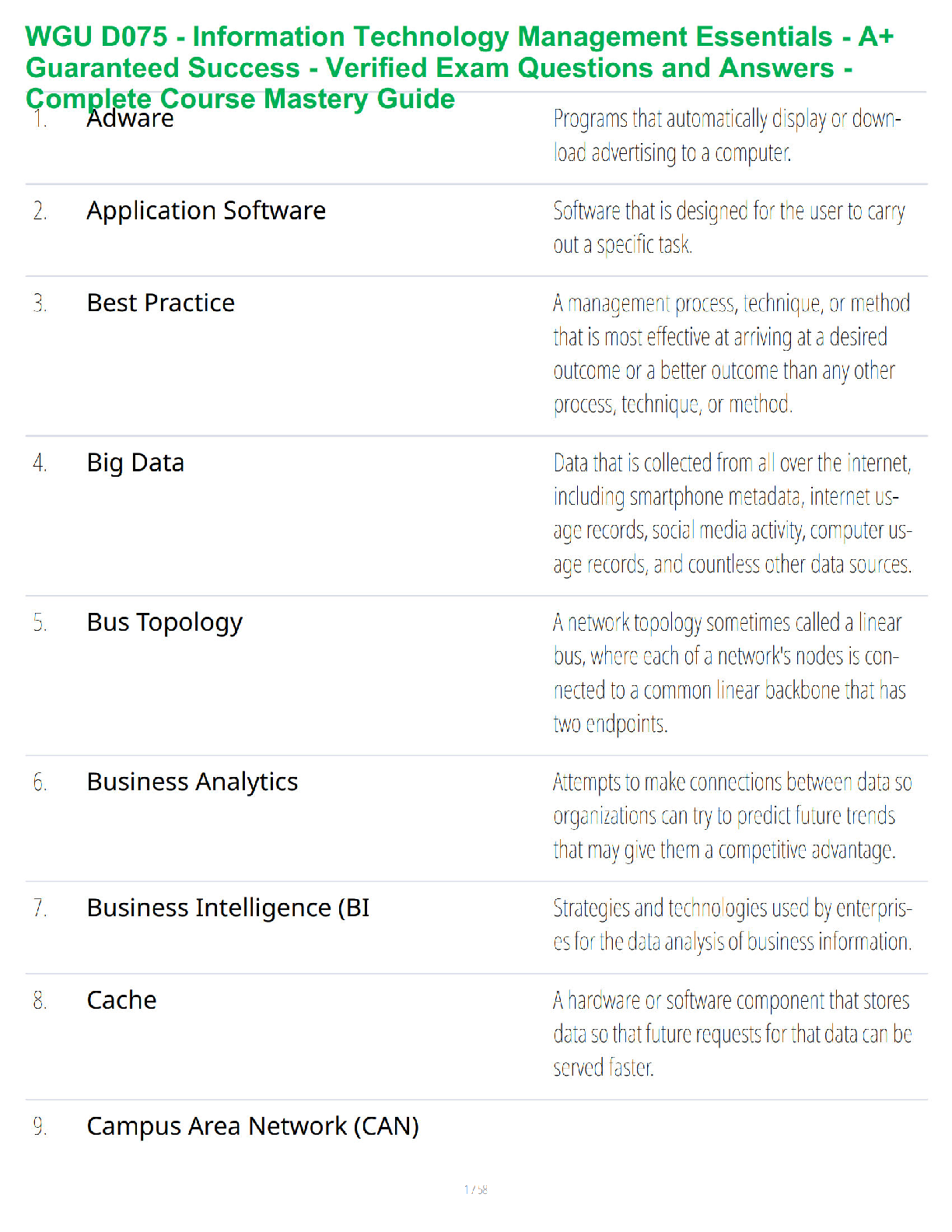
Adware
Programs that automatically display or download advertising to a computer.
Application Software
Software that is designed for the user to carry out a specific task.
Best Practice
A management process, technique, or method that is most effective at arriving at a desired outcome or
a better outcome than any other process, technique, or method.
Big Data
Data that is collected from all over the internet, including smartphone metadata, internet usage records,
social media activity, computer usage records, and countless other data sources.
Bus Topology
A network topology sometimes called a linear bus, where each of a network's nodes is connected to a
common linear backbone that has two endpoints.
Business Analytics
Attempts to make connections between data so organizations can try to predict future trends that may
give them a competitive advantage.
Business Intelligence (BI)
Strategies and technologies used by enterprises for the data analysis of business information.
Cache
A hardware or software component that stores data so that future requests for that data can be served
faster.
Campus Area Network (CAN)
A computer network that connects two or more LANs that are located on a campus.
Chief Information Officer (CIO)
A job title for the board-level head of an information technology department within a business
organization. The CIO's job is to make sure IT assets are in place to ensure a smooth transition.
Chief Information Security Officer (CISO)
The CISO is generally focused on the security of an organization's data and information, making sure it is
backed up, deciding who gets to see it and who does not, and so on.
Chief Security Officer (CSO)
A CSO is in charge of such things as the physical security and safety of employees, facilities, and
corporate assets and may have a law enforcement background.
Chief Technology Officers (CTO)
The CTO runs the organization's IT engineering group and serves as the company's top technology
architect.
Click Fraud
An internet fraud scheme that automatically passes a user to an advertiser, whether they had any
intention of visiting or not, in order to collect a per-click fee.
Clients
An end user's computer in a computer network.
Computer Network
Two or more computers connected together to communicate and share resources.
Cybersecurity
The convergence of technologies, sound practice, and processes designed to protect networks and their
devices, programs, and data from attack or unauthorized access.
Data Analysis
The application of statistics and logic techniques to define, illustrate, and evaluate data.
Data Management (DM)
The practices, architectural techniques, and tools for achieving consistent access to and delivery of data
across the spectrum of data subject areas and data structure types in the enterprise.
Data Management Processes
The process of acquiring data, making sure the data are valid, and then storing and processing the data
into usable information for a business.
Data Mapping
Extra notes about the definition of a field, its data, and its use.
Data Mining
The examination of huge sets of data to find patterns and connections and identify outliers and hidden
relationships.
Database Administrators (DBAs)
DBAs categorize data requirements and create the database entities and models that ensure accurate
and smooth-flowing information throughout a business.
Database Management System Software (DBMS)
An application software that is used to create a collection of related files that consist of records of data
separated by fields that can be queried to produce populations of information.
Databases
Well-thought-out collections of computer files, the most important of which are called tables.
Default-allow Firewall Rule
A rule that all traffic is allowed unless it has been specifically blocked.
Default-deny Firewall Rule
The only network connections that are permitted are the ones that have been explicitly allowed.
Denial-of-service
An attempt to make a computer or any of its resources unavailable to its intended users.
Disk Storage
Nonvolatile, secondary storage on a physical device like a hard drive or optical disk with a read/write
apparatus.
Ethernet Card
Provides the computer with a unique 48-bit address called a MAC (media access control) address. No
two Ethernet cards have the same address.
Extract, Transform, and Load
Tools that are used to standardize data across systems and allow the data to be queried.
File Allocation Table (FAT)
A table of contents that directs the read/write arm of the hard drive to the location where data exist and
accesses the data upon the user's request.
Firewall
Specialized hardware and software that ensures that only authorized personnel can access and use an
organization's intranet.
Foreign Key
A field in a database table that provides a link between two tables in a relational database.
Gantt Chart
A type of bar chart that illustrates a project schedule.
Graphical User Interface (GUI)
The visual system of computer screen designs that allow a user to interact with an electronic device.
Hardware
The physical part of the computer.
Hypertext Markup Language (HTML)
The major markup language used to create web pages.
Hypertext Transfer Protocol (HTTP)
Protocol used to define how messages are formatted and transmitted on the internet.
IT Managers
IT managers are in charge of software application development teams that develop, design, program,
and test software applications.
Identity Theft
A crime concerning the unlawful practice of assuming another individual's identity.
Information Security Analysts (ISA)
ISAs are responsible for protecting all sensitive information within an organization.
Information Technology
The study, design, development, implementation, support, and management of computer-based
information systems, particularly software and hardware.
Infrastructure
The underlying foundation or basic framework for an organization or project.
Internet Fraud
Refers to any fraudulent activity in an online setting. Internet fraud can occur through email systems,
message boards, chat rooms, or websites.
Intranet
A private network that works the same way as the internet but is confined within an organization.
Keylogging
When a perpetrator logs on to a computer workstation and installs a program that simply records every
keystroke made at the workstation's keyboard.
Knowledge Management Systems (KMS)
Collaborative systems that organize, create, and distribute an organization's collective knowledge to its
employees, which is called knowledge transfer.
Local Area Network (LAN)
A computer network that is relatively small, typically in a single building, but sometimes as small as a
single room.
MAC (Media Access Control)
A MAC is responsible for the transmission of data packets to and from the network interface card, and
to and from another remotely shared channel.
Mainframe Computers
Massive, room-sized computers that process and store enormous amounts of bulk data and information.
Malware
Programs specifically intended to penetrate or damage a computer system without the end user's
knowledge.
Metropolitan Area Network (MAN)
A computer network that connects two or more LANs or CANs together within the boundaries of a town
or city.
Microcomputers
The least powerful computers in terms of processing and come in four typical configurations: desktop,
laptop, tablet, and handheld.
Midrange Computers
Less powerful and smaller in physical size than mainframe computers, they do many of the same things
but on a smaller scale.
Network Administrator
The person(s) responsible for smooth network operations, network performance, and implementation
of new nodes or even new networks.
Network Hub
A central location of the computer network that serves as a traffic cop for network connection and
communication.
Network Interface Controller
A card that is plugged into a slot on the motherboard inside of the computer and allows a network cable
to be plugged in so it can interface or communicate with other computers.
Network Operating System (NOS)
Software that controls an entire network.
Network Operating Systems (NOS)
A computer operating system that connects computers together within a local area network.
Network Protocol
A set of rules a network must follow.
Node
Any device that is connected as part of a computer network, including computers, hubs, printers, and
switches.
Object Linking and Embedding
A Microsoft technology that allows a user to share information and data from an entire area in one
application in part of another application.
Operating System
A collection of computer programs that work together to manage hardware and software to ensure that
they are working properly.
Optical Disk
A computer disk that uses optical storage techniques and technology to read and write data.
Peer-to-peer Networks (P2P)
Computer networks that connect computers directly to one another without the use of a server.
Phishing
A criminal activity that involves using social engineering techniques and attempts to deceptively gain
private information, like usernames, PIN numbers, passwords, and credit card details by masquerading
as a legitimate business organization, typically in a legitimate-looking email.
Point of Failure
A part of a system that, if it fails, will stop the entire system from working.
Presentation Software
An application software used to present information in a slideshow format.
Primary Key
A field in a database table that uniquely identifies a record in the table.
Process
Any task a computer performs.
Protocol
A standard language that devices connected to a network use to communicate and transfer data.
Random Access Memory
A type of memory that allows data to be accessed in any order without physical movement of the
silicone media.
Registers
A location in a store of data used for a specific purpose and with quick access time.
Ring Topology
The ring shape created by network nodes where each node is connected to two other nodes with the
first and last nodes being connected to each other.
Schema
The organization or layout of a database that defines the tables, fields, keys, and integrity of the
database. It is the reference or blueprint of the database.
Semi-structured Data
Data that can be converted into structured data with a lot of work.
Servers
A central computer in a computer network.
Software
A collection of computer programs that accomplish a specific task.
Software Suite
A collection of business computer application programs of associated functionality that share a common
graphical user interace and have the capacity to smoothly exchange data across the programs.
Solid-state Drive (SSD)
A solid-state storage device that uses integrated circuit assemblies as memory to store data persistently,
typically using flash memory.
Spam
The abuse of an email system to arbitrarily send millions of unsolicited bulk messages.
Spyware
A computer program that is installed covertly on a computer to capture or take control of the system
without the user's knowledge or consent.
Star Topology
The star shape created by network nodes that radiate around a central node in a
[Show More]





.png)
.png)