AMCA CMAC Practice Exam Questions
and answers, 100% accurate, graded A+
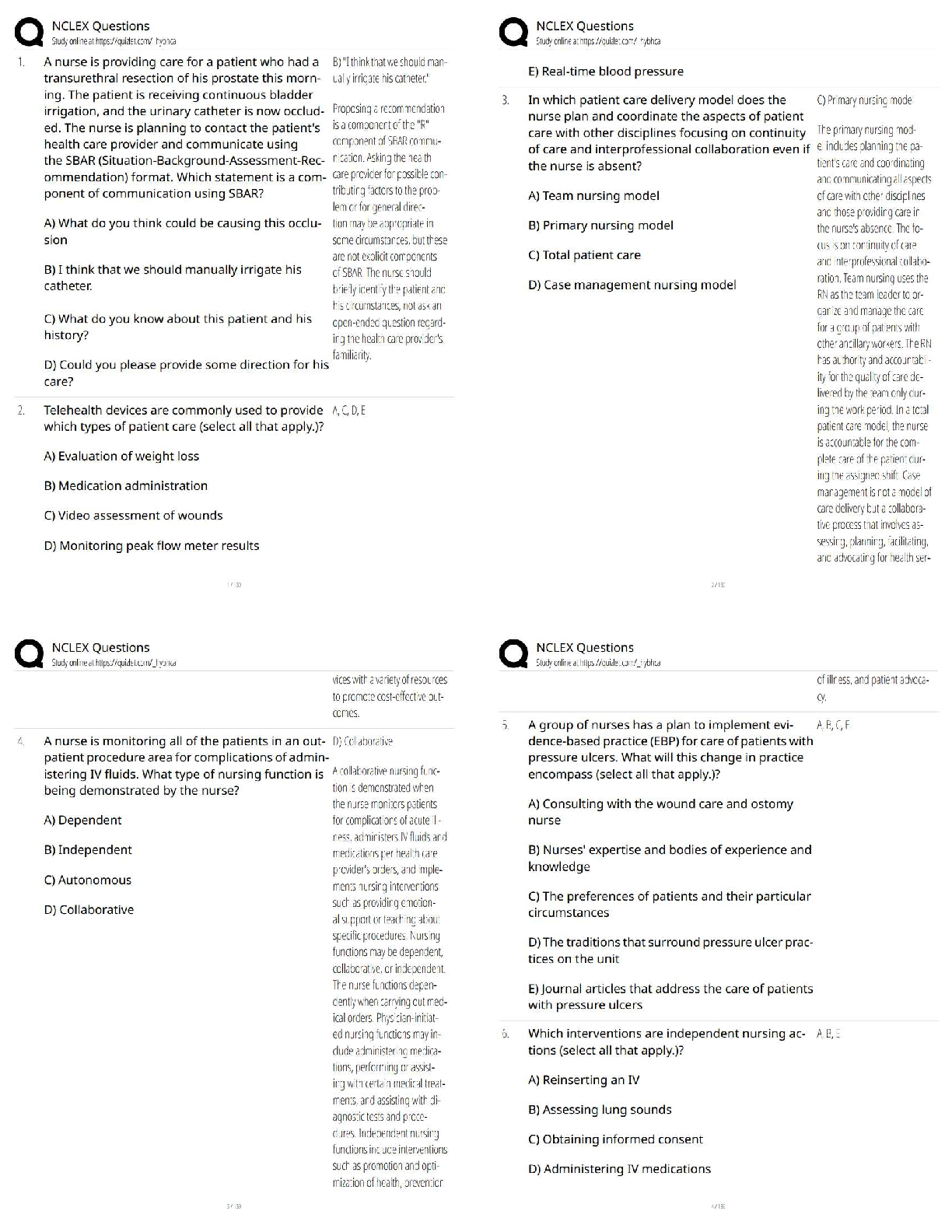
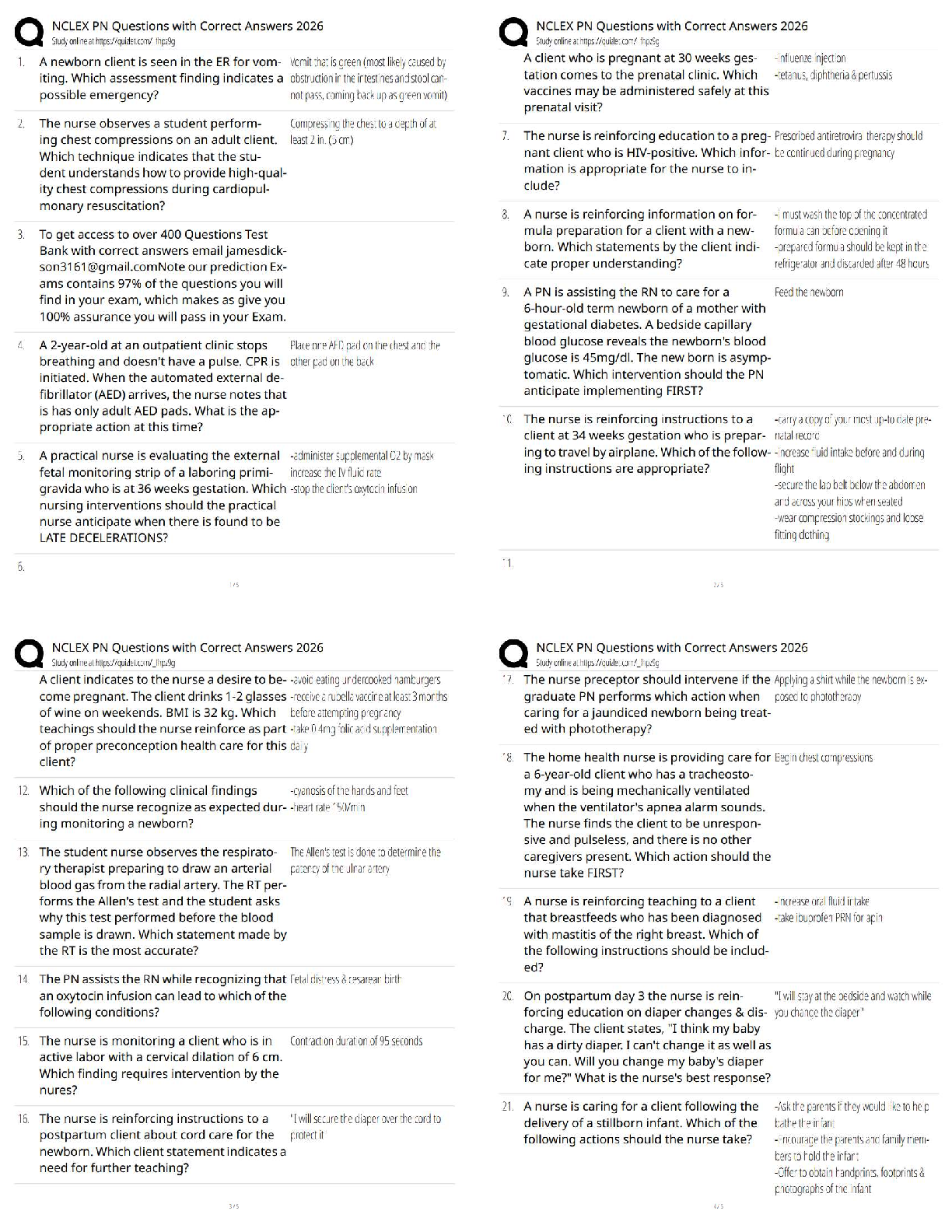
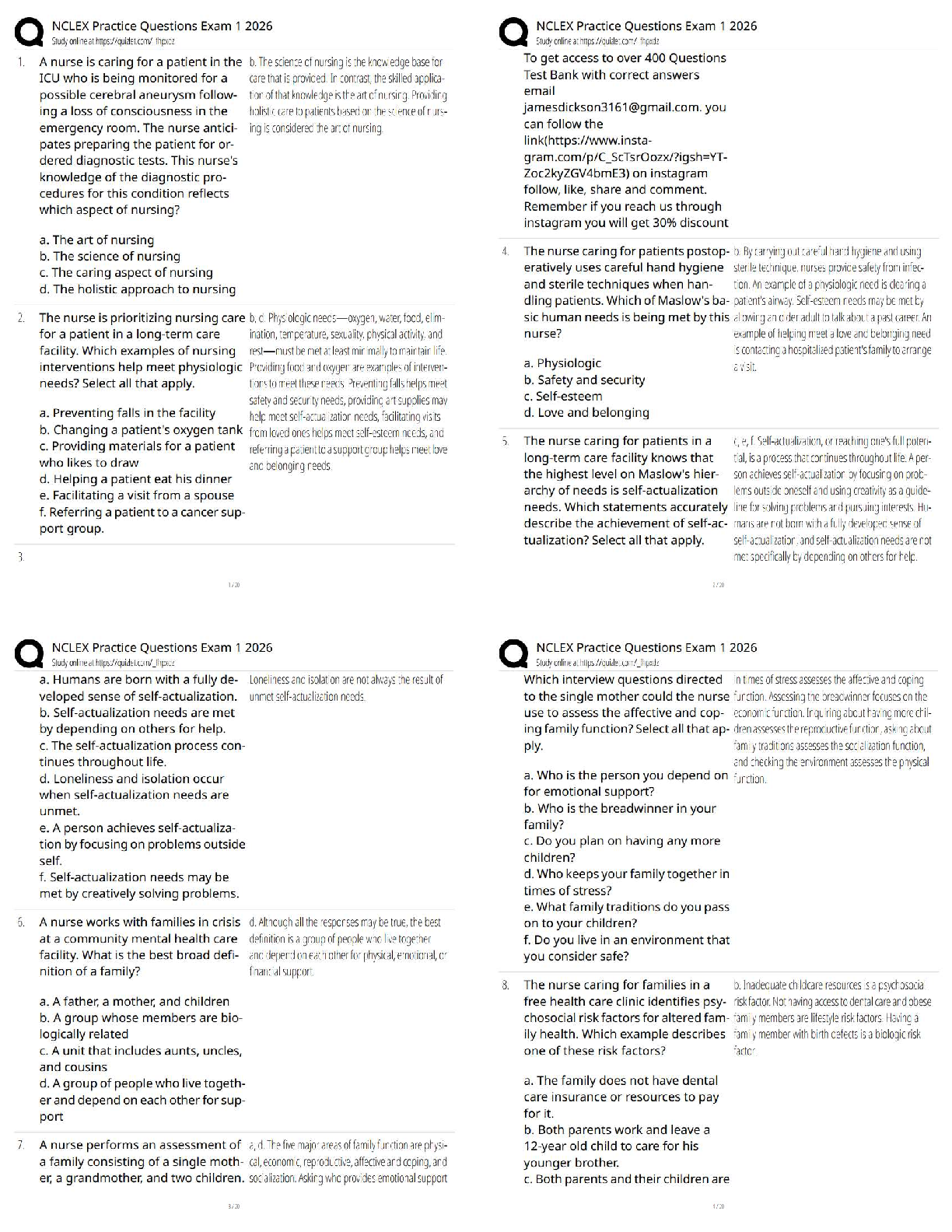
The opening inside the skull that holds the brain is the:
a. Cranial cavity
b. Orbital cavity
c. Nasal cavity
d. Thoracic cavity - ✔✔-*The d
...
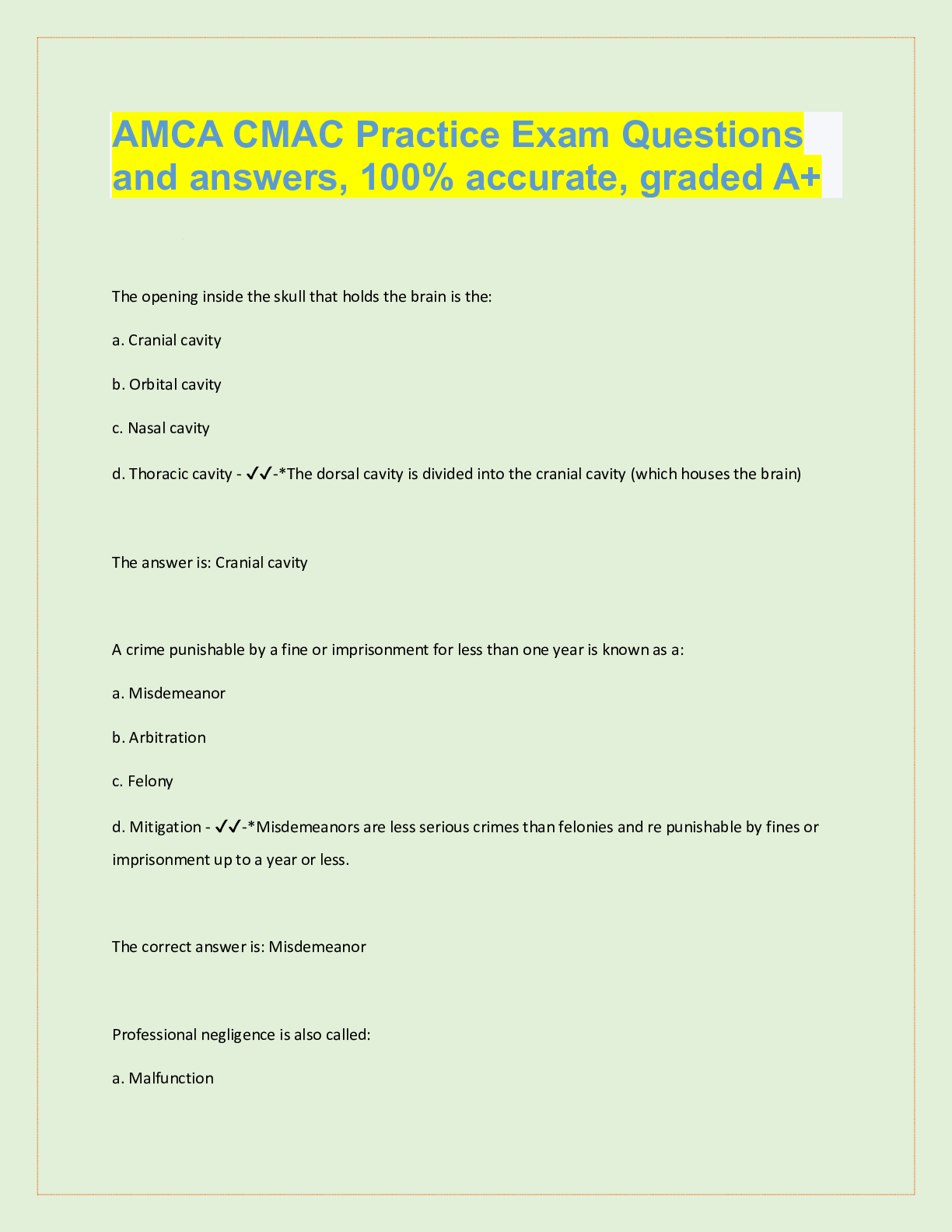
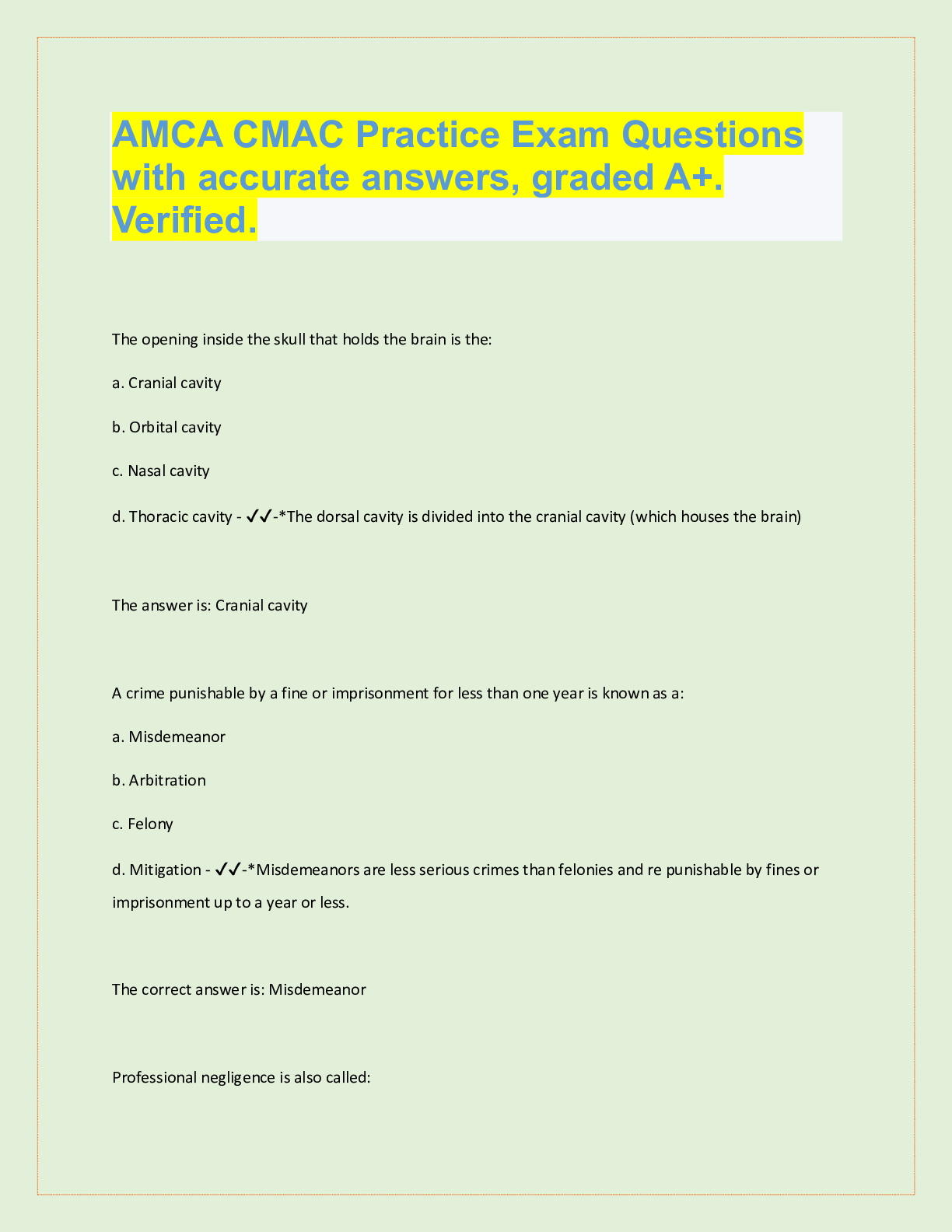
AMCA CMAC Practice Exam Questions
and answers, 100% accurate, graded A+
The opening inside the skull that holds the brain is the:
a. Cranial cavity
b. Orbital cavity
c. Nasal cavity
d. Thoracic cavity - ✔✔-*The dorsal cavity is divided into the cranial cavity (which houses the brain)
The answer is: Cranial cavity
A crime punishable by a fine or imprisonment for less than one year is known as a:
a. Misdemeanor
b. Arbitration
c. Felony
d. Mitigation - ✔✔-*Misdemeanors are less serious crimes than felonies and re punishable by fines or
imprisonment up to a year or less.
The correct answer is: Misdemeanor
Professional negligence is also called:
a. Malfunction
b. Arbitration
c. Malice
d. Malpractice - ✔✔-Medical negligence is commonly known as malpractice
The correct answer is: Malpractice
Which of the following items is the most important for assistive personnel to keep in mind during their
daily routine in medical settings?
a. Burglary
b. Confidentiality
c. Privilege granted to a physician
d. Consent - ✔✔-*In the Standard of Care the first item the medical assistant should uphold is
maintaining confidentiality
The correct answer is: Confidentiality
In which of the following situations is it permissible to release information from a patient's records?
a. When the patient's employer requests it
b. When an attorney requests it
c. When a court requests it by means of a subpoena
d. When the patient's best friend requests it - ✔✔-*The law may require the physician to release the
record when a court subpoenas it
The correct answer is: When a court requests it by means of a subpoena
Under which of the following circumstances is it permissible to release information from a patient's
records?
a. When the physician calls to request it
b. When the patient signs a release
c. When the insurance company signs a release
d. When the patient has signed a living will - ✔✔-*Information can be released only after a patient signs
a release statement
The correct answer is: When the patient signs a release
This cavity contains the heart and lungs, among other organs.
a. Thoracic
b. Cranial
c. Orbital
d. Nasal - ✔✔-*The thoracic cavity contains the lungs, heart, esophagus and trachea
The correct answer is: Thoracic
Located near the back of the body, this body cavity is a continuous internal opening that includes the
cranial and spinal cavities.
a. Posterior (dorsal) cavity
b. Transverse plane
c. Pelvic cavity
d. Abdominal cavity - ✔✔-*The dorsal cavity is divided into the cranial cavity and the spinal cavity
The correct answer is: Posterior (dorsal) cavity
This is the scrubbing of instruments with special brushes and detergents to remove blood, mucous, etc.
a. Sterilization
b. Sanitization
c. Distillation
d. Disinfection - ✔✔-*Sanitization is the scrubbing of instruments and equipment with special brushes
and detergents to remove blood, mucous and other contaminants
The correct answer is: Sanitization
This is the process that involves a soaking or wiping process and inhibits the activity of disease-causing
organisms.
a. Sterilization
b. Sanitizing
c. Disinfection
d. Treated with antiseptics - ✔✔-*Disinfection is the process that destroys most micro organisms;
however it cannot kill all
The correct answer is: Disinfection
The process used for supplies that would come in contact with internal body tissue or an open wound. It
involves the use of heat (steam) and an autoclave.
a. Disinfection
b. Sterilization
c. Surgical Asepsis
d. Sanitization - ✔✔-*Sterilization is required for all instruments and supplies that will penetrate a
patient's skin. Sterilization usually involves an autoclave or chemical (cold) process
The correct answer is: Sterilization
You are taking vitals on a patient and they complain that they have dizziness every once in a while. What
type of symptom is this?
a. Familial
b. Subjective
c. Objective
d. Social - ✔✔-*Subjective date is obtained from a conversation with the patient
The correct answer is: Subjective
You are taking vitals on a patient and they complain their right eye is throbbing. Their right eye is
swollen and bruised. What type of symptom is this?
a. Familial
b. Subjective
c. Social
d. Objective - ✔✔-*Objective data is readily apparent and measurable
The correct answer is: Objective
If you are recording a patient's height and are using centimeters, what is the conversion formula to go
from centimeters to inches?
a. Mulitply by 2.5
b. Subtract 2.5 from the number
c. Divide by 2.5
d. Add 2.5 to the number - ✔✔-*To go from CM to inches, the formula would be ____ CM ÷2.54 = Inches
The correct answer is: Divide by 2.5
You are taking the vitals of a patient with pneumonia. The patient coughs near your face. What could
you have done to minimize the risk of contracting the disease?
a. Put on goggles before entering the room
b. Sterilize the examination room
c. Wash your face as soon as the incident occurs.
d. Ask the patient to look the other way while coughing - ✔✔-*According to Standard Precautions, the
use of PPE in addition to cough etiquette includes covering mouth and providing at least 3 feet of space
between persons
The correct answer is: Ask the patient to look the other way while coughing
Which of the following liquids is used in an autoclave to sterilize instruments and supplies?
a. Alcohol
b. Sterile water
c. Tap water
d. Distilled water - ✔✔-When filling an autoclave, distilled water is best
The correct answer is: Distilled water
Which of the following is one of the six C's of charting?
a. Consult
b. Clerical
c. Counsel
d. Client's words - ✔✔-**The six C's of charting include client's words, clarity, completeness,
conciseness, chronological order and confidentiality
The correct answer is: Client's words
Which suture size listed below is the thickest?
a. 1-0
b. 5-0
c. 7-0
d. 0-0 - ✔✔-**Suture materials come in thicknesses ranging from size 11-0 (smallest) to size 7 (largest)
The correct answer is: 0-0
The patient has a history of cardiovascular disease. Which of the following tests would not be used as a
screening procedure?
a. Chest x-ray
b. Colonoscopy
c. Blood work
d. ECG - ✔✔-*A colonoscopy is done to visualize the large intestine and also to screen for colon cancer
The correct answer is: Colonoscopy
Which plane divides the body into right and left portions?
a. Frontal
b. Transverse
c. Sagittal
d. Lateral - ✔✔-**A sagittal plane divides the body into left and right portions
The correct answer is: Sagittal
The term meaning close to the point of attachment is:
a. Proximal
b. Distal
c. Superior
d. Medial - ✔✔-*Proximal means close to the point of attachment or to the trunk of the body
The correct answer is: Proximal
Which most accurately states the purpose of coding?
a. Coding identifies patients in a database
b. Coding is used to track a physician's payments
c. Coding helps physicians with the diagnosis
d. Coding determines the reimbursement of medical fees - ✔✔-*The combination of diagnostic codes
and procedure codes provides the basis for healthcare reimbursement
The correct answer is: Coding determines the reimbursement of medical fees
As you are taking vitals of an elderly patient, he begins to question you about his medication and
possible side effects. What is the best action to take?
a. Listen and explain that the doctor is the best one to have this discussion with
b. Ignore the patient and pretend to listen
c. Listen and tell the patient you will call the pharmacy to see if there are any other options
d. Listen and advise the patient on what to take - ✔✔-*As part of the patient advocacy, anything that
can be misconstrued as medical advice should be avoided
The correct answer is: Listen and explain that the doctor is the best one to have this discussion with
In which of the following positions, used for the examination of the rectum, does the patient lie on the
left side with the left leg slightly flexed?
a. Lithotomy
b. Sims'
c. Prone
d. Dorsal Recumbent - ✔✔-*The Sims Position is used during anal or rectal exams
The correct answer is: Sims'
Which of the following practices is most important for maintaining medical asepsis?
a. Making sure your vaccinations are up-to-date
b. Allowing the exam room to air out after each patient
c. Washing your hands before and after each patient contact
d. Wearing gloves and goggles during all examinations - ✔✔-*Hand sanitizing is one of the best means of
reducing the spread of microorganisms in a health care facility
The correct answer is: Washing your hands before and after each patient contact
Using a stethoscope, the artery most commonly used for taking a patient's pulse is:
a. Apical
b. Temporal
c. Carotid
d. Radial - ✔✔-**The apical pulse (the heartbeat at the apex of the heart) can be heard with a
stethoscope
The correct answer is: Apical
You've taken a patient's temperature and recorded it as 96.9°F. Later, the physician asks you to convert
this measurement to Celsius. What is the patient temperature in Celsius?
a. 21.8
b. 36.1
c. 116.8
d. 37.9 - ✔✔-**The formula for Fahrenheit to Celsius is 96.9 (F-32) x 5/9 = ? 96.9 - 32 x 5/9 = ?
The correct answer is: 36.1
Which of the following is not considered a vital sign?
a. Weight
b. Respiration
c. Pulse Rate
d. Blood pressure - ✔✔-**Vital signs include temperature, pulse, respirations, blood pressure and pain
The correct answer is: Weight
Which muscle acts to abduct and extend the arm at the shoulder?
a. Deltoid
b. Bicep
c. Gluteus Maximus
d. Tricep - ✔✔-*The deltoid acts to abduct and extend the arm at the shoulder
The correct answer is: Deltoid
Pointing the toes downward is known as:
a. Pronation
b. Plantar flexion
c. Abduction
d. Dorsiflexion - ✔✔-*Pointing the toes down is known as plantar flexion
The correct answer is: Plantar flexion
Which heart valve is between the left atrium and the left ventricle?
a. Tricuspid
b. Aortic semilunar
c. Right atrioventricular
d. Bicuspid - ✔✔-**The bicuspid valve has two cusps and is located between the left atrium and left
ventricle
The correct answer is: Bicuspid
Which of the following areas of the body is the site at which to detect the popliteal pulse?
a. Forearm
b. Foot
c. Knee
d. Ankle - ✔✔-*The popliteal pulse is found
[Show More]


.png)