ISSA Unit 1 – 31, Questions and
answers, 100% Accurate, graded A+
Muscle glycogen is the primary fuel used during endurance exercise.
• True
• False - ✔✔-• False
Catabolism and anabolism are the two phases of meta
...
ISSA Unit 1 – 31, Questions and
answers, 100% Accurate, graded A+
Muscle glycogen is the primary fuel used during endurance exercise.
• True
• False - ✔✔-• False
Catabolism and anabolism are the two phases of metabolism.
• True
• False - ✔✔-• True
ATP stands for:
• Alpha tri-peptide
• Adenosine triphosphate
• Amino triphosphate
• Acutely tense prostate - ✔✔-• Adenosine triphosphate
The primary fuel during endurance exercise is:
• Liver glycogen
• Muscle glycogen
• Muscle
• Fatty acids
• None of the above - ✔✔-• Fatty acids
The ATP/CP pathway is sufficient for over four minutes of ATP production.
• True
• False - ✔✔-• False
BMR stands for:
• Basic memory retention
• Bad muscle recovery
• Basal metabolic rate
• Bregmatic myofascial release
• None of the above - ✔✔-• Basal metabolic rate
Our muscles can produce ATP by which of the following pathways?
• ATP/CP pathway
• Glycolytic pathway
• Oxidative pathway
• All of the above
• None of the above - ✔✔-• All of the above
Oxidative glycolysis is reliable for:
• 3 to 15 seconds of ATP production
• Physical activities lasting more than 2 minutes in duration
• Over four minutes of ATP production
• Physical activities lasting 4 to 50 seconds in duration
• All of the above - ✔✔-• Physical activities lasting more than 2 minutes in duration
Hemoglobin is an oxygen transporting protein in red blood cells.
• True
• False - ✔✔-• True
Hormones are classified as:
• Steroids
• Amino acid derivatives
• Peptides
• All of the above
• None of the above - ✔✔-• All of the above
Excretion is one function of the digestive system.
• True
• False - ✔✔-• True
The main purpose of hormones is to:
• Alter the rate of synthesis of your cellular protein
• Change the rate of enzyme activity
• Change the rate of transport of nutrients through the cell wall
• All of the above
• None of the above - ✔✔-• All of the above
.) The circulatory system consists of:
• Lungs, mouth, throat, trachea, and bronchi
• Mouth, esophagus, stomach, and gallbladder
• Heart, arteries, and veins
• None of the above
• All of the above - ✔✔-• Heart, arteries, and veins
The respiratory system is responsible for:
• Supplying oxygen to the body
• Eliminating carbon dioxide in the body
• Regulating the body's pH balance
• A and B
• A, B, and C - ✔✔-• A, B, and C
About 98% of the human body is composed of only six elements: oxygen, carbon, hydrogen, nitrogen,
calcium, and phosphorous.
• True
• False - ✔✔-• True
The nervous system is made up of the:
• Peripheral nervous system
• Central nervous system
• Proximal nervous system
• A and B
• None of the above - ✔✔-• A and B
Type I muscle fibers are predominantly aerobic.
• True
• False - ✔✔-• True
Type II muscle fibers are entirely aerobic.
• True
• False - ✔✔-• False
The anatomical terms for front and back are:
• Superior and Inferior
• Proximal and Distal
• Anterior and Posterior
• Lateral and Medial
• None of the above - ✔✔-• Anterior and Posterior
Tendons:
• Are extensions of muscle fibers
• Connect bone to bone
• Connect muscle to bone
• A and B
• A and C - ✔✔-• A and C
The average human adult skeleton has:
• 80 bones
• 126 bones
• 206 bones
• Over 400 bones
• None of the above - ✔✔-• 206 bones
Muscular hypertrophy is a(n)...
• Increase in muscle fiber size
• Decrease in muscle fiber size.
• Increase in the number of muscle fibers
• Decrease in the number of muscle fibers
• None of the above - ✔✔-• Increase in muscle fiber size
Tendons connect bone to bone.
• True
• False - ✔✔-• False
Cardiovascular exercise results in:
• Contractile protein adaptation
• Mitochondrial adaptations
• Capillary capacity adaptations
• All of the above
• B and C - ✔✔-• B and C
An example of an antagonist muscle is:
• A biceps during biceps curl
• Internal and external obliques during a crunch
• Triceps during a biceps curl
• Pronator teres during pronation
• None of the above - ✔✔-• Triceps during a biceps curl
An example of flexion is the:
• Concentric action of a bicep curl
• Eccentric action of a bicep curl
• Lateral movement of a jumping jack
• Medial movement of a jumping jack
• Rotation in a Russian twist - ✔✔-• Concentric action of a bicep curl
True synergy occurs when a muscle contracts to stop the secondary action of another muscle.
• True
• False - ✔✔-• True
An isometric contraction is:
• A contraction in which a muscle exerts force, shortens and overcomes a resistance
• A contraction in which a muscle exerts force, lengthens and is overcome by a resistance
• A contraction in which a muscle exerts a force, but there is no limb or body movement
• Strength training that usually involves raising and lowering a maximal amount of weight
• None of the above - ✔✔-• A contraction in which a muscle exerts a force, but there is no limb or body
movement
Adduction is movement of a body part away from the midline of the body.
• True
• False - ✔✔-• False
Kinesiology is:
• The science or study of human movement, and the active and passive structures involved
• The science of the morphology or structure of organisms
• The science concerned with the normal vital processes of animal and vegetable organisms
• the science concerned with the action of forces, internal and external, on the living body
• None of the above - ✔✔-• The science or study of human movement, and the active and passive
structures involved
An example of a prime mover is:
• The biceps muscle during a biceps curl
• Internal and external obliques muscles during a crunch
• Triceps during a biceps curl
• Pronator teres during a tricep extension
• None of the above - ✔✔-• The biceps muscle during a biceps curl
In a concentric contraction the muscles shorten to produce movements.
• True
• False - ✔✔-• True
Biomechanics is the study of...
• Body structure
• How our body functions
• Movement
• None of the above
• All of the above - ✔✔-• Movement
Inertia can be categorized as...
• Resting inertia
• Moving inertia
• Static inertia
• A and B
• B and C - ✔✔-• A and B
Newtons' second law of motion deals with force and its relationship to mass and acceleration.
• True
• False - ✔✔-• True
A second-class lever is similar to a wheelbarrow.
• True
• False - ✔✔-• True
The ability to perceive your position and movement of the body or limbs in space is known as...
• Tonus
• Perception
• Kinesthesis
• None of the above
• All of the above - ✔✔-• Kinesthesis
A first-class lever is similar to a seesaw.
• True
• False - ✔✔-• True
Muscular force is broken down into the components of...
• Magnitude
• Direction
• Application of force
• Line of force
• All of the above
• None of the above - ✔✔-• All of the above
A third class lever is...
• One in which the force is applied between the axis and the resistance
• One in which the weight is distributed between the axis of rotation and application of force
• One in which the fulcrum is between the force and resistance
• None of the above - ✔✔-• One in which the force is applied between the axis and the resistance
When the superior iliac crest of the pelvis moves forward and downward from the normal anatomical
position, it is know as...
• Lordosis
• Kyphosis
• Scoliosis
• Spinalosis
• None of the above - ✔✔-• Lordosis
Kyphosis is an exaggerated anterior-posterior curvature of the spinal column.
• True
• False - ✔✔-• True
Excessive lateral curvature of the spinal column is known as...
• Lordosis
• Kyphosis
• Scoliosis
• Spinalosis
• None of the above - ✔✔-• Scoliosis
"Flat-back" can be identified by a...
• Pelvis tilted forward
• Pelvis tilted backward
• Pelvis tilted to the side
• Pelvis tilted slightly up on one side
• None of the above - ✔✔-• Pelvis tilted backward
Intradiscal pressure is up to 11 times greater when seated versus lying down.
• True
• False - ✔✔-• True
An anterior tilt of the pelvis is common with the postural deviation scoliosis.
• True
• False - ✔✔-• False
Exaggerated anterior-posterior curvature of the spinal column is known as...
• Lordosis
• Kyphosis
• Scoliosis
• Spinalosis
• None of the above - ✔✔-• Kyphosis
What should be of prime focus in all fitness activities?
• Flexibility
• Posture
• Endurance
• Strength
• None of the above - ✔✔-• Posture
The knee is stabilized on the anterior side by which muscle?
• Soleus
• Hamstrings
• Quadriceps
• Gluteus
• Tensor fasciae latae - ✔✔-• Quadriceps
The hamstrings muscles are a two-joint muscle that acts at the knee and hip.
• True
• False - ✔✔-• True
The wrist joint consists of the ends of the radius and ulna bones of the forearm with the carpal bones of
the hand.
• True
• False - ✔✔-• True
What muscle is located directly beneath the gastrocnemius and has similar functions to the
gastrocnemius?
• Anterior tibialis
• Extensor digitorum longus
• Extensor brevis
• Soleus
• Posterior tibialis - ✔✔-• Soleus
The semimembranosus and semitendinosus attach on what side of the knee?
• Lateral
• Medial
• Anterior
• Posterior
• None of the above - ✔✔-• Medial
The major movements that are possible at the knee joint are adduction and abduction.
• True
• False - ✔✔-• False
Which of the hamstrings muscles account for the substantial amount of muscle mass in the group?
• Semimembranosus
• Semitendinosus
• Biceps femoris
• Rectus femoris
• Vastus lateralis - ✔✔-• Biceps femoris
The shoulder girdle is made up of the clavicle and what other bone?
• Humerus
• Sternum
• Scapula
• Femur
• Ulna - ✔✔-• Scapula
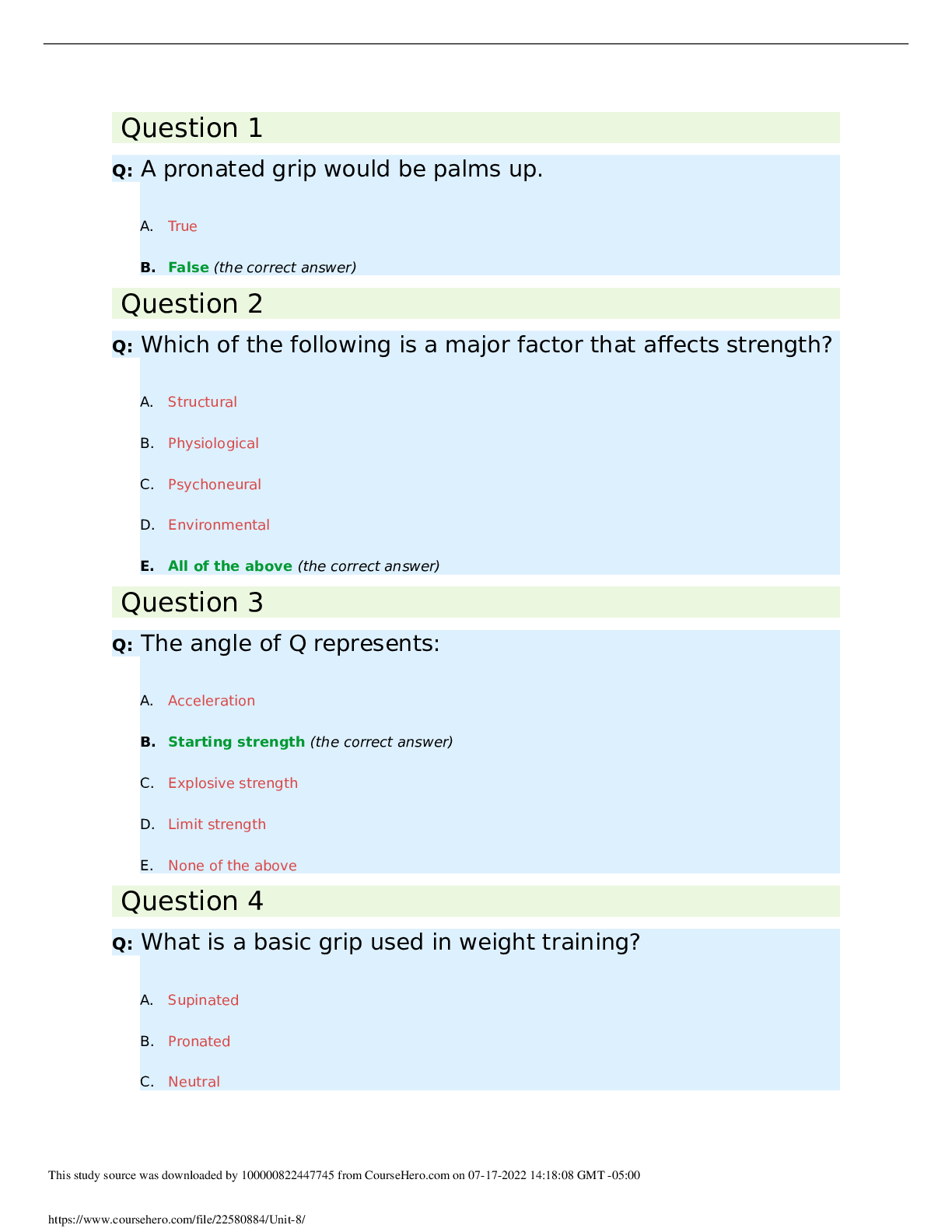
A pronated grip would be palms up.
• True
• False - ✔✔-• False
What is the basic grip used in weight training?
• Supinated
• Pronated
• Neutral
• All of the above
• None of the above - ✔✔-• All of the a
[Show More]



.png)
.png)



 (1).png)