Certified Coding Specialist (CCS) Exam
Preparation, Questions with accurate
answers, rated A+
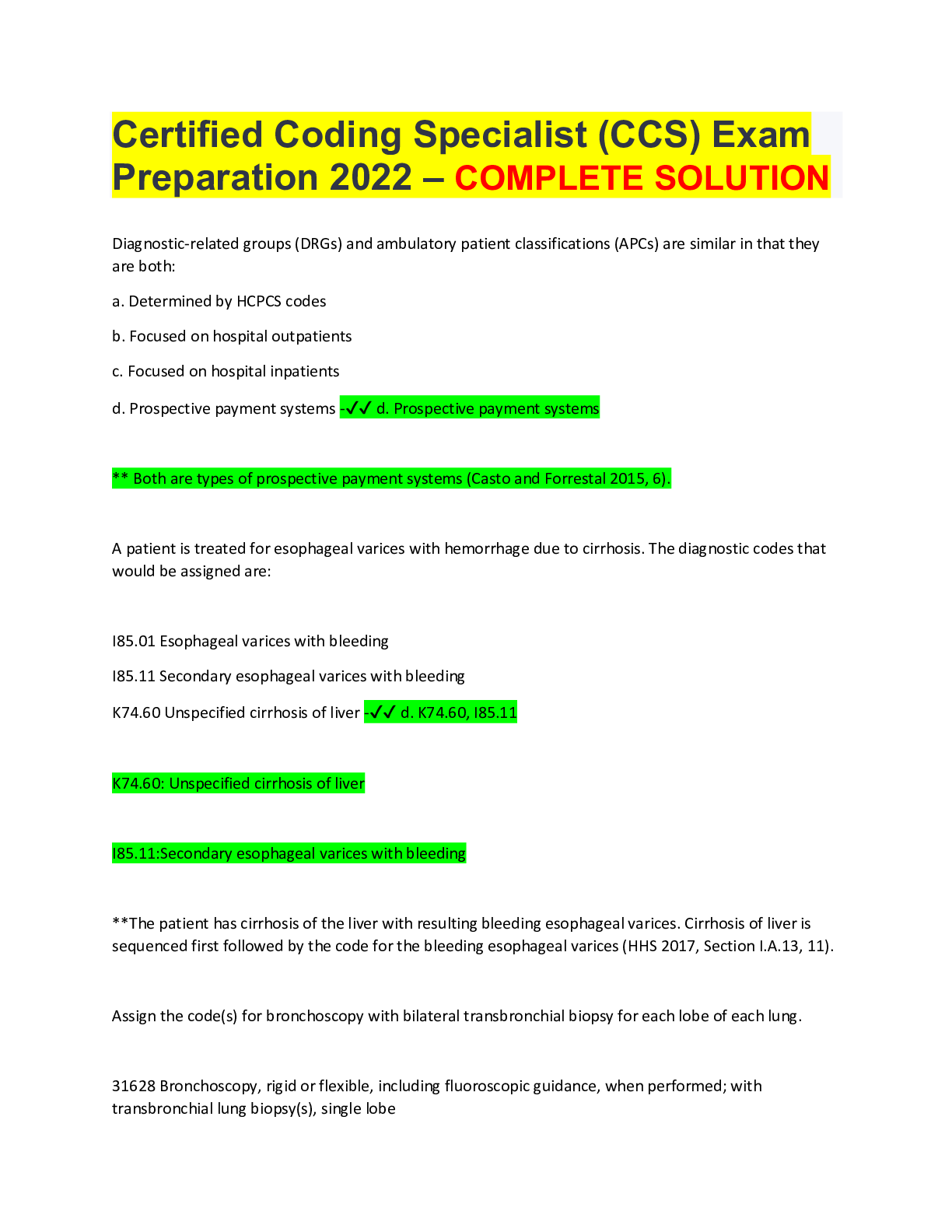
Diagnostic-related groups (DRGs) and ambulatory patient classifications (APCs) are similar in that they
are both:
a. D
...
Certified Coding Specialist (CCS) Exam
Preparation, Questions with accurate
answers, rated A+
Diagnostic-related groups (DRGs) and ambulatory patient classifications (APCs) are similar in that they
are both:
a. Determined by HCPCS codes
b. Focused on hospital outpatients
c. Focused on hospital inpatients
d. Prospective payment systems - ✔✔-d. Prospective payment systems
** Both are types of prospective payment systems (Casto and Forrestal 2015, 6).
A patient is treated for esophageal varices with hemorrhage due to cirrhosis. The diagnostic codes that
would be assigned are:
I85.01 Esophageal varices with bleeding
I85.11 Secondary esophageal varices with bleeding
K74.60 Unspecified cirrhosis of liver - ✔✔-d. K74.60, I85.11
K74.60: Unspecified cirrhosis of liver
I85.11:Secondary esophageal varices with bleeding
**The patient has cirrhosis of the liver with resulting bleeding esophageal varices. Cirrhosis of liver is
sequenced first followed by the code for the bleeding esophageal varices (HHS 2017, Section I.A.13, 11).
Assign the code(s) for bronchoscopy with bilateral transbronchial biopsy for each lobe of each lung.
31628 Bronchoscopy, rigid or flexible, including fluoroscopic guidance, when performed; with
transbronchial lung biopsy(s), single lobe
31629 Bronchoscopy, rigid or flexible, including fluoroscopic guidance, when performed; with
transbronchial needle aspiration biopsy(s), trachea, main stem and/or lobar bronchus(i)
31632 Bronchoscopy, rigid or flexible, including fluoroscopic guidance, when performed; with
transbronchial lung biopsy(s), each additional lobe
−50 Bilateral procedure - ✔✔-
Assign the code(s) for endoscopic sinusotomy with bilateral anterior ethmoidectomy.
31231 Nasal endoscopy, diagnostic, unilateral or bilateral (separate procedure)
31254 Nasal/sinus endoscopy, surgical; with ethmoidectomy, partial (anterior)
−50 Bilateral procedurea.
a. 31254
b. 31254-50
c. 31254, 31254
d. 31231 - ✔✔-b. 31254-50
31254 Nasal/sinus endoscopy, surgical; with ethmoidectomy, partial (anterior)
−50 Bilateral procedurea.
** A code for the anterior ethmoidectomy is assigned and to denote the bilateral procedure, a modifier
of -50 is added (CPT Assistant Winter 1993, 23; Jan. 1997, 4; Sept. 1997, 10; Oct. 1997, 5; Dec. 2001, 6;
May 2003, 5). The sinusotomy is not coded separately, as it is a diagnostic procedure.
The most common language used for both data definition language and data manipulation language is:
a. Unified modeling language
b. JAVA
c. Perl
d. Structured query language - ✔✔-d. Structured query language
** Structured query language (SQL) is used commonly for data language and data definitions (Sharp
2016, 184).
An ethmoidectomy removes infected tissue and bone in the ethmoid sinuses that blocks natural
drainage. The surgeon views your ethmoid sinuses with an endoscope, a thin flexible tube with a very
small camera and light at the end of it. - ✔✔-
Documentation from the nursing or other allied health professionals' notes can be used to establish
which of the following diagnoses:
a. Body mass index (BMI)
b. Malnutrition
c. Aspiration pneumonia
d. Fatigue - ✔✔-a. Body mass index (BMI)
** The physician must establish the diagnosis—obesity or morbid obesity—and the additional
information can be pulled from ancillary documentation to establish the correct code assignment for
body mass index (BMI) (Leon-Chisen 2017, 168).
A 55-year-old patient has hypertensive heart disease with congestive heart failure. What code would be
assigned?
a. I15.8, Other secondary hypertension
b. I11.0, Hypertensive heart disease with heart failure and I50.9, Heart failure, unspecified
c. I50.9, Heart failure, unspecified and I15.0, Renovascular hypertension
d. N18.6, End stage renal disease - ✔✔-b. I11.0, Hypertensive heart disease with heart failure and I50.9,
Heart failure, unspecified
** There is a cause and effect relationship established between the hypertension and the congestive
heart failure. A separate code for the congestive heart failure is assigned based on the "code also" note
(HHS 2017, Section I.C.9.a., 40).
A surgeon would like to undertake a research study on his patients with stage II malignant melanoma of
the back, who have undergone wide excision of the melanoma. What work processes and associated
software could be used to provide this information?
a. Obtain a summary of the cases from the cancer registry, import them into a spreadsheet, and provide
to the surgeon.
b. Obtain a summary of the cases from the chart completion software, import them into a spreadsheet,
and provide to the surgeon.
c. Obtain a summary of the cases from the master patient index, import them into a spreadsheet, and
provide to the surgeon.
d. Obtain a summary of the cases from the transcription tracking software, import them into a
spreadsheet, and provide to the surgeon. - ✔✔-a. Obtain a summary of the cases from the cancer
registry, import them into a spreadsheet, and provide to the surgeon.
**The cancer registry can be used to undertake studies in addition to reporting cases to a central
registry (Sharp and Madlock-Brown 2016, 173).
A facility located near a national park has a significant number of snake bites, and patients receive
treatment with antivenom in urgent-care settings. Sometimes a patient is admitted to the hospital after
several days. Can the urgent-care setting provide the hospital with a list of names of patients treated
with snake antivenom?
a. Only the names of patients who are admitted to the hospital can be requested if the physician needs
it for continuity of care, but an entire list of patients cannot be provided.
b. A list of names could be provided.
c. No information can be obtained under any circumstances.
d. A list of patients may be available after consultation with the national park ranger. - ✔✔-a. Only the
names of patients who are admitted to the hospital can be requested if the physician needs it for
continuity of care, but an entire list of patients cannot be provided.
**Only records that are required for care or authorized by the patient can be released by the urgent�care facility to the acute-care facility (Brodnik 2012, 225; Rinehart-Thompson 2016b, 243-247).
What diagnoses and procedures should be reported for recurrent left inguinal hernia with laparoscopic
repair?
K40.30 Unilateral inguinal hernia, with obstruction, without gangrene, not specified as recurrent
K40.31 Unilateral inguinal hernia, with obstruction, without gangrene, recurrent
K40.91 Unilateral inguinal hernia, without mention of obstruction or gangrene, recurrent
49520 Repair recurrent inguinal hernia, any age; reducible
49521 Repair recurrent inguinal hernia, any age; incarcerated or strangulated
49651 Laparoscopy, surgical; repair recurrent inguinal hernia
a. K40.91, 49520
b. K40.31, 49521
c. K40.91, 49651
d. K40.30, 49520 - ✔✔-c. K40.91:Unilateral inguinal hernia, without mention of obstruction or gangrene,
recurrent
49651:Laparoscopy, surgical; repair recurrent inguinal hernia
**The patient has a recurrent hernia without obstruction and this is captured in diagnosis code K40.91
(Leon-Chisen 2017, 253; CPT Assistant Nov. 1999, 24; March 2000, 9).
.In order to accurately code a cardiac catheterization, what needs to be determined based on a review
of the documentation?
a. The approach and the side of the heart (chambers) into which the catheter was inserted
b. The approach, the side of the heart (chambers) into which the catheter was inserted, as well as any
additional procedures performed
c. The duration of the procedure
d. If there is documentation of the procedure in the medical record that stents are considered - ✔✔-b.
The approach, the side of the heart (chambers) into which the catheter was inserted, as well as any
additional procedures performed
A condition is present on admission when:
a. It is the principal diagnosis
b. It is accordance with medical staff bylaws
c. A condition that occurs prior to an inpatient admission
d. It is present within 3 days after admission - ✔✔-c. A condition that occurs prior to an inpatient
admission
**It is important to understand the time frame for assigning a status code specifying that a condition is
present on admission (Leon-Chisen 2017, 571-574).
A patient was admitted after a fall down the steps. The patient was unconscious for approximately 45
minutes and was admitted to the emergency department (ED) within 3 hours of the fall. A CT scan was
performed within an hour of admission to the ED. A cerebral contusion was diagnosed by the ED
physician based on the findings in the CT scan. What conditions should be reported on the Uniform
Billing form 04 (UB-04)?
R40.0 Somnolence
S02.91XA Unspecified fracture of skull, initial encounter for closed fracture
S06.331A Contusion and laceration of cerebrum, unspecified, with loss of consciousness of 30 minutes
or less, initial encounter
S06.332A Contusion and laceration of cerebrum, unspecified, with loss of consciousness of 31 minutes
to 59 minutes, initial encounter
W10.9XXA Fall (on) (from) unspecified stairs and steps, initial encounter
a. S02.91XA, W10.9XXA
b. R40.0
c. S06.331A, W10.9XXA
d. S06.332A, W10.9XXA - ✔✔-d. S06.332A:Contusion and laceration of cerebrum, unspecified, with loss
of consciousness of 31 minutes to 59 minutes, initial encounter.
W10.9XXA: Fall (on) (from) unspecified stairs and steps, initial encounter
**The code for the injury to the brain also includes the time of unconsciousness. The external cause
code is provided here as part of the review; however, no external cause codes are used on the exam
except those for poisonings and adverse effects of drugs (Leon-Chisen 2017, 487-488).
Medicare reimbursement depends on all of the following, except:
a. The correct designation of the principal diagnosis
b. Policies and procedures of the medical staff
c. The presence or absence of additional codes that represent complications, comorbidities, or major
complications/comorbidities
d. Procedures performed - ✔✔-b. Policies and procedures of the medical staff
**Policies and procedures of the medical staff are not relevant. But the presence or absence of
additional codes that represent complications, comorbidities, or major complications/ comorbidities are
all important to determine the MS-DRG as part of Medicare Acute Inpatient Prospective Payment
System (Leon-Chisen 2017, 566; Rinehart-Thompson 2016a, 240-241).
A 35-year-old woman has hypertension with acute renal failure and stage 3 chronic kidney disease.
What code would be assigned?
a. N17.9, Acute kidney failure, unspecified
b. I13.2, Hypertensive heart and chronic kidney disease with heart failure and with stage 5 chronic
kidney disease, or end stage renal disease
c. I50.9, Heart failure, unspecified
d. N17.9, Acute kidney failure, unspecified and I12.9, Hypertensive chronic kidney disease with stage 1
through stage 4 chronic kidney disease, or unspecified chronic kidney disease and N18.3, Chronic kidney
disease, stage 3 (moderate) - ✔✔-d. N17.9, Acute kidney failure, unspecified and I12.9, Hypertensive
chronic kidney disease with stage 1 through stage 4 chronic kidney disease, or unspecified chronic
kidney disease and N18.3, Chronic kidney disease, stage 3 (moderate)
**Code the hypertension with stage 3 chronic kidney disease. In this case, both hypertension and
chronic kidney disease are documented and a combination code is used. Also the code for the stage 3
chronic kidney disease must be assigned due to the "code also" note. The acute renal failure is identified
with a separate code (HHS 2017, Section I.C.9.a., 40; HHS 2017, Section I.C.14.a., 53).
A patient is diagnosed with infertility due to endometriosis and undergoes an outpatient laparoscopic
laser destruction of pelvic endometriosis. In order to code this encounter accurately, what steps must
the coder take?
a. Review the operative report to determine what procedure codes to use and also to determine the site
or sites of endometriosis so codes with the highest specificity may be assigned, and use infertility as a
principal diagnosis.
b. Review the operative report to determine where the laser was used in the pelvis so the site or sites of
endometriosis can be specified, and assign a principal diagnosis of infertility.
c. Review the operative report to determine where the laser was used in the pelvis so the site or sites of
endometriosis can be specified as principal, and assign a secondary diagnosis of infertility.
d. Review the operative report to determine what procedure codes to use and also to determine the site
or sites of endometriosis so codes with the highest specificity may be assigned, and use the diagnosis of
infertility as a secondary condition. - ✔✔-d. Review the operative report to determine what procedure
codes to use and also to determine the site or sites of endometriosis so codes with the highest
specificity may be assigned, and use the diagnosis of infertility as a secondary condition.
** There may be endometrial implants throughout the pelvic cavity which may attach to various
anatomic structures such as the fallopian tube, ovary, and omentum. These locations should be
identified so that the appropriate diagnostic codes can be assigned and the appropriate procedure
codes can be assigned based on the destruction of the endometrial implants. Therefore, the correct
answer is to review the operative report to determine what procedure codes to use and determine the
site or sites of endometriosis so that codes with the highest specificity may be assigned. Also, use the
diagnosis of infertility as a secondary condition (Schraffenberger 2017, 455-457; Leon-Chisen 2017, 272).
A patient is admitted to a psychiatric unit of an acute-care facility. The patient experienced the following
symptoms almost every day for the last month: loss of interest or pleasure in most or all activities, which
is a change from her prior level of functioning. She has also gained 15 lbs, has difficulty falling asleep,
feels fatigued, and has difficulty making decisions. What potential diagnosis most closely fits the
patient's overall symptoms?
a. Insomnia
b. Major depression
c. Reye's syndrome
d. Bipolar disorder - ✔✔-b. Major depression
The CPT definition of a surgical package contains which of the following?
a. The surgical procedure(s)
b. Follow-up surgery
c. Preoperative tests
d. Yearly follow-up visits - ✔✔-a.The surgical procedure(s)
[Show More]




, 2e Suzanne Kearns.png)
.png)