C836 CHAPTER 1-6 WGU, Top Exam
Questions and answers, graded A+
FISMA (Federal Information Security Modernization Act) - ✔✔-this law provides a framework for
ensuring the effectiveness of information security contro
...
C836 CHAPTER 1-6 WGU, Top Exam
Questions and answers, graded A+
FISMA (Federal Information Security Modernization Act) - ✔✔-this law provides a framework for
ensuring the effectiveness of information security controls in federal government
- changed from Management (2002) to Modernization in 2014
HIPAA (Health Insurance Portability and Accountability Act) - ✔✔-this law improves the efficiency and
effectiveness of the health care system and protects patient privacy
FERPA (Family Educational Rights and Privacy Act) - ✔✔-this law protects the privacy of students and
their parents
SOX (Sarbanes-Oxley Act) - ✔✔-this law regulates the financial practice and governance of corporations
GLBA (Gramm-Leach-Bliley Act) - ✔✔-this law protects the customers of financial institutions
compliance - ✔✔-relating to an organization's adherence to laws, regulations, and standards
regulatory compliance - ✔✔-Regulations mandated by law usually requiring regular audits and
assessments
industry compliance - ✔✔-Regulations or standards designed for specific industries that may impact
ability to conduct business (e.g. PCI DSS)
privacy - ✔✔-the state or condition of being free from being observed or disturbed by other people
The Federal Privacy Act of 1974 - ✔✔-This act safeguards privacy through the establishment of
procedural and substantive rights in personal data
privacy rights - ✔✔-Rights relating to the protection of an individual's personal information
PII (Personally Identifiable Information) - ✔✔-Information that can be used to identify an individual, and
should be protected as sensitive data and monitored for compliance
cryptography - ✔✔-the science of keeping information secure
Cryptanalysis - ✔✔-The science of breaking through the encryption used to create ciphertext
cryptology - ✔✔-The overarching field of study that covers cryptography and cryptanalysis
cryptographic algorithm (cipher) - ✔✔-The specifics of the process used to encrypt plaintext or decrypt
ciphertext
plaintext (cleartext) - ✔✔-unencrypted data
ciphertext - ✔✔-encrypted data
Caesar cipher - ✔✔-an ancient cryptographic technique based on transposition; involves shifting each
letter of a plaintext message by a certain number of letters (historically 3)
ROT13 cipher - ✔✔-a more recent cipher that uses the same mechanism as the Caesar cipher but moves
each letter 13 places forward
symmetric key cryptography (private key cryptography) - ✔✔-uses a single key for both encryption of
the plaintext and decryption of the ciphertext
block cipher - ✔✔-A type of cipher that takes a predetermined number of bits in the plaintext message
(commonly 64 bits) and encrypts that block
stream cipher - ✔✔-A type of cipher that encrypts each bit in the plaintext message, 1 bit at a time
AES (Advanced Encryption Standard) - ✔✔-A set of symmetric block ciphers endorsed by the US
government through NIST. Shares the same block modes that DES uses and also includes other modes
such as XEX-based Tweaked CodeBook (TCB) mode
asymmetric key cryptography (public key cryptography) - ✔✔-this method uses 2 keys, a public key and
a private key
SSL (secure sockets layer) - ✔✔-a protocol that uses the RSA algorithm (an asymmetric algorithm) to
secure web and email traffic
hash function (message digest) - ✔✔-keyless cryptography that creates a largely unique and fixed-length
hash value based on the original mesage
hash - ✔✔-used to determine whether the message has changed;
provides integrity (but not confidentiality)
digital signature - ✔✔-a method of securing a message that involves generating a hash and encrypting it
using a private key
certificate - ✔✔-created to link a public key to a particular individual;
used as a form of electronic identification for that person
CA (certificate authority) - ✔✔-a trusted entity that handles digital certificates
PKI (public key infrastructure) - ✔✔-infrastructure that includes the CAs that issue and verify certificates
and the RAs that verify the identity of the individuals associated with the certificates
RA (registration authority) - ✔✔-An authority in a PKI that verifies the identity of the individual
associated with the certificate
CRL (Certificate Revocation List) - ✔✔-a public list that holds all the revoked certifications for a certain
period of time
data at rest - ✔✔-Data that is on a storage device of some kind and is not moving
data in motion - ✔✔-Data that is moving over a WAN or LAN, a wireless network, over the internet, or in
other ways
data at rest - ✔✔-This type of data is protected using data security (encryption) and physical security
data in motion - ✔✔-This type of data is best protected by protecting the data itself (using SSL, TLS) and
protecting the connection (using IPsec VPN, SSL VPN)
data in use - ✔✔-This type of data is the hardest to protect
encryption - ✔✔-a subset of cryptography that refers specifically to the transformation of unencrypted
data into its encrypted form
decryption - ✔✔-The process of recovering the plaintext message from the ciphertext
authentication - ✔✔-a set of methods we use to establish a claim of identity as being true
corroborates the identity of an entity, whether it is the sender, the sender's computer, some device, or
some information
ECC (Elliptic Curve Cryptography) - ✔✔-An asymmetric encryption algorithm that uses smaller key sizes
and requires less processing power than many other encryption methods.
commonly used in smaller wireless devices
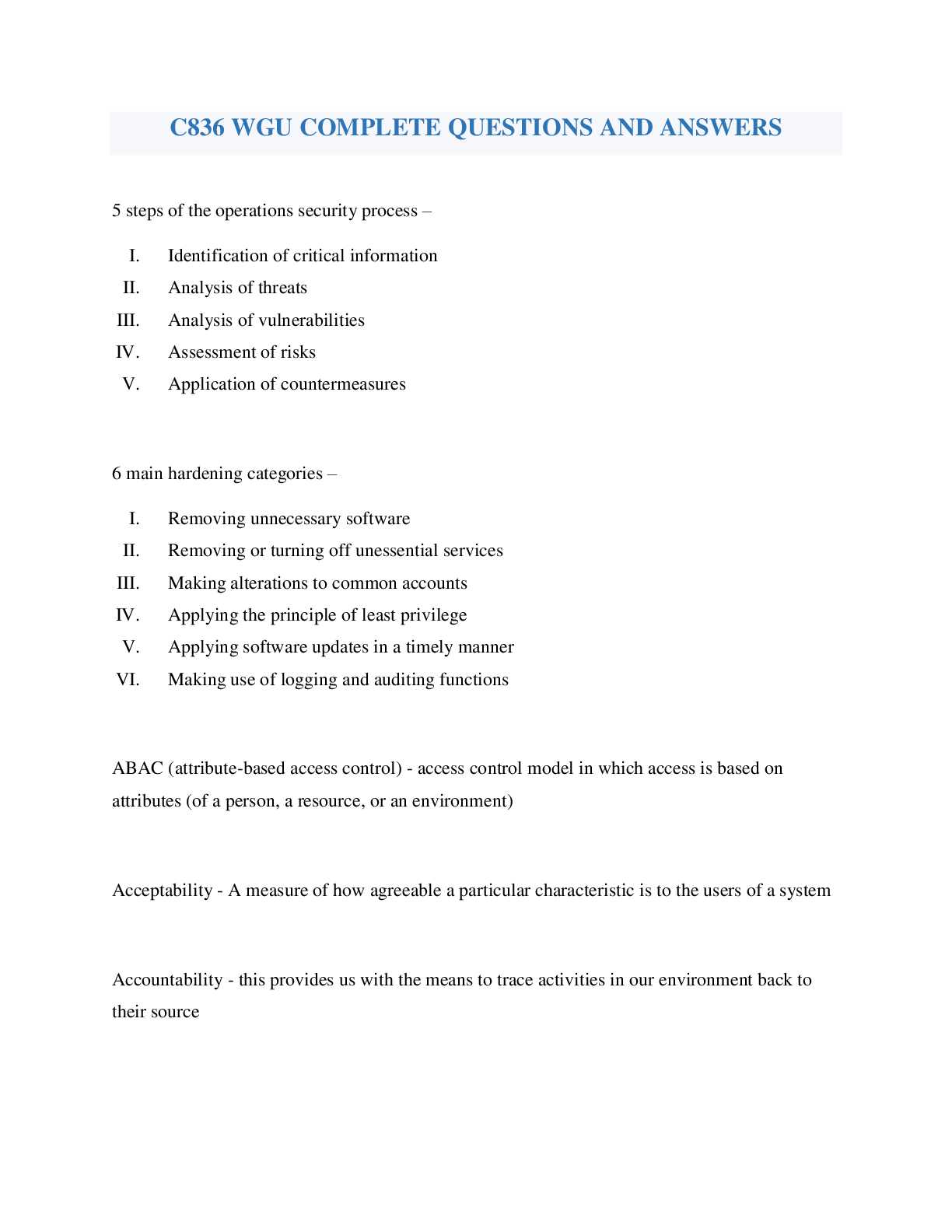
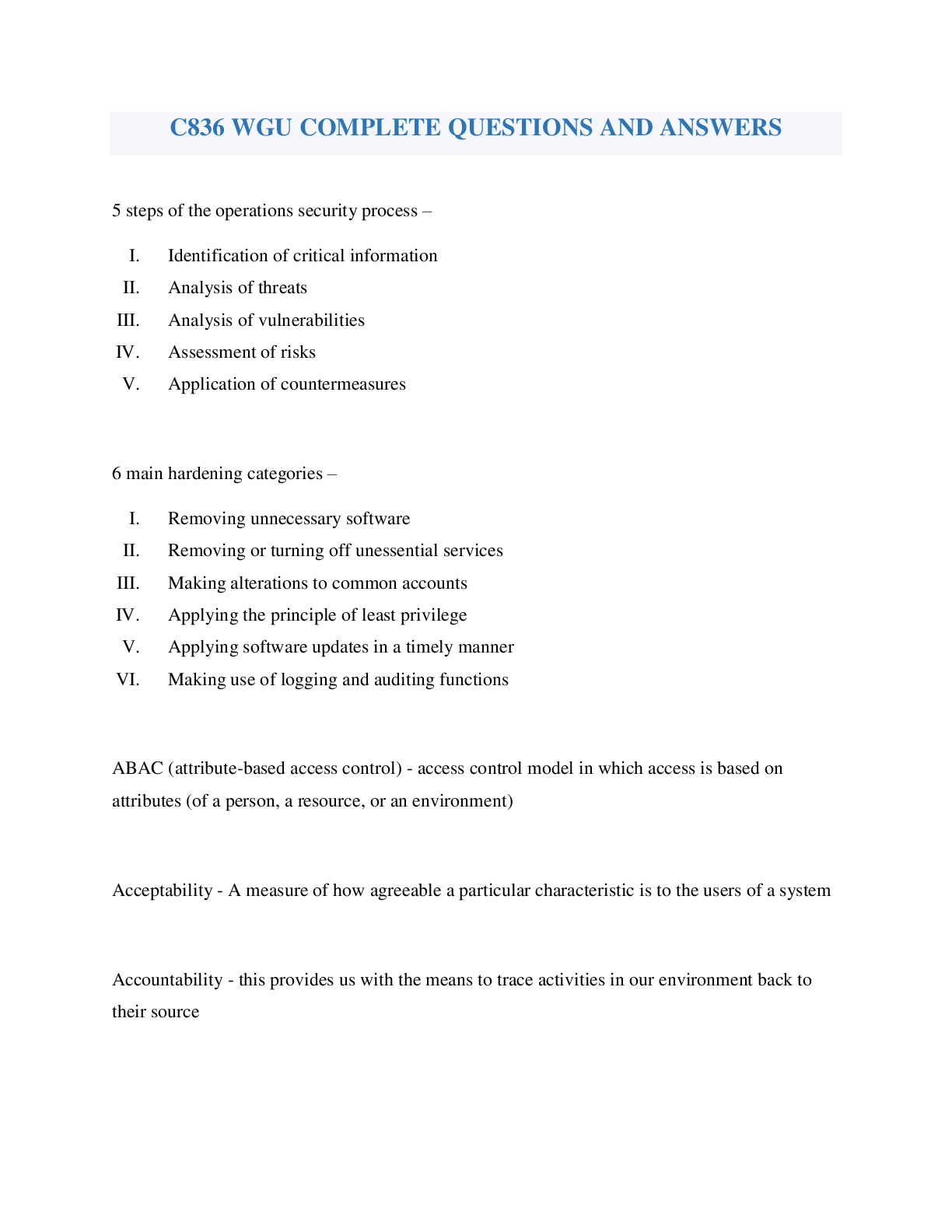
accountability - ✔✔-this provides us with the means to trace activities in our environment back to their
source
nonrepudiation - ✔✔-Refers to a situation in which sufficient evidence exists as to prevent an individual
from successfully denying that he or she has made a statement, or taken an action
deterrence - ✔✔-refers to elements that discourage or prevent misbehavior in our environments
IDS (intrusion detection system) - ✔✔-a monitoring tool that alerts when an attack or other undesirable
activity is taking place
IPS (Intrusion Prevention System) - ✔✔-a tool that alarms and takes actions when malicious events
occur
auditing - ✔✔-a methodical examination and review that ensures accountability through technical
means;
ensures compliance with applicable laws, policies, and other bodies of administrative control, and
detects misuse
logging - ✔✔-A process that provides a history of the activities that have taken place in the environment
monitoring - ✔✔-a subset of auditing that focuses on observing information about the environment in
order to discover undesirable conditions such as failures, resource shortages, security issues, and trends
vulnerability assessment - ✔✔-An activity involving the careful examination of our environment using
vulnerability scanning tools in order to discover vulnerabilities
penetration testing - ✔✔-A more active method of finding security holes that includes using the kinds of
tools attackers use to mimic an attack on our environment
Nessus - ✔✔-A well-known vulnerability scanning tool
chain of custody - ✔✔-a record of where evidence was and how it was passed and protected;
required by courts for admissibility of records
authorization - ✔✔-enables us to determine what users are allowed to do
principle of least privilege - ✔✔-States that we should allow only the bare minimum access required in
order for a given party (person, user account, or process) to perform a needed functionality
violation - ✔✔-the act of doing something that is prohibited by law or rule
allowing access - ✔✔-An act that grants a particular party access to a given resource
denying access - ✔✔-an act that prevents a party from accessing something, such as logging on to a
machine or entering the lobby of our building after hours
limiting access - ✔✔-An act that allows some access to a given resource, but only up to a certain point
sandbox - ✔✔-A set of resources devoted to a program, process, or similar entity, outside of which the
entity cannot operate
revocation - ✔✔-the ability to remove access from a resource at any point in time
ACL (Access Control List) - ✔✔-typically built to a certain resource, these contain the identifiers of the
party allowed to access the resource and what that party is allowed to do
capability-based security - ✔✔-in this method of security, a person's capabilities are oriented around the
use of a token that controls their access (e.g. a personal badge)
confused deputy problem - ✔✔-A type of attack that is more common in systems that use ACLs rather
than capabilities;
- when software has greater permissions than user, the user can trick the software into misusing
authority
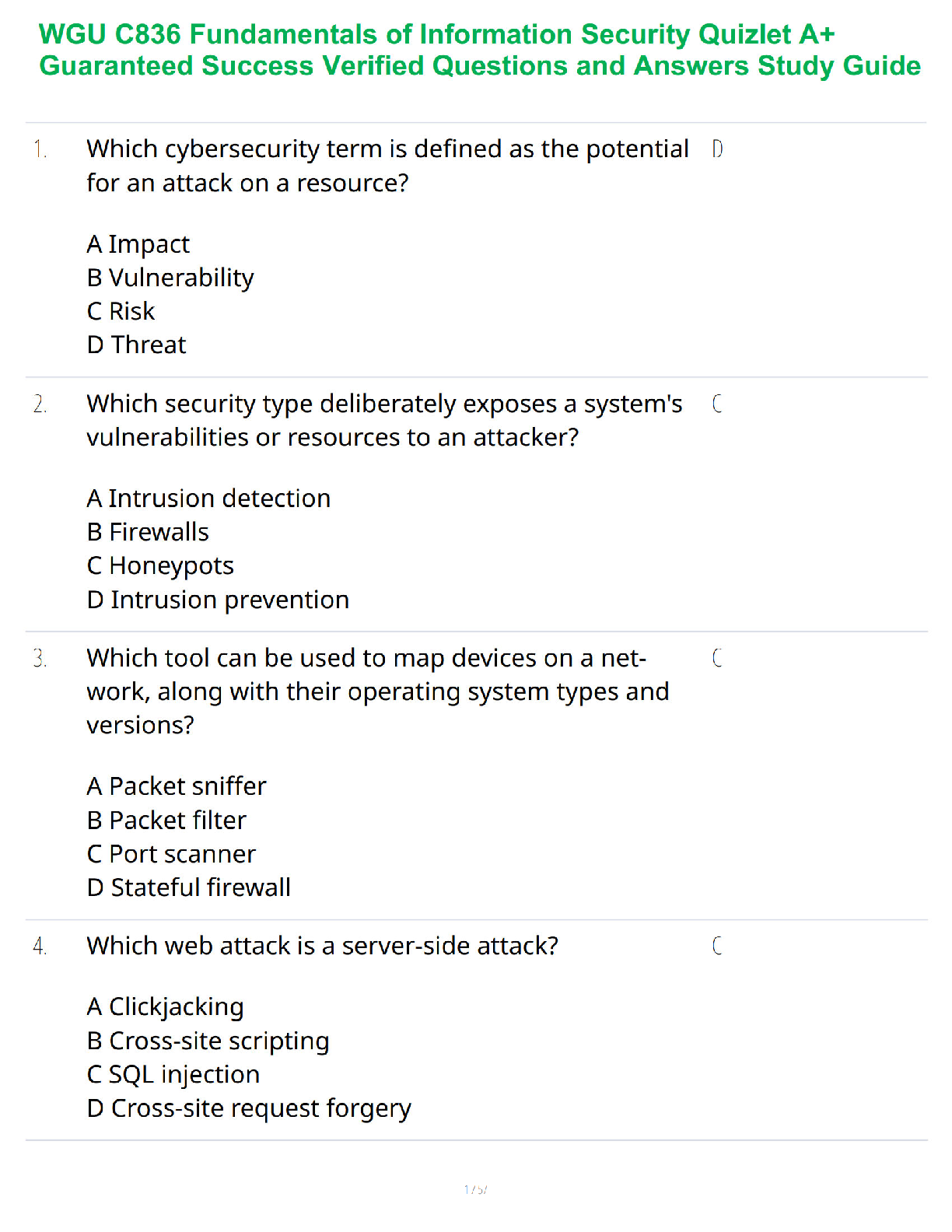
CSRF (Cross Site Request Forgery) - ✔✔-a type of attack that misuses the authority of the browser on
the user's computer
clickjacking (user interface redressing) - ✔✔-client-side attack that involves the attacker placing an
invisible layer over something on a website that
[Show More]




.png)