C836 WGU, Top Exam Questions and
answers, rated A+
bounds checking - ✔✔-to set a limit on the amount of data we expect to receive to set aside storage for
that data
*required in most programming languages
* preven
...
C836 WGU, Top Exam Questions and
answers, rated A+
bounds checking - ✔✔-to set a limit on the amount of data we expect to receive to set aside storage for
that data
*required in most programming languages
* prevents buffer overflows
race conditions - ✔✔-A type of software development vulnerability that occurs when multiple processes
or multiple threads within a process control or share access to a particular resource, and the correct
handling of that resource depends on the proper ordering or timing of transactions
input validation - ✔✔-a type of attack that can occur when we fail to validate the input to our
applications or take steps to filter out unexpected or undesirable content
format string attack - ✔✔-a type of input validation attacks in which certain print functions within a
programming language can be used to manipulate or view the internal memory of an application
authentication attack - ✔✔-A type of attack that can occur when we fail to use strong authentication
mechanisms for our applications
authorization attack - ✔✔-A type of attack that can occur when we fail to use authorization best
practices for our applications
cryptographic attack - ✔✔-A type of attack that can occur when we fail to properly design our security
mechanisms when implementing cryptographic controls in our applications
client-side attack - ✔✔-A type of attack that takes advantage of weaknesses in the software loaded on
client machines or one that uses social engineering techniques to trick us into going along with the
attack
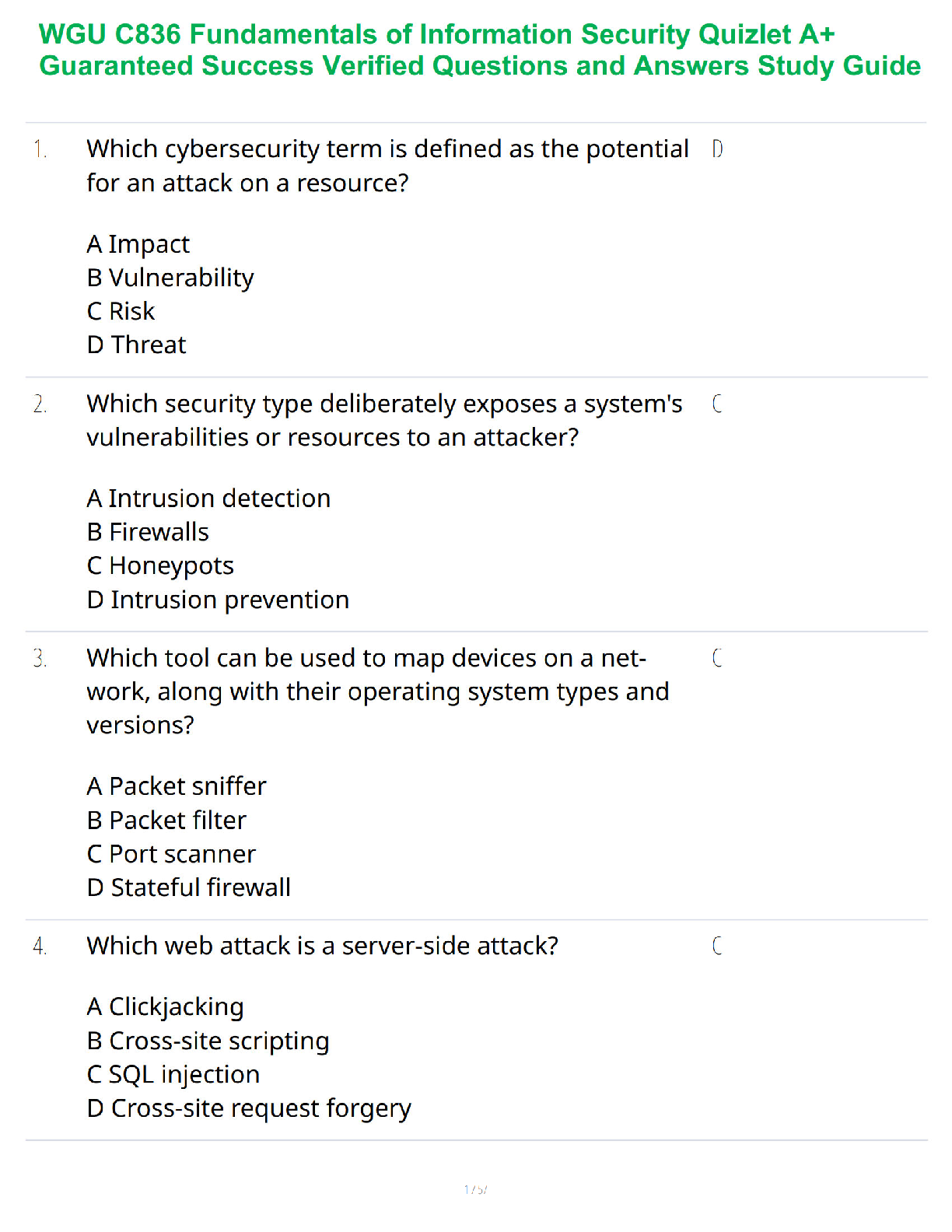
XSS (Cross Site Scripting) - ✔✔-an attack carried out by placing code in the form of a scripting language
into a web page or other media that is interpreted by a client browser
XSRF (cross-site request forgery) - ✔✔-an attack in which the attacker places a link on a web page in
such a way that it will be automatically executed to initiate a particular activity on another web page or
application where the user is currently authenticated
SQL Injection Attack - ✔✔-Attacks against a web site that take advantage of vulnerabilities in poorly
coded SQL (a standard and common database software application) applications in order to introduce
malicious program code into a company's systems and networks.
clickjacking - ✔✔-An attack that takes advantage of the graphical display capabilities of our browser to
trick us into clicking on something we might not otherwise
server-side attack - ✔✔-A type of attack on the web server that can target vulnerabilities such as lack of
input validation, improper or inadequate permissions, or extraneous files left on the server from the
development process
Protocol issues, unauthenticated access, arbitrary code execution, and privilege escalation - ✔✔-Name
the 4 main categories of database security issues
web application analysis tool - ✔✔-A type of tool that analyzes web pages or web-based applications
and searches for common flaws such as XSS or SQL injection flaws, and improperly set permissions,
extraneous files, outdated software versions, and many more such items
protocol issues - ✔✔-unauthenticated flaws in network protocols, authenticated flaws in network
protocols, flaws in authentication protocols
arbitrary code execution - ✔✔-An attack that exploits an applications vulnerability into allowing the
attacker to execute commands on a user's computer.
* arbitrary code execution in intrinsic or securable SQL elements
Privilege Escalation - ✔✔-An attack that exploits a vulnerability in software to gain access to resources
that the user normally would be restricted from accessing.
* via SQL injection or local issues
validating user inputs - ✔✔-a security best practice for all software
* the most effective way of mitigating SQL injection attacks
Nikto (and Wikto) - ✔✔-A web server analysis tool that performs checks for many common server-side
vulnerabilities & creates an index of all the files and directories it can see on the target web server (a
process known as spidering)
burp suite - ✔✔-A well-known GUI web analysis tool that offers a free and professional version; the pro
version includes advanced tools for conducting more in-depth attacks
fuzzer - ✔✔-A type of tool that works by bombarding our applications with all manner of data and
inputs from a wide variety of sources, in the hope that we can cause the application to fail or to perform
in unexpected ways
MiniFuzz File Fuzzer - ✔✔-A tool developed by Microsoft to find flaws in file-handling source code
BinScope Binary Analyzer - ✔✔-A tool developed by Microsoft to examine source code for general good
practices
SDL Regex Fuzzer - ✔✔-A tool developed by Microsoft for testing certain pattern-matching expressions
for potential vulnerabilities
good sources of secure coding guidelines - ✔✔-CERT, NIST 800, BSI, an organization's internal coding
guidelines
OS hardening - ✔✔-the process of reducing the number of available avenues through which our OS
might be attacked
attack surface - ✔✔-The total of the areas through which our operating system might be attacked
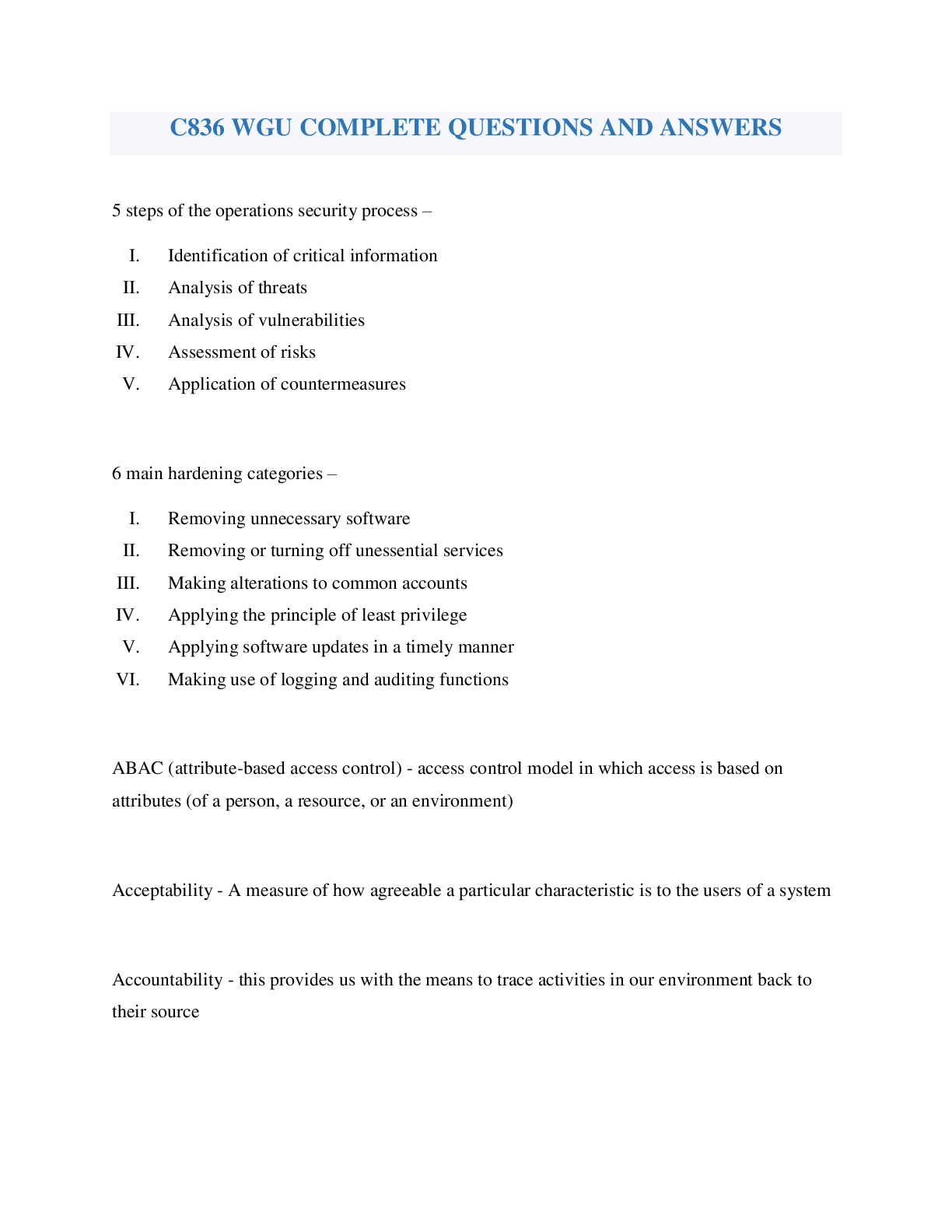
6 main hardening categories - ✔✔-1. Removing unnecessary software
2. Removing or turning off unessential services
3. Making alterations to common accounts
4. Applying the principle of least privilege
5. Applying software updates in a timely manner
6. Making use of logging and auditing functions
Principle of Least Privilege - ✔✔-states we should only allow a party the absolute minimum permission
needed for it to carry out its function
stuxnet - ✔✔-A particularly complex and impactful item of malware that targeted the Supervisory
Control and Data Acquisition (SCADA) systems that run various industrial processes; this piece of
malware raised the bar for malware from largely being a virtual-based attack to actually being physically
destructive
anti-malware tool - ✔✔-A type of tool that uses signature matching or anomaly detection (heuristics) to
detect malware threats, either in real-time or by performing scans of files and processes
heuristics - ✔✔-the process of anomaly detection used by anti-malware tools to detect malware without
signatures
executable space protection - ✔✔-A hardware and software-based technology that prevents certain
portions of the memory used by the operating system and applications from being used to execute code
buffer overflow (overrun) - ✔✔-The act of inputting more data than an application is expecting from a
particular input, creating the possibility of executing commands by specifically crafting the excess data
ASLR (Address Space Layout Randomization) - ✔✔-a security method that involves shifting the contents
of memory around to make tampering difficult
software firewall - ✔✔-This type of firewall generally contains a subset of the features on a large firewall
appliance but is often capable of similar packet filtering and stateful packet inspection activities
HIDS (host-based intrusion detection system) - ✔✔-a system used to analyze the activities on or directed
at the network interface of a particular host.
* may communicate with management device by sending regular beacons
scanner - ✔✔-a type of tool that can detect various security flaws when examining hosts
vulnerability assessment tool - ✔✔-A tool that is aimed specifically at the task of finding and reporting
network services on hosts that have known vulnerabilities
Nessus - ✔✔-A well-known vulnerability assessment tool that includes a port scanner
exploit framework - ✔✔-A group of tools that can include network mapping tools, sniffers, and exploits
exploits - ✔✔-small bits of software that take advantage of flaws in software/applications in order to
cause them to behave in ways that were not intended by their creators
Metasploit, Immunity CANVAS, Core Impact - ✔✔-Name 3 examples of exploit frameworks
security in network design - ✔✔-This method of security involves a well-configured and patched
network, and incorporating elements such as network segmentation, choke points, and redundancy
network segmentation - ✔✔-The act of dividing a network into multiple smaller networks, each acting as
its own small network (subnet)
choke points - ✔✔-certain points in the network, such as routers, firewalls, or proxies, where we can
inspect, filter, and control network traffic
redundancy - ✔✔-a method of security that involves designing a network to always have another route
if something fails or loses connection
firewall - ✔✔-a mechanism for maintaining control over the traffic that flows into and out of our
networks
packet filtering - ✔✔-A firewall technology that inspects the contents of each packet in network traffic
individually and makes a gross determination (based on source and destination IP address, port number,
and the protocol being used) of whether the traffic should be allowed to pass
SPI (Stateful Packet Inspection) - ✔✔-a firewall that can watch packets and monitor the traffic from a
given connection
DPI (Deep Packet Inspection) - ✔✔-a firewall technology that can analyze the actual content of the
traffic that is flowing through
proxy server - ✔✔-a specialized type of firewall that can serve as a choke point, log traffic for later
inspection, and provides a layer of security by serving as a single source of requests for the devices
behind it
DMZ (demilitarized zone) - ✔✔-a combination of a network design feature and a protective device such
as a firewall.
Often used for systems that need to be exposed to external networks but are connected to our own
network (such as a web server)
NIDS (Network intrusion detection system) - ✔✔-A system that monitors network traffic and alerts for
unauthorized activity
signature-based IDS - ✔✔-An IDS that maintains a database of signatures that might signal a particular
type of attack and compares incoming traffic to those signatures
anomaly-based IDS - ✔✔-an IDS that takes a baseline of normal network traffic and activity and
measures current traffic against this baseline to detect unusual events
VPN (Virtual Private Network) - ✔✔-an encrypted connection between two points
SSH (Secure Shell) - ✔✔-protocol used to secure traffic in a variety of ways, including file transfers and
terminal access. uses RSA encryption (asymmetric encryption)
BYOD (bring your own device) - ✔✔-a phrase that refers to an organization's strategy and policies
regarding the use of personal vs. corporate d
[Show More]




.png)