Lesson 3 Authorization and Access
Control- WGU C836, top Questions and
answers, rated A+
Attributes of a particular individual, such as height - ✔✔-Subject attributes
allows us to specify where the party should be
...
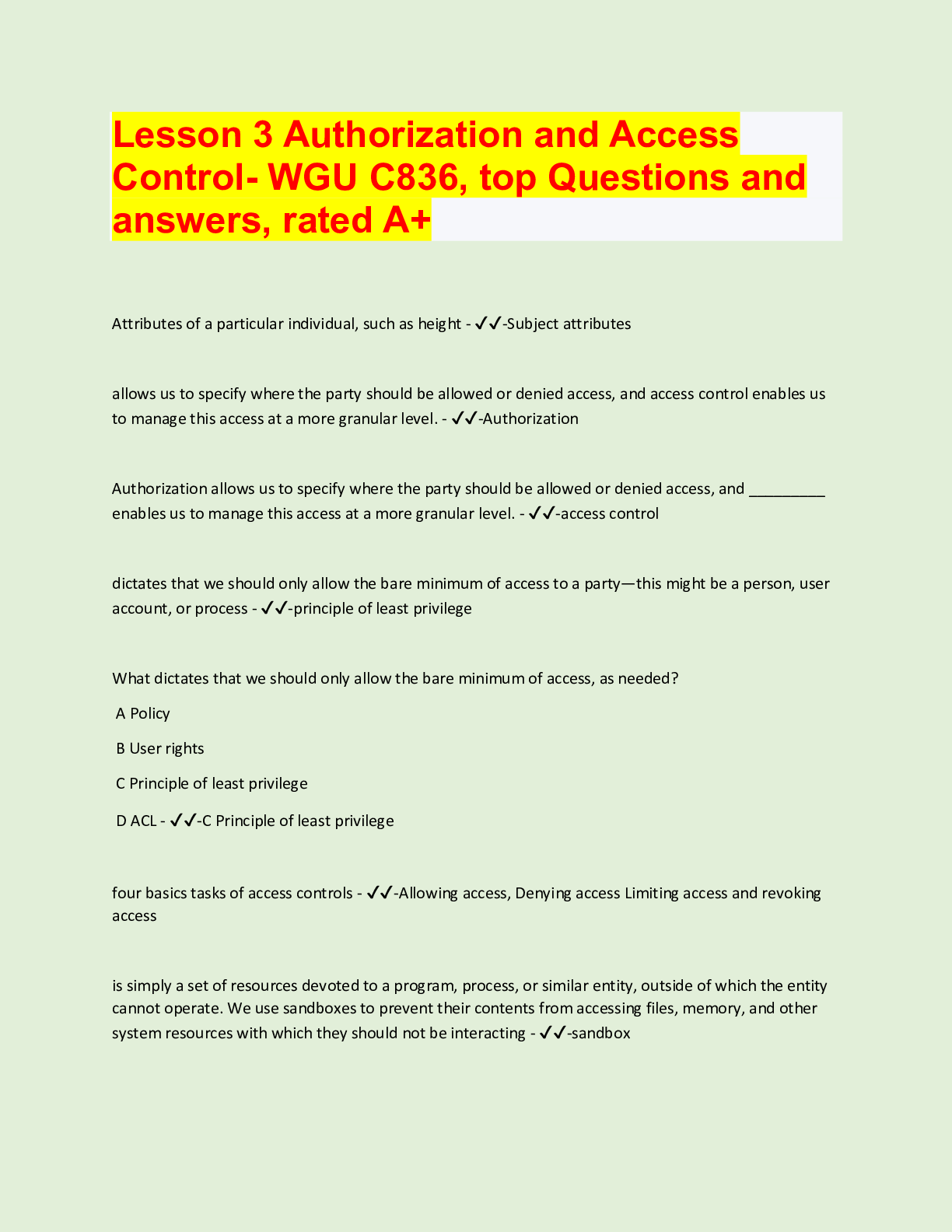
Lesson 3 Authorization and Access
Control- WGU C836, top Questions and
answers, rated A+
Attributes of a particular individual, such as height - ✔✔-Subject attributes
allows us to specify where the party should be allowed or denied access, and access control enables us
to manage this access at a more granular level. - ✔✔-Authorization
Authorization allows us to specify where the party should be allowed or denied access, and _________
enables us to manage this access at a more granular level. - ✔✔-access control
dictates that we should only allow the bare minimum of access to a party—this might be a person, user
account, or process - ✔✔-principle of least privilege
What dictates that we should only allow the bare minimum of access, as needed?
A Policy
B User rights
C Principle of least privilege
D ACL - ✔✔-C Principle of least privilege
four basics tasks of access controls - ✔✔-Allowing access, Denying access Limiting access and revoking
access
is simply a set of resources devoted to a program, process, or similar entity, outside of which the entity
cannot operate. We use sandboxes to prevent their contents from accessing files, memory, and other
system resources with which they should not be interacting - ✔✔-sandbox
access controls, there are two main methods that we might use - ✔✔-access control lists and
capabilities
often referred to as "ackles," are a very common choice of access control implementation. are usually
used to control access in the file systems on which our operating systems run and to control the flow of
traffic in the networks to which our systems are attached. - ✔✔-Access control lists (ACLs)
When we look at the ACLs in most file systems, we commonly see three permissions in use - ✔✔-read,
write, and execute
Permissions in network ACLs tend to be binary in nature, generally consisting of - ✔✔-allow and deny
filtering can take the form of dropping traffic from individual IP addresses, to ranges, to the entire IP
space of large organizations, ISPs, or even entire countries. This practice is commonly referred to as -
✔✔-blackholing
FTP uses ports - ✔✔-20 and 21 to transfer files,
Internet Message Access Protocol (IMAP) uses port - ✔✔-143 for managing e-mail
Secure Shell (SSH) uses port - ✔✔-22 to manage remote connections to systems
are oriented around the use of a token that controls our access. We can think of a token in a capability
as being analogous to the personal badge we might use to open the door in a building - ✔✔-capabilities
when the software with access to a resource has a greater level of permission to access the resource
than the user who is controlling the software - ✔✔-Confused deputy problem
Two of the more common client-side attack are - ✔✔-cross-site request forgery (CSRF) and clickjacking.
are attacks that take advantage of weaknesses in applications that are running on the computer being
operated directly by the user, often referred to as the client. - ✔✔-Client-side attacks
is an attack that misuses the authority of the browser on the user's computer. If the attacker knows of,
or can guess, a Web site to which the user might already be authenticated - ✔✔-CSRF
most common access control models in security world are - ✔✔-discretionary access control, mandatory
access control, rule-based access control, role-based access control, and attribute-based access control.
is a model of access control based on access being determined by the owner of the resource in question.
The owner of the resource can decide who does and does not have access, and exactly what access they
are allowed to have - ✔✔-Discretionary access control (DAC)
is a model of access control in which the owner of the resource does not get to decide who gets to
access it, but instead access is decided by a group or individual who has the authority to set access on
resources. - ✔✔-Mandatory access control (MAC)
is, logically, based on attributes. These can be the attributes of a particular person, of a resource, or of
an environment. - ✔✔-Attribute-based access control (ABAC)
are used to control access, based on whether the party on the other end can pass a test that is, in
theory, too difficult for a machine to complete, thus proving the party to be human. - ✔✔-Captchas
model implements a combination of DAC and MAC and is primarily concerned with the confidentiality of
the resource in question - ✔✔-Bell-LaPadula
The level of access granted to an individual must be at least as high as the classification of the resource
in order for the individual to be able to access it. - ✔✔-The simple security property
In Bell-LaPadula, we have two security properties that define how information can flow to and from the
resource - ✔✔-The simple security property and The * property
Anyone accessing a resource can only write its contents to one classified at the same level or higher. -
✔✔-The * property
is primarily concerned with protecting the integrity of data, even at the expense of confidentiality. - ✔✔-
The Biba model of access control
The level of access granted to an individual must be no lower than the classification of the resource. -
✔✔-The simple integrity axiom
Anyone accessing a resource can only write its contents to one classified at the same level or lower. -
✔✔-The * integrity axiom
Biba has two security rules that are the exact reverse of those we discussed in the Bell-LaPadula model -
✔✔-The simple integrity axiom and The * integrity axiom
also known as the Chinese Wall model, is an access control model designed to prevent conflicts of
interest - ✔✔-The Brewer and Nash mode
[Show More]

.png)