CRC Example questions, Exam
Questions and answers, 100% Accurate,
graded A+
Managed care is a health delivery concept initially implemented due to: - ✔✔-Spiraling medical costs.
Managed care models emphasize struct
...
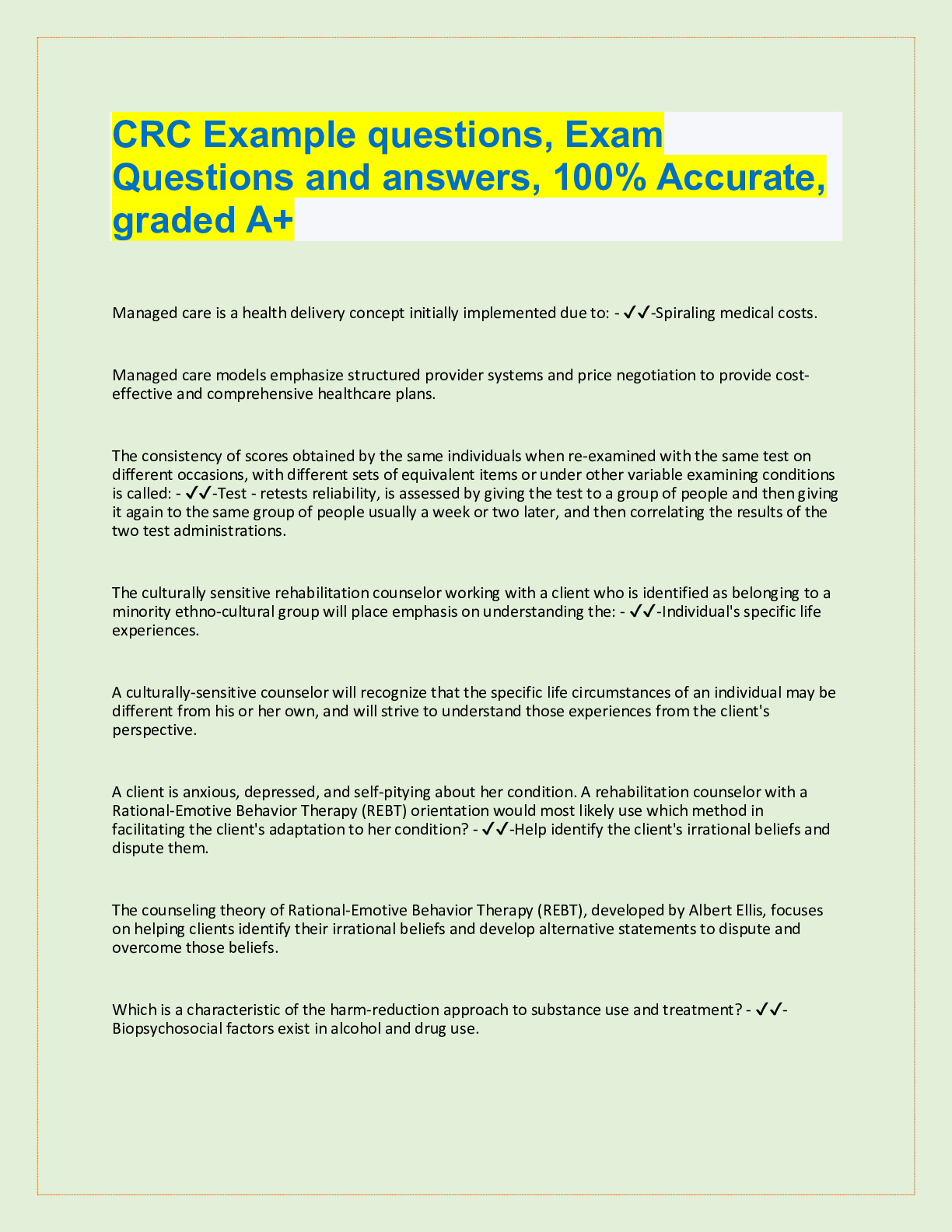
CRC Example questions, Exam
Questions and answers, 100% Accurate,
graded A+
Managed care is a health delivery concept initially implemented due to: - ✔✔-Spiraling medical costs.
Managed care models emphasize structured provider systems and price negotiation to provide cost�effective and comprehensive healthcare plans.
The consistency of scores obtained by the same individuals when re-examined with the same test on
different occasions, with different sets of equivalent items or under other variable examining conditions
is called: - ✔✔-Test - retests reliability, is assessed by giving the test to a group of people and then giving
it again to the same group of people usually a week or two later, and then correlating the results of the
two test administrations.
The culturally sensitive rehabilitation counselor working with a client who is identified as belonging to a
minority ethno-cultural group will place emphasis on understanding the: - ✔✔-Individual's specific life
experiences.
A culturally-sensitive counselor will recognize that the specific life circumstances of an individual may be
different from his or her own, and will strive to understand those experiences from the client's
perspective.
A client is anxious, depressed, and self-pitying about her condition. A rehabilitation counselor with a
Rational-Emotive Behavior Therapy (REBT) orientation would most likely use which method in
facilitating the client's adaptation to her condition? - ✔✔-Help identify the client's irrational beliefs and
dispute them.
The counseling theory of Rational-Emotive Behavior Therapy (REBT), developed by Albert Ellis, focuses
on helping clients identify their irrational beliefs and develop alternative statements to dispute and
overcome those beliefs.
Which is a characteristic of the harm-reduction approach to substance use and treatment? - ✔✔-
Biopsychosocial factors exist in alcohol and drug use.
Substance use has multiple effects on the individual and family, causing health and psychological
problems and disrupting social systems. Harm reduction approaches can be contrasted to abstinence�only approaches such as twelve step meetings.
A client exhibiting learned helplessness could perceive that success and failure result from: - ✔✔-
External forces beyond their control.
Learned helplessness is an expectancy that events occur by chance and the client has no control over
them. Those expectations can result in feelings of helplessness, depression, and ineffectiveness.
The counseling theorist who was a major contributor to the psychodynamic approach to therapy is: -
✔✔-Alfred Adler.
Alfred Adler's theory is based on a psychodynamic perspective. In contrast, the other theorists listed are
associated most with cognitive (Ellis), behavioral (Lazarus), and person-centered (Rogers) approaches.
In the Minnesota model of patient treatment for addiction, the three phases include: - ✔✔-
Detoxification, rehabilitation, and aftercare.
Patients entering an inpatient treatment program usually undergo assessments including medical,
psychiatric, psychological, social, and family appraisal. Based on the assessment, the treatment plan may
consist of detoxification, counseling, and/or group counseling. Patients may remain as inpatients (21-28
days); however, most treatment plans emphasize outpatient treatment.
Rehabilitation counselors who work with individuals with alcoholism know the importance of obtaining
an accurate drinking history during the initial interview. In an effort to get a clear picture of the alcohol
use, the rehabilitation counselor should: - ✔✔-Exhibit a non-judgmental attitude when asking about
drinking patterns.
Unless rehabilitation counselors show they are non-judgmental, individuals with alcoholism are unlikely
to disclose their actual drinking history because they may be embarrassed to do so. An effective
counseling relationship requires communicating acceptance of the client's situation and their inherent
worth.
According to Viktor Frankl, the essence of being human lies in the: - ✔✔-Search for meaning and
purpose.
Rehabilitation counselors recognize that individuals with disabilities are human beings, each with their
own unique view of the world and their purpose in life. Frankl's approach to counseling emphasizes
freedom, responsibility, meaning, and search for value.
The stage of group therapy where cohesion usually occurs is the: - ✔✔-Working stage.
During the working stage, the group displays a great amount of intimacy, self-disclosure, feedback,
teamwork, confrontation, and humor, if it is healthy. Feelings of empathy, compassion and care abound,
and groups gradually grow closer emotionally. Cohesiveness usually increases as group members
interact and understand each other better. Emotional closeness is especially likely to grow if group
members can identify with each other and have been successful in working through their struggles
together.
During a family counseling session, the rehabilitation counselor asked a question that offered family
members an opportunity to ponder what their lives and subsequent behavior would be like once the
problem was remedied. This is known as: - ✔✔-The miracle question.
Within the solution-focused area of family counseling practice, techniques such as the "miracle
question" can be used to help change the family's beliefs and behavior patterns.
Acute Stress Disorder (ASD) is an anxiety disorder that develops: - ✔✔-Within a month after a severe
traumatic event.
Many individuals with disabilities have experienced acute stress related to trauma. In some cases, this
leads to an anxiety disorder within a month after the traumatic event. Rehabilitation counselors can
assist with managing the stress in an effective manner.
One of the first steps of crisis intervention is to provide an opportunity for the individual to: - ✔✔-Fully
express himself/herself.
Many individuals with disabilities may experience crises. Rehabilitation counselors should exhibit
sensitive listening, hearing, and understanding skills to help each individual express himself/herself.
Denying the crisis can be counter-productive; allowing the individual to harm self or others is unethical.
Self-destructive behavior, such as repeated suicide attempts and self-mutilation, is one of the defining
characteristics of which psychiatric diagnosis? - ✔✔-Borderline personality disorder.
DSM-5 defines borderline personality disorder as "a pervasive pattern of instability of interpersonal
relationships, self-image, and affects, and marked impulsivity beginning by early adulthood and present
in a variety of contexts." Five of nine diagnostic criteria must be met; one of those is "recurrent suicidal
behavior, gestures or threats, or self-mutilating behavior."
Personality assessments evaluate what trait? - ✔✔-Emotion.
Personality characteristics affect the individual throughout the rehabilitation counseling process, in
areas such as adjustment to disability and job satisfaction. Personality assessments measure emotional
traits, along with other personal and social characteristics.
Which is affected most by extreme scores? - ✔✔-Mean.
Extreme scores will pull the mean in the direction of those extremes. For example, in the United States,
a few people have extremely high incomes, their income pulls the mean so that it is not a good
representation of what the average citizen earns. The median would be a better choice to represent
what is average.
A labor market survey is valuable to the rehabilitation counselor because it provides information related
to: - ✔✔-Realistic placement opportunities.
[Show More]