CGSC/ILE Comp Study Terms X100,
Questions and answers. Verified.
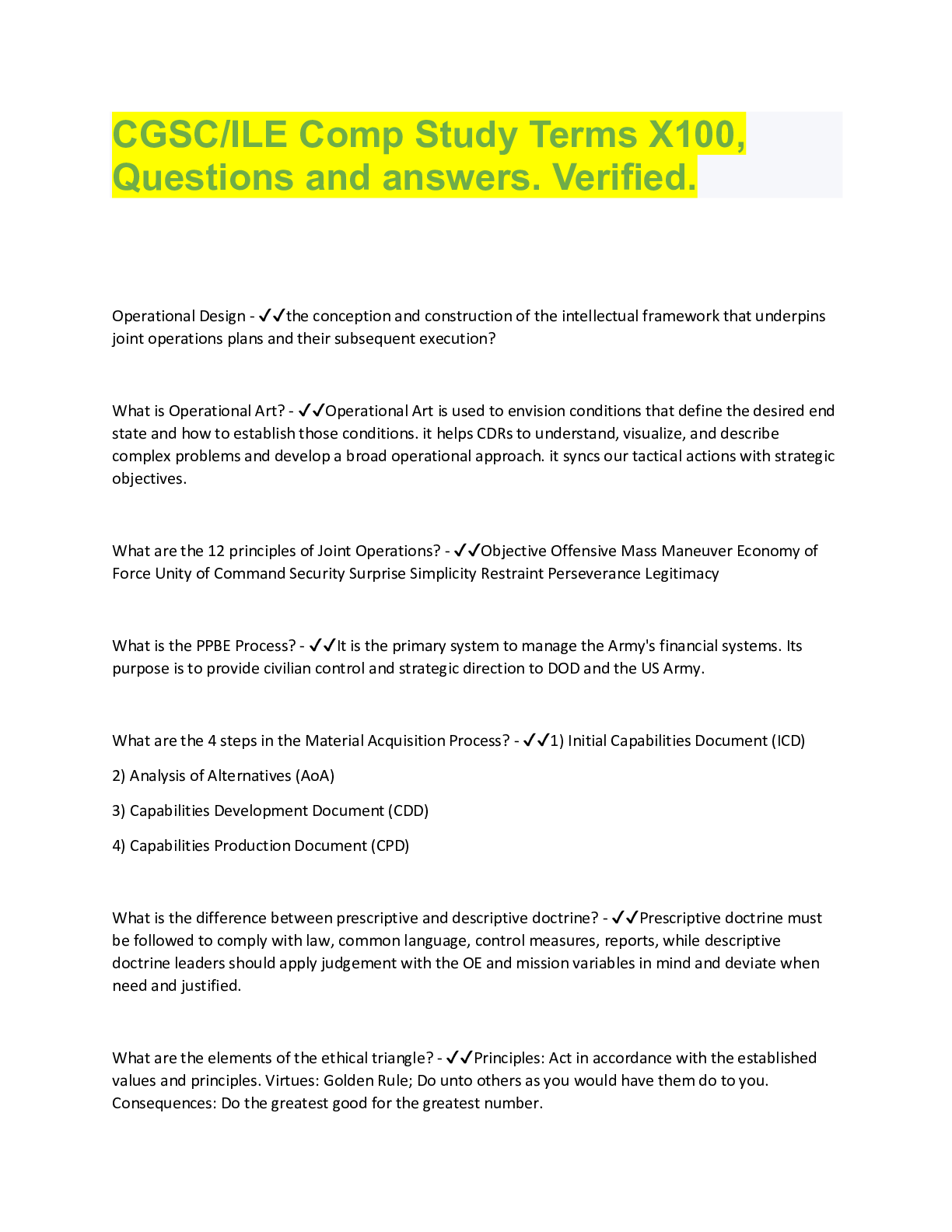
Operational Design - ✔✔the conception and construction of the intellectual framework that underpins
joint operations plans and their subsequent execut
...
CGSC/ILE Comp Study Terms X100,
Questions and answers. Verified.
Operational Design - ✔✔the conception and construction of the intellectual framework that underpins
joint operations plans and their subsequent execution?
What is Operational Art? - ✔✔Operational Art is used to envision conditions that define the desired end
state and how to establish those conditions. it helps CDRs to understand, visualize, and describe
complex problems and develop a broad operational approach. it syncs our tactical actions with strategic
objectives.
What are the 12 principles of Joint Operations? - ✔✔Objective Offensive Mass Maneuver Economy of
Force Unity of Command Security Surprise Simplicity Restraint Perseverance Legitimacy
What is the PPBE Process? - ✔✔It is the primary system to manage the Army's financial systems. Its
purpose is to provide civilian control and strategic direction to DOD and the US Army.
What are the 4 steps in the Material Acquisition Process? - ✔✔1) Initial Capabilities Document (ICD)
2) Analysis of Alternatives (AoA)
3) Capabilities Development Document (CDD)
4) Capabilities Production Document (CPD)
What is the difference between prescriptive and descriptive doctrine? - ✔✔Prescriptive doctrine must
be followed to comply with law, common language, control measures, reports, while descriptive
doctrine leaders should apply judgement with the OE and mission variables in mind and deviate when
need and justified.
What are the elements of the ethical triangle? - ✔✔Principles: Act in accordance with the established
values and principles. Virtues: Golden Rule; Do unto others as you would have them do to you.
Consequences: Do the greatest good for the greatest number.
What are the 5 Phases of the Army Force Development Process? - ✔✔1) Develop Capabilities 2) Design
Organizations 3) Develop Organizational Models 4) Determine Authorizations 5) Document Organization
Authorizations
Commander's Planning Guidance - ✔✔Describe the OE. Describe the problem. Describe the operational
approach. Give the CDR's Initial Intent.
What are the elements of system's prespective? - ✔✔RAFT - Relationships, Actors, Functions, Tension.
Mission Command as a Warfighting Function - ✔✔It is the related tasks and mission command systems
that support the commander's exercise of authority and direction.
Decision Point - ✔✔a point in space or time the commander or staff anticipate making a key decision
concerning a specific course of action.
Decisive Operation - ✔✔the operation that directly accomplishes the mission. It determines the
outcome of a major operation, battle, or engagement. The decisive operation is the focal point around
which commanders design an entire operation.
Three operational frameworks - ✔✔Decisive-Shaping-Sustaining. Deep-Close-Security. Main Effort�Supporting Effort.
What is IPB? - ✔✔the systematic process of analyzing of METT-TC in the AI to determine their effect on
operations.
What is JIPOE? - ✔✔a systematic approach used by intelligence personnel to analyze the adversary and
other relevant aspects of the operational environment.
The 4 Steps to IPB - ✔✔1) Define the OE. 2) Describe the Environmental Effects on Operations. 3)
Evaluate the Threat. 4) Determine Threat/Adversary COAs.
Characteristics of the Defense - ✔✔Disruption, Flexibility, Maneuver, Mass/Concentration, Operations in
Depth, Preparation, Security
Primary Defensive Tasks - ✔✔Area Defense, Mobile Defense, Retrograde
Leadership - ✔✔The Army defines leadership as "the process of influencing people by providing
purpose, direction, and motivation to accomplish the mission, and improve the organization." Within
this definition, leaders influence the organization through positional and personal power in order to
achieve compliance and commitment.
Clausewitz Trinity - ✔✔Reason (the government), chance (the military), and passion (the people)
Concept of friction in war - ✔✔Danger, physical effort, and ambigous information
Center of Gravity (doctrine) - ✔✔The source of power that provides moral or physical strength, freedom
of action, or will to act.
Center of Gravity (theory) - ✔✔The hub of all power and movement, on which everything depends; The
CoG's movement and direction govern the rest.
The purpose of CoG Analysis - ✔✔Help JFCs and staffs analyze friendly and adversary sources of strength
as well as weaknesses and vulnerabilities.
Operational Art - ✔✔A deliberate process designed to Understand and Visualize the Environment in
order to develop a strategy. It is a vision that links tactical actions to strategic objectives.
Operational Methodology - ✔✔Understand the strategic direction. Understand the OE. Understand the
problem.
Elements of Operational Design - ✔✔Termination, Military End State, Objectives, Effects, CoG, Decisive
Points, LOO/LOEs, Direct & Indirect Approach, Anticipation, Operational Reach, Culmination, Arranging
Operations, Forces & Functions, Phasing
Critical Capabilities - ✔✔verb; considered crucial enablers for a COG to function as such, and are
essential to the accomplishment of the adversary's assumed objective(s)
Critical Requirements - ✔✔noun; the conditions, resources, and means that enable a critical capability
to become fully operational
Critical Vulnerability - ✔✔aspects or components of critical requirements that are deficient and can be
targeted
Decisive Point - ✔✔a geographic place, specific key event, critical factor, or function that, when acted
upon, allows commanders to gain a marked advantage
ULO - ✔✔how the Army seizes, retains, and exploits the initiative to gain and maintain a position of
relative advantage in sustained land operations
Four Foundations of ULO - ✔✔Begins and ends with the initiative. Executed through DA. By means of
Army Core Competencies. Guided by Mission Command.
Operational Initiative - ✔✔Is setting or dictating the terms of action throughout the operation
Personal Initiative - ✔✔The willingness to act in the absence of orders, when existing orders no longer
make sense, or the unforeseen arises
Philosophy of Mission Command - ✔✔the exercise of authority and direction by the commander using
mission orders to enable disciplined initiative within the commander's intent to empower agile and
adaptive leaders in the conduct of unified land operations
Initiative in DA - ✔✔Initiative gives all operations the spirit, if not the form, of the offense. Initiative is
used to gain a position of advantage that degrades and defeats the enemy throughout the depth of an
organization.
Initiative in CAM - ✔✔Commanders compel the enemy to respond to friendly actions
Initiative in WAS - ✔✔By improving civil conditions and applying combat power to prevent the situtation
from deteriorating
Mission Command - ✔✔as a Warfighting Function It is the related tasks and mission command systems
that support the commander's exercise of authority and direction.
Decision Point - ✔✔a point in space or time the commander or staff anticipate making a key decision
concerning a specific course of action.
Decisive Operation - ✔✔the operation that directly accomplishes the mission. It determines the
outcome of a major operation, battle, or engagement. The decisive operation is the focal point around
which commanders design an entire operation.
Three operational frameworks - ✔✔Decisive-Shaping-Sustaining. Deep-Close-Security. Main Effort�Supporting Effort.
What is IPB? - ✔✔the systematic process of analyzing of METT-TC in the AI to determine their effect on
operations.
What is JIPOE? - ✔✔a systematic approach used by intelligence personnel to analyze the adversary and
other relevant aspects of the operational environment.
The 4 Steps to IPB - ✔✔1) Define the OE. 2) Describe the Environmental Effects on Operations. 3)
Evaluate the Threat. 4) Determine Threat/Adversary COAs.
Characteristics of the Defense - ✔✔Disruption, Flexibility, Maneuver, Mass/Concentration, Operations in
Depth, Preparation, Security
Primary Defensive Tasks - ✔✔Area Defense, Mobile Defense, Retrograde
Forms of Defense - ✔✔Defense of a Linear Obstacle, Perimeter Defense, Defense of a Reverse Slope
2 Types of Power - ✔✔Personal (commitment) and Positional (compliance)
3 Types of Influence Techniques - ✔✔Hard, soft, and rational
Define Organizational Climate - ✔✔consists of collective perceptions of the work environment formed
by members of the organization based on actions, policies, and procedures of the leadership
Define Organizational Culture - ✔✔The shared beliefs of a group used to solve problems and manage
internal anxiety
Define Joint Operations - ✔✔means military actions conducted by joint forces and those Service forces
employed in specified command relationships with each other.
What is an RMA? - ✔✔The assembly of a complex mix of tactical, organizational, doctrinal, and
technological innovations in order to implement a new conceptual approach to warfare or specialized
sub-branch of warfare
What is JCIDS? - ✔✔a need driven joint capabilities-based requirements generation process
What is the purpose of JCIDS? - ✔✔The objective is to develop a balanced and synchronized DOTMLPF-P
solution that is affordable, useful, effective, supportable, and based on mature technology
What is DAS - ✔✔Defense Acquisition System (DAS). A management process to translate user needs and
technological opportunities into reliable and sustainable systems
What is the JCIDS - ✔✔relationship to DAS? JCIDS is related to the DAS by the MDD
Examples of RMA - ✔✔• England's 14th Cent RMA Dutch & Swedish tactical reforms • French tactical
and org reforms • National political & economic mobilization • Napoleonic warfare • Tech rev in land
warfare (pre-WWI) • Combined-arms tactics and operations
What is the goal of Force Management - ✔✔To provide trained and ready units for the Combatant
Commanders
What is the Army Force Development Process? - ✔✔It is a five-phase process that is the start point,
rationale and underlying basis for defining the Army's force structure. The force development process
consists of defining required military capabilities, designing force structures to provide these
capabilities, and translating organizational concepts into a trained and ready Army.
What are the 5 Phases of the Army Force Development Process? - ✔✔1) Develop Capabilities 2) Design
Organizations 3) Develop Organizational Models 4) Determine Authorizations 5) Document Organization
Authorizations
Why is Force Management important? - ✔✔Force Management is important because it ensures that
today's Army can rapidly respond to the challenges of today and the future. Force management is future
readiness.
What are the 4 steps in the Material Acquisition Process? - ✔✔1) Initial Capabilities Document (ICD) 2)
Analysis of Alternatives (AoA) 3) Capabilities Development Document (CDD) 4) Capabilities Production
Document (CPD)
What is an Initial Capabilities Document? - ✔✔The ICD documents the need for non-materiel and/or
materiel solution approaches to resolve a specific high risk capability gap derived from the JCIDS C-BA
process.
What is a Capabilities Development Document? - ✔✔The CDD is the warfighter's primary means of
defining authoritative, measurable, and/or testable capabilities for the Engineering and Manufacturing
phase of an acquisition program.
What is the Capabilities Production Document? - ✔✔The CPD is the warfighter's primary means of
providing authoritative and testable capabilities for the Production and Deployment (P&D) phase of an
acquisition program.
What is an Analysis of Alternatives? - ✔✔The AoA evaluates potential materiel solutions to satisfy
validated capabilities and supports a decision on the most cost effective, affordable solution to meet the
validated capability requirement(s).
What is doctrine? - ✔✔It is the body of professional knowledge that guides how Soldiers employ land
power in a distinctly American way.
What is the purpose of doctrine? - ✔✔Doctrine serves as a starting point for thinking about and
conducting operations. In other words, it serves as a common professional language for amongst service
members and as a common frame of reference for discussing operations.
Who are the Statutory / Principle members of the National Security Organization/Council? -
✔✔President Vice President Secretary of State Secretary of Energy Secretary of Defense
Who are the Statutory / Principle advisors of the National Security Organization/Council? - ✔✔Director
of National Intelligence (DNI) Chairman of the Joint Chief of Staff (CJCS)
What is the purpose of a National Security Strategy? - ✔✔To Articulate national interest and basic policy
direction and intent to the rest of the world.
Define "Ends"? - ✔✔What is to be accomplished (objectives)
Define "Ways"? - ✔✔How objectives are to be accomplished by the employment of DIME.
Define "Means"? - ✔✔Determine types and levels of resources that are necessary to support the
concepts of strategy.
What does "Strategy" do? - ✔✔Lays down what is important and to be achieved, sets the parameters
for the necessary actions, and prescribes what the state is willing to allocate in terms of resources.
Achieving national strategic objectives requires effective unified action resulting in unity of effort. This is
accomplished by collaboration, synchronization, and coordination in the use of what? - ✔✔"DIME" -
instruments of national power
How often is the Unified Command Plan (UCP) reviewed and updated? - ✔✔Every two years
By whom is the Unified Command Plan (UCP) prepared? - ✔✔Chairman of the Joint Chief of Staff (CJCS)
What does the Unified Command Plan (UCP) do? - ✔✔Assigns missions; planning, training, &
operational responsibilities; & geographical AOR to COCOMs.
What are some CCDR's roles and responsibilities? - ✔✔Plan for contingencies as directed. Plan, conduct
and assess security cooperation activities.
Defense Planning Guidance (DPG) is reviewed and updated when? - ✔✔2 - 6 Years
Guidance For Employment of the Force (GEF) _____ the "WHAT". - ✔✔Provides
[Show More]

![Preview of TESTBANK 2 [1] RX 100 Questions with Correct Answers Grade A](https://scholarfriends.com/storage/test_bank_2__1__RX.png)

.png)