PSI FNP Practice Questions and
answers, 100% Accurate. Graded A
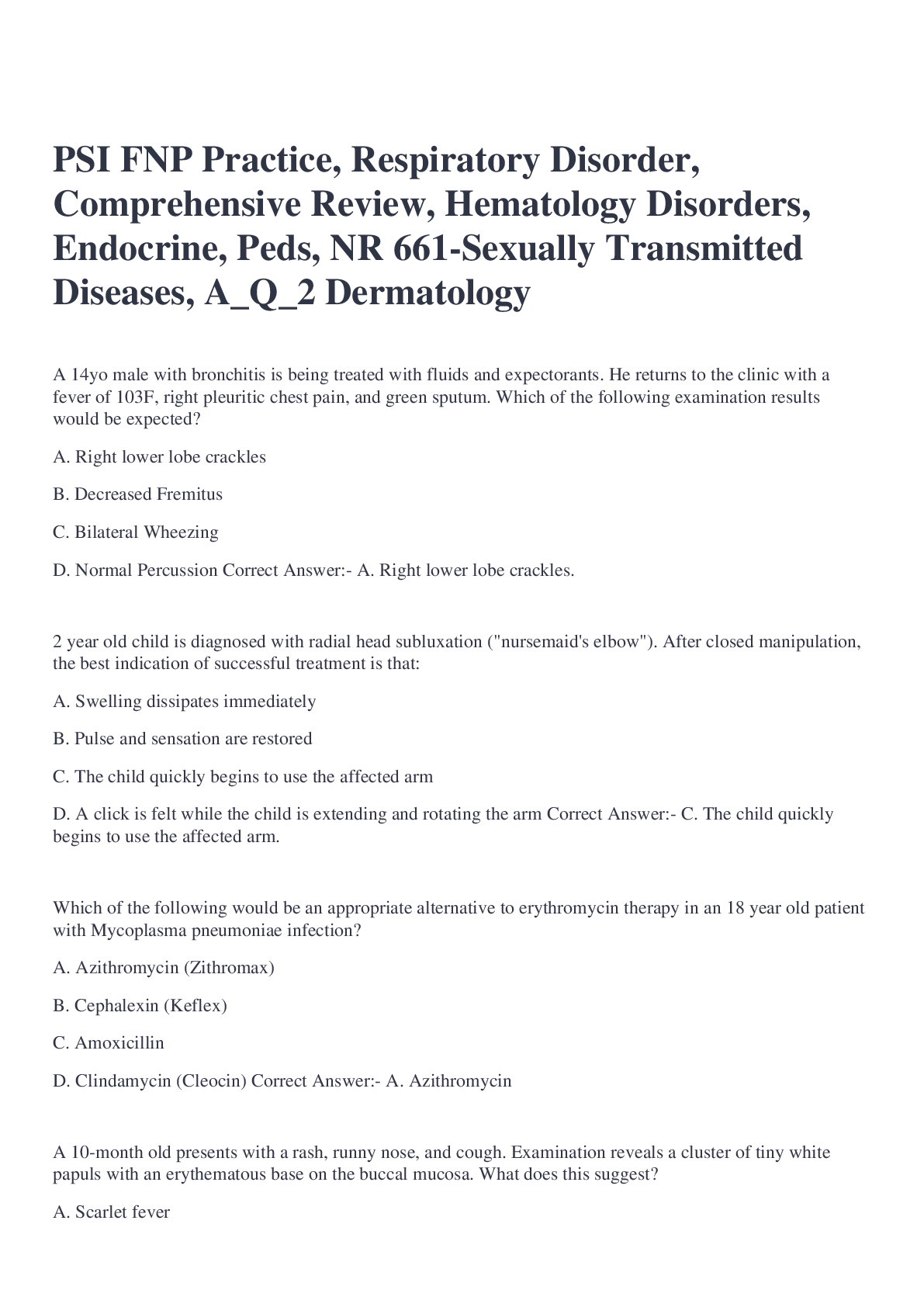
A 14yo male with bronchitis is being treated with fluids and expectorants. He returns to the clinic with a
fever of 103F, right pleuritic chest pain, a
...
PSI FNP Practice Questions and
answers, 100% Accurate. Graded A
A 14yo male with bronchitis is being treated with fluids and expectorants. He returns to the clinic with a
fever of 103F, right pleuritic chest pain, and green sputum. Which of the following examination results
would be expected?
A. Right lower lobe crackles
B. Decreased Fremitus
C. Bilateral Wheezing
D. Normal Percussion - ✔✔A. Right lower lobe crackles.
2 year old child is diagnosed with radial head subluxation ("nursemaid's elbow"). After closed
manipulation, the best indication of successful treatment is that:
A. Swelling dissipates immediately
B. Pulse and sensation are restored
C. The child quickly begins to use the affected arm
D. A click is felt while the child is extending and rotating the arm - ✔✔C. The child quickly begins to use
the affected arm.
Which of the following would be an appropriate alternative to erythromycin therapy in an 18 year old
patient with Mycoplasma pneumoniae infection?
A. Azithromycin (Zithromax)
B. Cephalexin (Keflex)
C. Amoxicillin
D. Clindamycin (Cleocin) - ✔✔A. Azithromycin
A 10-month old presents with a rash, runny nose, and cough. Examination reveals a cluster of tiny white
papuls with an erythematous base on the buccal mucosa. What does this suggest?
A. Scarlet fever
B. Rubella
C. Erythema infectiosum
D. Measles - ✔✔D. Measles
Office Spriometry performed with an albuterol nebulizer treatment can confirm a diagnosis of asthma
because it indicates:
A. Oxygen saturation
B. Whether airway obstruction is from pulmonary fibrosis
C. Chronic carbon dioxide retention
D. Whether a patient has reversible airway obstruction - ✔✔D. Whether a patient has reversible airway
obstruction
An 18yr old patient presents with complaints of maxillary facial pain and yellow nasal discharge for 14
days. What is the appropriate initial pharmacologic intervention?
A. Amoxicillin-Clavulanate (Augmentin)
B. Ceftriaxone (Rocephin)
C. Levofloxacin (Levaquin)
D. Erythromycin - ✔✔A. Amoxicillin-Clavulanate (Augmentin)
Which of the following is the leading cause of cancer-related deaths in the majority of women?
A. cervical Cancer
B. Ovarian Cancer
C. Breat Cancer
D. Lung Cancer - ✔✔D. Lung Cancer
A 29-year old male with noncomplicated Chlamidia infection may exhibit:
A. Urticaria
B. No remarkable clinical symptoms
C. A green mucoid penile discharge
D. A penile ulcer - ✔✔B. No remarkable clinical symptoms
To assess a patient's ability to think abstractly, a nurse practitioner could ask the patient:
A. The meaning of a common proverb
B. What action the patient would take if their was a fire in the house
C. To count backwards from 100 by 7s
D. To spell a word backward. - ✔✔A. The meaning of a common proverb
A common rule to follow when prescribing many medications for the elderly is to:
A. Give most medications in the morning to allow slowed body functions to have time to adjust to the
drug.
B. Start at a lower dose than what is commonly prescribed for adults, and increase the dose slowly.
C. Perform a creatinine clearance test for baseline data on all person over age 70 before starting on new
medications.
D. Give medication with a full glass of water to promote absorption and limit harm to the kidneys. -
✔✔B. Start at a low dose than what is commonly prescribed for adults, and increase the dose slowly.
A 72 year old female presents with a medical history unremarkable except for the occasional headache.
She enjoyed emotional health throughout marriage and childrearing, although her family history is
significant for strokes and nervous breakdowns. Since her husband died a year ago, however, she has
been waking every morning at 3am, is reluctant to go out although she has family member living nearby,
and feels a continual urge to sleep. She cannot discuss her late husband without crying. Differential
diagnoses would include:
A. Stroke, depression, and hyperthyroidism
B. Depression, Unresolved grief, and hypothyroidism
C. Migraine, anxiety disorder, and hypertension
D. Dementia, delirium, and pna - ✔✔B. Depression, Unresolved grief, and hypothyroidism
The parent of a 13-year old diagnosed with seizure disorder calls to report that the child is exhibiting
symptoms of a cold, but has no fever. The nurse practitioner should advise the parent that development
of fever may:
A. make the seizure medication less effective
B. Lower the seizure threshold
C. Increase the seizure threshold
D. Have no effect on the seizure threshold - ✔✔B. Lower the seizure threshold
After a 3-week camping trip, an 11-year old is seen for a target lesion with central clearing, located in
the inguinal area. The patient has had a severe headache, malaise, fatigue, and generalized
musculoskeletal pain for several days. Pharmacologic management of this condition includes:
A. trimethoprim-sulamethoxazole (Bactrim)
B. Azithromycin (Zithromax)
C. Metronidazole (Flagyl)
D. Doxycycline (Doryx) - ✔✔D. Doxycycline
An 88 year old male presents with concerns about memory loss. He feels good, takes an aspirin daily,
and has no chronic diseases. He lives alone, drives his own car, and manages his financial affairs. To
evaluate his memory, which of the following tests should the nurse practitioner choose?
A. Folstein Mini-Mental State examination
B. Geriatric Depression Scale
C. Minnesota Multiphasic Personality Inventory
Myers-Briggs Test - ✔✔A. Folstein Mini-mental state examination
During development of a treatment plan for an 84 year old patient with hypothyroidism, the nurse
practitioner has to keep in mind the worsening of:
A. renal insufficiency
B. Osteoporosis
C. Dementia
D. Anemia - ✔✔B. Osteoporosis
A 16 year old female in the first month of taking Ortho-Novum 7/7/7 complains of midcycle spotting.
She hasn't missed any doses and uses no other medication. Which of the following is appropriate?
A. Modifying use
B. Double dosing for 2 days
C. Changing to Ortho-Novum 1/35
D. Providing reassurance - ✔✔D. Providing reassurance
The management of choice for polymyalgia rheumatica includes:
A. whirlpool
B. Prednisone
C. Anelgesics
D. Celebrex - ✔✔B. Prednisone
A 50 year old male presents with a chief complaint of malaise. Further questioning reveals that his
primary concern is delayed ejaculation. He is currently taking the following medications: atenolol
(Tenormin), 50 mg daily; paroxetine (Paxil), 20 mg daily; loratadine (Claritin-D), 1 tablet daily; and
hydrochlorthoriazide (HCTZ), 25 mg daily. The most likely cause of the patient's concern would be:
A. loratadine
B. hydrochlorthoriazide (HCTZ)
C. lisinopril (Zestril)
D. paroxetine (Paxil) - ✔✔D. Paroxetine (Paxil)
A 3 year old patient presents at an inner-city clinic with fever, cough, malaise, and loss of appetite. The
patient lives with several relatives, including a grandmother who also has a cough. Which of the
following diagnostic tests would be most appropriate for the patient?
A. throat culture
B. sputum culture
C. Mantoux (PPD) skin test
D. Cold agglutinin test - ✔✔B. Sputum culture
A 25-year old presents with the chief complaint of decreased mobility and pain of the right shoulder
exacerbated with movement. The patient reports that he participated in extensive house painting 24
hours prior to the onset of pain. He denies any trauma. Passive ROM is intact. No redness or ecchymosis
is present. What is the next step that should be taken in order to make a diagnosis?
A. Palpate structures around the shoulder
B. Obtain an MRI to evaluate the shoulder
C. Order an Xray of the shoulder
D. Request an EMG - ✔✔A. Palpate the structures around the shoulder
A 17 year old femlae has never had her menses. She is at Tanner stage III of sexual development. Her
physical exam in completely normal, and her weight is appropriate for her age and height. What is the
most likely diagnosis?
A. Ovarian dysgenesis
B. Dysmenorrhea
C. Primary amenorrhea
D. Secondary amenorrhea - ✔✔C. Primary amenorrhea
An 18-month old child presents with a bulging, immobile tympanic membrane; T-103F(39.4C).
Assessment also reveals a grade II/VI systolic murmur at the left sternal border. After initiation of
treatment for otitis media, the most appropriate intervention is to:
A. Obtain an EKG
B. Obtain an Echocardiogram
C. Reevaluate the patient in 10 days
D. Refer the patient to a cardiologist - ✔✔C. Reevaluate the patient in 10 days
Which of the following is NOT an indication of preeclampsia?
A. visual disturbances
B. Glucosuria
C. Edema of the face and hands
D. Headaches - ✔✔B. Glucosuria
Which of the following pharmacotherapeutics would be most important to administer to a patient who
has a corneal abrasion?
A. Olopatadine (Patanol)
B. Cromolyn opthalmic (Crolom)
C. Timolol (Timoptic)
D. Gentamycin Opthalmic (Genoptic) - ✔✔D. Gentamycin Opthalmic (Genoptic)
An 88 year old patient presents with right-sided weakness after being unable to rise unassisted following
a fall to the bathroom floor. History includes aphasia and noncompliance with hypertension medication
regimen. What is the most likely diagnosis?
A. Seizure
B. Right-sided Stroke
C. Left-sided stroke
D. Trans ischemic attack - ✔✔C. Left-sided Stroke
A nurse pracitioner is evaluating a 40 year old patient suspected of having a pulmonary embolus. The
patient complains of anxiety and cough. A stat chest x-ray is normal. Which of the following tests should
the nurse practitioner perform next?
A. Spirometry
B. MRI
C. Contrast venography
D. Helical CT pulmonary angiography - ✔✔D. Helical CT pulmonary angiography
A routine laboratory assessment of a 12 year old patient with a family history of thalassemia and anemia
reveals Tanner II presentation and Hct=355. In addition to a complete blood count (CBC), the nurse
practitioner should order which of the following?
A. serum folic acid
B. Vitamin B12 level
C. Hemoglobin Electrophoresis
D. 24-hour urine creatinine - ✔✔C. Hemoglobin electrophoresis
A patient who is 28 weeks pregnant reports a single episode of vaginal bleeding. History indicates
normal prenatal progress to date, and the patient denies pain, vaginal itching, or discharge. Which of the
following is the most appropriate intervention to aid in the diagnosis of this case?
A. Nitrazine test
B. Non-Stress test
C. Ultrasound
D. Bimanual cervical exam - ✔✔C. Ultrasound
The common bacteria responsible for pneumonia in older adults residing in the community is:
A. Staphylococcus aureus
B. Streptococcus pneumoniae
C. Pseudomonas Aeruginosa
D. Moraxelle catarrhalis - ✔✔B. Strep Pneumo
A 40 year old male patient presents with a 2 week history of rectal pain and itching. He reports a past
history of constipation, and finding spots of bright red blood on toilet paper several times a week. Rectal
exam reveals a tender, swollen, bluish, ovoid mass. The stool guaiac test is negative. Which of the
following actions should the nurse practitioner take?
A. Prescribe diphenoxylate/atropine( Lomotil)
B. Schedule a colonoscopy to rule out colon cancer
C. Repeat the guaiac test three times and obtain complete blood count
D. Prescribe bulk forming agents and hydrocortisone suppositories. - ✔✔D. Prescribe bulk forming
agents and hydrocortisone suppositories.
A 17 year old female is suspected of having polycystic ovary syndrome. In addition to testosterone, the
most appropriate diagnostic tests to order would be:
A. BUN, creatinine, electrolytes, and dehydroepiandrosterone(DHEA)
B. CBC, BUN, creatinine, and estrone
C. Fasting blood sugar (FBS), complete blood count (CBC), BUN, and sex hormone binding globulin
D. Follicle-stimulating hormone (FSH), Luteinizing hormone (LH), prolactin, and thyroid-stimulating
hormone (TSH) - ✔✔D. FSH, LH, TSH
Which of the following wet-mount results confirms a preliminary diagnosis of bacterial vaginosis?
A. Squamous epithelial cells with stippling appearance and indistinct borders, no lactobacillus rods, and
many white cells
B. Squamous epithelial cells with clear cytoplasm and distinct borders, many lactobacillus rods, and
occasional WBC
C. Organisms about the size of white blood cells with undulating flagellum, occasional lactobacillus rods,
and many WBC
D. Hyphae and spores, few lactobacillus rods, and occasional WBC - ✔✔Squamous epithelial cells with
stippling appearance and indistinct borders, no lactobacillus rods, and many white cells.
A patient is referred with a diagnosis of diabetes mellitus, hypertension, and coronary artery disease.
The patient is on both insulin and a beta blocker. Assuming that the patient will continue the beta
blocker, it will be important to educate the patient on the recognition of hypoglycemia. Which symptom
would be most indicative of hypoglycemia in this patient?
A. edema
B. Tachycardia
C. Palpitations
D. Sweating - ✔✔D. Sweating
A 67-year old with type 2 diabetes mellitus, congestive heart failure, and mild coronary artery disease is
currently taking Digoxin, 0.25mg daily; HCTZ, 25mg daily; Metformin 500mg daily; glipizide 10mg daily;
and Atorvastatin (Lipitor) 20mg HS. Which of the following is an accurate statement regarding the
regimen?
A. The glipizide will increase the risk of potassium depletion.
B. The digoxin will increase the risk of hypoglycemia
C. The HCTZ will predispose the patient to Digoxin toxicity
D. The atorvastatin will worsen the diabetes. - ✔✔C. The HCTZ will predispose the patient to Digoxin
toxicity
The initial therapy for a 3 week old infant with uncomplicated symptoms of gastroesophageal reflux
disease includes of the following positions and change in diet?
A. Prone position and rotate formulas in order to find one that causes less reflux
B. Smaller, more frequent feedings while holding infant
C. Semisupine position and offer more ounces of formula less frequently
D. Lateral position and start small amounts of solid food with formula - ✔✔Smaller, more frequent
feedings while holding infant.
Which of the following best describes psoriatic lesions in an elderly patient?
A. Shiny, purple, smooth lesions
B. Localized erythematous vesicles
C. Erythematous plagues with central clearing
D. Red, sharply defined plaques with silvery scales - ✔✔D. Red, sharply defined plaques with silvery
scales
A 68-yo female presents with a new onset of left-sided throbbing headache. She has noticed some spots
in her visual fields that come and go. She is being treated with an NSAID for arthritis. Sedimentation rate
is elevated, but all other lab values are WNL. The headache is most likely due to:
A. TIA
B. NSAID induced headache
C. Temporal arteritis
D. Glaucoma - ✔✔C. Temporal arteritis
A patient with Type 1 diabetes mellitus who is on NPH and regular insulin split-dosing presents with
complaints of early morning rise in fingerstick blood glucose. A review of an at-home glucose test
reveals increased morning levels. After an increase in the evening insulin dose, the problem worsens.
This is most likely an example of:
A. Insulin resistance
B. Cortisol deficiency
C. the Somogyi effect
D. pawn phenomenon - ✔✔C. the Somogyi effect
An 18 yo college student presents for an athletic physical. When asked about current medications, she
mentions that she takes "some hearb" she bought at a health food store for migrains and menstrual
cramps. Which of the following herbal remedies has been commonly used for these conditions?
A. Ephedra
B. Echinacea
C. Feverfew
D. Ginko Biloba - ✔✔C. Feverfew
Which of the following GI changes in associated with normal aging?
A. Decreased production of gastric acid
B. Decreased incidence of gallstones
C. Increased salivation
D. Increased esophageal emptying - ✔✔A. Decreased production of gastric acid.
A 32 year old patient reports a 6-month history of intermittant symmetrical swelling of the wrists and
daily morning stiffness lasting 1 hour or more in and around other joints. What is the most likely
diagnosis?
A. Rheumatoid arthritis
B. Osteoarthritis
C. Gouty arthritis
D. Reiter's syndrome - ✔✔A. Rheumatoid Arthritis
An 85 year old patient related that on the way to an annual physical exam, the patient suffered a sudden
loss of vision in the right eye characterized by a "bunch of lights" and a feeling that " a curtain came
down" The most likely diagnosis is:
A. Vitreal hemorrhage
B. Optic nerve lesion
C. Central retinal nerve occlusion
D. Retinal Detachment - ✔✔D. Retinal detachment
Assessment findings that would support a diagnosis of mitral regurgitation include:
A. atrial fibrillation with summation gallop
B. Loud, high-pitched pansystolic murmur
C. Diastolic murmur with split S1
D. Early diastolic murmur with an S3 wave. - ✔✔B. Loud, high-pitched pansystolic murmur
During an employment physical exam of a 21-year old female, bruising around the areola on the breasts
is noted. An appropriate health history for these findings should include all of the following EXCEPT:
A. Current social relatonships
B. History of present or past traumas
C. Mental health status
D. Socioeconomic status. - ✔✔D. Socioeconom
[Show More]