ACLS MUST KNOW Updated (2022/2023)
Revisions
What is the recommended compression depth for adults and children?
2 inches
What is the recommended compression depth for infants?
1 1/2 inches
What can result if a pati
...
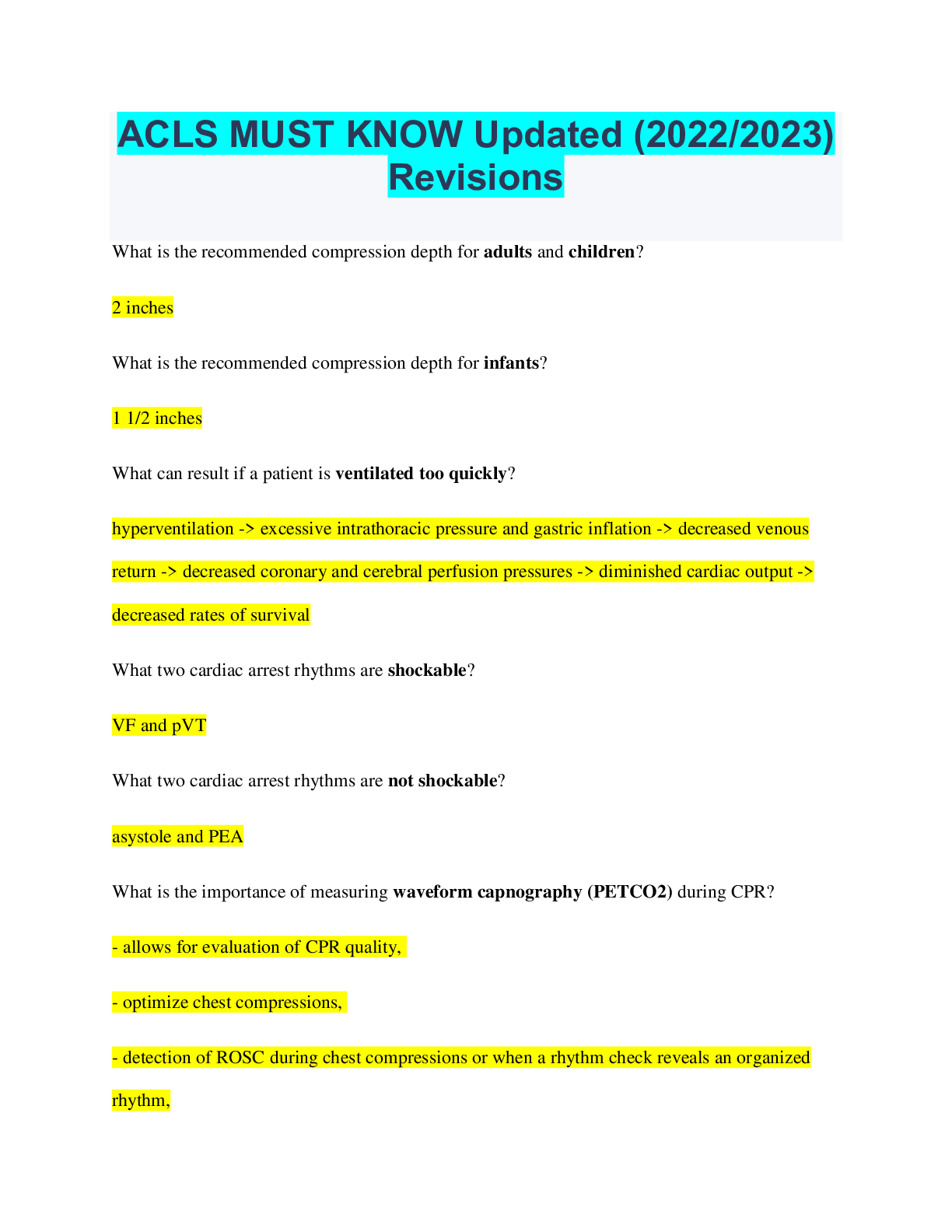
ACLS MUST KNOW Updated (2022/2023)
Revisions
What is the recommended compression depth for adults and children?
2 inches
What is the recommended compression depth for infants?
1 1/2 inches
What can result if a patient is ventilated too quickly?
hyperventilation -> excessive intrathoracic pressure and gastric inflation -> decreased venous
return -> decreased coronary and cerebral perfusion pressures -> diminished cardiac output ->
decreased rates of survival
What two cardiac arrest rhythms are shockable?
VF and pVT
What two cardiac arrest rhythms are not shockable?
asystole and PEA
What is the importance of measuring waveform capnography (PETCO2) during CPR?
- allows for evaluation of CPR quality,
- optimize chest compressions,
- detection of ROSC during chest compressions or when a rhythm check reveals an organized
rhythm,
- ET tube placement
What is an adequate waveform capnogrpahy (PETCO2) range?
35-45 mm Hg
What is the appropriate tidal volume for adult cardiac arrest patients?
500-600 mL or 6-7 mL/kg (half a squeeze of an adult ventilation bag; enough to see visible chest
rise)
Single rescuers should use the compression-to-ventilation ratio of ____ compressions to ____
breaths when giving CPR to victims of any age.
30:2
At what rate should compressions occur?
100-120/min
Interruptions in chest compressions should be limited to how many seconds?
<10
Rescuers should switch compressors how often?
every 5 cycles (2 min) or sooner if fatigued
What method should be utilized when opening the airway of a patient who is suspected of having
a head or neck injury?
jaw thrust
Which pulse is palpated when performing a BLS assessment on an adult?
carotid
What do agonal gasps represent?
not normal breathing may sound like a snort, snore, or groan; is a sign of cardiac arrest
When should the victim be moved during chest compressions?
never unless the victim is in a dangerous environment (such as a burning building) or if you
believe you cannot perform CPR effectively in the victim's present position or location
When placing AED pads on a patient with an implanted defi
[Show More]

![Preview of ALS/ACLS - Red Cross Final Exam [2022/2023] Graded A+](https://browseimages.nyc3.digitaloceanspaces.com/paper-images/2023/Jun/05/e2eKrAsv2023-06-05-08-35647e1cdb3eb04.png)