ACLS Final Exam Questions and
Answers Rated A+
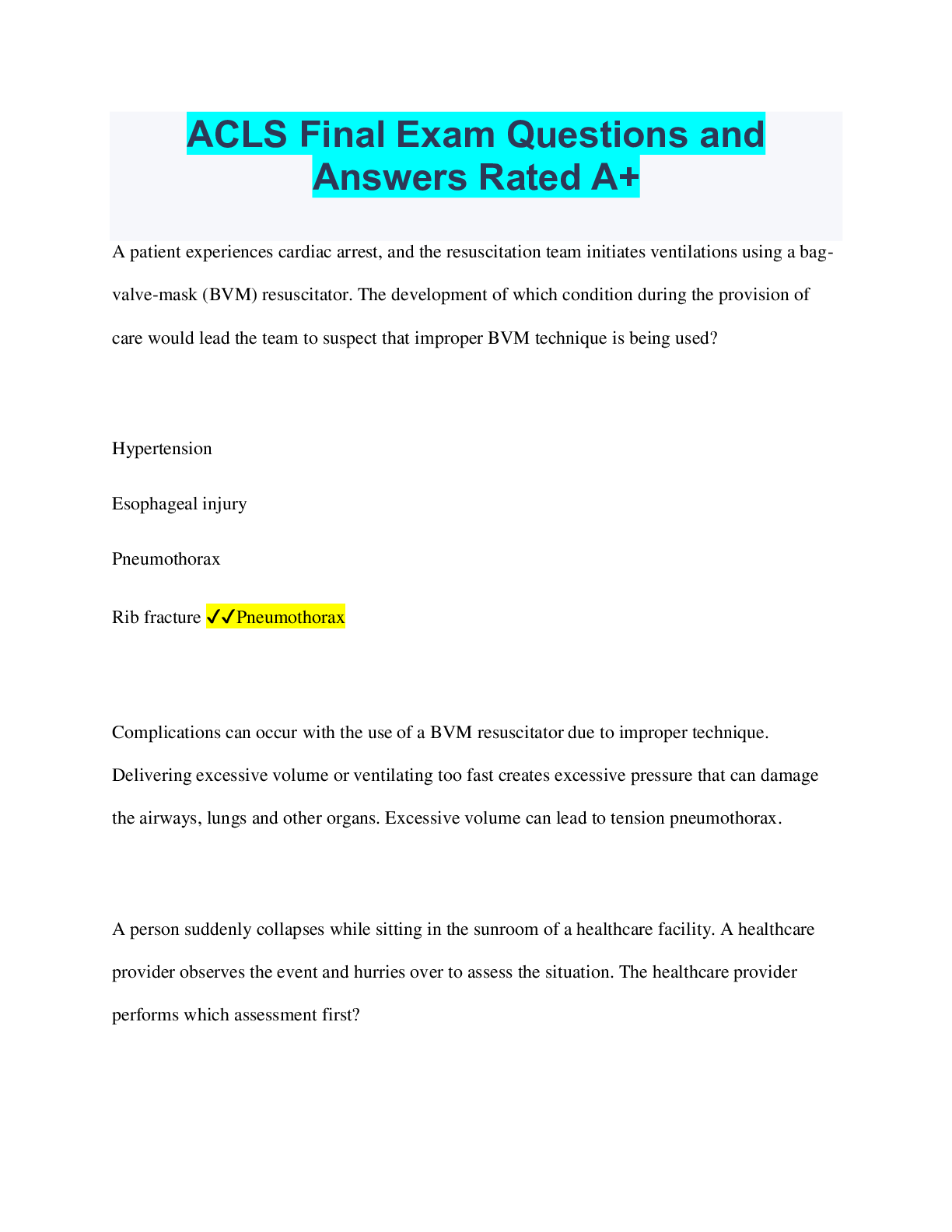
A patient experiences cardiac arrest, and the resuscitation team initiates ventilations using a bagvalve-mask (BVM) resuscitator. The development of which condition during
...
ACLS Final Exam Questions and
Answers Rated A+
A patient experiences cardiac arrest, and the resuscitation team initiates ventilations using a bagvalve-mask (BVM) resuscitator. The development of which condition during the provision of
care would lead the team to suspect that improper BVM technique is being used?
Hypertension
Esophageal injury
Pneumothorax
Rib fracture ✔✔Pneumothorax
Complications can occur with the use of a BVM resuscitator due to improper technique.
Delivering excessive volume or ventilating too fast creates excessive pressure that can damage
the airways, lungs and other organs. Excessive volume can lead to tension pneumothorax.
A person suddenly collapses while sitting in the sunroom of a healthcare facility. A healthcare
provider observes the event and hurries over to assess the situation. The healthcare provider
performs which assessment first?
Rapid assessment
Basic life support assessment
Secondary assessment
Primary assessment ✔✔Rapid assessment
A systematic approach to assessment is necessary. The healthcare provider should first perform a
rapid assessment. A rapid assessment is a visual survey to ensure safety, form an initial
impression about the patient's condition (including looking for life-threatening bleeding), and
determine the need for additional resources. This would be followed by a primary assessment
and then a secondary assessment.
A patient is receiving ventilation support via bag-valve-mask (BVM) resuscitator. Capnography
is established and a blood gas is obtained to evaluate the adequacy of the ventilations. Which
arterial carbon dioxide (PaCO2) value signifies adequate ventilations?
10 to 15 mmHg
20 to 25 mmHg
25 to 30 mmHg
35 to 45 mmHg ✔✔35 to 45 mmHg
Arterial carbon dioxide (PaCO2) values in the range of 35 to 45 mmHg confirm adequacy of
ventilation.
A resuscitation team is debriefing following a recent event. A patient experienced cardiac arrest,
and advanced life support was initiated. The patient required the placement of an advanced
airway to maintain airway patency. Which statement indicates that the team performed highquality CPR?
"We initiated chest compressions at a rate of 100 to 110 per minute to a depth of 2.4 inches and
then gave 1 ventilation every 10 seconds."
"We provided chest compressions at a rate of 100 to 120 compressions per minute while giving 1
ventilation every 6 seconds without pausing compressions."
"We provided chest compressions at a rate of 80 to 120 per minute to a depth of at least 2 inches
and gave 1 ventilation every 6 seconds without pausing compressions."
"We kept the rate of chest compressions to around 100 per minute but adjusted their depth to 1.5
inches while giving 1 ventilation every 3 seconds without pausing compressions." ✔✔"We
provided chest compressions at a rate of 100 to 120 compressions per minute while giving 1
ventilation every 6 seconds without pausing compressions."
[Show More]

![Preview of ALS/ACLS - Red Cross Final Exam [2022/2023] Graded A+](https://browseimages.nyc3.digitaloceanspaces.com/paper-images/2023/Jun/05/e2eKrAsv2023-06-05-08-35647e1cdb3eb04.png)