ALS/ACLS - Red Cross Final Exam
[2022/2023] Graded A+
The resuscitation team suspects that hyperkalemia is the cause of cardiac arrest in a patient
brought to the emergency department. Which finding on a 12-lead ECG w
...
ALS/ACLS - Red Cross Final Exam
[2022/2023] Graded A+
The resuscitation team suspects that hyperkalemia is the cause of cardiac arrest in a patient
brought to the emergency department. Which finding on a 12-lead ECG would confirm this
suspicion? ✔✔Wide-complex ventricular rhythm or tall, pointed T waves
A patient with dyspnea and a change in mental status arrives at the emergency department. The
healthcare team completes the necessary assessments and begins to care for the patient, including
initiating cardiac monitoring, pulse oximetry, supplemental oxygen and vascular access. The
team reviews the patient's ECG rhythm strip, as shown in the following figure. Which agent
would the team most likely administer? ✔✔Atropine 0.5 mg every 4 to 5 minutes
A patient experiencing an unstable bradyarrhythmia does not respond to atropine or
transcutaneous pacing. Which intervention would the healthcare provider use next?
✔✔Administration of an epinephrine infusion
A patient's ECG reveals a tachyarrhythmia. The patient is hemodynamically stable and has a
heart rate ranging from 120 to 135 beats per minute. Based on the findings of the secondary
assessment, which statement(s) by the patient would the team interpret as a possible contributing
cause? ✔✔1. "I've had a terrible cold with a horrible cough and fever the past week."
2. "I've been so anxious lately because I just lost my job."
3. "I've been vomiting for the past 2 days from a gastrointestinal bug."
A patient's ECG reveals a narrow QRS complex with a regular rhythm, indicating a narrowcomplex supraventricular tachyarrhythmia. The patient is hemodynamically stable. Which
intervention would be initiated first? ✔✔Vagal maneuvers
A patient in the telemetry unit is stable. Cardiac monitoring indicates the patient has ventricular
tachycardia with a pulse. Further assessment reveals that the corrected QT interval is greater than
0.46 seconds. Which treatment would be appropriate at this time? ✔✔Synchronized
cardioversion
An ECG strip of a patient in the emergency department reveals the following rhythm. Which
feature would the healthcare provider interpret as indicating atrial fibrillation? ✔✔Absence of
discrete P waves and presence of irregularly irregular QRS complexes
A patient is brought into the emergency department. The patient does not have a pulse. The
cardiac monitor shows the following rhythm. The team interprets this as which condition?
✔✔Ventricular tachycardia
A patient with acute renal failure experiences cardiac arrest. Just before the cardiac arrest, the
patient's ECG showed peaked T waves. What might be causing the patient's cardiac arrest?
✔✔Hyperkalemia
A member of the resuscitation team is preparing to defibrillate a patient in cardiac arrest using a
biphasic defibrillator. The team member would set the energy dose according to the
manufacturer's recommendations, which is usually: ✔✔120 to 200 joules
A member of the resuscitation team is preparing to administer medications intravenously to a
patient in cardiac arrest. The team member follows each medication administration with a bolus
of fluid. How much would the team member give? ✔✔10 to 20 mL
A 30-year-old patient has been brought to the emergency department in full cardiac arrest. The
cardiac monitor shows the following rhythm. Interpretation of this rhythm would suggest which
of the following as a possible precipitating factor? ✔✔Electrocution
Cardiac monitoring of a patient in cardiac arrest reveals ventricular fibrillation. What
intervention would the team perform next? ✔✔Administer 1 shock.
A patient has experienced return of spontaneous circulation (ROSC) after cardiac arrest. The
healthcare team is conducting a secondary assessment to determine the possible cause of the
patient's cardiac arrest. Before the arrest, the patient exhibited jugular venous distension,
cyanosis, apnea and hyperresonance on percussion. The patient was also difficult to ventilate
during the response. The team would most likely suspect which condition as the cause?
✔✔Tension pneumothorax
A patient in cardiac arrest experiences return of spontaneous circulation. As part of post-cardiac
arrest care, the patient is receiving mechanical ventilation. Which finding(s) would indicate the
need for change in the ventilator settings to optimize the patient's ventilation and oxygenation?
✔✔1. SaO2 92%
2. PaCO2 35 mmHg
3. ETCO2 50 mmHg
After cardiac arrest and successful resuscitation, the patient has a return of spontaneous
circulation. The patient is unable to follow verbal commands and has a Glasgow Coma Scale
score of 7. Targeted temperature management is initiated. Which method(s) would be
appropriate for the resuscitation team to use? ✔✔1. Applying cooling blankets to the patient's
body
2. Giving an ice-cold IV fluid bolus
3. Using an endovascular catheter
A 40-year-old patient in the waiting room of the primary care provider's office approaches a staff
member and says, "I'm having really severe, crushing chest pain that is moving to both my
arms." The patient is diaphoretic and dyspneic. Which action would be appropriate for the staff
member to take? ✔✔Activate the emergency medical services system.
A patient with suspected acute coronary syndromes (ACS) is placed on a cardiac monitor. The
patient is complaining of dyspnea and is given supplemental oxygen. The provider determines
that the oxygen is effective based on which SaO2 level? ✔✔95%
A 35-year-old female patient's ECG is consistent with STEMI. The ECG reveals a new STsegment elevation at the J point in leads V2 and V3 of at least which size? ✔✔0.15 mV
A patient with STEMI is experiencing chest pain that is refractory to sublingual nitroglycerin.
Intravenous nitroglycerin is prescribed. When administering this medication, it would be titrated
to maintain which systolic blood pressure? ✔✔90 mmHg
A patient experiencing STEMI comes to the emergency department of a large medical center at
9:30 p.m. The patient states that the symptoms started about 8 p.m. After confirming the
diagnosis and initiating care, the healthcare team schedules the patient for percutaneous coronary
intervention (PCI). The facility is capable of administering PCI. To achieve the best outcomes,
therapy should be administered to this patient by which time? ✔✔11:00 p.m.
A patient presents to the emergency department with mild to moderate recurrent chest pain,
without any nausea or vomiting. A 12-lead ECG is obtained and shows ST-segment depression
with transient T-wave elevation indicative of NSTE-ACS. Cardiac enzyme levels are obtained
and are not elevated. These findings suggest which condition? ✔✔Unstable angina
A patient is being treated in the emergency department and is determined to have NSTE-ACS.
Invasive management is planned based on which finding? ✔✔Ventricular tachycardia
A patient presents to the emergency department with suspected ACS. Electrocardiogram and
cardiac biomarkers show the patient has ST-segment elevation myocardial infarction (STEMI).
Physical examination reveals signs of left ventricular dysfunction. Which finding(s) would
support this? ✔✔1. Pulmonary edema
2. Crackles
3. Hypotension
A patient with a diagnosis of ACS is experiencing cardiogenic shock. Which adjuvant therapy
would be contraindicated? ✔✔β-Blockers
A patient with a suspected stroke arrives at the emergency department at 7:10 p.m. The stroke
team ensures that a neurologic assessment and brain computed tomography or magnetic
resonance imaging is obtained by which time? ✔✔7:30 p.m.
A patient is brought to the emergency department by their spouse. The spouse says, "I think it's a
stroke." The stroke team initiates a rapid stroke assessment using the National Institutes of
Health Stroke Scale. Which area(s) would the team include in this assessment? ✔✔1. Language
deficits
2. Level of consciousness
3. Visual function
A patient comes to the emergency department with a suspected stroke. The patient is alert and
oriented and accompanied by a family member. The family member says, "I noticed he was
slurring his words and had trouble walking, like his leg was numb." After completing the
primary assessment, the stroke team completes a secondary assessment. Which finding would
suggest that the patient is experiencing a condition that mimics a stroke? ✔✔Hypoglycemia
The stroke team is assessing a patient with a suspected stroke. The patient is alert and able to
carry on a conversation, although the patient has difficulty getting the words out. Testing
confirms that the patient has had an ischemic stroke. Based on the patient's medical history, a
history of which arrhythmia would alert the team to the patient's increased risk for stroke?
✔✔Atrial fibrillation
A patient with an ischemic stroke arrives at the emergency department at 2 a.m. The patient's
symptoms started about 12:30 a.m. After completing the necessary assessments, the healthcare
team diagnoses an ischemic stroke, and the patient is determined to be a candidate for
fibrinolytic therapy. To achieve the best outcomes, the team should initiate therapy for this
patient no later than by which time? ✔✔3:00 a.m.
A patient enters the emergency department in respiratory compromise. The team is monitoring
the patient using capnography and identifies that ETCO2 levels are initially 33 mmHg and later
40 mmHg. From these readings, the team identifies that the patient is progressing in what stage
of respiratory compromise? ✔✔Respiratory distress
The ECG rhythm strip of a patient who arrived in the emergency department complaining of
dizziness, syncope and shortness of breath reveals sinus bradycardia. When reviewing the
patient's medication history, the healthcare provider identifies which agent(s) as a potential cause
of the patient's current condition? ✔✔1. Metoprolol
2. Verapamil
3. Digoxin
A person suddenly collapses while sitting in the sunroom of a healthcare facility. A healthcare
provider observes the event and hurries over to assess the situation. The healthcare provider
performs which assessment first? ✔✔Rapid assessment
A healthcare provider initiates ventilations to ensure adequate breathing and oxygenation. While
ventilations are being performed, capnography is established to evaluate the adequacy of the
ventilations. The healthcare provider determines that ventilations are adequate based on which
end-tidal carbon dioxide (ETCO2) value? ✔✔35 to 45 mmHg
A healthcare provider is establishing cardiac monitoring using a five-electrode system. The
healthcare provider demonstrates proper use of the system by placing the green electrode in
which location? ✔✔On the lower right abdomen
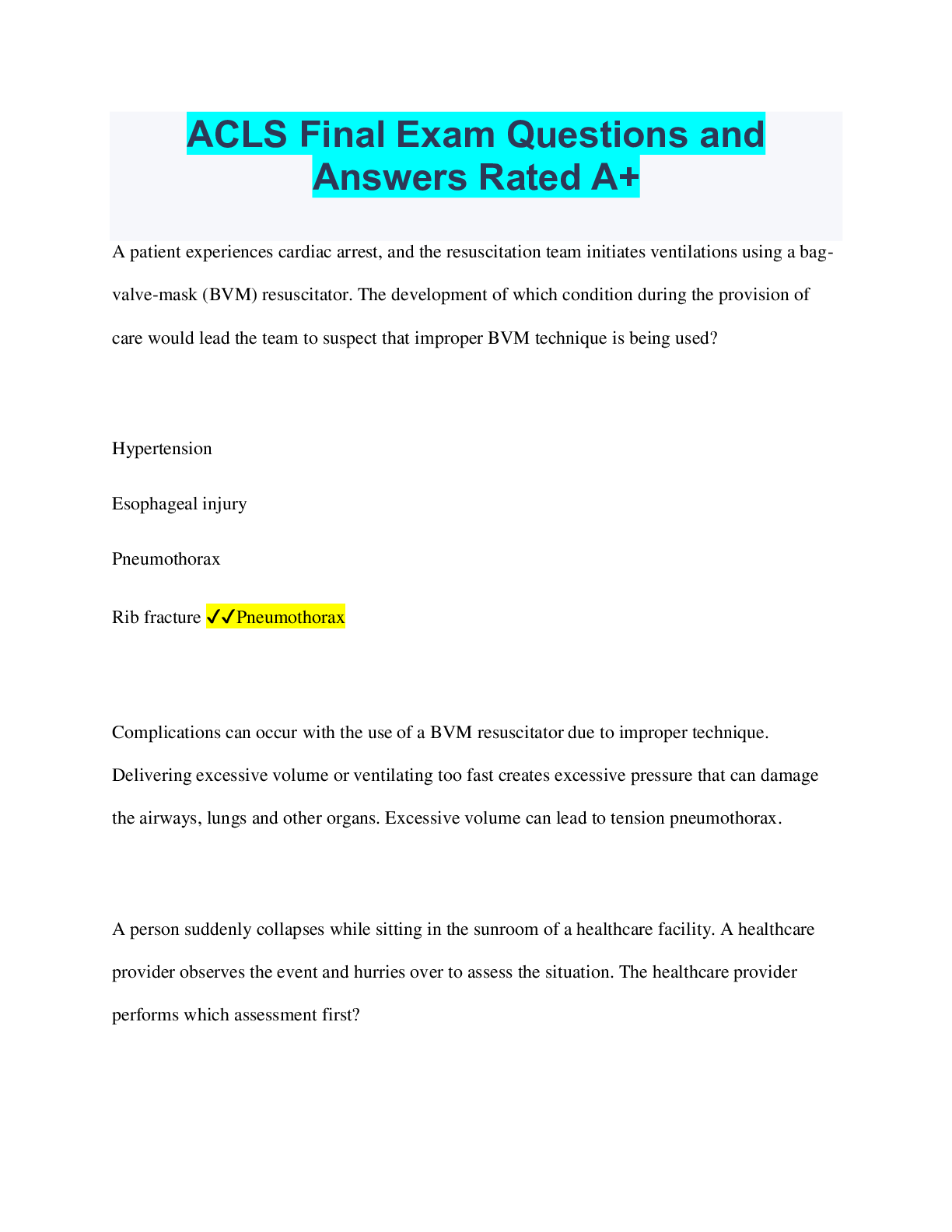
A patient experiences cardiac arrest, and the resuscitation team initiates ventilations using a bagvalve-mask (BVM) resuscitator. The development of which condition during the provision of
care would lead the team to suspect that improper BVM technique is being used?
✔✔Pneumothorax
A resuscitation team is debriefing following a recent event. A patient experienced cardiac arrest,
and advanced cardiac life support was initiated. The patient required the placement of an
advanced airway to maintain airway patency. Which statement indicates that the team performed
high-quality CPR? ✔✔"We delivered 1 ventilation every 6 seconds and chest compressions at a
rate of 100 to 120 compressions per minute."
Assessment of a patient reveals an ETCO2 level of 55 mmHg and an arterial oxygen saturation
(SaO2) level of 88%. The provider would interpret these findings as indicative of which
condition? ✔✔Respiratory failure
A patient's capnogram reveals the following waveform. Which segment would the healthcare
provider interpret as reflecting the beginning of exhalation? ✔✔A-B
A patient arrives at the emergency department complaining of shortness of breath. The patient
has a long history of chronic obstructive pulmonary disease. Assessment reveals respiratory
failure. Which action would be the initial priority? ✔✔Assisted ventilation with BVM
resuscitator
A 20-year-old man with respiratory depression is brought to the emergency department by his
parents. The parents state that "[They] found him at home with various needles and syringes
around him, but [they] have no idea what he took." Opioid overdose is suspected, and an initial
dose of naloxone is administered at 10 p.m. The patient does not respond to this initial dose. The
team would expect to administer a second dose after how many minutes? ✔✔4 minutes
Assessment of a patient in the emergency department reveals that the patient is experiencing
respiratory compromise. From the assessment, the team identifies that the patient is in the earliest
stage of this condition. Which stage would this be? ✔✔Respiratory distress
The following capnogram is from a patient experiencing respiratory distress. At which point in
the waveform would the patient's ETCO2 level be measured? ✔✔D
A patient is experiencing respiratory distress secondary to an exacerbation of chronic obstructive
pulmonary disease. The patient begins to exhibit signs and symptoms of worsening respiratory
function and experiences respiratory arrest. The team intervenes, delivering ventilations via
BVM resuscitator. The team would deliver 1 ventilation at which interval? ✔✔Every 5 to 6
seconds
A patient is brought into the emergency department with a suspected opioid overdose. The
patient is in cardiac arrest. Which action would be the team's priority? ✔✔Initiating high-quality
CPR
A patient in the telemetry unit is receiving continuous cardiac monitoring. The patient has a
history of myocardial infarction. The patient's ECG rhythm strip is shown in the following
figure. The provider interprets this strip as indicating which arrhythmia? ✔✔Third-degree AV
block
A patient comes to the emergency department complaining of palpitations and "some shortness
of breath." Cardiac monitoring is initiated and reveals the following ECG rhythm strip. The
provider interprets this strip as indicating which arrhythmia? ✔✔Atrial flutter
The emergency department team is providing care to a patient who is experiencing ventricular
tachycardia. The patient's serum electrolyte levels are a contributing cause of the patient's current
condition. Which electrolyte imbalance(s) would most likely be involved? ✔✔1.
Hypomagnesemia
2. Hypocalcemia
[Show More]
![Preview of ALS/ACLS - Red Cross Final Exam [2022/2023] Graded A+](https://browseimages.nyc3.digitaloceanspaces.com/paper-images/2023/Jun/05/e2eKrAsv2023-06-05-08-35647e1cdb3eb04.png)