RELI 448N Week 4 Midterm
Question 1
2 / 2 Points A worldview that sees all elements of nature as being filled with spirit or spirits is called: Animism
Polytheism Atheism Pantheism
The belief that reality is ma
...
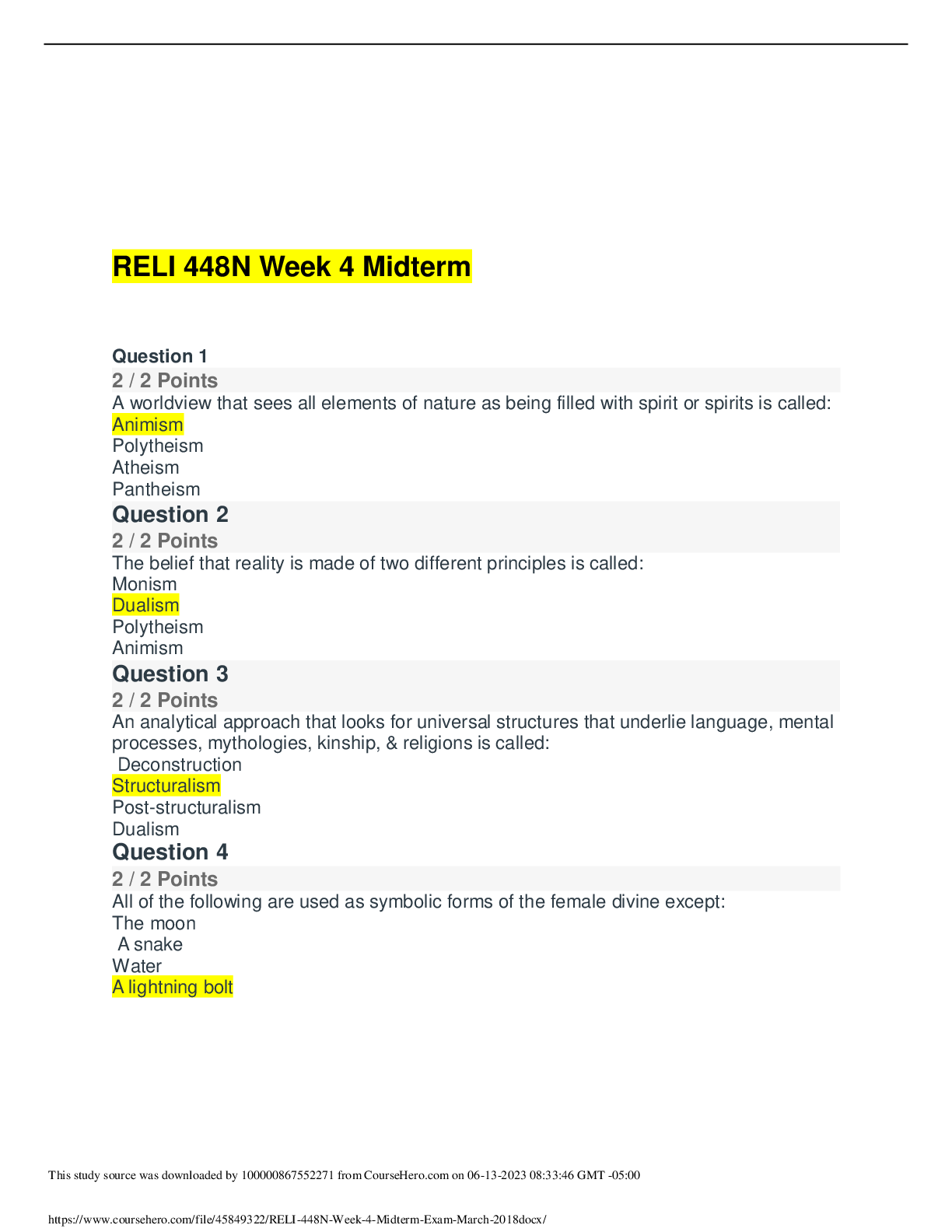
RELI 448N Week 4 Midterm
Question 1
2 / 2 Points A worldview that sees all elements of nature as being filled with spirit or spirits is called: Animism
Polytheism Atheism Pantheism
The belief that reality is made of two different principles is called:
Monism Dualism Polytheism Animism
An analytical approach that looks for universal structures that underlie language, mental
processes, mythologies, kinship, & religions is called:
Deconstruction Structuralism Post-structuralism Dualism Question 4
2 / 2 Points
All of the following are used as symbolic forms of the female divine except: The moon
A snake Water
A lightning bolt
Question 5
2 / 2 Points The philosophical position that all apparently separate realities are ultimately one is called:
Dualism Transcendent Monism
Yoga
Question 6
2 / 2 Points
Which of the following is not seen as being an avatar of Vishnu? Rama
Buddha Shiva Krishna
Question 7
2 / 2 Points
Which of the following is not one of the 4 Life Stages of Hinduism? Student
Business Owner Renunciate Retiree Question 8
0 / 2 Points True or False: The presence of female divinities means that women have always enjoyed equality & fair treatment in the religious traditions of India.
True False
Question 9
2 / 2 Points
A spiritual teacher to whom devotion may be directed is called a: Sage
Brahmin Guru Avatar
Question 10
2 / 2 Points
A state of complete inner peace, resulting from meditation, is called: Dhyana
Samadhi Yoga Maya
Question 11
2 / 2 Points
In Hinduism, that which keeps us from seeing reality correctly is: Moksha
Maya Karma Atman
The Buddha who is expected to appear on Earth in the future is: Maitreya
Amitabha Guanyin Shakyamuni
This term literally means impermanence:
Anatta Anicha Bodhi Satori
Question 14
2 / 2 Points
The Mahayana notion of emptiness is called:
Bodhi Samsara Shunyata Tathata
Question 15
2 / 2 Points
A sacred text that records the words of the Buddha is called a: Vinaya
Abhidharma Sutra
Stupa
Question 16
2 / 2 Points
Which of the following is not one of the Three Jewels of Buddhism? Dharma
Sangha Bodhi Buddha
Question 17
2 / 2 Points The school of Buddhism that focuses on meditation & monastic discipline, calling itself the “Way of the Elders,” is:
Theravada Bhakti Mahayana Dukkha Question 18
2 / 2 Points The receptive aspect of reality that expresses itself in silence, darkness, & coolness is called:
Yin Yang Dao Wu wei
Question 19
0 / 2 Points
After the Bible, the “ ” is the world’s most frequently translated book. Analects
Daodejing Five Classics Zhuangzi
Question 20
2 / 2 Points
The “second sage” of Confucianism was:
Zhuangzi Mencius Laozi
Li Bai
Question 21
Not yet graded / 25 Points Compare & contrast Sigmund Freud's theory about the origin of religions with William James's theory. How does each of these psychologists view religion (positively or negatively)? Now analyze how the insights of Freud orJames might illuminate one of the religious traditions we have studied so far. How would Freud or James underst& that tradition? Use specific examples to support your answer (e.g., a specific belief or ritual). Your Answer:
Sigmund Freud believed that there were subconscious levels within the mind. He felt that if we could under dreams then we could underst& our needs & fears. Freud spent a lot of his career trying to underst& religion. He wrote many books on it, but he believed that religion was just an expression. He felt that it was another form of control within social groups.
William James on the other h& felt completely different about religion. He believed that religion significantly impacted your mind & body. He felt it was something very positive, it provided safety & “harmonious relation with the universe” (Molloy, 2012).
The religions we have studied so far are very strong in nature. The people who follow them truly believe in what they learn & that it is a way of their life. I believe according that they follow more of how William James felt about religion. What they believe in gives them comfort & many believe it does keep them in sync with the universe.
It would be easier for James to underst& the traditions of the Chinese & within Hinduism more than Freud would understand. Both religions have very strong beliefs about things & how things should be done. Freud could argue, why would you give someone so much power, trying to learn how to meditate, or trying to reach nirvana. James may find the good in nirvana. It is so simple, & finding the ultimate peace should be something that all people want to achieve in life.
Reference:
Molloy, Michael. Experiencing the World's Religions, 6th Edition. McGraw-Hill Learning Solutions, 11/2012. VitalBook file.
[Show More]