Chapter 10 QuickBooks Questions and
Answers Already Passed
In Chapter 10, use the ______________________ to reconcile Account 101 Checking.
a. Activity list.
b. Account and Settings.
c. Vendor purchases.
d. Bank st
...
Chapter 10 QuickBooks Questions and
Answers Already Passed
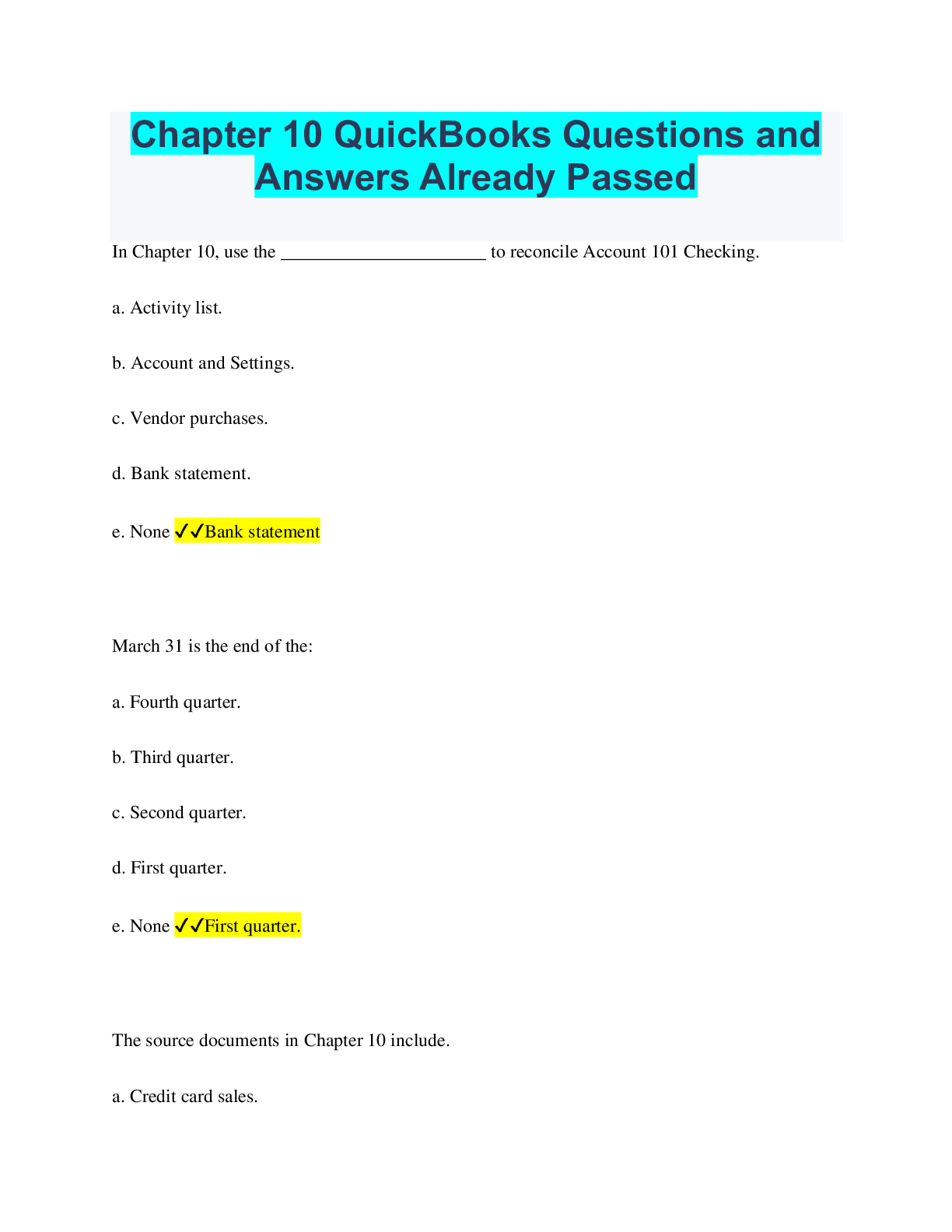
In Chapter 10, use the ______________________ to reconcile Account 101 Checking.
a. Activity list.
b. Account and Settings.
c. Vendor purchases.
d. Bank statement.
e. None ✔✔Bank statement
March 31 is the end of the:
a. Fourth quarter.
b. Third quarter.
c. Second quarter.
d. First quarter.
e. None ✔✔First quarter.
The source documents in Chapter 10 include.
a. Credit card sales.
b. Accounts payable transactions.
c. Accounts receivable transactions.
d. Checks.
e. All. ✔✔All.
At the end of March, adjustments for the following accounts are made except for:
a. Rent expense.
b. Insurance expense.
c. Accumulated depreciation.
d. Checking account balance.
e. None. ✔✔Checking account balance
What report do you run to display overdue bills?
a. Accounts Payable Aging report.
b. Accounts Receivable Aging report.
c. Open Bills.
d. Audit Log.
e. None ✔✔Accounts Payable Aging report
This report lists transactions subtotaled by each account on the chart of accounts.
a. Statement of Cash Flows.
b. Balance Sheet.
c. Summary transaction report for a specific period.
d. Transaction Detail by Account.
e. None ✔✔Transaction Detail by Account.
This report breaks down every transaction during a period of time into debits and credits and
displays them chronologically.
a. Customer balance summary.
b. Vendor balance summary.
c. Profit and Loss.
d. Journal.
e. All. ✔✔Journal.
This report summarizes key information such as quantity on hand, value, and average cost for
each item.
a. A/R Aging Summary.
b. A/P Aging Summary.
c. Inventory Valuation Summary.
d. Adjusting entry report.
e. All. ✔✔Inventory Valuation Summary
Which report shows unpaid bills for the current period?
a. A/P Summary.
b. Balance Sheet.
c. Profit and Loss.
d. Statement of Cash Flows.
e. None. ✔✔A/P Summary
Which report shows unpaid invoices for the current period?
a. Balance Sheet.
b. A/P Summary.
c. A/R Summary.
d. Profit and Loss.
e. None. ✔✔A/R Summary.
The date for the end of the first quarter is:
A) December 31.
B) January 31.
C) February 28.
D) March 31.
E) None of the above. ✔✔March 31.
The source document for ordering inventory is:
A) Memo.
B) Sales Receipt.
C) Transaction Register.
D) Bill.
E) None of the above. ✔✔Bill.
The source document that shows sales to customers on account is a:
A) Transaction Register.
B) Sales Invoice.
C) Sales Receipt.
D) Bill
E) None of the above. ✔✔Sales Invoice.
To make sure you are starting Chapter 10 in the correct place in the data, display this report:
A) January 1 through March 31 A/P Aging
Summary.
B) Inventory Valuation Summary.
C) Account 101 Checking Register.
D) January 1 through February 28 Trial Balance.
E) None of the above ✔✔January 1 through February 28 Trial Balance
In Chapter 10, all transactions occurred in:
A) February.
B) March.
C) April.
D) May.
E) None of the above. ✔✔March.
This type of transaction includes a field for selecting the credit card used:
A) Sales Invoices.
B) Memo.
C) Bill.
D) Sales Receipt.
E) None of the above. ✔✔Sales Receipt.
When a vendor is paid, the following document is shown:
A) Sales Invoice.
B) Sales Receipt.
C) Remittance.
D) Check.
E) None of the above. ✔✔Remittance
The following report is printed before the end-of-quarter transactions are journalized and posted:
A) Profit and Loss.
B) Balance Sheet.
C) Adjusted Trial Balance.
D) Unadjusted Trial Balance.
E) All of the above. ✔✔Unadjusted Trial Balance.
After recording the adjusting entry for rent paid on January 1, Account 125 Prepaid Rent has this
balance:
A) $6,000.00.
B) $0.00.
C) $1,500.00.
D) $53,493.52.
E) None of the above. ✔✔$0.00.
To adjust depreciation, debit and credit the following accounts:
A) Debit Accumulated Depreciation, Credit
Depreciation Expense.
B) Debit Computer Equipment, Credit
Accumulated Depreciation.
C) Debit Depreciation Expense, Credit
Accumulated Depreciation.
D) Debit Depreciation Expense, Credit
Computer Equipment.
E) None of the above. ✔✔Debit Depreciation Expense, Credit
Accumulated Depreciation.
[Show More]




![Preview of [SOLVED] HIEU 201 / HIEU201 Chapter 10 Quiz (LATEST 2022)](https://scholarfriends.com/storage/HIEU_201_Chapter_10_Quiz.png)
.png)