Introduction to Cryptography - C839 -
ECES EC-Council Certified Encryption
Specialist Practice Exam Already Passed
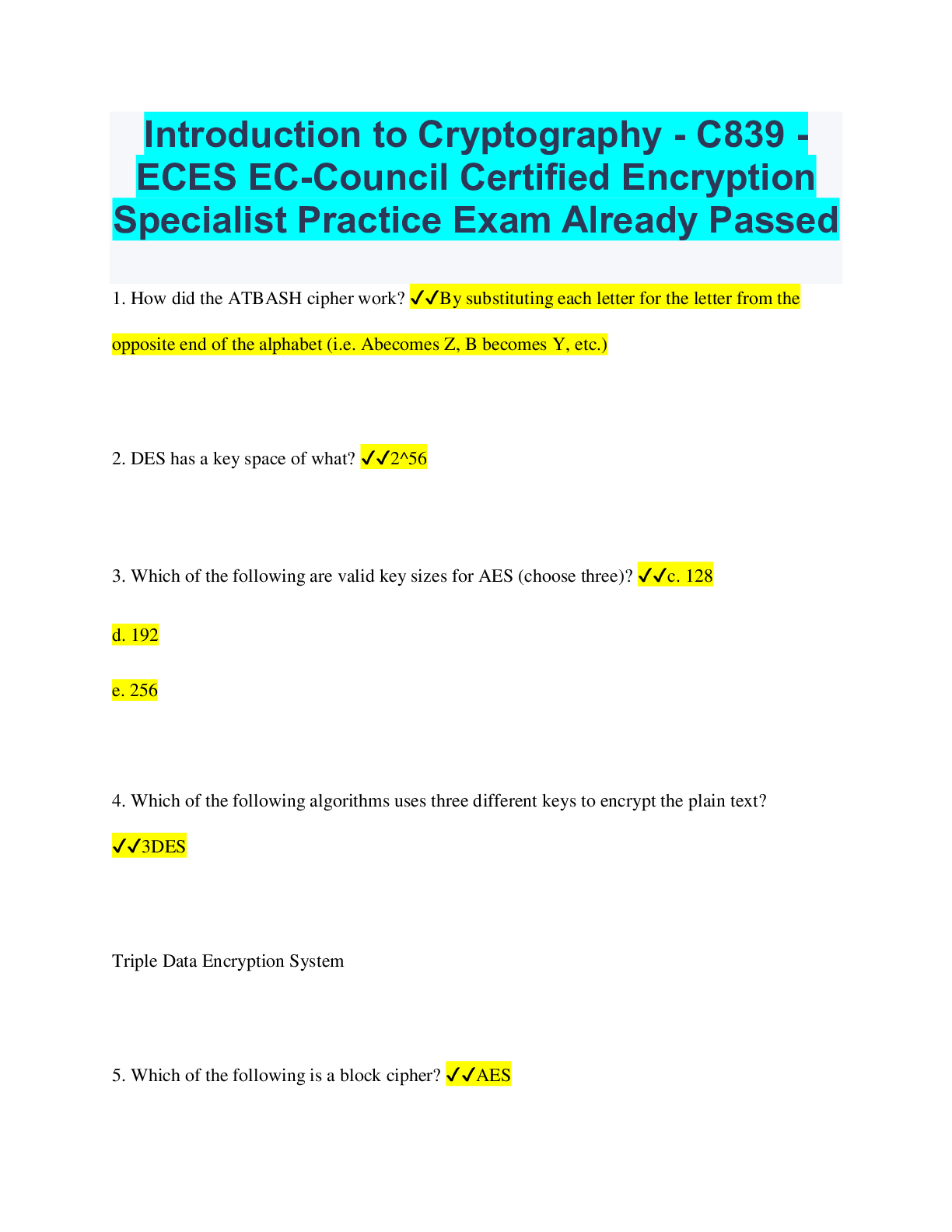
1. How did the ATBASH cipher work? ✔✔By substituting each letter for the letter from the
opposite end
...
Introduction to Cryptography - C839 -
ECES EC-Council Certified Encryption
Specialist Practice Exam Already Passed
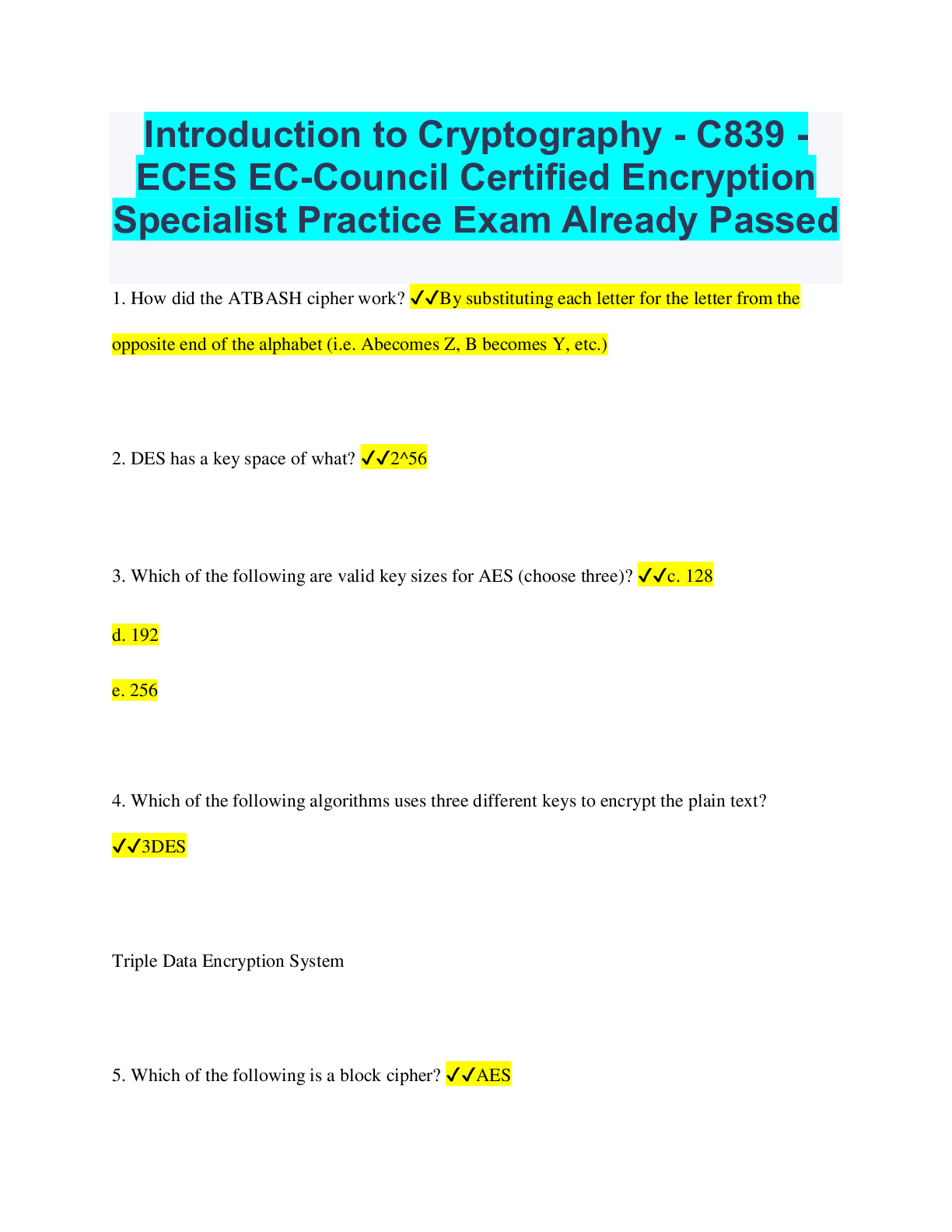
1. How did the ATBASH cipher work? ✔✔By substituting each letter for the letter from the
opposite end of the alphabet (i.e. Abecomes Z, B becomes Y, etc.)
2. DES has a key space of what? ✔✔2^56
3. Which of the following are valid key sizes for AES (choose three)? ✔✔c. 128
d. 192
e. 256
4. Which of the following algorithms uses three different keys to encrypt the plain text?
✔✔3DES
Triple Data Encryption System
5. Which of the following is a block cipher? ✔✔AES
The Advanced Encryption Standard (AES) is a symmetric-key block cipher algorithm and U.S.
government standard for secure and classified data encryption and decryption.
6. Which of the following is a type of encryption that has two different keys.
One key can encrypt the message and the other key can only decrypt it? ✔✔Asymmetric
7. Which of the following is an asymmetric cipher? ✔✔RSA
The acronym stands for Rivest, Shamir, and Adelman, the inventors of the technique. The RSA
algorithm is based on the fact that there is *no efficient way to factor very large numbers.*
8. A cipher is defined as what ✔✔The algorithm(s) needed to encrypt and decrypt a message
9. Which of the following is not an asymmetric system? ✔✔AES
The Advanced Encryption Standard (AES) is a symmetric-key block cipher algorithm and U.S.
government standard for secure and classified data encryption and decryption.
10. John is going to use RSA to encrypt a message to Joan. What *key* should he use?
✔✔Joan's public key
11. What advantage do symmetric algorithms have over asymmetric algorithms ✔✔Symmetric
algorithms are faster than Asymmetric algorithms
12. Which of the following is generally true about key sizes? ✔✔Larger key sizes increase
security
13. A ____ is a function is not reversible. ✔✔Hash
14. Which of the following is a protocol for exchanging keys? ✔✔*DH*
Diffie-Hellman is a way of *generating a shared secret between two people* in such a way that
the secret can't be seen by observing the communication. That's an important distinction: You're
not sharing information during the key exchange, *you're creating a key together.*
15. Which of the following would be the fastest process? ✔✔AES
The Advanced Encryption Standard (AES) is a symmetric-key block cipher algorithm and U.S.
government standard for secure and classified data encryption and decryption.
16. Which of the following would be the *weakest encryption* algorithm? ✔✔DES
Data Encryption Standard
17. What is the largest key size that AES can use? ✔✔256
18. What are a few different *key exchange protocols?* ✔✔*MED*
DH - Diffie-Hellman
MQV - Menezes-Qu-Vanstone is an *authenticated protocol* for key agreement *based on the
Diffie-Hellman* scheme
ECDH - ECDH is a *variant* of the Diffie-Hellman algorithm for *elliptic curves*
AES *is not* a key exchange protocol; it is a Symmetric Block Cipher
19. Which of the following is a key exchange protocol? ✔✔MQV
MQV (Menezes-Qu-Vanstone) is an authenticated protocol for key agreement based on the
Diffie-Hellman scheme. Like other authenticated Diffie-Hellman schemes, MQV provides
protection against an active attacker.
20. Which of the following encryption algorithms relies on the *inability to factor large prime
numbers?* ✔✔*RSA*
The acronym stands for Rivest, Shamir, and Adelman, the inventors of the technique. The RSA
algorithm is based on the fact that there is *no efficient way to factor very large numbers.*
21. Using substitution without transposition leads to what *weakness?* ✔✔Letter/word
frequency is maintained
22. What algorithm does the *clipper chip* use? ✔✔Skipjack
*Remember CLIPskip*
23. What size key does Skipjack use? ✔✔80 bit
24. What size block does Skipjack use? ✔✔64
25. With *E*lectronic *C*ode*B*ook (ECB) what happens ✔✔The *message* is divided into
blocks and *each block is encrypted separately.*
This is the most basic mode for symmetric encryption.
*Think of the OSI 7-Layer Model, TRANSPORT Layer under TCP*
26. Which algorithm implements an *Unbalanced Feistel* cipher? ✔✔Skipjack
27. With Cipher-*block chaining* (*CBC*) what happens? ✔✔Each block of plaintext is
*XOR*'d *with* the *previous ciphertext block BEFORE being encrypted*
*XOR* a.k.a. (e*X*clusive *OR*). A Boolean logic operation that is widely used in
cryptography as well as in generating parity bits for *error checking and fault tolerance.*
XOR compares two input bits and generates one output bit.
28. What happens with *C*ipher *F*eed*B*ack (*CFB*)? ✔✔The *ciphertext block is
ENCRYPTED then* the ciphertext produced is *XOR*'d back *with* the *plaintext* to produce
the current ciphertext block.
*1 - Ciphertext block is Encrypted*
*2 - Ciphertext XOR/error check with Plaintext*
*3 - Current Ciphertext Block produced*
29. What does Output feedback (*OFB*) do? ✔✔A *block cipher is converted into a stream
cipher* by generating a key-stream blocks, which are then XORed with the plaintext blocks to
get the ciphertext
30. Which of the following modes cannot be used to *turn a block cipher into a stream cipher?*
✔✔CTR
OFB
CTR is a chaining mode for symmetric block encryption or decryption. Messages are divideded
into blocks, and the cipher operation takes place on each block using the secret key and a unique
counter block
Output feedback (OFB) is a mode of operation for a block cipher.
31. What is an IV? ✔✔A *fixed size random stream that is added to a block cipher* to increase
randomeness.
32. A number that is used only one time, then discarded is called what? ✔✔Nonce
33. What is the *largest key size* that *RC4* can use? ✔✔256 bits
34. What is the basis for the *FI*SH algorithm? ✔✔The Lagged *Fi*bonacci generator
35. Which of the following is *required* for a hash? ✔✔*VLI & FLO*
a. Variable length input, fixed length output
b. Few collisions
d. Not reversible
36. Which of the following is used to *encrypt email AND create digital signatures?* ✔✔RSA
The acronym stands for Rivest, Shamir, and Adelman, the inventors of the technique. The RSA
algorithm is based on the fact that there is no efficient way to factor very large numbers.
37. Bob's password is hashed, and so is John's. Even though they used different passwords, the
*hash is the same.* What is this called? ✔✔A collision
38. In relationship to hashing, the term ____ refers to *random bits* that are used *as one of the
inputs* to the hash.
Essentially the is intermixed with the message that is to be hashed. ✔✔Salt
39. This is a *128-bit* hash that is specified by RFC 1321.
It was *designed* by Ron Rivest in 1991 *to replace an earlier hash* function. ✔✔MD5
MD5 (*M*essage-*D*igest algorithm *5*) is a widely used cryptographic hash function with a
128-bit hash value.
40. This hash function *uses 512-bit blocks* and implements preset constants that change after
each repetition. *Each block is hashed into a 256-bit block* through four branches that divides
each 512 block into *sixteen 32-bit* words that are further encrypted and rearranged
✔✔FORK256
41. Which of the following is an *asymmetric* algorithm that was first publicly described in
*1977?* ✔✔*RSA*
The acronym stands for Rivest, Shamir, and Adelman, the inventors of the technique. The RSA
algorithm is based on the fact that there is no efficient way to factor very large numbers.
42. Which of the following *equations* describes the encryption process for *RSA?* ✔✔*M^e
% n*
M to the "e" power
%
n
43. Which of the following is an *asymmetric* algorithm related to the *equation*
*y2= x3+ Ax + B?* ✔✔Elliptic Curve
*Remember this is a type of DH; more known as ECDH*
44. Which of the following *asymmetric* algorithms is described by *U.S. Patent* 5,231,668
and *FIPS* ✔✔*DSA*
DSA stands for *Digital Signature Algorithm* - and is specifically designed to produce digital
signatures, *not perform encryption*
45. Which of the following is the *standard for digital certificates?* ✔✔X.509
46. Rather than look in a list, one can use a *protocol* to find *revoked certificates.* What
protocol is that? ✔✔OCSP = *Online Certificate Status Protocol*
47. What must occur in order for a *cipher* to be considered *broken?* ✔✔You must find a
method that is *more efficient* than Brute force.
48. __________ cryptography uses *one key to encrypt* a message and a *different key to
decrypt* it. ✔✔Asymmetric
49. If the *round function* is a cryptographically secure pseudorandom function, then _____
rounds is sufficient to make the block cipher a *pseudorandom permutation.* ✔✔3
50. If the *round function* is a cryptographically secure pseudorandom function, then ____
rounds is sufficient to make it a *STRONG* pseudorandom permutation. ✔✔4
[Show More]

.png)
.png)
.png)
.png)
.png)
.png)
.png)
.png)
.png)