Com 312 Test 1|51 Questions with Verified Answers
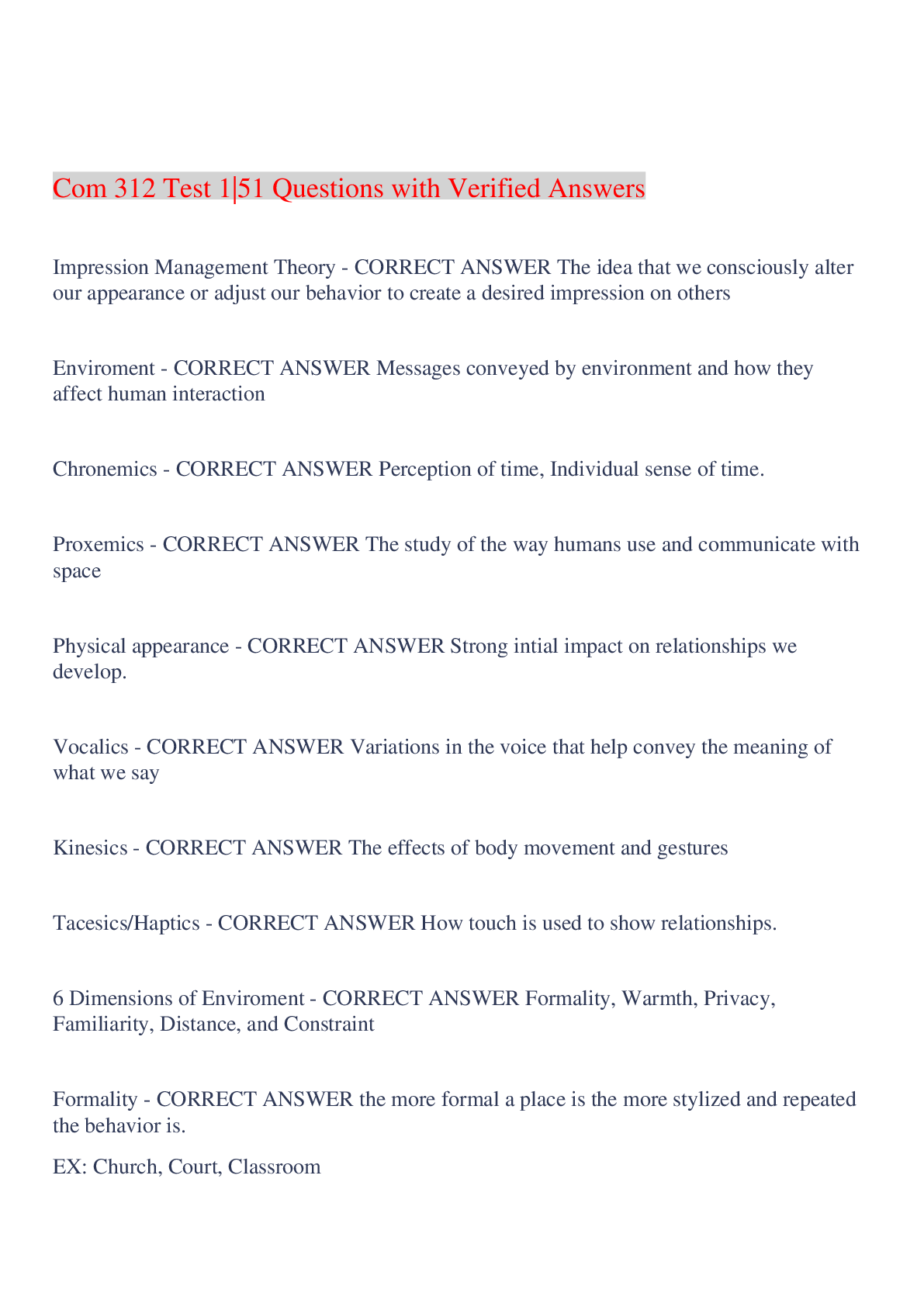
Impression Management Theory - CORRECT ANSWER The idea that we consciously alter our appearance or adjust our behavior to create a desired impression on others
Envi
...
Com 312 Test 1|51 Questions with Verified Answers
Impression Management Theory - CORRECT ANSWER The idea that we consciously alter our appearance or adjust our behavior to create a desired impression on others
Enviroment - CORRECT ANSWER Messages conveyed by environment and how they affect human interaction
Chronemics - CORRECT ANSWER Perception of time, Individual sense of time.
Proxemics - CORRECT ANSWER The study of the way humans use and communicate with space
Physical appearance - CORRECT ANSWER Strong intial impact on relationships we develop.
Vocalics - CORRECT ANSWER Variations in the voice that help convey the meaning of what we say
Kinesics - CORRECT ANSWER The effects of body movement and gestures
Tacesics/Haptics - CORRECT ANSWER How touch is used to show relationships.
6 Dimensions of Enviroment - CORRECT ANSWER Formality, Warmth, Privacy, Familiarity, Distance, and Constraint
Formality - CORRECT ANSWER the more formal a place is the more stylized and repeated the behavior is.
EX: Church, Court, Classroom
Warmth - CORRECT ANSWER we consider a place warm when we feel relaxed and comfortable.
EX: Our House, Room
Privacy - CORRECT ANSWER The more privacy we feel in an environment, the more personal we are with our communication.
Ex: Therapy, Library
Familiarity - CORRECT ANSWER The more familiar an environment is, the more comfortable we are.
Ex: McDonald's
Distance - CORRECT ANSWER In close spaces, we create mental distance
Constraint - CORRECT ANSWER the feeling that you cannot leave your environment.
M-R Model : 3 Ways environments can effect emotion - CORRECT ANSWER 1) Arousal - excitement
2) Pleasure - Happiness, Joy
3) Dominance - Feeling in control
2 Basic responses based on our reaction to these: - CORRECT ANSWER 1) Approach
2) Avoidance
Enviromental Psychology - CORRECT ANSWER Looks at the interrelationship between environment and human behavior.
EX: Restaurant Ambiance and Aesthetics
Servicescape - CORRECT ANSWER Man made physical surroundings
EX: In restaurants, lighting, decor, and layout
Olfactics - CORRECT ANSWER The study of smell
Indoor Plants - CORRECT ANSWER provide psychological benefits such ass stress reductions and tolerance for pain.
Ways to create a Mood - CORRECT ANSWER Lightning, colors, Architecture, Furniture, and people
Artifacts - CORRECT ANSWER The Desk ; desk used as a barrier
Personalized Workspace - CORRECT ANSWER Provide Visitors with information to incite a conversation
Colors and Impressions - CORRECT ANSWER Blue: Serenity
Black: Power
Excitement: Red
Black wearing teams might be perceived as tougher, but can instill perceptions.
Pink as showed as a calming color , used in Jails located in Texas.
Gemeinschaft - CORRECT ANSWER community
- people connected by family, friends
- people help each other
Gesellschaft - CORRECT ANSWER Means Society
- people are tired to each other by business and legal contract.
- peoples court, judge judy
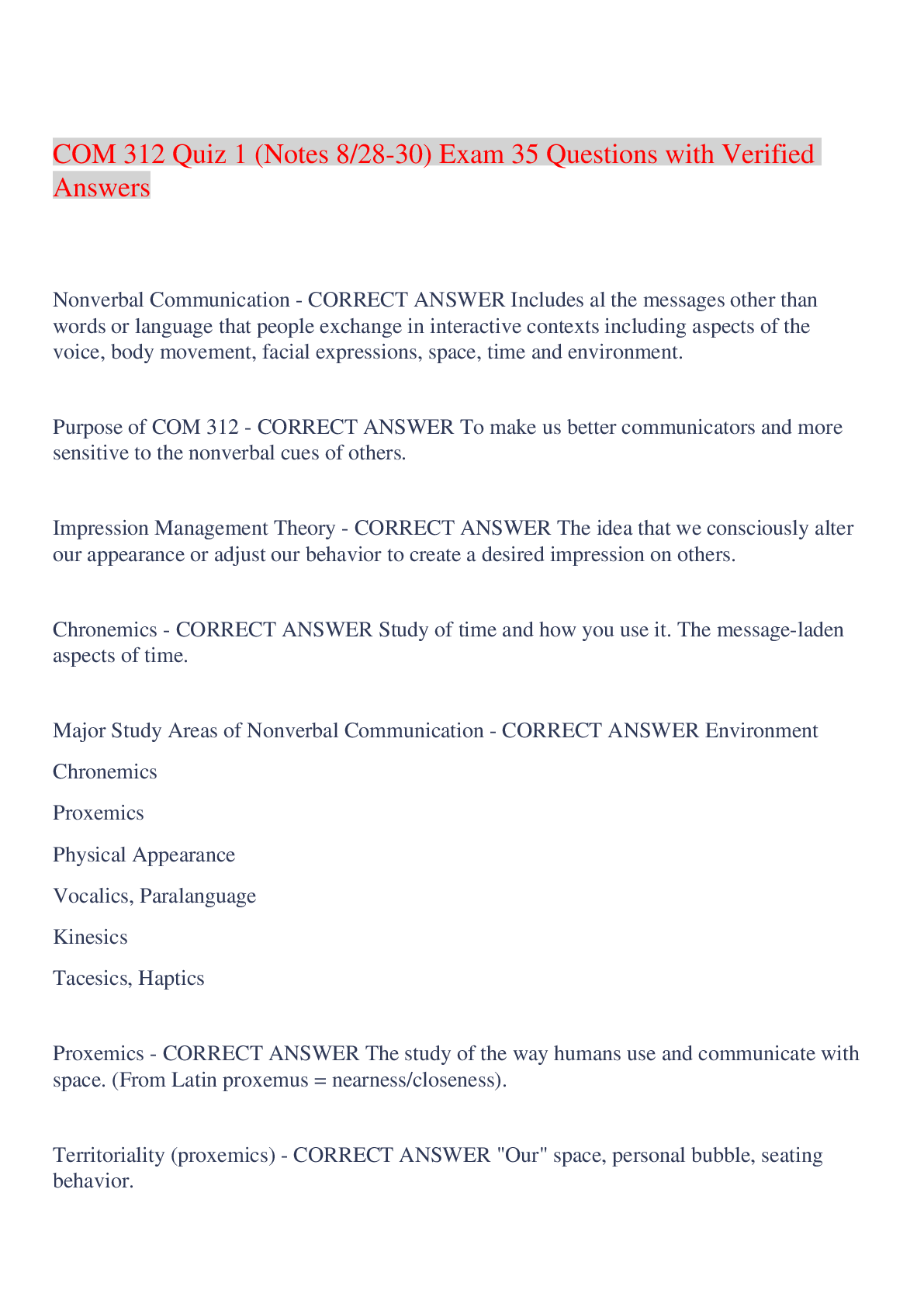
Chronemics - CORRECT ANSWER Study of time as communication
- the message-laden aspects of time.
Time spent in a place
1) Sense of experience
-Bad Time
- Good Time
2) Perceptions of time in a place
- time goes slowly (watching the clock)
- time goes by fast (time flies when you're having fun)
Ways to think about time - CORRECT ANSWER 1) Individual sense of time
Are you slow? Are you a morning person?
2) Individual Time Orientation
Do you think about the past a lot ? Do you think mostly about the future ?
What can time tell us about people ? - CORRECT ANSWER 1) Status
2) Liking/Disliking - Doctor/Patient
3) Our cultural background and personality
4) The type of society we live in
- Monochronic
-Polychronic
Monochronic - CORRECT ANSWER Time is important (Society)
- measurable by clocks, watches, calendars
- American Society
Polychronic - CORRECT ANSWER Time isnt so important
- time is flexible
- things can wait
(Mexico, Spain, US South)
Proxemics - CORRECT ANSWER The study of the way humans use and communicate with space.
Also known as
-informal space
-interpersonal space
- personal bubble
-conversational distance
Ex: The Close Talker *Seinfeld
Personal Space - CORRECT ANSWER Depends on a number of factors: sex, age, cultural/ethnic background, topic, setting, physical characteristics, attitudes/emotions, type of relationships, personalities
Density - CORRECT ANSWER Refers to a physical space
Refers to the number of people per unit of space
Crowding - CORRECT ANSWER Psychological feeling caused when a person becomes aware of spatial restrictions.
High Density but Low Crowding - CORRECT ANSWER there might be lots of people who have little personal space, but they dont feel crowded in.
EX: Concerts, NYE
Tables Shapes - CORRECT ANSWER most common in corporate boardrooms heuristic: decision making cue/decision making.
Small Group Ecology - CORRECT ANSWER seating behavior and spatial arrangements in small groups.
- status
- available space
- relationships
- tasks
- personality
Territoriality - CORRECT ANSWER Behavior characterized by indentification with a geographic area in a way that indicates
- ownership
- defense from invaders
3 Primary Types of Territory - CORRECT ANSWER Primary, Secondary, Public
Primary - CORRECT ANSWER Exclusive domain of the owner, most respected by others, needs permission to enter
Secondary - CORRECT ANSWER Generally associated with a person or a group, not central to daily functioning, not under exclusive control all the time.
Example: Bars
Public - CORRECT ANSWER Most difficult to defend, We can only temporarily own it.
3 Types of Encroachment - CORRECT ANSWER Invasion, Violation, and Contamination
Invasion - CORRECT ANSWER Most serious, Permanent Intent
EX: when someone moves into your home
Violation - CORRECT ANSWER Unwarranted use of your space
- temporary
Ex: someone sitting at your desk
Contamination - CORRECT ANSWER Rendering the territory of another impure with respects to its definition and usage.
Ex: leaving something behind
Territorial Defense - CORRECT ANSWER 1) Prevention
-Physical Presence
- Territorial Markers
2) Reaction
Positive: No Problem ; Negative: Conflict
3 Ways to React - CORRECT ANSWER 1) Withdrawal - Leave
2) Insulation - Create a wall
3) Turf Defense - Verbal say "Get out"
Interactional Territory - CORRECT ANSWER special places that can develop anywhere people congregate to talk
- no visible boundaries.
[Show More]