NURSING > QUESTIONS & ANSWERS > Chamberlain College of Nursing - PHARM 508 Week 1 Discussion (GRADED A) (All)
Chamberlain College of Nursing - PHARM 508 Week 1 Discussion (GRADED A)
Document Content and Description Below
Last updated: 4 years ago
Preview 1 out of 5 pages
Instant download

Buy this Document to get the Full Access Instantly
Provided by Students Who Aced it
We Verify Document Content to Gurantee Accuracy
Reviews( 0 )
Document information
Connected school, study & course
About the document
Uploaded On
Apr 23, 2020
Number of pages
5
Written in
All

Additional information
This document has been written for:
Uploaded
Apr 23, 2020
Downloads
0
Views
179
Topic Tags
Recommended For You
Get more on QUESTIONS & ANSWERS »
Chamberlain College of Nursing - PHARM 508 ch6 2019/2020 ALL C...
FROM ANCIENT WORLD TO THE MIDDLE AGES COMPLETED QUIZ 2024 | EN...
NI-BC Mometrix Study Guide / Nursing Informatics Part 1.1 / Sc...
ANCC Informatics Nursing Study Guide / NI-BC Certification Exa...

TEST BANK for Fundamentals of Nursing: Active Learning for Col...
Solutions Manual for Organic Chemistry 9th Edition by John McM...
Test Bank for Byrd & Chen's Canadian Tax Principles 1st edit...
Test Bank for Community Health Nursing A Canadian Perspective...
Test Bank For High-Acuity Nursing 7th Edition By Kathleen Wagn...
Test Bank For Health & Physical Assessment in Nursing 4th Edit...
TEST BANK for ROACHS INTRODUCTORY CLINICAL PHARMACOLOGY, 11TH...
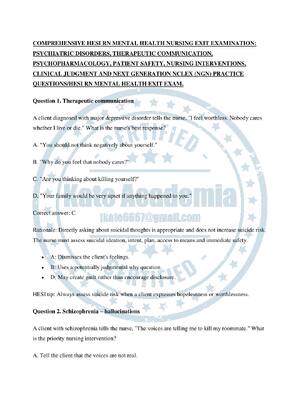
COMPREHENSIVE HESI RN MENTAL HEALTH NURSING EXIT EXAMINATION:...