Autocratic leader ✔✔One with absolute power.
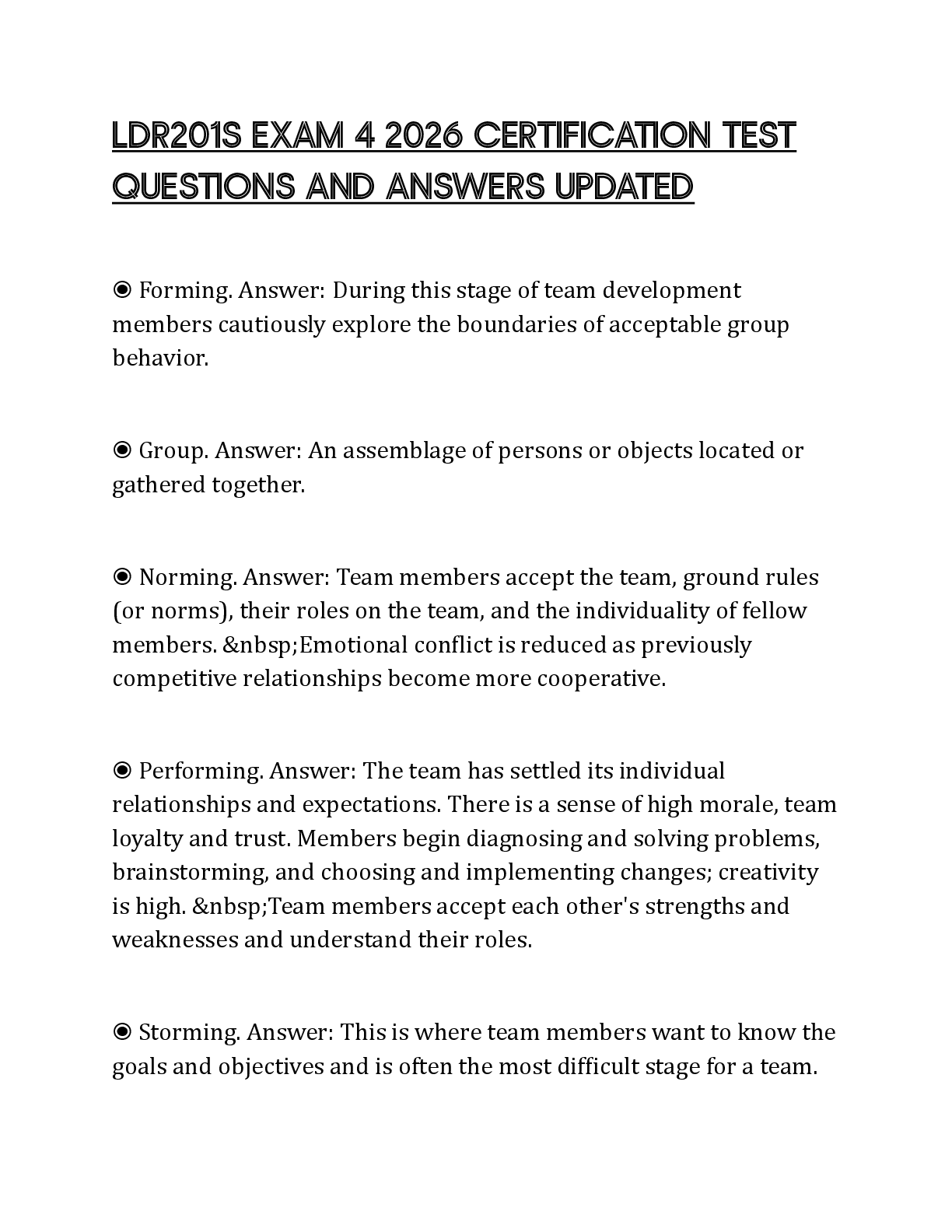
Trait Theory ✔✔"Great Man Theory" Born as a leader
Behavioral Theory ✔✔Effective leaders focus on influencing the performance and motivation of
their employees.
Job-Orient
...
Autocratic leader ✔✔One with absolute power.
Trait Theory ✔✔"Great Man Theory" Born as a leader
Behavioral Theory ✔✔Effective leaders focus on influencing the performance and motivation of
their employees.
Job-Oriented Theory ✔✔Focus on helping employees improve their job performance.
Situational Theroy ✔✔Leadership style is adapted to fit the situation of the employee.
Emergent Theory ✔✔Leaders emerge naturally from within the group.
Holocracy ✔✔Decision making is distributed throughout the team.Contingency Theory ✔✔Predicts that effective leaders are those whose personal traits match the
needs of the situation
Transactional Theory ✔✔Exchange between two parties.
Leadership Style - Anti-change ✔✔Seeks to avoid change. "Stay the course. Keep adjusting
small. No need to change in any major way."
Leadership Style - Rational ✔✔Focuses on how to constrain and control change with the logical
planning and clearly defined steps.
Leadership Style - Panacea ✔✔Responds to pressure for change is to communicate and motivate.
Have an understanding to the resistance of the change and has enthusiasm for change.
Leadership Style - Bolt on ✔✔Regains control of change by attaching change management
techniques that create a response to pressure for change.
Leadership Style - Integrated ✔✔Use structure and discipline. Understands the culture, roles,
capabilities, and attitudes of it's people.Leadership Style - Continuous ✔✔Creates and agile and quick responding organization that can
quickly anticipate threats and seize opportunities.
Strategic Management Process - 4 stages ✔✔Strategic Objectives, Strategic Formulation,
Strategic Implementation, and Strategic Evaluation.
Strategic Management Process - Strategic Objective ✔✔SWOT & PESTEL
SWOT ✔✔Strength, Weakness, Opportunities, Threats
PESTEL ✔✔Political
Economic
Social
Technological
Environmental
LegalStrategic Management Process - Strategic Formulation ✔✔Goals and Objectives written on the
information from SWOT and PESTEL
Strategic Management Process - Strategic Implementation ✔✔Planning stops and action begins.
Employees know their assignments, responsibilities, and authority.
Strategic Management Process - Strategic Evaluation & Control ✔✔Performance measurements
to determine progress and milestones. Corrective actions can be used if results are verified from
the plan.
Competitive Strategies - 3 Types ✔✔Cost Leadership, Differentiation, and Market
Segmentation.
Competitive Strategy - Cost Leadership ✔✔Ability to create Economies of Scale. Being able to
produce a product in a large amount for an efficient price.
Competitive Strategy - Differentation ✔✔To create a product or service that is unique and it
satisfies a specific target market. Focused on branding.Competitive Strategy - Market Segmentation ✔✔Identifies a specific target group of customers
that are not being satisfied by competition. The organization uses both differentiation and cost
leadership. This approach describes a company that is focused only on economies of scale.
Factors of Cultures - The Paradigm ✔✔Management determines both the mission and vision of
the organization and sets the groundwork for the values that employees are expected to align
with. Communication is critical.
Factors of Cultures - Control Systems ✔✔Behavioral expectations are laid out explicitly for
employees to read and understand.
Factors of Cultures - Organizational Structures ✔✔Enormous cultural implications for openness
of communication, organization of resources, and flow of information.
Factors of culture - Power Structures ✔✔Being able (or not) to influence management.
Factors of Culture - Rituals and Routines ✔✔Strong behavior Modifiers that significantly impact
culture. Looser and open work environment, limited routine and high individual freedom.Factors of Culture - Stories and Myths ✔✔Stories are powerful communicators of culture.
Big Five Traits - Openness ✔✔Broad range of interest . Curious about the world and other
people. More adventurous and creative.
Big five Traits - Conscientiousness ✔✔Goal directed behaviors, organized and mindful f teh
details.
Big Five Traits - Extraversion ✔✔Sociable, assertive, outgoing, and being around people
energizes them.
Big Five Trait - Agreeableness ✔✔Trust, kindness, and cooperative.
Big Five Traits - Neuroticism ✔✔Sadness, Moodiness, Emotional instability. They experience
mood swings, anxiety, and irritability.
McClelland's Theory ✔✔Explains an Individuals motivation for learning. Motivated by power
seeks out high levels of influenceHerzberg's Two-Factor Theory ✔✔Job satisfaction is influenced by motivator factors,
achievement, recognition, and responsibility. Hygiene factors, working conditions, coworkers
relations, and policy and rules.
Equity Theory ✔✔How is the employee treated in relations to other employees.
Vroom Theory ✔✔Employee must value the results and expect their behaviors will result in the
achievement of a reward.
simple conflict ✔✔conflict over differences in ideas, definitions, perceptions, or goals.
pseudo conflict ✔✔the perception that conflict exists when it doesn't
ego conflict ✔✔conflict based on personal issues in which people attack each other's selfesteem, personal attacks and character assassinations.
Conflict Resolution Strategies - Integrative Approach ✔✔Focus on the issue to be solved and
aim to find resolution that meets everyones needs.Conflict Resolution Strategies - Distributive Approach ✔✔Divide a fixed number pf positive
outcomes/resources in which one side comes out ahead of another who doesn't get their way
today but may end up winning tomorrow.
Conflict Resolution Strategies - Mediating Approach ✔✔Bring in a third party to facilitate a non
confrontational discussion to help the team reach a consensus about how to resolve the conflict.
Smoothing ✔✔Attempts to minimize the difference among the people who conflict with each
other.
Yielding ✔✔Describes the choice team members make to give in when others disagree with
them rather than engage in conflict. Stake is small
Avoiding ✔✔Team member may choose to ignore all but most contentious disagreements.
8 Components of the Communication Process- Source ✔✔Person that imagines, creates and
sends the message.8 Components of the Communication Process- Message ✔✔The Stimulus or meaning produced
by the source for the receiver or audience.
8 Components of the Communication Process- Channel ✔✔How a message travels between the
source an the reciever.
8 Components of the Communication Process- Reciever ✔✔Receives the message from the
source
8 Components of the Communication Process- Feedback ✔✔When you respond to the source.
8 Components of the Communication Process-Enviroment ✔✔The atmosphere you send and
receive the message.
8 Components of the Communication Process- context ✔✔Involves the setting, scene, and
expectations of the individuals involved.
8 Components of the Communication Process- Interference ✔✔Anything that blocks or changes
the sources's intended meaning of the message.Three Models of Communication - Transmission ✔✔Communication is Linear. one way process
in which a sender intentionally transmits a message to a receiver.
Three Model Communication - Interactional ✔✔Communication is a process in which
participants alternate positions. Instead of one way process this model incorporates feedback.
Three Model of Communication - Transaction ✔✔You communicate to create relationships.
Competitive Listening ✔✔happens when we are more interested in explaining our own point of
view than in understanding someone else's
Appreciative Listening ✔✔listening for pleasure or enjoyment
Active Listening ✔✔empathetic listening in which the listener echoes, restates, and clarifies.
Passive Listening ✔✔listening role in which the listener does not share in the responsibility nor
involve himself in the communication processCombative Listening ✔✔When a person listens very intently to senders messages for the
purpose of attacking them, often by using their own words against them as soon as they are
finished speaking.
Kolb Learning Cycle- Step One ✔✔Experience - The thing that happened
Kolb Learning Cycle - Step Two ✔✔Publishing - Participants reflect on themselves
Kolb Learning Cycle - Step Three ✔✔Processing - Participants reflect on observations of others
who shared the experience.
Kolb Learning Cycle - Step Four ✔✔Generalizing - Participants work to relate the experience to
other aspects of their life.
Kolb Learning Cycle - Step Five ✔✔Applying - Participants consider how they can apply the
results of the experience in the future.
SMART Goals ✔✔SpecificMeasurable
Attainable
Realistic
Time-bound
Smart - Specific ✔✔Focused, defined, Clear. Objective should identify the expected actions and
outcomes. 5 w'
What do I want to accomplish?
Why is this goal important?
Who is involved?
Where is it located?
Which resources or limits are involved?
sMart - Measurable ✔✔Keeps you focused and Motivated. 3 H'sHow much?
How many?
How will I know when it's accomplished?smArt - Achievable ✔✔Crucial for all Stakeholders. Must be attainable.
smaRt - Relevant ✔✔Your goal aligns with the company's mission
smarT - Time bound ✔✔Having a schedule or deadline. They will help increase productivity and
prevent work from dragging on.
salient ✔✔Information relates to a particular context that makes it meaningful and relvant.
Mission ✔✔What a Company does well
Vision ✔✔What a company would like to do well
Values ✔✔What a company thinks is important
Long Range Planning ✔✔Helps companies determine where they want to be. "Big Picture"
Controlling ✔✔Evaluation and corre
[Show More]




.png)
.png)


.png)