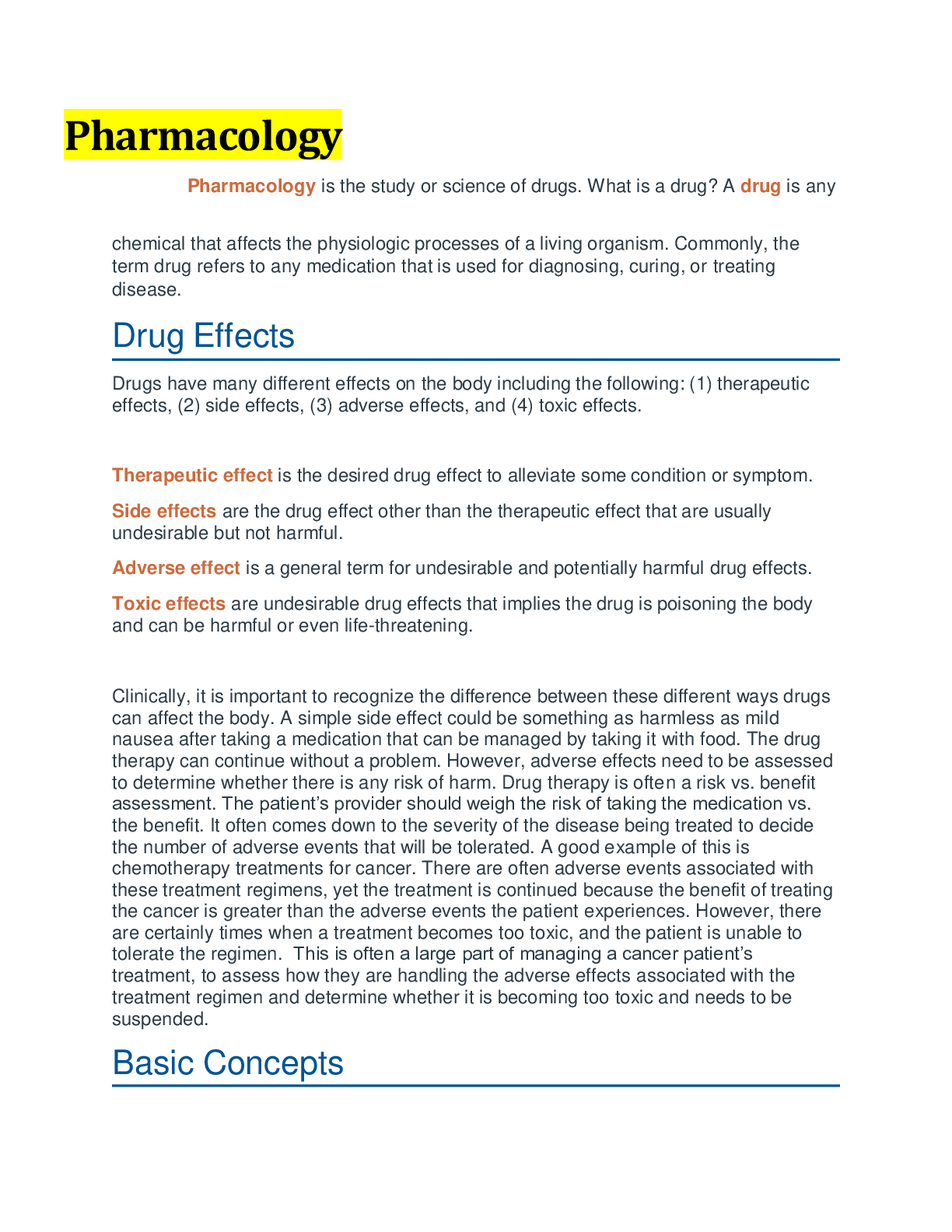
NSG 307
Common Maternity Drugs Utilized in L&D
Name Classification
Action Route/Dosag
e Indications Side effects Contraindications Nursing
Considerations
Antenatal/Labor Medications
Cytotec (misoprostol) Syn
...
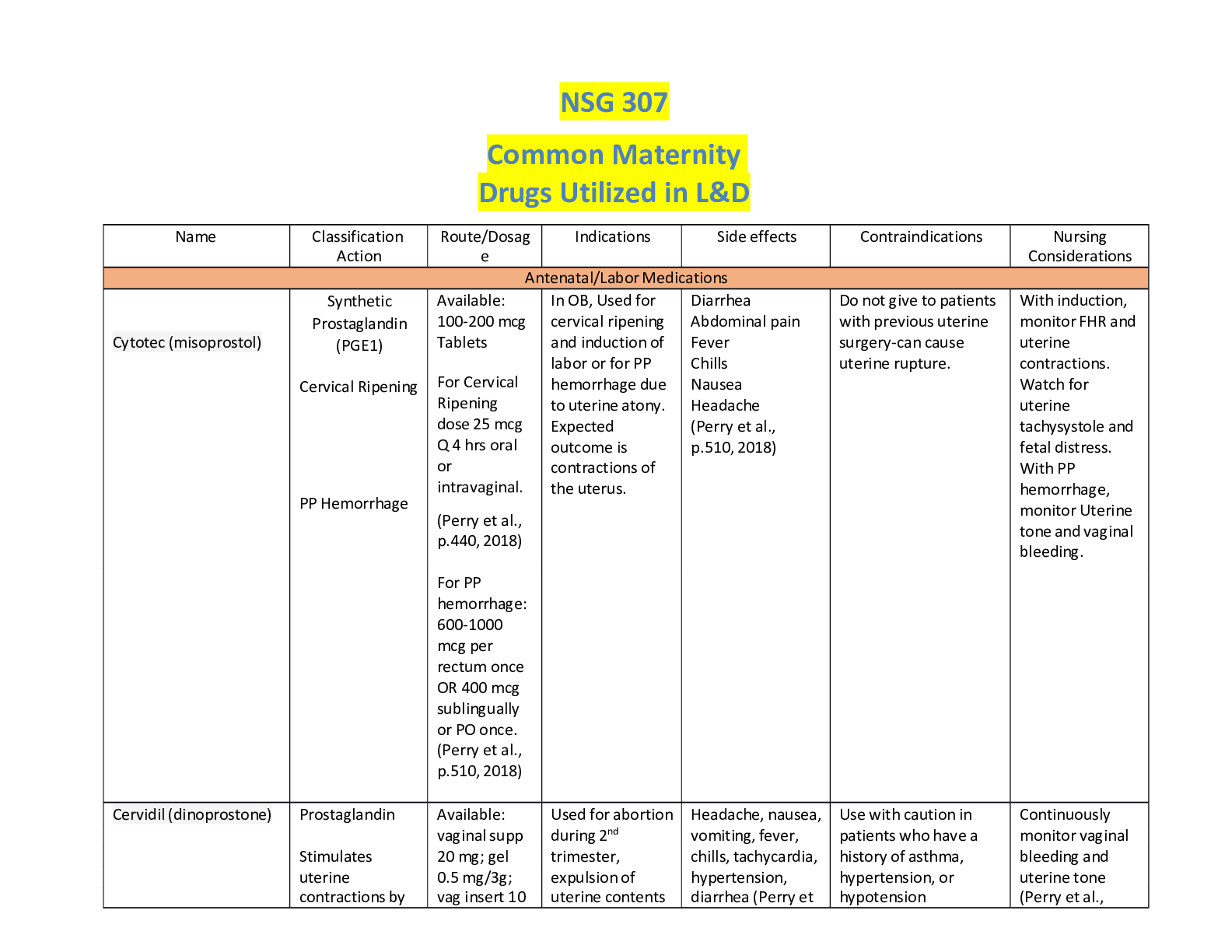
NSG 307
Common Maternity Drugs Utilized in L&D
Name Classification
Action Route/Dosag
e Indications Side effects Contraindications Nursing
Considerations
Antenatal/Labor Medications
Cytotec (misoprostol) Synthetic Prostaglandin (PGE1)
Cervical Ripening
PP Hemorrhage Available: 100-200 mcg Tablets
For Cervical Ripening dose 25 mcg Q 4 hrs oral or intravaginal.
(Perry et al., p.440, 2018) In OB, Used for cervical ripening and induction of labor or for PP hemorrhage due to uterine atony. Expected outcome is contractions of the uterus. Diarrhea Abdominal pain Fever
Chills Nausea Headache (Perry et al., p.510, 2018) Do not give to patients with previous uterine surgery-can cause uterine rupture. With induction, monitor FHR and uterine contractions.
Watch for uterine tachysystole and fetal distress.
With PP hemorrhage, monitor Uterine tone and vaginal bleeding.
For PP hemorrhage: 600-1000
mcg per rectum once OR 400 mcg sublingually or PO once. (Perry et al., p.510, 2018)
Cervidil (dinoprostone) Prostaglandin Available: Used for abortion Headache, nausea, Use with caution in Continuously
vaginal supp during 2nd vomiting, fever, patients who have a monitor vaginal
Stimulates 20 mg; gel trimester, chills, tachycardia, history of asthma, bleeding and
uterine 0.5 mg/3g; expulsion of hypertension, hypertension, or uterine tone
contractions by vag insert 10 uterine contents diarrhea (Perry et hypotension (Perry et al.,
Name Classification
Action Route/Dosag
e Indications Side effects Contraindications Nursing
Considerations
myometrium stimulation; Abortifacient (Skidmore-Roth, pg. 305, 2019) mg.
For cervical ripening: gel
0.5 mg vag gel placed in cervical canal, may repeat in 6 hr; vag insert 10 mg to be removed at onset of labor or within 12 hours. in fetal deaths, missed abortion, and cervical effacement and dilatation in term pregnancy. (Skidmore-Roth, pg. 305, 2019) al., p.510, 2018) (Perry et al., p.510, 2018) p.510, 2018)
Procedure requires specialized setting & clinician, and emergency equipment should be available at all times (Skidmore- Roth, pg. 306,
2019)
Abortifacient: vag supp 20 mg q3-5 hr until abortion occurs
(Skidmore- Roth, pg. 306,
2019)
Pitocin (oxytocin) Labor Induction or Augmentation
PP Hemorrhage Available:
30 units
added to 500 mL of IVF started at 1-2 mu/min and titrated up as needed Used for the stimulation of labor, stimulation of milk letdown, and/or control of bleeding; therapeutic outcomes
include induction Infrequent: water intoxication, nausea and vomiting (p.510) Do not use in patients with serum toxemia, cephalopelvic disproportion, fetal distress, or active genital herpes.
Medication should only be used with elective High Alert medication; Nurse should regularly assess labor contractions and signs of water intoxication.
Medication
Name Classification
Action Route/Dosag
e Indications Side effects Contraindications Nursing
Considerations
(p.444)
10 to 80 units/L
10-20 units IM (Perry et al., p.510, 2018) of labor, decreased PP bleeding, and stimulation of milk letdown (Skidmore-Roth, pg. 750, 2019) induction and when medically necessary. (Skidmore-Roth, pg. 796, 2019) should be discontinued immediately if fetal distress or uterine hyperactivity occurs (Skidmore-Roth,
pg. 796, 2019)
Bicitra (sodium citrate) Alkalinizing agent
Alkalinizing urine by citrate binding with urinary calcium (Cleveland Clinic, 2020) Mix prescribed medication with 6-8 ounces of water (Cleveland Clinic, 2020) Makes blood and urine more alkaline or less acidic; prevents metabolic acidosis, gout, and/or kidney disease; reduces nausea in pregnancy (Cleveland Clinic, 2020) Diarrhea, nausea, vomiting, GI disturbances, chest pain, edema (Cleveland Clinic, 2020) Do not administer to pts or use with caution in those with Addison’s disease, dehydration, heart disease, elevated potassium, kidney disease, low sodium, breastfeeding or pregnant (Cleveland Clinic, 2020). -monitor respiratory status and heart rate/rhythm
-take at regular intervals
-mix with 6 ounces of water
-monitor electrolyte levels (Cleveland Clinic, 2020)
Phenergan Antihistamine, H1-receptor antagonist; antiemetic
Acts on blood vessels, GI, respiratory system by competing for H1 receptor sites;
(Skidmore-Roth, Available routes: tab, supp, inj.
For N/V: 0.5mg/kg q4- 6h; maximum 25mg/dose (Perry et al., p.808, 2018) Management of N/V secondary to opioid use
(Perry et al., p.808, 2018) Dizziness, drowsiness, constipation, retention (Skidmore-Roth, pg. 816, 2019) Do not give to pts with agranulocytosis, bone marrow suppression, breastfeeding, coma, jaundice, or Reyes syndrome (Skidmore- Roth, pg. 816, 2019) Block box warning: not to be used in children under 2years old
-monitor for neuroleptic malignant syndrome, monitor CBC
-assess
respiratory status
Name Classification
Action Route/Dosag
e Indications Side effects Contraindications Nursing
Considerations
pg. 816, 2019) before and after administration. (Skidmore-Roth,
pg. 816, 2019)
Zofran (ondansetron) Antiemetic
Prevents nausea and vomiting by blocking serotonin peripherally, centrally and in the small intestine (Skidmore-Roth, pg. 734, 2019) Available routes: tab, oral sol, inj., oral dissolving film
For N/V: 0.1-
0.15mg/kg IV or PO q4h; max 8 mg/dose (Perry et al.,
p.808, 2018) Management of N/V secondary to opioid use
(Perry et al., p.808, 2018) Headache, diarrhea, constipation, musculoskeletal pain, shivering, fever, urinary retention (Skidmore-Roth, pg. 734, 2019) Do not give to pts with phenylketonuric hypersensitivity or torsades de pointes (Skidmore-Roth, pg.
734, 2019) Monitor ECG for QT prolongation
-Assess for EPS & serotonin syndrome
-drink with full glass of water
Spinal Anesthesia (Block) Anesthetic solution containing a local anesthetic alone or in combo with an opioid agonist analgesic used for C/S delivery (Perry et al., p.348, 2018) Intrathecal injection into the CSF of the spinal canal of anesthetic solution (Perry et al., p.348, 2018) Used for anesthesia during a cesarean birth (Perry et al., p.348, 2018) Hypotension, impaired placental perfusion, ineffective breathing pattern, spinal headache (PDPH)
(Perry et al., p.249-250, 2018) Active or anticipated maternal hemorrhage, maternal hypotension, coagulopathy, infection at the needle insertion site, increased ICP, allergy, some cardiac conditions
(Perry et al., p.353, 2018) -monitor maternal BP, pulse & RR
-Monitor FHR and pattern
-emergency care needed if systolic BP <100mmhg or fetal distress develops
-monitor for leakage of CSF (Perry et al.,
p.350-351, 2018)
Epidural Block Local anesthetic;
Pain relief for injection into
the epidural Used for relief of
pain from uterine Orthostatic
hypotension, Active or anticipated
maternal hemorrhage, -woman’s ability
to move freely
Name Classification
Action Route/Dosag
e Indications Side effects Contraindications Nursing
Considerations
vaginal or C/S delivery (Perry et al., p.351, 2018) space of anesthetic solution in combination with an opioid agonist analgesic (Perry et al., p.351, 2018) contractions and birth
(Perry et al., p.351, 2018) dizziness, sedation, fever, pruritus, and weakness of the legs
(Perry et al., p.352, 2018) maternal hypotension, coagulopathy, infection at the needle insertion site, increased ICP, allergy, some cardiac conditions
(Perry et al., p.353, 2018) and maintain control of labor is limited
-after epidural, woman should be positioned on her side
-for obese women, early initiation should be considered (Perry et al.,
p.351, 2018)
Lidocaine Topical anesthetics
Inhibits conduction of nerve impulses from sensory nerves (Skidmore-Roth, pg. 1158, 2019) Topical application qid as needed; rect insert tid after each BM
(Skidmore- Roth, pg. 1158, 2019) Used for the reduction in inflammation, itching and /or pain (Skidmore- Roth, pg. 1158,
2019) Rash, irritation, sensitization (Skidmore-Roth, pg. 1158, 2019) Hypersensitivity, infants, and/or application to large areas (Skidmore-Roth, pg. 1158, 2019) -assess pain, location, duration, before and after administration
-assess for infection and/or irritation after application (Skidmore-Roth,
pg. 1158 2019)
Nubain (nalpbuphine) Opioid agonist- antagonist analgesic
Stimulates mu and kappa opioid receptors, causing analgesia with less resp.
depression and IV 5-10 mg
q3h PRN
IM 10 mg q3h PRN
(Perry et al., p.347, 2018) Moderate to severe labor pain and postoperative pain after C- section
(Perry et al., p.347, 2018) Sedation, drowsiness, N/V, dizziness, respiratory depression, absent or minimal FHR variability.
(Perry et al., p.347, 2018) May precipitate withdrawal symptoms in opioid dependent woman and newborn (p. 347) -Assess VS, pain, FHR, and uterine activity before and during administration
-Observe for resp. depression
-Encourage voiding q2h
-Observe for
Name Classification
Action Route/Dosag
e Indications Side effects Contraindications Nursing
Considerations
N/V than opioid agonist analgesics. (Perry et al., p.347, 2018) newborn resp. depression if birth within 1 to 4 hours of administration 9(Perry et al., p.347, 2018)
Ephedrine Beta adrenergic agonists
“activates adrenergic α and β-receptors as well as inhibiting norepinephrine reuptake, and increasing the release of norepinephrine from vesicles in nerve
cells.4 These actions combined lead to larger quantities of norepinephrine present in the synapse, for longer periods of time, increasing stimulation of
the sympathetic IV 50mg/1mL
PO 25 mg,
tab (DrugBank, 2019) Ephedrine intravenous injections are indicated to treat hypotension under anesthesia (DrugBank, 2019) Insomnia, headache, tachycardia, palpitations, nausea, vomiting, urinary retention (DrugBank, 2019) Do not use with those that have a sulfate allergy; use with caution in patients with heart disease, angina, diabetes, pregnant and/or breastfeeding (DrugBank, 2019) -closely monitor CNS changes
-Overdoes manifests as rapidly increasing blood pressure and may require antihypertensive s
(DrugBank, 2019)
Name Classification
Action Route/Dosag
e Indications Side effects Contraindications Nursing
Considerations
nervous system” (DrugBank, 2019)
Demerol Opioid agonist analgesic
Stimulates mu and kappa opioid receptors to decrease pain impulses; reported to cause less maternal respiratory depression than morphine
(Perry et al., p.346, 2018) IV 25-50 mg
every 1to 2 hours; PCA pump 15 mg
every 10 minutes PRN until birth (Perry et al., p.346, 2018) Moderate to severe labor pain and postoperative pain after C- section
(Perry et al., p.346, 2018) Tachycardia, sedation, N/V, dizziness, altered mental state.
Euphoria. Decreased GI motility, urinary retention, delayed gastric emptying (Perry et al., p.346, 2018) Do not give if birth is expected to occur in 1- 4 hours after administration
(Perry et al., p.346, 2018) -implement safety measures
-respiratory depression can’t be reversed by naloxone
-med has long half-life
-neonates can exhibit sedation 2-3 days after birth
(Perry et al., p.346, 2018)
Duramorph/Morphine Opioid analgesic
“depresses pain impulse transmission at the spinal cord level by interacting with opioid receptors”
(Skidmore-Roth, pg. 677, 2019) PO: 10-30 mg
q3-4h prn
IV/IM/subcut: 2.5-15 mg q2-
6h prn, titrate of 0.05-0.1
g/kg IV
Epidural: initially 5 mg in the lumbar region, if
relief not Used to treat moderate to severe pain (Skidmore-Roth, pg. 677, 2019) Confusion, sedation, palpitations, bradycardia, constipation, dizziness, drowsiness, nausea, vomiting, change in B/P (Skidmore-Roth, pg. 682, 2019) Do not give to those with an opioid/alcohol addition, hemorrhage, bronchial asthma, increased ICP, paralytic ileus, hypovolemic shock, or on MAOI therapy. (Skidmore- Roth, pg. 677, 2019) -do not discontinue abruptly
-monitor closely for CNS changes and respiratory depression
-assess pain before and after administration
-do not use while breastfeeding
-remove
contaminated
Name Classification
Action Route/Dosag
e Indications Side effects Contraindications Nursing
Considerations
subsided in 1
hr, give 1-2 mg more, max 10 mg/24hr (Skidmore- Roth, pg. 677,
2019) clothing and rinse area if accidently exposure to skin occurs. (Skidmore-Roth, pg. 683, 2019)
Apresoline (hydralazine) Antihypertensive
; arteriolar vasodilator
Vasodilates arterioles in smooth muscle by direct relaxation (Skidmore-Roth, pg. 487, 2019) PO 10 mg 2-4
days, then 25 mg QID for rest of 1st week; max 300mg/day
If given IV, administer in recumbent position and maintain position for 1 hour (Skidmore- Roth, pg. 412,
2019) Used for hypertension during pregnancy (Perry et al., p.293, 2018) Maternal: headache, flushing, palpitations, tachycardia, increased heart rate, N/V, increase O2 consumption Fetal: tachycardia (Perry et al., p.293, 2018) Do not give to pts with mitral valvular rheumatic heart disease or CAD (Skidmore-Roth, pg.
412, 2019) -Assess BP frequently
-Wait at least 20 minutes between first and second dose
-maintain pt on bed rest in lateral position with sides up (Perry et al., p.293, 2018)
Magnesium sulfate CNS depressant Used for PTL
Used for PIH (Perry et al., p. 496 & 292, 2018) IV fluid should contain 40mg in 1000mL, piggyback to primary infusion and administer
using Tocolytic therapy for preterm labor; relaxes smooth muscle (Perry et al., p.426, 2018) Hot flushes, sweating, N/V, pain at IV site, dry mouth, drowsiness, blurred vision, headache, ileus, hypocalcemia,
dyspnea, lethargy, Do not give to women with myasthenia gravis.
Discontinue if intolerable adverse effects occur (Perry et al., p.347, 2018) Assess maternal and fetus before, during, and after therapy.
-monitor serum mg levels
-keep calcium gluconate or
chloride
Name Classification
Action Route/Dosag
e Indications Side effects Contraindications Nursing
Considerations
controller pump:
-Loading dose: 4-6 g
over 20-30 min.
-Maint. Dose: 1-4g/dose
-usefor stabilization only
-discontinue for 24-48 hrs. (Perry et al.,
p.426, 2018) hypotension (Perry et al., p.426, 2018) available for emergency
-limit IV to 125mL/hr. (Perry et al., p.347, 2018)
Calcium gluconate Electrolyte replacement; calcium product
Increases calcium levels needed for maintenance of nervous muscular, and skeletal systems, as well as to balance the effects of magnesium toxicity, secondary to
magnesium sulfate use in the PO 22.5-45
g/day in 3 divided doses
IV 500-800
mg of 10% solution, max of 3 g (Skidmore- Roth, pg. 154,
2019) Anecdote for Magnesium Sulfate toxicity (Perry et al., p.291, 2018)
Restoration of calcium levels (Skidmore-Roth, pg. 154, 2019) Hypotension, bradycardia, drowsiness, lethargy, muscle weakness, headache, pain at IV site, nausea/vomiting (Skidmore-Roth, pg. 157, 2019) Do not give to patients with hypercalcemia, digoxin toxicity, ventricular fibrillation or renal calculi (Skidmore-Roth, pg.
154, 2019) -closely monitor ECG for decreased QT interval and T- wave inversion
-Monitor calcium and magnesium levels closely
(Skidmore-Roth, pg. 157, 2019)
Name Classification
Action Route/Dosag
e Indications Side effects Contraindications Nursing
Considerations
instance of preeclampsia (Skidmore-Roth, pg. 154, 2019)
(Perry et al.,
p.291, 2018)
Indocin (indomethacin) Prostaglandin Synthetase Inhibitor
Relaxes uterine smooth muscle by inhibiting prostaglandins (Perry et al., p.427, 2018) Loading dose: 50 mg PO,
then 25-50 mg PO q6h for 48 hr (Perry et al., p.427, 2018) Tocolytic therapy to arrest labor after uterine contractions and cervical changes have occurred (Perry et al., p.427, 2018) Maternal: N/V and heartburn
Less common: GI bleedings, thrombocytopenia
, and asthma in aspirin sensitive patients (Perry et al., p.427, 2018) Do not give to women with renal or hepatic disease, active peptic ulcers, poorly controlled hypertension, asthma or coagulation disorders. (Perry et al., p.427, 2018) Should only be used of gestational age is less than 32 weeks
Can mask a maternal fever
Administer with food to decrease GI distress (Perry et al.,
p.427, 2018)
Betamethasone Glucocorticoid
Stimulates fetal lung maturation by promoting release of enzymes that induce production or release of lung surfactant (Perry et al., p.429, 2018) 12mg IM repeated in 24 hours (Perry et al., p.288, 2018) Used “to enhance fetal lung maturation for gestations less than 34 weeks” in maternal patients with severe gestational hypertension and preeclampsia with severe
features (Perry et Maternal: transient increase in WBC and platelet counts & hyperglycemia
Fetal: transient decrease in fetal breathing and body movements.
(Perry et al., p.429, 2018) Do not use in patients with psychosis, hypersensitivity, idiopathic thrombocytopenia, acute glomerulonephritis, fungal infections, AIDs, TB, glaucoma, or ocular infection (Skidmore-Roth, pg.
285, 2019) -Give deep IM in ventral gluteal or vastus laterlis muscle
-medication must be given by IM injection
-Injection is painful
-medication should not affect maternal BP
-assess blood
glucose levels
Name Classification
Action Route/Dosag
e Indications Side effects Contraindications Nursing
Considerations
al., p.288, 2018) (Perry et al.,
p.429, 2018)
Dexamethasone Glucocorticoid
Stimulates fetal lung maturation by promoting release of enzymes that induce production or release of lung surfactant (Perry et al., p.429, 2018) Four doses of 6mg IM, 12
hours apart (Perry et al., p.288, 2018) Used “to enhance fetal lung maturation for gestations less than 34 weeks” in maternal patients with severe gestational hypertension and preeclampsia with severe features (Perry et al., p.288, 2018) Depression, flushing, sweating, hypertension, diarrhea, nausea, abdominal distention, increased appetite (Skidmore-Roth, pg. 287, 2019) Do not use in patients with psychosis, hypersensitivity, idiopathic thrombocytopenia, acute glomerulonephritis, fungal infections, AIDs, TB, glaucoma, or ocular infection (Skidmore-Roth, pg.
285, 2019) -Give deep IM in ventral gluteal or vastus laterlis muscle
-medication must be given by IM injection
-Injection is painful
-medication should not affect maternal BP
-assess blood glucose levels (Perry et al.,
p.429, 2018)
Procardia (Nifedipine) Calcium Channel Blocker; relaxes smooth muscle by blocking the calcium entry (Perry et al., p.428, 2018) Initial dose: 10-20 mg PO
q3-6h until contractions are rare, followed by long-acting 30 or 60 mg
q8-12h for 48 hours.
(Perry et al.,
p.428, 2018) PTL use: Relaxes smooth muscle including the uterus.
High BP use: Reduces SVR (Perry et al.,
p.293 & 428, 2018) Most effects are mild: hypotension, headache, flushing, dizziness, nausea
(Perry et al., p.428, 2018) -Do not give concurrently with magnesium sulfate
-Do not give simultaneously with or immediately after terbutaline
(Perry et al., p.428, 2018) -Do not give subcut
-Monitor woman and fetus throughout administration (Perry et al., p.428, 2018)
Pepcid (famotidine) H2-histamine receptor antagonist
antiulcer agent; Available routes: PO and IV.
Dosage varies Used for short- term treatment of duodenal
ulcers, gastric Headache, dizziness, constipation, rash
(Skidmore-Roth, Hypersensitivity; give with caution in those with severe
renal/hepatic disease, Monitor patients with decreased renal function as
they are at risk
Name Classification
Action Route/Dosag
e Indications Side effects Contraindications Nursing
Considerations
“Inhibits histamine at H2- receptor site in gastric parietal cells, which inhibits gastric acid secretion wile pepsin remains at a stable level” (Skidmore-Roth, pg. 412, 2019) depending on need; PO 10- 40mg, max 160mg q6h; IV 20mg q12hr – inject over 2 minutes.
(Skidmore- Roth, pg. 412,
2019) ulcers, GERD< heartburn, and Zollinger-Ellison syndrome (Skidmore-Roth, pg. 412, 2019) pg. 413, 2019) geriatrics, children under 12, and pregnant/breastfeedin g
(Skidmore-Roth, pg. 412, 2019) for dysrhythmias
-monitor I&O, BUN, creatinine, and CBC monthly
(Skidmore-Roth, pg. 413, 2019)
Reglan(metoclopramide
) Dopamine antagonists; galactagogues
Typically used to treat GERD; believed to increase prolactin levels & enhance milk production (Perry et al., p.629, 2018) Available forms: tabs 5 & 10mg, syr 5mg/5ml, inj 5mg/5ml, tabs 5/10mg, and oral sol 5mg/5ml
-Give 1 ½ hours before meals for better absorption (Skidmore- Roth, pg. 649,
2019) -Enhance and increase breast milk production
-Gastroesophageal reflux
(Perry et al., p.629, 2018) Sedation, fatigue, restlessness, headache, sleepiness, dystonia (Skidmore-Roth, pg. 649, 2019) Hypersensitivity to product or procaine, seizure disorder, pheochromocytoma, GI obstruction (Skidmore-Roth, pg. 647, 2019) -Clearance is prolonged in neonates
-Mothers at risk for sever reactions including, depression and suicidal ideations (Perry et al., p.629, 2018)
Penicillin G Broad spectrum
antibiotic Primary,
secondary, Used for the
treatment of all Nausea, vomiting,
diarrhea, vaginitis, Do not give to those
with penicillin allergy -Assess patient
for signs and
Name Classification
Action Route/Dosag
e Indications Side effects Contraindications Nursing
Considerations
“Interferes with cell wall replication of susceptible organisms; bactericidal effects on gram- positive cocci” (Skidmore-Roth, pg. 775, 2019) early latent disease: IM
2.4 million units, once
Late-latent or unknown duration: 7.2 million units in 3 doses,
2.4 million units, at 1- week intervals (Perry et al.,
p.74, 2018) stages of syphilis (Perry et al., p.76, 2018) moniliasis (Skidmore-Roth, pg. 775, 2019) or hypersensitivity (Skidmore-Roth, pg. 775, 2019) symptoms of sensitivity
-Monitor urine output and bowel pattern daily
-Assess for infection growth
-teach patients to notify partners (Skidmore-Roth, pg. 778, 2019)
Narcan (naloxone) Opioid analgesic
Blocks mu and kappa opioid receptors from the effects of opioid agonists (Perry et al., p.348, 2018) 0.4 to mg IV, may repeat IV at 2-3-minute intervals until a maximum of 10mg; if IV unavailable, IM or subcut can be used Opioid analgesic (Perry et al.,
p.348, 2018) “Reverses opioid- induced respiratory depression in woman or newborn; can reduce pruritus from epidural opioids”
(Perry et al., p.348, 2018) Maternal hypotension or hypertension, tachycardia, hyperventilation, N/V, sweating and tremors (Perry et al., p.348, 2018) May precipitate withdrawal symptoms in opioid dependent woman and newborn
-Do not breastfeed while medication is in system
(Perry et al., p.347&348, 2018) -Duration is short: monitor for return of opioid depression
-additional doses may be needed to maintain reversal
(Perry et al., p.348, 2018)
Benadryl (diphenhydramine) Antihistamine
“Acts on blood vessels, GI,
respiratory For pruritus & management of opioid side
effects: 1 Allergy symptoms, rhinitis, motion sickness,
nonproductive Dizziness, drowsiness, retention, nausea (Skidmore-Roth,
pg. 307, 2019) Do not use with those with a hypersensitivity to H1-receptor antagonist,
breastfeeding, or -Monitor I&O and respiratory status
-Discontinue 4
days prior to skin
Name Classification
Action Route/Dosag
e Indications Side effects Contraindications Nursing
Considerations
system by competing with histamine for H1- receptor site; decreases allergic response by blocking histamine” (Skidmore-Roth,
pg. 307, 2019) mg/kg IV or PO q4-6h
prn; max: 25 mg/dose; max 150mg/day (Skidmore- Roth, pg. 307,
2019) cough, pruritus secondary to opioid administration (Skidmore-Roth, pg. 307, 2019) neonates. (Skidmore-Roth, pg. 307, 2019) allergy tests
-do not use if breastfeeding as it can be excreted in milk (Skidmore-Roth, pg. 307, 2019)
Terbutaline Beta adrenergic agonist;
Arrest premature labor by relaxing uterine smooth muscle
(Perry et al., p.424, 2018) Subcutaneou s injection of 0.25mg q4h Tocolytic therapy to arrest labor after uterine contractions and cervical changes have occurred (Perry et al., p.424, 2018) Most are mild and of limited duration: tachycardia, dizziness, tremors, headaches, nasal congestion, N/V, hypokalemia, hyperglycemia, hypotension “should not be used in women with known or suspected heart disease, gestational diabetes, preeclampsia, hyperthyroidism, or with hemorrhage or possible chorioamnionitis (Perry et al., p.426,
2018) Hold if HR > 130 Bpm. Watch for S&S of pulmonary edema
Assess maternal glucose and potassium levels before and during treatment Perry et al.,
p.426, 2018)
Fentanyl Opioid analgesic
Pain relief and supplement to anesthesia (Skidmore-Roth, pg. 418, 2019) For moderate to severe pain: IV/IM 50-100 mcg q1-2h
For anesthetic: IV 50-100
mcg/kg over 1-2 min, max
150 mcg/kg Controls moderate to severe pain and acts as an adjunct to general anesthesia (Skidmore-Roth, pg. 418, 2019) Dizziness, drowsiness, N/V, sedation, weakness, confusion (Skidmore-Roth, pg. 418, 2019) Do not give to those with myasthenia gravis or a known hypersensitivity to opiates
(Skidmore-Roth, pg. 418, 2019) Black box warning for respiratory depression, headaches & migraines substance abuse, accidental exposure
Nurse will regularly assess
Name Classification
Action Route/Dosag
e Indications Side effects Contraindications Nursing
Considerations
For supplement to general anesthesia: low does 1-2 mg/kg; moderate dose 2-20 mcg/kg
(Skidmore- Roth, pg. 418,
2019) for CNS changes, pain, and VS (specifically RR and SpO2) (Skidmore-Roth, pg. 418, 2019)
Methadone Opioid analgesic
Opioid Addiction treatment (p.
278)
Pain relief (Skidmore-Roth, pg. 628, 2019) Pain relief (opioid naïve): PO 2.5 mg q8-12 hr; IV/IM/Subcut 2.5-10mg q8-
12hr
Opiate withdrawal: PO 20-30 mg
initially, then 5-10mg prn
(Skidmore- Roth, pg. 628,
2019) “Depresses pain impulse transmission at the spinal cord.” Used for severe pain and opiate withdrawal
(Skidmore-Roth, pg. 628, 2019) Drowsiness, dizziness, confusion, headache, N/V, constipation, rash (Skidmore-Roth, pg. 628, 2019) May cause respiratory depression. Do not give to those with hypersensitivity, asthma or ileus
(Skidmore-Roth, pg. 628, 2019) Many black box warnings: respiratory depression, QT prolongation, overdose, substance abuse. Accidental exposute.
Palpitations.
Nurse should monitor VS and and CNS changes
Subutex/Suboxone Opioid analgesic, partial agonist Pain relief: IM/IV 0.3 mg
q6-8h for “Depresses pain impulse
transmission at Drowsiness, dizziness,
confusion, Do not give to those with hypersensitivity,
ileus, and status Medication may cause QT
prolongation –
Name Classification
Action Route/Dosag
e Indications Side effects Contraindications Nursing
Considerations
Opioid Addiction treatment (Perry et al., p.278 2018)
Moderate to severe pain release (Skidmore-Roth, pg. 141, 2019) pain
Opiate dependence: Sublingual (place under tongue and dissolve, transdermal (change weekly), IM and IV (0.3mg/2min; go very slow) routes available. the spinal cord by interacting with opioid receptors” (Skidmore-Roth, pg. 141, 2019) headache, sedation, euphoria, nausea, miosis, rash (Skidmore-Roth, pg. 142, 2019) asthmatics. Precautions should be taken when giving to those that are pregnancy, breastfeeding, have increased ICP or acute MI.
(Skidmore-Roth, pg. 141, 2019) monitor EKG.
Continuously assess for CNS changes and respiratory depression.
Black Box: overdose potential, keep out of reach of children, dependence potential. (Skidmore-Roth,
pg. 142, 2019)
References
Cleveland Clinic. (2020). Citric Acid; Sodium Citrate Oral Solution. Retrieved January 29, 2021, from https://my.clevelandclinic.org/health/drugs/20960-citric-acid-sodium-citrate-oral-solution
DrugBank. (2019). Ephedrine. Retrieved January 29, 2021, from https://go.drugbank.com/drugs/DB01364
Perry, Lowdermilk, Rodgers, Wilson, Hockenberry, Olshansky, . . . Cashion. (2018). Maternal Child Nursing Care (6th ed.). St. Louis, MO: Elsevier.
Skidmore-Roth, L. (2019). Mosby's drug guide for nursing students. St. Louis, MO: Elsevier.
[Show More]



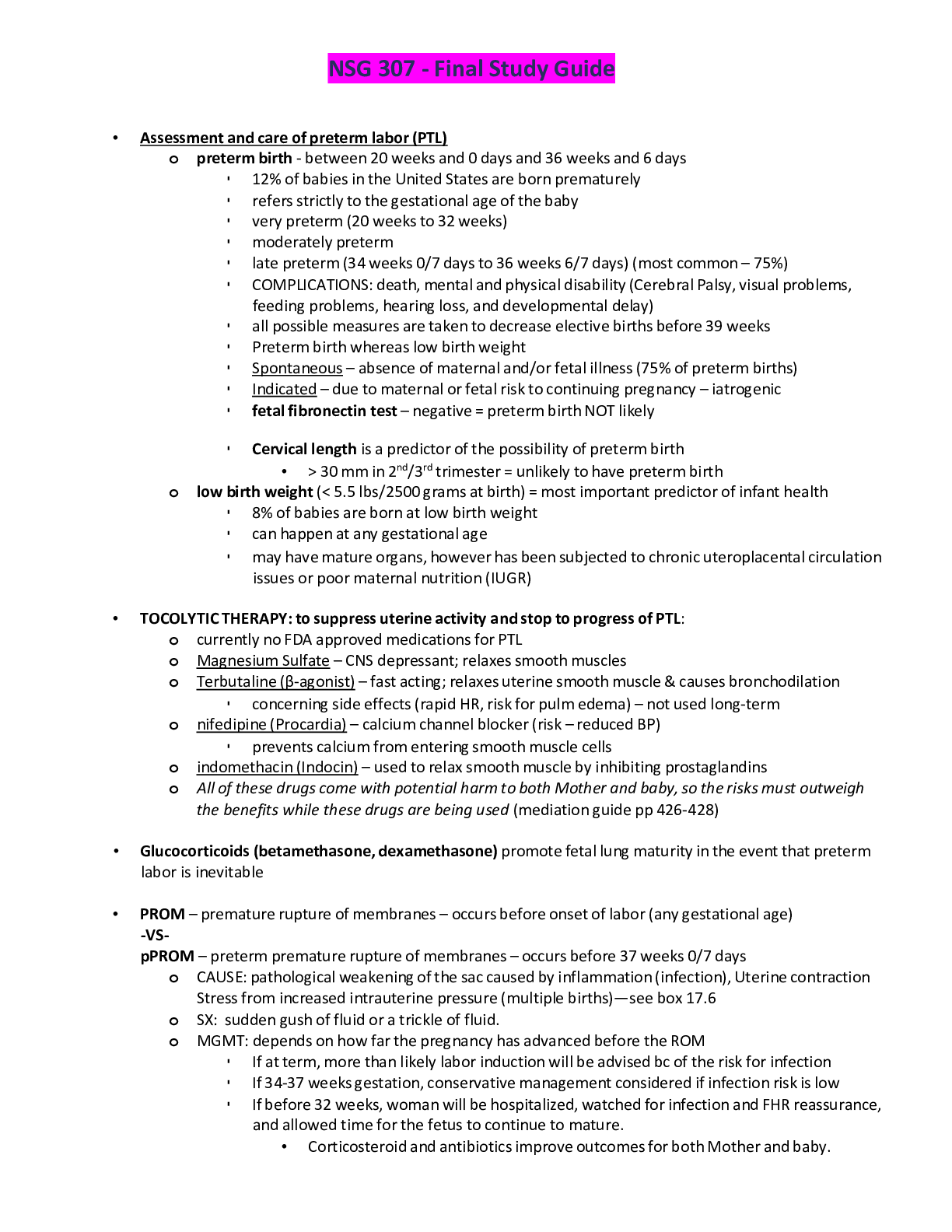
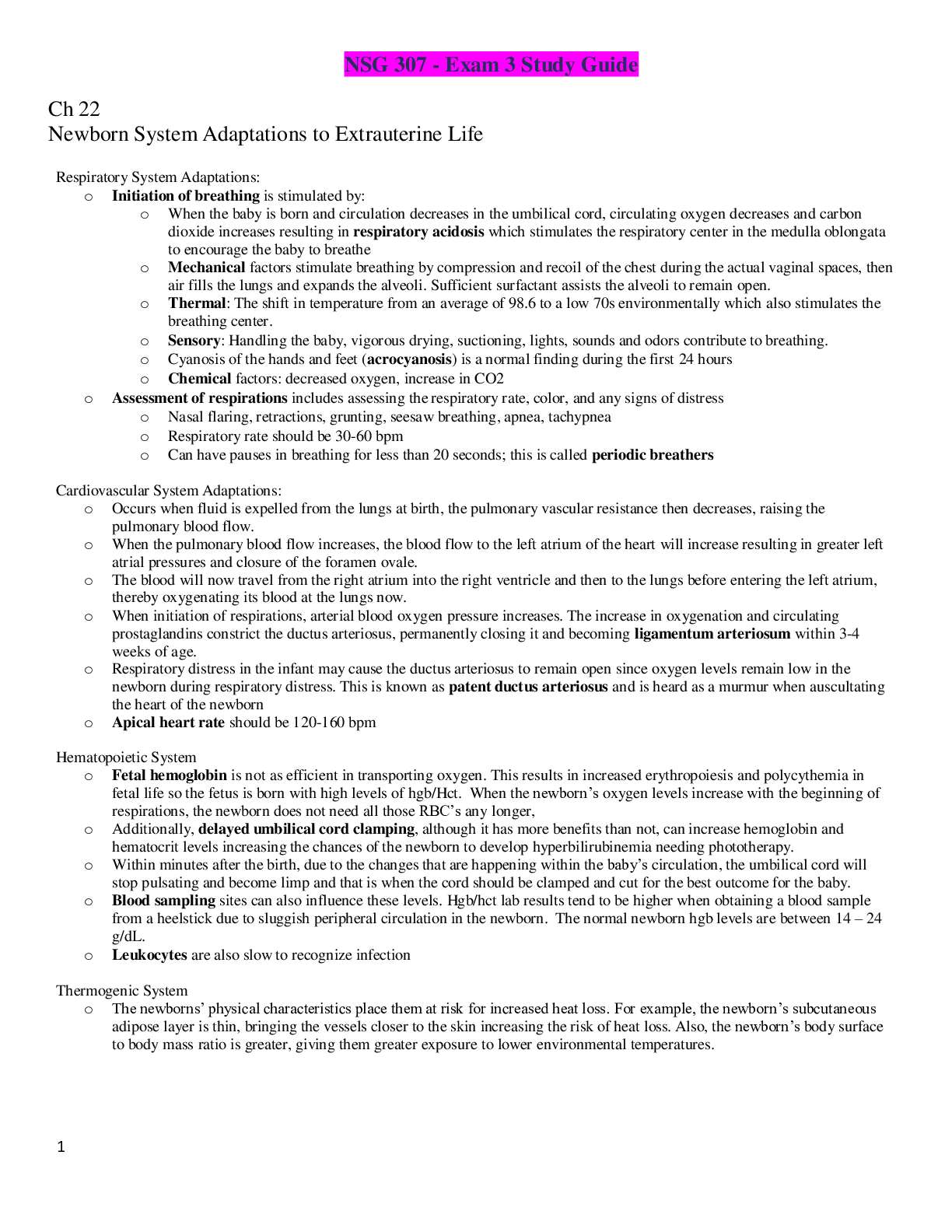
 Quiz 2 Concept Notes MY21.png)











.png)