Lab Report I (Biol 203, Spring 2019)
PART I
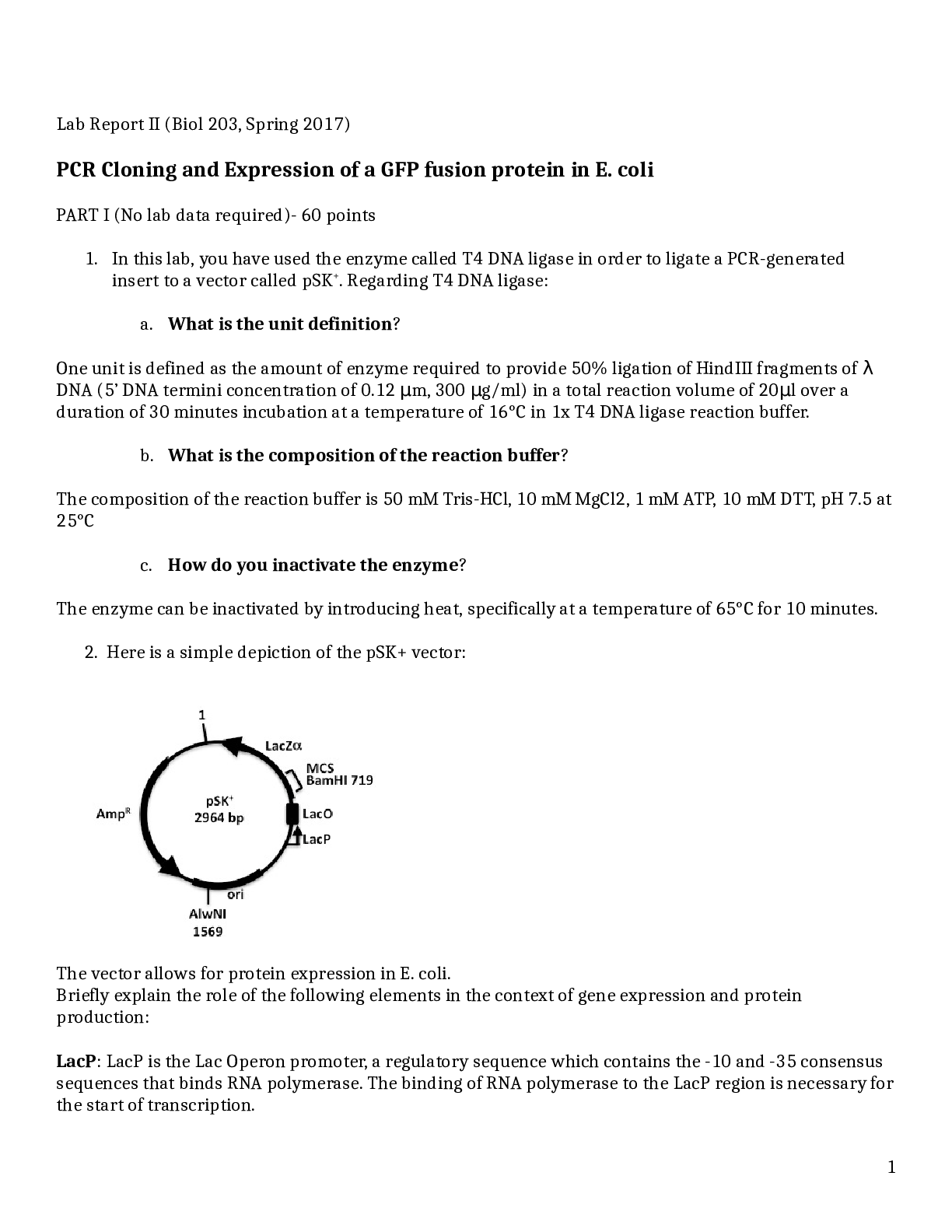
1. In the 203 laboratory, you have used an enzyme called T4 DNA ligase. Answer the few
questions below regarding this enzyme:
a) What is the definition of one Unit for this
...
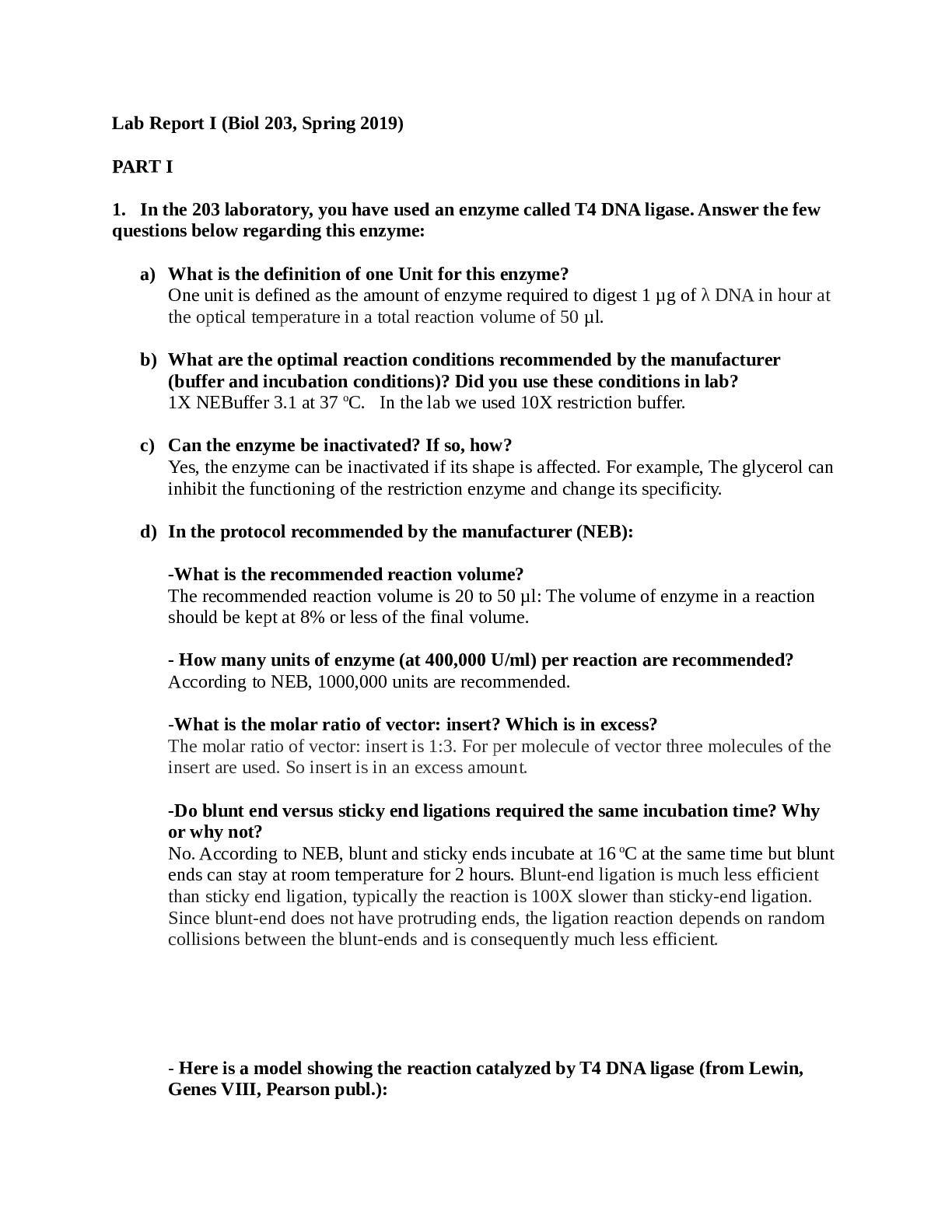
Lab Report I (Biol 203, Spring 2019)
PART I
1. In the 203 laboratory, you have used an enzyme called T4 DNA ligase. Answer the few
questions below regarding this enzyme:
a) What is the definition of one Unit for this enzyme?
One unit is defined as the amount of enzyme required to digest 1 µg of λ DNA in hour at
the optical temperature in a total reaction volume of 50 µl.
b) What are the optimal reaction conditions recommended by the manufacturer
(buffer and incubation conditions)? Did you use these conditions in lab?
1X NEBuffer 3.1 at 37 oC. In the lab we used 10X restriction buffer.
c) Can the enzyme be inactivated? If so, how?
Yes, the enzyme can be inactivated if its shape is affected. For example, The glycerol can
inhibit the functioning of the restriction enzyme and change its specificity.
d) In the protocol recommended by the manufacturer (NEB):
-What is the recommended reaction volume?
The recommended reaction volume is 20 to 50 µl: The volume of enzyme in a reaction
should be kept at 8% or less of the final volume.
- How many units of enzyme (at 400,000 U/ml) per reaction are recommended?
According to NEB, 1000,000 units are recommended.
-What is the molar ratio of vector: insert? Which is in excess?
The molar ratio of vector: insert is 1:3. For per molecule of vector three molecules of the
insert are used. So insert is in an excess amount.
-Do blunt end versus sticky end ligations required the same incubation time? Why
or why not?
No. According to NEB, blunt and sticky ends incubate at 16 oC at the same time but blunt
ends can stay at room temperature for 2 hours. Blunt-end ligation is much less efficient
than sticky end ligation, typically the reaction is 100X slower than sticky-end ligation.
Since blunt-end does not have protruding ends, the ligation reaction depends on random
collisions between the blunt-ends and is consequently much less efficient.
- Here is a model showing the reaction catalyzed by T4 DNA ligase (from Lewin,
Genes VIII, Pearson publ.):
[Show More]