Unit 3 Assessment Questions
1.) Bob has a less-than-container shipment that needs to be moved by water from Miami to Buenos
Aires. His shipment will need to be consolidated with the shipments of other shippers. Bob
sh
...
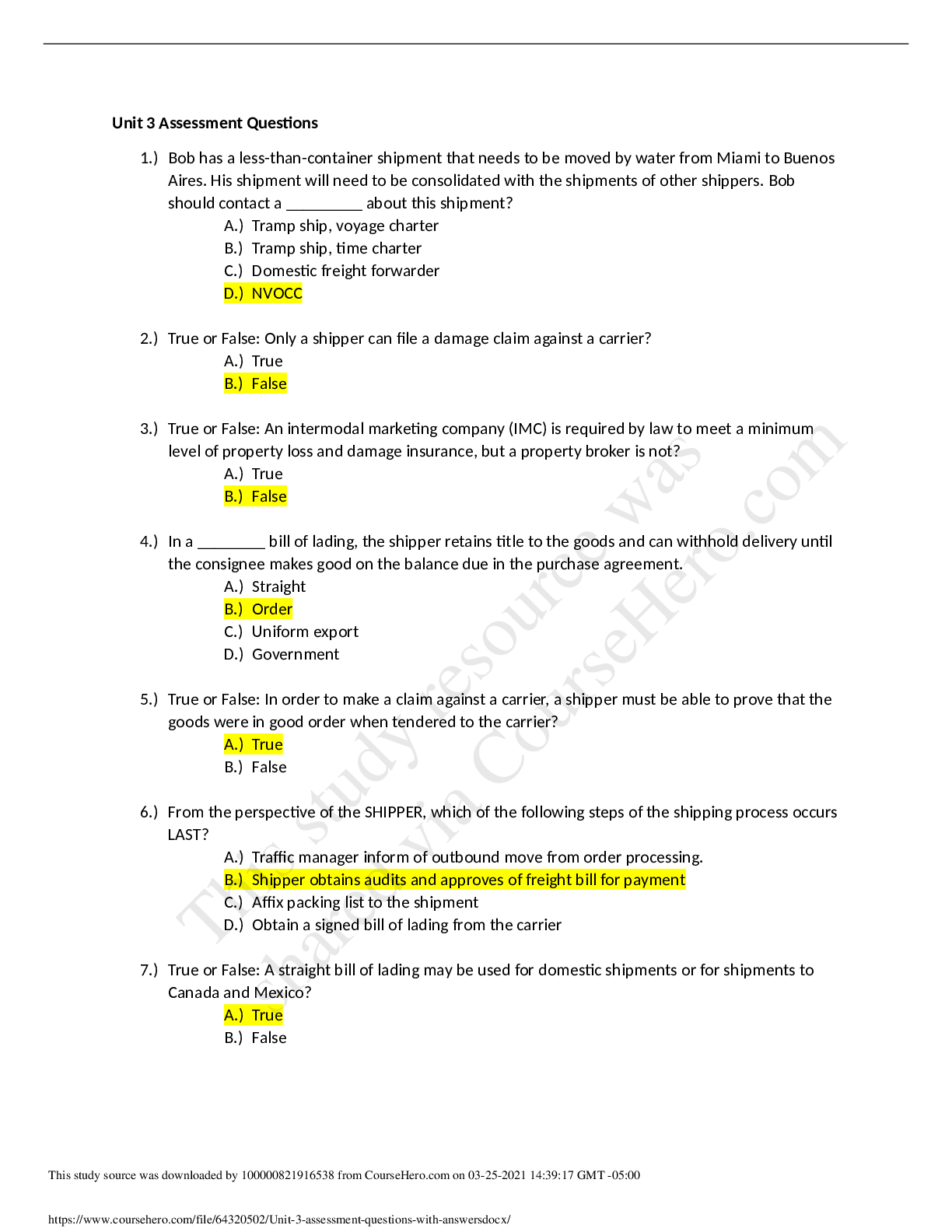
Unit 3 Assessment Questions
1.) Bob has a less-than-container shipment that needs to be moved by water from Miami to Buenos
Aires. His shipment will need to be consolidated with the shipments of other shippers. Bob
should contact a _________ about this shipment?
A.) Tramp ship, voyage charter
B.) Tramp ship, time charter
C.) Domestic freight forwarder
D.) NVOCC
2.) True or False: Only a shipper can file a damage claim against a carrier?
A.) True
B.) False
3.) True or False: An intermodal marketing company (IMC) is required by law to meet a minimum
level of property loss and damage insurance, but a property broker is not?
A.) True
B.) False
4.) In a ________ bill of lading, the shipper retains title to the goods and can withhold delivery until
the consignee makes good on the balance due in the purchase agreement.
A.) Straight
B.) Order
C.) Uniform export
D.) Government
5.) True or False: In order to make a claim against a carrier, a shipper must be able to prove that the
goods were in good order when tendered to the carrier?
A.) True
B.) False
6.) From the perspective of the SHIPPER, which of the following steps of the shipping process occurs
LAST?
A.) Traffic manager inform of outbound move from order processing.
B.) Shipper obtains audits and approves of freight bill for payment
C.) Affix packing list to the shipment
D.) Obtain a signed bill of lading from the carrier
7.) True or False: A straight bill of lading may be used for domestic shipments or for shipments to
Canada and Mexico?
A.) True
B.) False
This study source was downloaded by 100000821916538 from CourseHero.com on 03-25-2021 14:39:17 GMT -05:00
https://www.coursehero.com/file/64320502/Unit-3-assessment-questions-with-answersdocx/
This study resource was
shared via CourseHero.com
8.) True or False: Since the passage of ICCTA, a signed bill of lading can no longer serve as a receipt
for the goods shipped?
A.) True
B.) False
9.) True or False: In order to make a claim against a carrier, a shipper must be able to prove the
exact time and location in which the damage or loss occurred while the goods were under the
control of the carrier?
A.) True
B.) False
10.) The ________ is the carrier’s invoice for freight charges.
A.) Bill of lading
B.) Waybill
C.) Freight bill
11.) True or False: In order to make a claim against a carrier, a shipper must be able to prove the loss
was in excess of $1,000.
A.) True
B.) False
12.) Which of the following occurs LAST in the shipment process for the CARRIER?
A.) Bill of lading is signed by the driver
B.) Carrier determines the customer is “credit worthy”
C.) Shipper loads the vehicle or trailer
13.) From the perspective of a shipper, what is the primary advantage of a shipment contract? (in
comparison to a destination contract)
A.) A shipment contract is likely to cost less per mile
B.) A shipment contract is likely to cost less per pound
C.) A shipment contract carriers less risk, since title transfers to the buyer when the
goods are loaded onto the carrier
D.) All of the above are true
14.) In general, how long does a shipper have to file a damage claim?
A.) One week
B.) One month
C.) Nine months
D.) Twenty-four months
E.) Thirty-six months
F.) Forty-eight months
This study source was downloaded by 100000821916538 from CourseHero.com on 03-25-2021 14:39:17 GMT -05:00
https://www.coursehero.com/file/64320502/Unit-3-assessment-questions-with-answersdocx/
This study resource was
shared via CourseHero.com
15.) In filling a damage claim, what document should be submitted as documentation if a bill of
lading is unavailable?
A.) The original invoice
B.) The bond of indemnity
C.) The name of the shipper’s traffic manager
D.) None of these – if there is no bill of lading, no claim can be filed
16.) A traffic manager should be focused on?
A.) Finding the lowest cost for each individual freight movement
B.) Finding the highest level of service for each individual freight moment
C.) Being focused on the total costs associated with all freight movements
17.) A livestock bill of lading is used when livestock are transported by?
A.) Truck
B.) Rail
C.) Water
D.) Truck or Rail
E.) Truck, Rail, or water
18.) True or False: It is normally required to have both the carrier and the route selected specified on
the bill of lading?
A.) True
B.) False
19.) Which of the following items is normally found on the bill of lading?
A.) The gross weight of the shipment
B.) The number of packages, TL or CL
C.) Shipper’s name and address
D.) Carrier’s name
E.) All of the above are typically on a bill of lading
20.) True or False: If a carrier sees that a shipper has improperly loaded a shipment, the carrier
should reject the load – otherwise the carrier may be liable for damages to the shipment.
A.) True
B.) False
21.) From the perspective of the CONSIGNEE, which of the following activities should occur first
when processing an inbound shipment?
A.) Filing a damage claim if needed
B.) Signing the delivery receipt
C.) Moving the goods from the unloading area
D.) Determining if goods are in proper condition
This study source was downloaded by 100000821916538 from CourseHero.com on 03-25-2021 14:39:17 GMT -05:00
https://www.coursehero.com/file/64320502/Unit-3-assessment-questions-with-answersdocx/
This study resource was
shared via CourseHero.com
22.) True or False: In determining whether to accept a full-value rate or a released value rate, the
shipper should estimate the likelihood of a loss, and the amount of such losses, and then
compare this to the difference in coverage and cost between a full-value rate and released value
rate
A.) True
B.) False
23.) I consolidate small shipments for lower cost pooled container lots. I mostly work for exporters,
but may work for some importers. WHO AM I?
A.) An NVOCC
B.) A ship broker
C.) A ship agent
D.) An exporter trading company
24.)Which of the following is NOT a part of the CONTROL area of the traffic management decisionmaking framework?
A.) Setting standards to measure progress towards organizational goals
B.) Preparing and processing shipping standards
C.) Implementing a system to compare performance against standards
D.) Implementing a system to create deviations from standards
25.)True or False: The released value rate is typically less expensive for a shipper than a full value
rate?
A.) True
B.) False
26.) Which type of bill of lading is used to make sure that a consignee makes good on the balance
due in the purchase agreement?
A.) Government bill of lading
B.) Straight bill of lading
C.) Order bill of lading
D.) Air bill of lading
E.) Uniform export bill of lading
27.) Once a damage claim has been filed, how long does the carrier have to either pay, decline,
settle, or report the updates status/progress of the claim to the shipper?
A.) 120 days
B.) 200 days
C.) One Year
D.) Eighteen months
E.) Two years
This study source was downloaded by 100000821916538 from CourseHero.com on 03-25-2021 14:39:17 GMT -05:00
https://www.coursehero.com/file/64320502/Unit-3-assessment-questions-with-answersdocx/
This study resource was
shared via CourseHero.com
28.) A Traffic manager needs to assume that the availability of carrier services will
A.) Remain relatively consistent over time
B.) Will not remain constant over time
C.) Will increase to meet the needs of the traffic manager
29.) Which of the following is NOT a part of the OPERATIONS area of the traffic management
decision-making framework?
A.) Setting standards to measure progress towards organizational goals
B.) Scheduling
C.) Making and scheduling shipments
D.) Claims prevention and processing
E.) Supervising fleets
30.) Ture or False: A shipper’s load and count is considered an exception to common carrier liability
on an interstate shipment moving on a straight bill of lading.
A.) True
B.) False
31.) Which of the following could potentially be an example of a “land-bridge” move?
A.) A shipment from Chicago to Los Angeles
B.) A shipment from Tokyo to Los Angeles
C.) A shipment from Tokyo to Stockholm
D.) A shipment from Chicago to Mexico City
32.) True or False: In the motor carrier industry, a photocopy bill of lading normally fulfills the
function of a waybill?
A.) True
B.) False
33.) An official document which lists all cargoes on each voyage of a ship is called a?
A.) Consular invoice
B.) Dock receipt
C.) Cargo manifest
D.) Commercial invoice
E.) Booking request
34.) A bill of lading serves as (1) a contract of carriage and/or (2) a receipt for the goods shipped.
A.) (1) is correct, but (2) is incorrect
B.) (1) is incorrect, but (2) is correct
C.) Both (1) and (2) are correct
D.) Neither (1) and (2) are correct
This study source was downloaded by 100000821916538 from CourseHero.com on 03-25-2021 14:39:17 GMT -05:00
https://www.coursehero.com/file/64320502/Unit-3-assessment-questions-with-answersdocx/
This study resource was
shared via CourseHero.com
35.) True or False: If a haul is not successfully completed, the bill of lading serves as the basis for a
breach of contract?
A.) True
B.) False
36.) When the need for equipment is temporary and flexibility is needed within an organization, a
company is more likely to consider ________ of a fleet?
A.) Purchase
B.) Lease
37.) I am a firm local to a port that arranges many of the details required while a ship is in port (such
as a berth, clearance, documentation). Tramp ship owners, importers, and exporters may use my
services. WHO AM I?
A.) NVOCC
B.) A foreign freight forwarder
C.) A ship broker
D.) A ship agent
E.) An Exporter trading company
38.) I arrange ocean bookings, land transportation, terminal storage, crating and documentation. I
provide knowledge of foreign nation requirements and translation services. I may work for
importers or exporters. WHO AM I?
A.) An NVOCC
B.) A ship broker
C.) A ship agent
D.) A stevedoring firm
E.) A foreign freight forwarder
39.) Which type of bill of lading would be most appropriate when a shipment requires an overland
move plus a water move plus an overland delivery?
A.) Straight bill of lading
B.) Order bill of lading
C.) Government bill of lading
D.) Air bill of lading
E.) Uniform export bill of lading
40.) True or False: The carrier normally prepares the bill of lading?
A.) True
B.) False
41.) True or False: A bill of lading can serve as a receipt for goods shipped?
A.) True
B.) False
This study source was downloaded by 100000821916538 from CourseHero.com on 03-25-2021 14:39:17 GMT -05:00
https://www.coursehero.com/file/64320502/Unit-3-assessment-questions-with-answersdocx/
This study resource was
shared via CourseHero.com
42.) True or False: A shipment contract is also referred to as “FOB Origin.”?
A. True
B. False
[Show More]