Unit 5 Assessment Questions
1.) True or False: The Surface Transportation Board has the power to investigate, including the
power to issue subpoenas?
A.) True
B.) False
2.) As a general rule, brokers are advised not
...
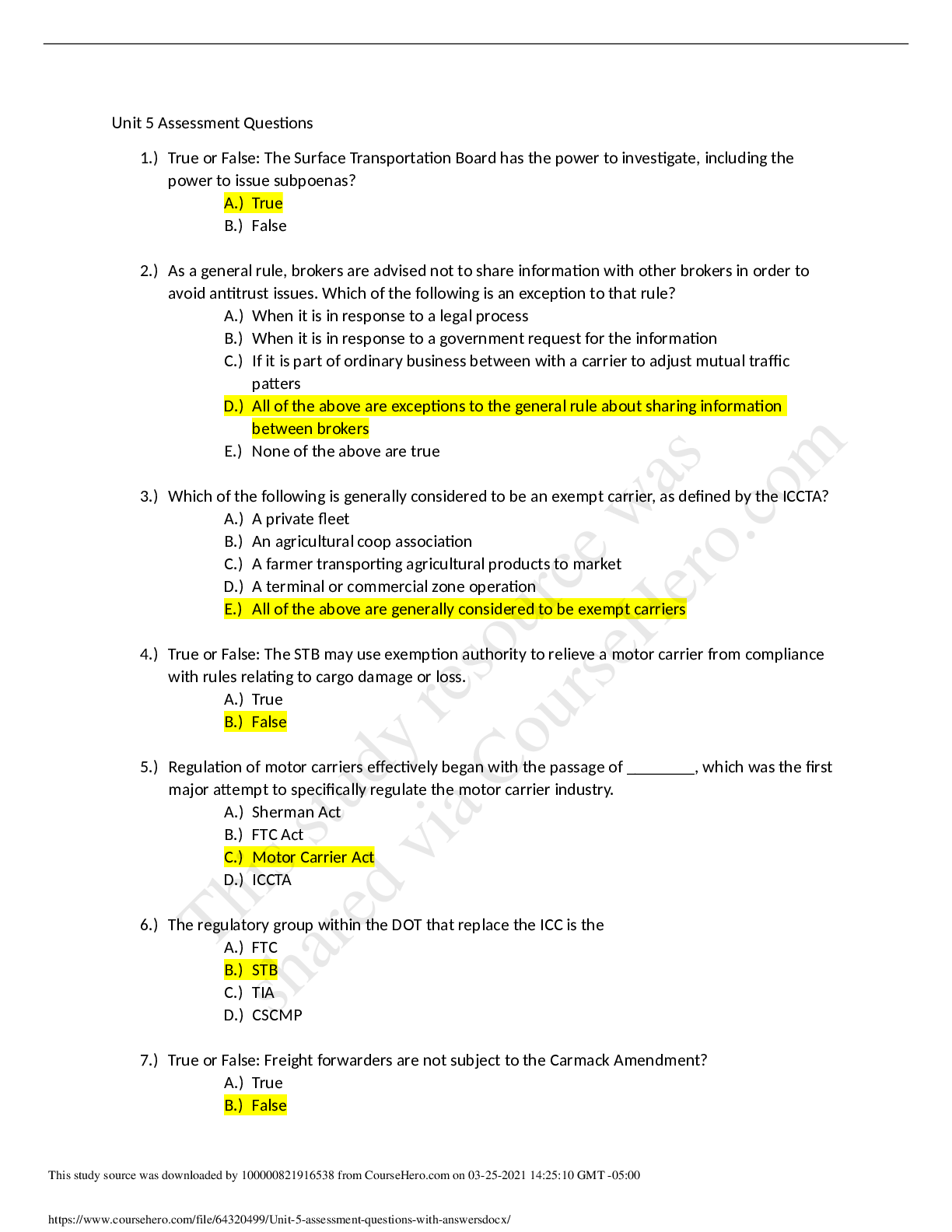
Unit 5 Assessment Questions
1.) True or False: The Surface Transportation Board has the power to investigate, including the
power to issue subpoenas?
A.) True
B.) False
2.) As a general rule, brokers are advised not to share information with other brokers in order to
avoid antitrust issues. Which of the following is an exception to that rule?
A.) When it is in response to a legal process
B.) When it is in response to a government request for the information
C.) If it is part of ordinary business between with a carrier to adjust mutual traffic
patters
D.) All of the above are exceptions to the general rule about sharing information
between brokers
E.) None of the above are true
3.) Which of the following is generally considered to be an exempt carrier, as defined by the ICCTA?
A.) A private fleet
B.) An agricultural coop association
C.) A farmer transporting agricultural products to market
D.) A terminal or commercial zone operation
E.) All of the above are generally considered to be exempt carriers
4.) True or False: The STB may use exemption authority to relieve a motor carrier from compliance
with rules relating to cargo damage or loss.
A.) True
B.) False
5.) Regulation of motor carriers effectively began with the passage of ________, which was the first
major attempt to specifically regulate the motor carrier industry.
A.) Sherman Act
B.) FTC Act
C.) Motor Carrier Act
D.) ICCTA
6.) The regulatory group within the DOT that replace the ICC is the
A.) FTC
B.) STB
C.) TIA
D.) CSCMP
7.) True or False: Freight forwarders are not subject to the Carmack Amendment?
A.) True
B.) False
This study source was downloaded by 100000821916538 from CourseHero.com on 03-25-2021 14:25:10 GMT -05:00
https://www.coursehero.com/file/64320499/Unit-5-assessment-questions-with-answersdocx/
This study resource was
shared via CourseHero.com
8.) How long must a broker keep a record of each transaction?
A.) One year
B.) Eighteen months
C.) Two years
D.) Three years
9.) A company is acting as a ________ when it holds itself out to provide transportation for hire and
it assembles consolidators, break bulk, distributes, or provides for those operations, assumes
responsibility for transportation, and uses a regulated carrier to provide the service.
A.) Broker
B.) Freight forwarder
C.) Shipper’s agent
D.) Shipper’s association
10.) A ________ is a person other than a motor carrier who sells, offers for sale, negotiates for, or
holds itself out by solicitation, advertisement, or otherwise as selling, providing, or arranging for
transportation by a motor carrier for compensation.
A.) Broker
B.) Freight forwarder
C.) Shipper’s association
D.) Carrier
11.) True or False: ICCTA represents a shift in motor carrier regulation, changing from a safety fitness
orientation and being responsive to damages if a carrier does not operate safely to an economic
viewport towards regulation.
A.) True
B.) False
12.) True or False: If a company performs brokerage functions and motor carrier functions, it is
advisable to combine revenues and expenses for those two areas into a single account, since
both activities are part of one company
A.) True
B.) False
13.) True or False: A carrier can use their own mileage guide, provided it is available on request to
interested parties.
A.) True
B.) False
14.) True or False: A broker may NOT receive compensation from a carrier for brokerage services if
the broker owns the shipment.
A.) True
B.) False
This study source was downloaded by 100000821916538 from CourseHero.com on 03-25-2021 14:25:10 GMT -05:00
https://www.coursehero.com/file/64320499/Unit-5-assessment-questions-with-answersdocx/
This study resource was
shared via CourseHero.com
15.)True or False: The 1937 case of Anna M. Grant Broker Application established brokering
authority as a person right that could be transferred to another entity by the broker.
A.) True
B.) False
16.) In the 1970s, the ICC reviewed the surety bond requirement for brokers and decided to
A.) Raise it from $1,000 to $5,000
B.) Leave it at $5,000
C.) Raise it from $5,000 to $10,000
D.) Leave it at $10,000
17.) Between 1982 and 1987, the number of brokerage licenses in the US
A.) Decreased by 50%
B.) Remained about the same
C.) Increased by 50%
D.) Increased by more than 50%
18.)The wave of deregulation of the freight industry began in earnest in the
A.) 1930s
B.) 1950s
C.) 1970s
D.) 1990s
E.) 2000s
19.) The Maislin Industries, U. S. Inc vs Primary Steel, Inc case (1990) is most closely associated with
which of the following issues?
A.) Negligent hiring
B.) Vicarious liability
C.) Undercharge claims
D.) Interstate motor carrier regulation
20.) As defined in ICCTA, “________ are persons who are part of the normal organization of a motor
carrier and perform duties under the carrier’s directions pursuant to a preexisting agreement
which provides a continuing relationship, precluding the exercise of discretion on part of (the
individual), in allocating traffic between the carrier and others.”
A.) Broker
B.) Freight forwarder
C.) Bona fide agent
D.) Shipper’s association
21.) True or False: Under ICCTA, a shipper and carrier may not waive the right to remedies to
disputes in court, even if both parties agree to it in the contract.
A.) True
B.) False
This study source was downloaded by 100000821916538 from CourseHero.com on 03-25-2021 14:25:10 GMT -05:00
https://www.coursehero.com/file/64320499/Unit-5-assessment-questions-with-answersdocx/
This study resource was
shared via CourseHero.com
22.) The major legislative act which deregulated freight forwards was
A.) Motor Carrier Act
B.) FTC Act
C.) ICCTA
D.) Surface freight forwarder Act
E.) Trick question regulations on freight forwarders have increased substantially over
the past 30 years
23.) The STB may exempt a motor carrier from compliance when 1 regulation is not necessary to
carry out national transportation policy, 2 regulation is not needed to protect shippers from
abuses of market power, and 3 ________
A.) An exemption fee is paid to DOT
B.) The exemption is in the public interest
C.) Both of the above are correct
D.) None of the above are correct
24.) As a result of ICCTA, which of the following contract provisions may be waived if both parties
agree to it
A.) Rates
B.) Registration
C.) Safety fitness
D.) Insurance
25.) In a pre-ICCTA regulatory environment, the gap between the rate on file with the ICC and the
rate agreed to between a shipper and carrier is referred to as a(n)
A.) Undercharge
B.) Released rate
C.) Exemption
D.) Filed rate
26.) True or False: A broker cannot hold itself out to be more than a broker if it is not registered as
such (i.e., registered as a motor carrier)
A.) True
B.) False
27.) True or False: A broker who wishes to provide transportation does not need a register as a
motor carrier as long as providing transportation does not constitute more than 50% of revenues
A.) True
B.) False
28.) When brokerage first began to be regulated in the 1930s, what was the primary reason cited for
a need to regulate the industry?
This study source was downloaded by 100000821916538 from CourseHero.com on 03-25-2021 14:25:10 GMT -05:00
https://www.coursehero.com/file/64320499/Unit-5-assessment-questions-with-answersdocx/
This study resource was
shared via CourseHero.com
A.) Triggering increased competition
B.) Creating economies of scale
C.) Protecting the interests of the public
D.) To protect the interests of shippers and carriers
29.) During the 1980s and 1990s the ICC ________ regulatory restraints on brokers
A.) Increased
B.) Decreased
C.) Made little change on the
30.) True or False: Since ICCTA was approved in 1995, surface freight forwarders are no longer
required to complete an application and register
A.) True
B.) False
31.) True or False: Under the Carmack Amendment, each carrier who helped transport goods (which
later become damaged) is liable for the actual loss
A.) True
B.) False
32.) Two brokers who serve the same shipper meet over coffee and decide they could both become
more profitable if they were to stop competing with each other over price for this one shipper’s
business. They agree to quote the shipper comparable, higher prices on all future loads. This is
an example of
A.) Effective horizontal cooperation between brokers
B.) Predatory pricing
C.) Price discrimination
D.) Price fixing
33.) Which of the following is NOT one of the duties of a common carrier?
A.) A duty to deliver
B.) A duty to serve
C.) A duty to charge reasonable rates
D.) A duty of nondiscrimination
E.) All of the above are duties of common carriers
34.) True or False: A freight forwarder is defined as being a carrier
A.) True
B.) False
35.) Tovey Transport is a brokerage company. Tovey states in its ads “Let Tovey Transport be your
complete solution for all your transportation needs. We’ll move your goods wherever they are
This study source was downloaded by 100000821916538 from CourseHero.com on 03-25-2021 14:25:10 GMT -05:00
https://www.coursehero.com/file/64320499/Unit-5-assessment-questions-with-answersdocx/
This study resource was
shared via CourseHero.com
going tin the US and Canada just leave it all tu us.” Which of the following statements about this
is true?
A.) This ad is not advisable, as no broker should advertise it can arrange shipments
internationally
B.) This ad is not advisable, as it appears Tovey Transport is representing itself to be a
carrier.
C.) The ad is appropriate, as such claims are likely to be viewed by the courts as
“puffery”
36.) True or False: ICCTA changed the definition of a broker
A.) True
B.) False
37.) ICCTA specified that the remedy for a breach of contract should be ________ , unless the parties
agree otherwise.
A.) An independent arbiter
B.) An appropriate state or US district court
C.) The Surface Transportation Board (STB)
D.) A recognized trade association
38.) Which of the following actions typically triggered an undercharge claim against a shipper?
A.) When a carrier filed for bankruptcy
B.) When a complaint was filed to the DOT
C.) When a shipper filed for bankruptcy
D.) When a carrier invoice invoices the broker for freight charges
39.)The percentage of Brokerage applications that were approved ________ as the decade of the
1970s progressed.
A.) Increased
B.) Decreased
C.) Remained about the same
40.) In the 1980 ICC ruling “Acceptable Forms of Request for Operating Authority (Motor Carriers
and Brokers of Property),” the ICC determined that contract carriers.
A.) Needed to seek licensing in each state in which they sought to operate
B.) Would have unrestricted geographic authority nationwide
C.) May serve shippers in Canada and Mexico as a part of NAFTA
D.) None of the above are true
41.) True or False: The passage of ICCTA also eliminated the Carmack Amendment
A.) True
B.) False
This study source was downloaded by 100000821916538 from CourseHero.com on 03-25-2021 14:25:10 GMT -05:00
https://www.coursehero.com/file/64320499/Unit-5-assessment-questions-with-answersdocx/
This study resource was
shared via CourseHero.com
42.) True or False: A common reason for rejecting a broker’s application in the 1930’s was a
perception that a broker would serve no useful public purpose or that other alternatives for
arranging transportation already existed.
A.) True
B.) False
43.) A person providing motor vehicle transportation for compensation is defined as a….
A.) Broker
B.) Freight forwarder
C.) Shipper’s association
D.) Motor carrier
[Show More]