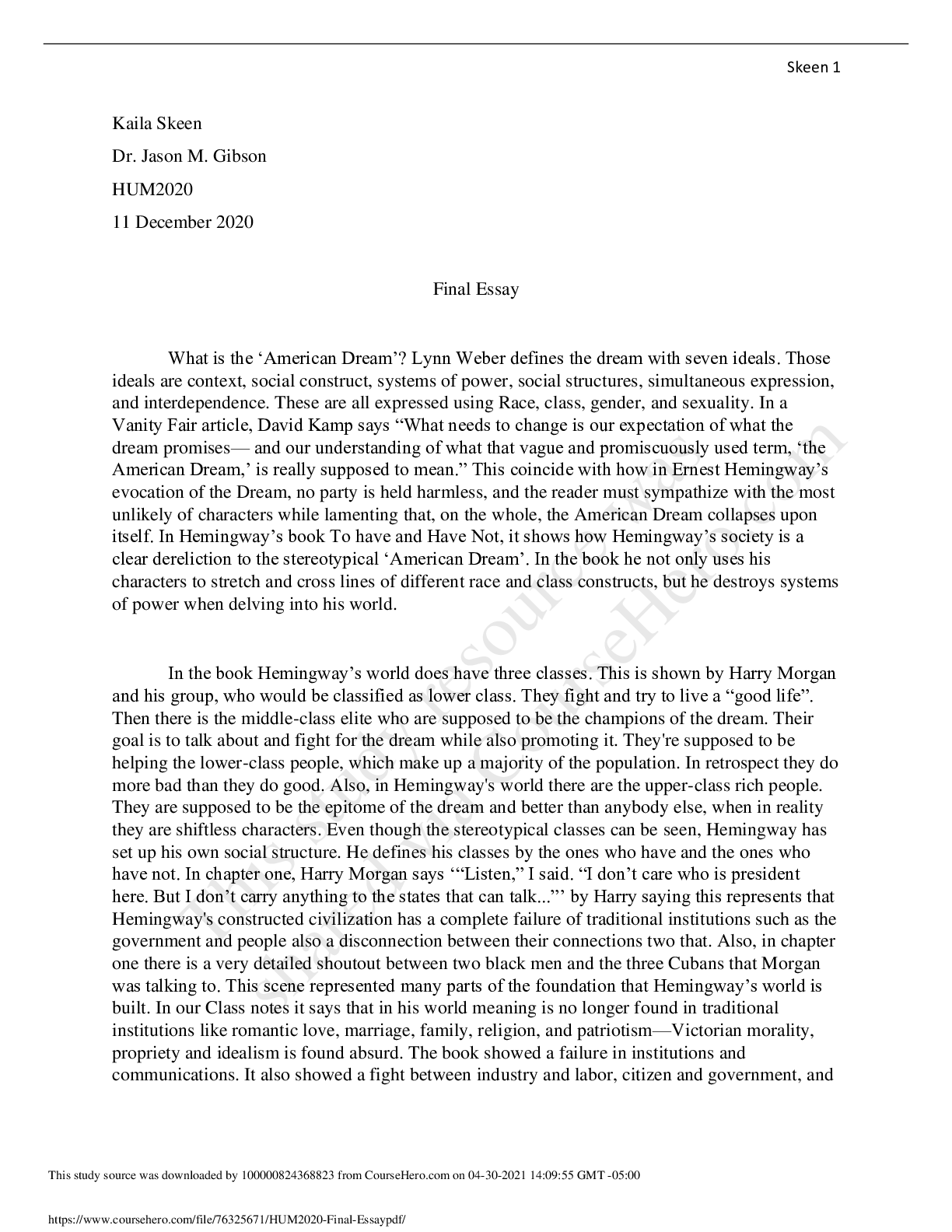
Kaila Skeen
Dr. Jason M. Gibson
HUM2020
11 December 2020
Final Essay
What is the ‘American Dream’? Lynn Weber defines the dream with seven ideals. Those
ideals are context, social construct, systems of power, socia
...
Kaila Skeen
Dr. Jason M. Gibson
HUM2020
11 December 2020
Final Essay
What is the ‘American Dream’? Lynn Weber defines the dream with seven ideals. Those
ideals are context, social construct, systems of power, social structures, simultaneous expression,
and interdependence. These are all expressed using Race, class, gender, and sexuality. In a
Vanity Fair article, David Kamp says “What needs to change is our expectation of what the
dream promises— and our understanding of what that vague and promiscuously used term, ‘the
American Dream,’ is really supposed to mean.” This coincide with how in Ernest Hemingway’s
evocation of the Dream, no party is held harmless, and the reader must sympathize with the most
unlikely of characters while lamenting that, on the whole, the American Dream collapses upon
itself. In Hemingway’s book To have and Have Not, it shows how Hemingway’s society is a
clear dereliction to the stereotypical ‘American Dream’. In the book he not only uses his
characters to stretch and cross lines of different race and class constructs, but he destroys systems
of power when delving into his world.
In the book Hemingway’s world does have three classes. This is shown by Harry Morgan
and his group, who would be classified as lower class. They fight and try to live a “good life”.
Then there is the middle-class elite who are supposed to be the champions of the dream. Their
goal is to talk about and fight for the dream while also promoting it. They're supposed to be
helping the lower-class people, which make up a majority of the population. In retrospect they do
more bad than they do good. Also, in Hemingway's world there are the upper-class rich people.
They are supposed to be the epitome of the dream and better than anybody else, when in reality
they are shiftless characters. Even though the stereotypical classes can be seen, Hemingway has
set up his own social structure. He defines his classes by the ones who have and the ones who
have not. In chapter one, Harry Morgan says ‘“Listen,” I said. “I don’t care who is president
here. But I don’t carry anything to the states that can talk...”’ by Harry saying this represents that
Hemin
[Show More]