PMI-ACP
Exam Practice Questions
This PMI-ACP exam PDF provides detailed practice questions, answers, and
explanations. These PMI PMI-ACP exam practice questions are designed for IT
professionals, system administrator
...
PMI-ACP
Exam Practice Questions
This PMI-ACP exam PDF provides detailed practice questions, answers, and
explanations. These PMI PMI-ACP exam practice questions are designed for IT
professionals, system administrators, and students preparing for PMI Certification
certification.
Key Features
Exam-Oriented Questions: Realistic practice questions that mirror the format
and difficulty of actual certification exams.
Wide Coverage: Includes cloud computing, networking, security, AI, and
enterprise IT management exams.
Study-Friendly Format: Organized sections by exam type, enabling focused
preparation.
Important Note:
This material is for personal study purposes only. Please do not
redistribute or use for commercial purposes without permission.
Share some PMI-ACP exam online questions below.
1.An executive sponsor of a new Scrum team actively attends Scrum ceremonies.
How does this benefit the team?
A. It helps the team to focus on and meet sprint goals.
B. It reminds the team about who sponsors the project.
C. It provides high-level project updates to the sponsor.
D. It helps to quickly resolve issues using the sponsor's influence.
Answer: D
Explanation:
The correct answer is D C It helps to quickly resolve issues using the sponsor's influence. A sponsor's
presence in Scrum ceremonies (like sprint reviews or retrospectives) helps escalate and resolve highlevel issues, remove organizational blockers, and reinforce alignment between the team and the
business.
From the PMI Agile Practice Guide:
“Active sponsor engagement can accelerate issue resolution, remove organizational impediments,
and provide vital support to the team. Sponsors are valuable allies in ensuring team success and
organizational alignment.”
(PMI Agile Practice Guide, Section 4.2 C Stakeholder Engagement)
Mike Griffiths explains:
“When sponsors are visible and engaged, teams benefit from faster decision-making, quicker
escalation of issues, and improved morale. Their influence can break through bureaucratic barriers.”
(Mike Griffiths, PMI-ACP Exam Prep, Chapter 3 C Stakeholder Engagement)
Incorrect options:
A misattributes sprint discipline to sponsor involvement?this is a team responsibility.
B is passive and doesn’t reflect tangible benefits.
C is useful but not the primary advantage of sponsor participation.
Answer. D
2.A team member does not understand what the project risks are or the impact that they could have.
How should an Agile leader communicate risks in a way that the team will understand?
A. Create a RAG chart (Responsible, Accountable, Consulted, Informed) that identifies who is
accountable for each risk.
B. Create a Gantt chart that includes slack to accommodate for unknowns.
C. Create a communications management plan that details who is responsible for communicating
risks.
D. Create a risk burndown chart showing the reduction of risks over time.
Answer: D
Explanation:
The correct answer is D C Create a risk burndown chart showing the reduction of risks over time.
In Agile, risk management is integrated into each iteration. A risk burndown chart is a visual
information radiator that tracks the total risk exposure and how it changes over time, making risk
transparent and easy for the team to understand.
From the PMI Agile Practice Guide:
“A risk burndown chart can be used to communicate the decreasing level of project risk over time and
encourage discussion on risk mitigation strategies.”
(PMI Agile Practice Guide, Section 6.4 C Risk Management)
Mike Griffiths also states:
“Agile teams use tools like risk burndown charts to visualize risks and track mitigation. They provide
real-time understanding of current and remaining risks.”
(Mike Griffiths, PMI-ACP Exam Prep Book, Chapter 6 C Problem Detection and Resolution)
Other options:
A is a responsibility assignment matrix (not risk-focused).
B and C are traditional (predictive) methods and don’t align with Agile risk communication.
Answer. D
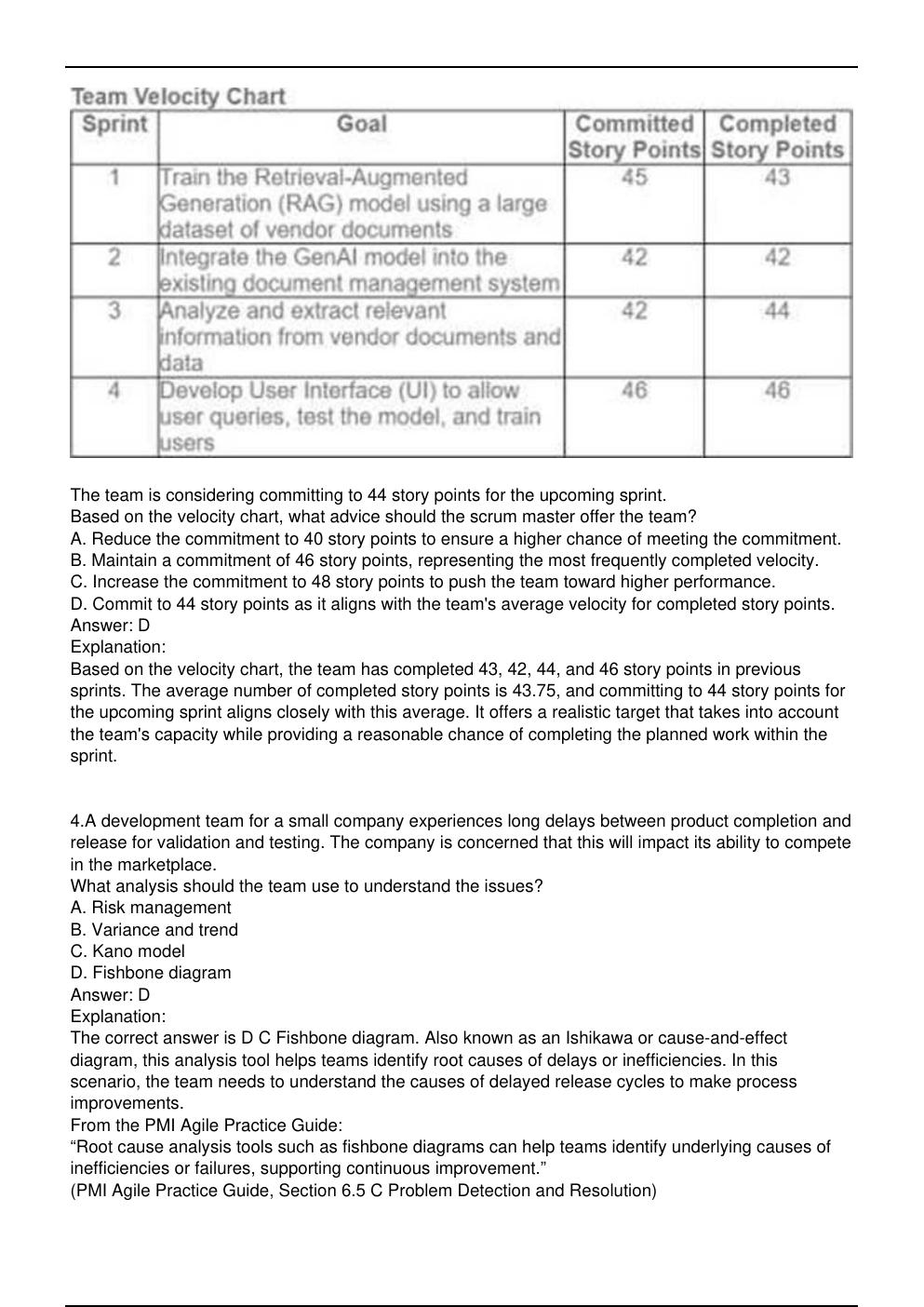
3.Refer to the exhibit.
The team is considering committing to 44 story points for the upcoming sprint.
Based on the velocity chart, what advice should the scrum master offer the team?
A. Reduce the commitment to 40 story points to ensure a higher chance of meeting the commitment.
B. Maintain a commitment of 46 story points, representing the most frequently completed velocity.
C. Increase the commitment to 48 story points to push the team toward higher performance.
D. Commit to 44 story points as it aligns with the team's average velocity for completed story points.
Answer: D
Explanation:
Based on the velocity chart, the team has completed 43, 42, 44, and 46 story points in previous
sprints. The average number of completed story points is 43.75, and committing to 44 story points for
the upcoming sprint aligns closely with this average. It offers a realistic target that takes into account
the team's capacity while providing a reasonable chance of completing the planned work within the
sprint.
4.A development team for a small company experiences long delays between product completion and
release for validation and testing. The company is concerned that this will impact its ability to compete
in the marketplace.
What analysis should the team use to understand the issues?
A. Risk management
B. Variance and trend
C. Kano model
D. Fishbone diagram
Answer: D
Explanation:
The correct answer is D C Fishbone diagram. Also known as an Ishikawa or cause-and-effect
diagram, this analysis tool helps teams identify root causes of delays or inefficiencies. In this
scenario, the team needs to understand the causes of delayed release cycles to make process
improvements.
From the PMI Agile Practice Guide:
“Root cause analysis tools such as fishbone diagrams can help teams identify underlying causes of
inefficiencies or failures, supporting continuous improvement.”
(PMI Agile Practice Guide, Section 6.5 C Problem Detection and Resolution)
Mike Griffiths also writes:
“A fishbone diagram helps the team brainstorm and categorize the potential causes of a problem,
enabling a structured investigation into delays or bottlenecks.”
(Mike Griffiths, PMI-ACP Exam Prep, Chapter 6 C Problem Resolution)
Incorrect options:
A is for identifying and managing risks, not diagnosing root causes.
B analyzes progress metrics but doesn’t provide root cause insights.
C is for understanding customer satisfaction, not operational delays.
Answer. D
[Show More]