350-101
Exam Practice Questions
This 350-101 exam PDF provides detailed practice questions, answers, and
explanations. These Cisco 350-101 exam practice questions are designed for IT
professionals, system administrat
...
350-101
Exam Practice Questions
This 350-101 exam PDF provides detailed practice questions, answers, and
explanations. These Cisco 350-101 exam practice questions are designed for IT
professionals, system administrators, and students preparing for CCIE Wireless
certification.
Key Features
Exam-Oriented Questions: Realistic practice questions that mirror the format
and difficulty of actual certification exams.
Wide Coverage: Includes cloud computing, networking, security, AI, and
enterprise IT management exams.
Study-Friendly Format: Organized sections by exam type, enabling focused
preparation.
Important Note:
This material is for personal study purposes only. Please do not
redistribute or use for commercial purposes without permission.
Share some 350-101 exam online questions below.
1.Which function does FRA use to optimize client experience and network coverage?
A. Monitoring on the physical interface level in the AP
B. Enhances roaming by redirecting the client to move to the appropriate AP
C. Implementation by local data path control
D. Dynamically adapts the roles of dual-band radios in an AP
Answer: B
Explanation:
FRA (Flexible Radio Assignment) is a feature in Cisco wireless networks designed to optimize the
client experience and enhance network coverage. FRA functions by managing roaming behavior and
ensuring that clients are connected to the most appropriate access point (AP) based on signal quality
and other factors. This helps in ensuring a seamless experience when clients move across coverage
areas, by actively guiding them to the best AP.
The key functionality of FRA involves redirecting clients to the appropriate AP when they are
experiencing suboptimal performance on the current AP, which is typically influenced by factors such
as interference or distance. This optimization helps improve both coverage and user experience by
making sure clients stay on the most optimal radio connection.
Option A, which refers to monitoring on the physical interface level, is not directly related to FRA but
more to basic radio management.
Option C, which mentions local data path control, refers to how data paths are managed locally within
an AP but does not address the dynamic nature of client roaming.
Option D, about dual-band radios, involves how radios are configured but does not directly describe
FRA's function.
FRA is vital for dynamically enhancing wireless network performance, particularly in large, dense
environments where clients are constantly moving.
2.What is a characteristic of 20 MHz channel width in a wireless network?
A. Narrowest channel width in the 2.4 GHz band
B. Increases authentication handoff frequency
C. Supports automatic client reassociation
D. Higher throughput than wider channels
Answer: A
Explanation:
In wireless networks, the 20 MHz channel width is the standard and narrowest channel allocation in
the 2.4 GHz frequency band. Using narrower channels reduces adjacent-channel interference and
allows for better coexistence in high-density environments, which is particularly important in the
crowded 2.4 GHz spectrum. A 20 MHz channel uses less RF bandwidth than 40 MHz or 80 MHz
channels, providing more non-overlapping channels (channels 1, 6, and 11 in 2.4 GHz) to reduce cochannel interference.
Option B is incorrect, as channel width does not inherently increase authentication handoff frequency;
handoff behavior is determined by RSSI, client roaming thresholds, and 802.11r fast roaming settings.
Option C describes client reassociation support, which is handled by the wireless controller and client
firmware, not the channel width itself.
Option D is incorrect because wider channels (40 MHz, 80 MHz) provide higher throughput than 20
MHz, at the expense of increased interference potential. Cisco Wireless Core Technologies
emphasize that 20 MHz channels are preferred for dense deployments in the 2.4 GHz band to
maximize non-overlapping channels and reduce interference, ensuring predictable coverage and
reliable client connectivity.
Reference topics: RF Fundamentals ? 20 MHz channels, 2.4 GHz spectrum planning, interference
management, channel allocation.
3.Which feature does a high-gain patch antenna impart to a wireless signal?
A. single narrow frequency use
B. partial overlap of frequency bands
C. focused beam in a flat area
D. alternating direction with elevation
Answer: C
Explanation:
A high-gain patch antenna is a directional antenna that concentrates RF energy into a defined
coverage area rather than radiating equally in all directions. Cisco’s Wireless RF Reference Guide
explains that antenna gain determines how RF power is radiated and that higher-gain antennas do
not create additional transmit power; they focus existing power in a given direction. Cisco also
distinguishes omnidirectional high-gain patterns, which flatten coverage, from directional antennas,
which focus energy toward a target area.
That makes option C correct: a patch antenna imparts a focused beam, typically useful for covering a
hallway, warehouse aisle, seating section, point-to-point link, or defined flat service area. Cisco’s
antenna documentation also states that higher-gain antennas provide longer coverage distance but
with a coverage-area tradeoff, especially in a particular direction.
Option A is incorrect because antenna gain does not restrict operation to a single narrow frequency;
frequency support is determined by antenna design and radio band.
Option B describes channel overlap, not antenna behavior.
Option D does not describe a standard patch antenna radiation pattern.
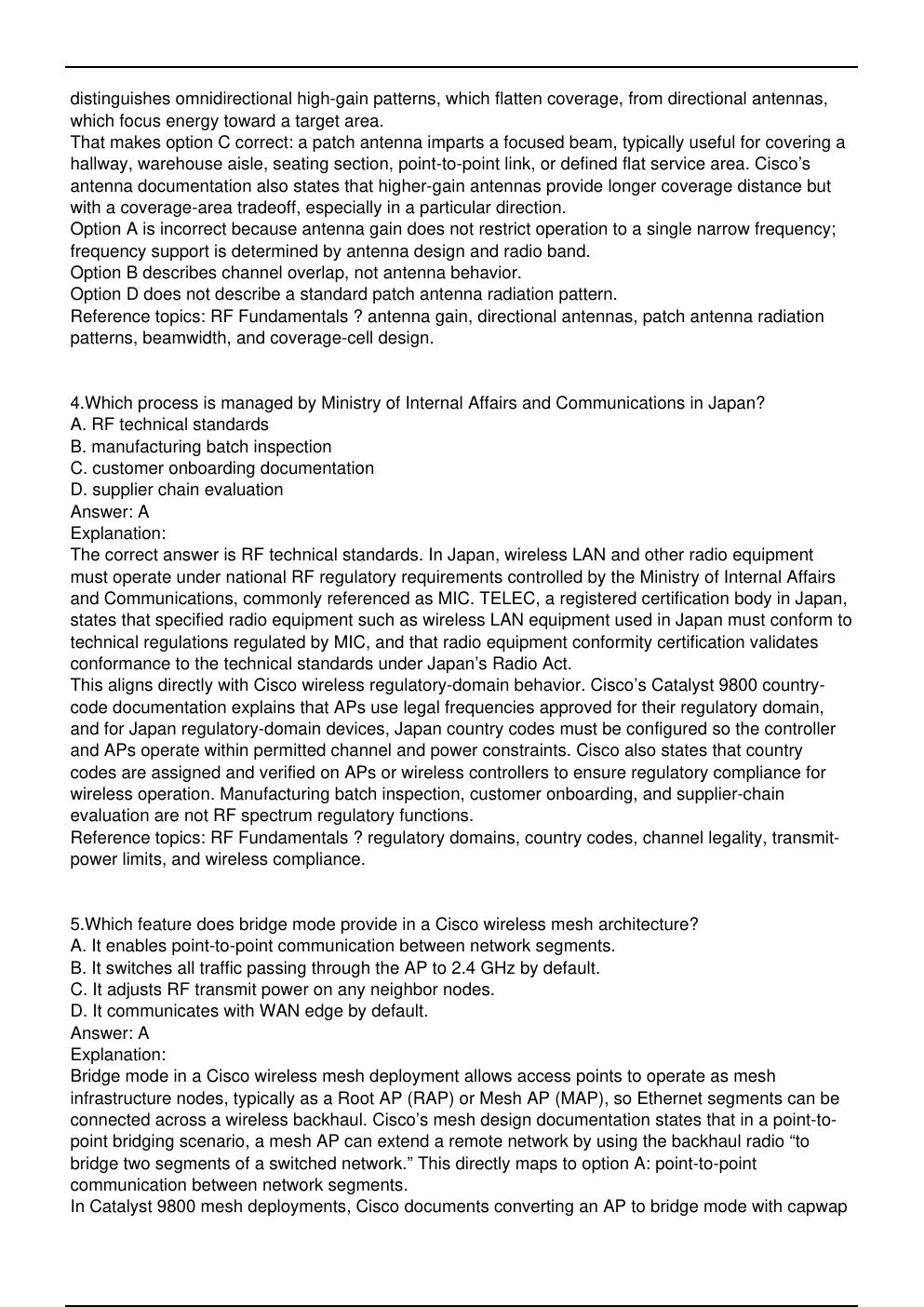
Reference topics: RF Fundamentals ? antenna gain, directional antennas, patch antenna radiation
patterns, beamwidth,
[Show More]



![Preview of eBook [PDF] Advanced Technologies for Rechargeable Batteries Metal Ion, Hybrid, and Metal-](https://browseimages.nyc3.digitaloceanspaces.com/paper-images/2024/Aug/31/4CeOA98s2024-08-31-08-3766d2ac249f11f.png)
![Preview of eBook [PDF] Digital Personality A Man Forever Volume 2 Technical Aspects 1st Edition By Ku](https://browseimages.nyc3.digitaloceanspaces.com/paper-images/2024/Aug/30/t3vEGYrg2024-08-30-02-3166d1adaa38427.png)