FIN 111 Financial Final Exam
Topic Summary for Final Exam
1.Financial management decisions (working capital management, capital budgeting and
financing)
2.Financial system and economy
-Financial system: money transf
...
FIN 111 Financial Final Exam
Topic Summary for Final Exam
1.Financial management decisions (working capital management, capital budgeting and
financing)
2.Financial system and economy
-Financial system: money transfers from SSUs to DSUs (direct and indirect financial)
3.Financial markets, institutions and instruments
-Financial markets: primary (issued by DSUs) and secondary (move form people to another,
no money return to company-exist already) markets
Money (short term) and capital (long term) markets
Retail and wholesale markets
-Financial institutions: Strong, semi-strong and weak try to create strong financial
institutions (inside trading)
- Financial instruments:
4.Commercial banks ownership structure and activities (product and services), assets (uses
of funds) and liabilities (sources of funds), and regulation
- Bank asset: cash, investment and loans
- Liabilities: deposits and borrow funds
- Regulation: APRA (can except the deposit)
- Own commercial bank: Share holders
5.Liquidity management
- Cash management to pay demand deposits (drawings) for customers
-They need funding to management loan requirement
6.Off-balance-sheet banking
- it might affect later
-Contingent asset (loan commitment) and contingent liabilities (letter of credit)
7.Nonbank financial institution (NBFI) ownership structure and activities (product and
services), assets (uses of funds) and liabilities (sources of funds), and regulation
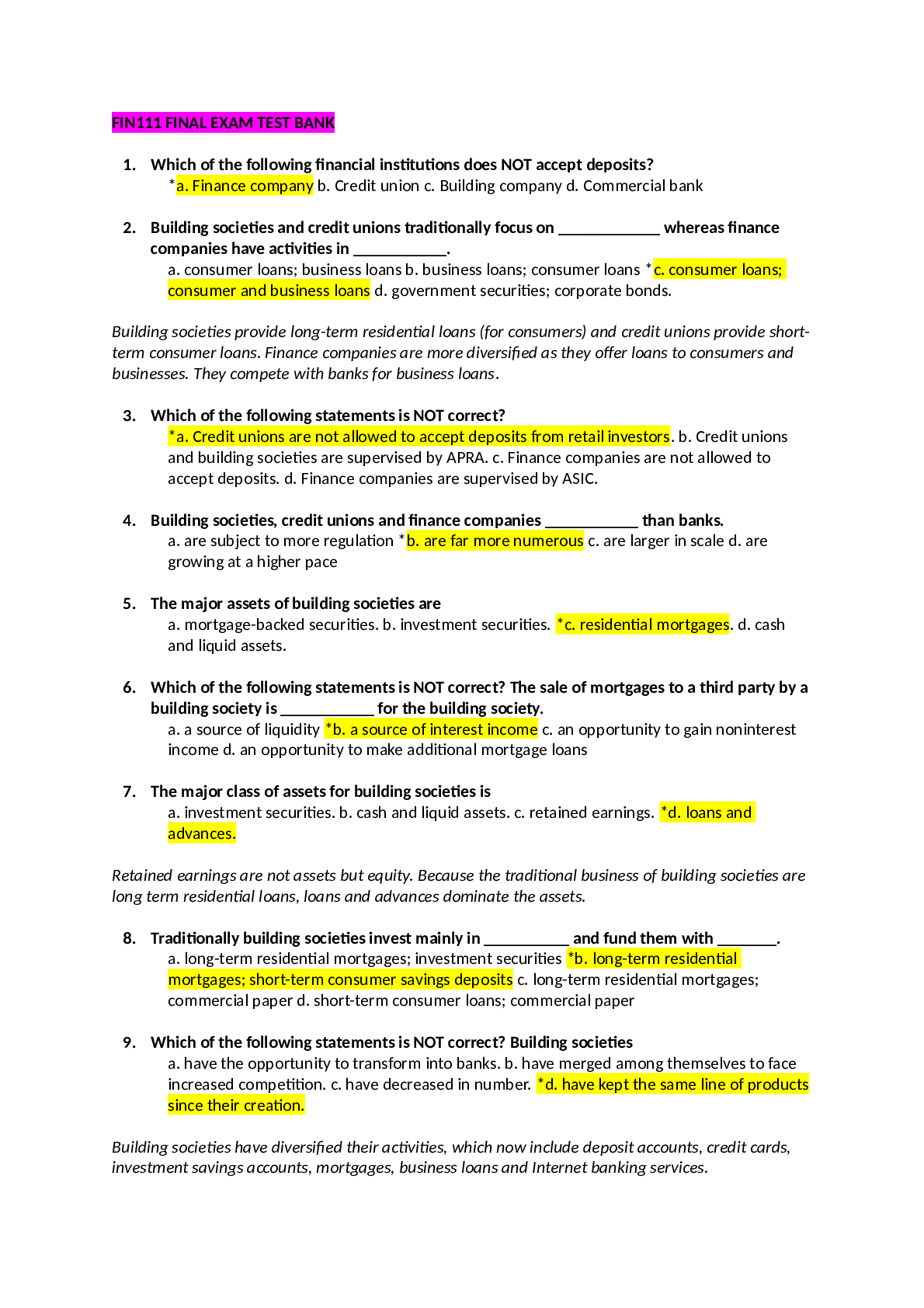
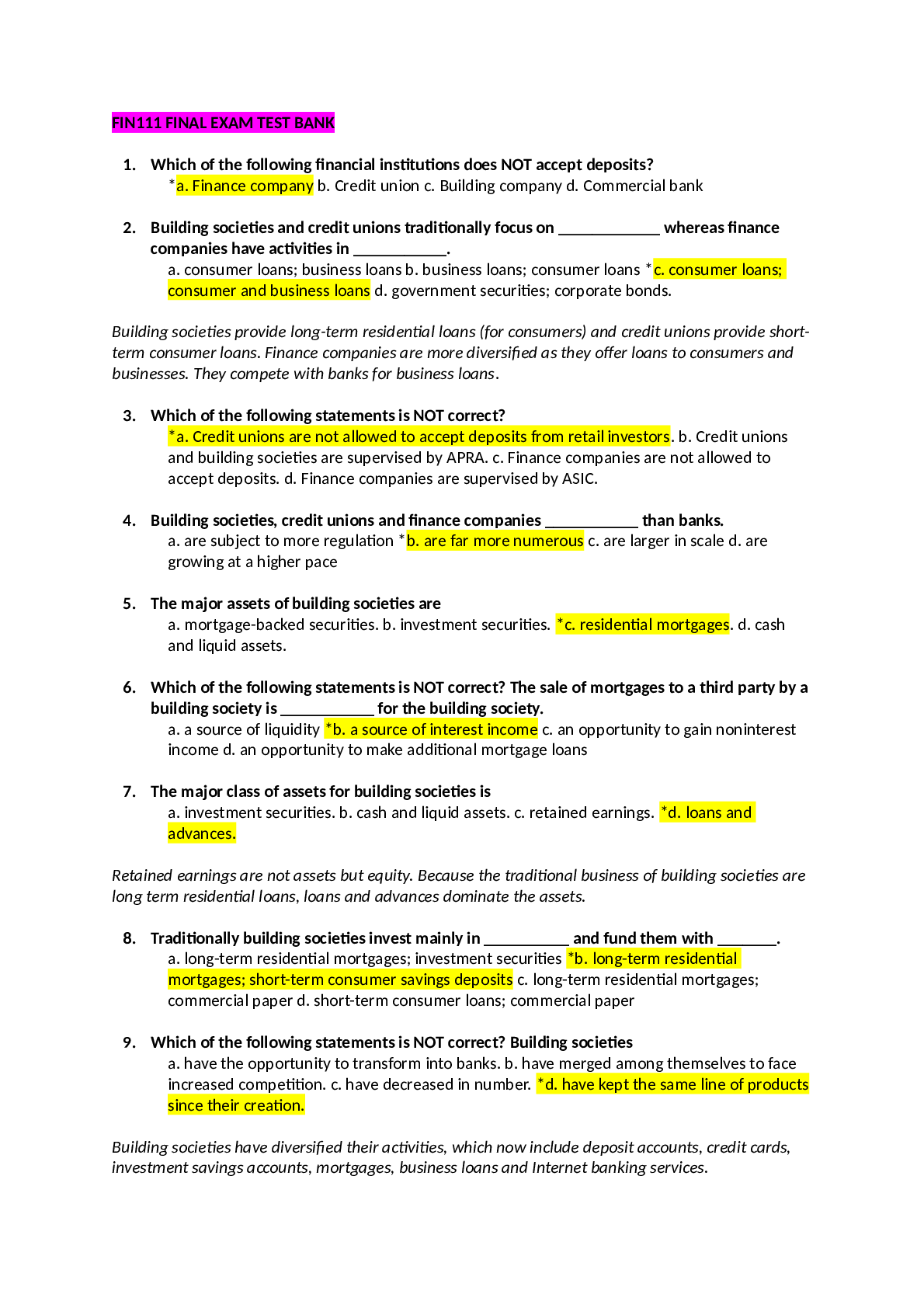
-Credit unions, building society and financial company- Credit unions: business loans, asset: money market, APRA because ADIs
-Building society: personal loans; members; asset: mortage loans; APRA because it regulated
ADIs
-Financial company: business loans; share holders, asset: higher risk loans which not
approved by big banks charge higher interest rate; ASIC because it does not regulate ADIs
8.Time value of money (future value and compounding, present value and discounting)
9.Annual Percentage Rate (APR) and Effective Annual Rate (EAR) calculation
10.Multiple cash flow valuation (unequal and equal amounts - annuities, perpetuities)
11.Closed end loan structures and interrelationship with annuity formula – loan principal
and repayment calculation
12.Bond valuation
13.Bond structure and comparison of coupon rates and term structure of interest rates (i.e.
discount rate, market rate, yield to maturity)
14.Share price valuation
15.Types and sources of consumer credit
-Advantages: More convenient – enjoy goods now and pay later
-Disadvantage: The cost, overspend bankrupt
- Types: Credit card, personal loans, car loans
- Sources: banks, family and friends, credit unions, building society and financial company
16.Calculating the cost of credit
17.Ethics, FPA Code of Ethics for conduct and professional responsibilities
- Ethics: think different between right or wrong
-
18.Financial counsellor and personal budgeting
-
19.Financial planning advice areas
- Taxes, Investment planning, Superannuation
20.Provision of financial advice requirements
- SOA
- PDS- FSG
21. Financial planning 6 step process
1. Gather client information
2. Establish financial goals and objectives
3. Analyse data and identify financial issues
4. Prepare and develop the Statement Of Advice (SOA)
5. Implement the agreed-upon recommendations
6. Review and revise the SOA
22. Life cycle analysis theory and application to financial planning
- States in life: 6
+ Young and single
+ Newly married
+ Married and young children
+ Married and older children
+ Preretirement
+ Retirement
23.Personalising financial planning advice
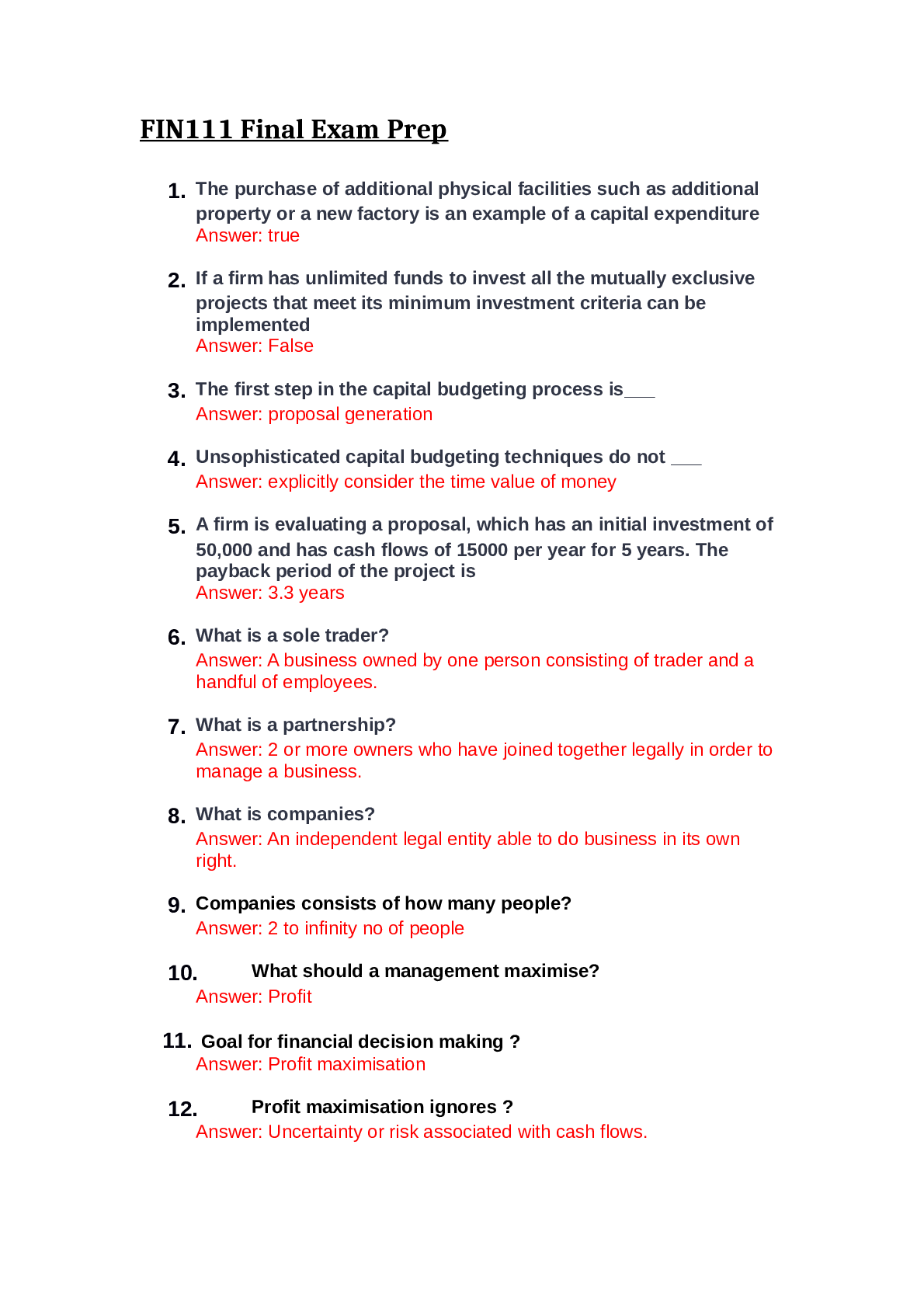
24. Goal of financial management
25. Forms of business organisation
FINAL EXAM STRUCTURE (9 or 10 marks for each)
6 short questions (half a page)
5 calculation questions (some of them include theory)
watashi no namae wa vera desu toi la vera
watashi wa aho (baka) des
[Show More]







.png)