Physics > Lab Report > Report for Experiment Simple Harmonic Motion (All)
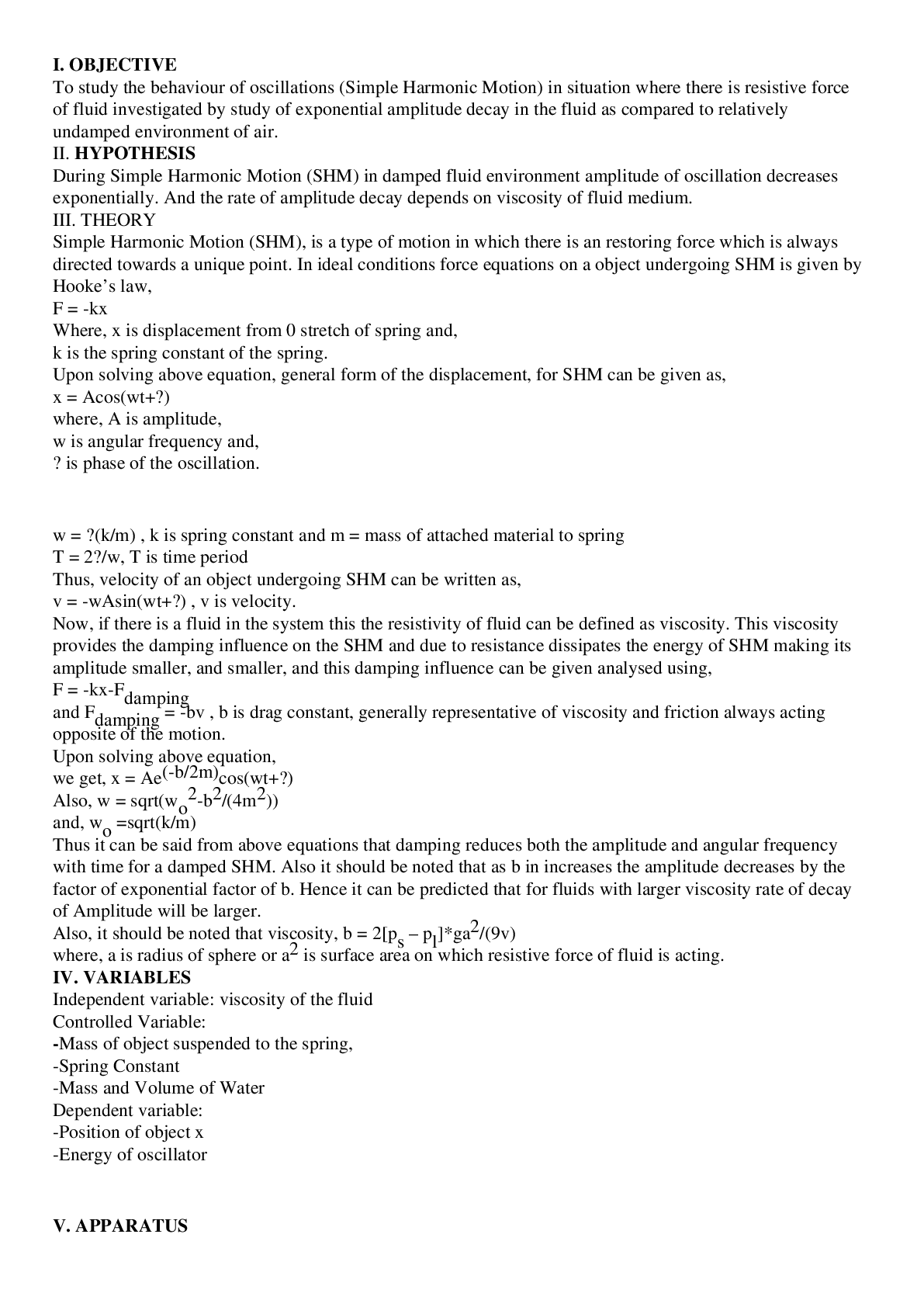
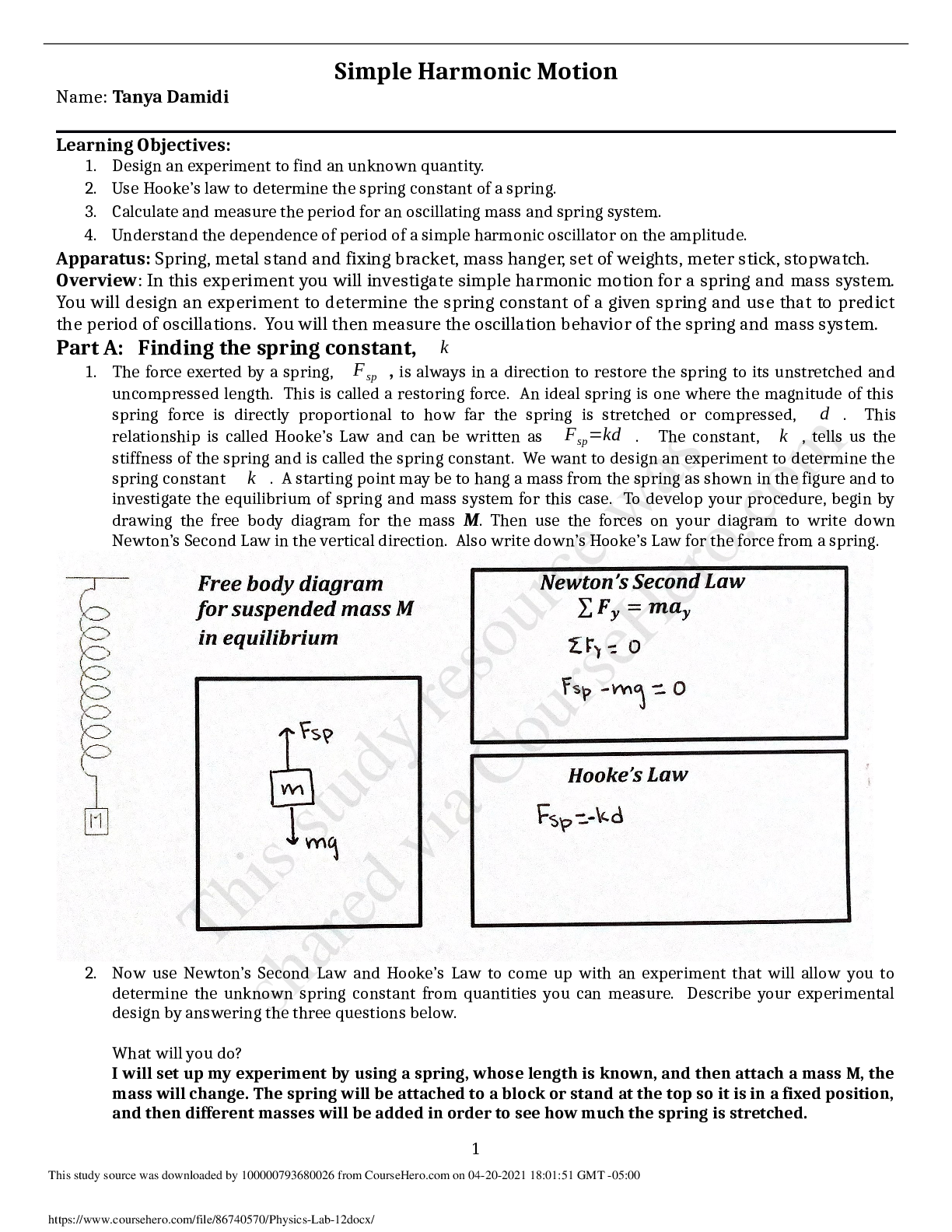
Report for Experiment #13 Simple Harmonic Motion Adilsultan Lepes Lab Partner: Sanjali Sur TA: Wei-Chi Chiu Experiment Date: 05/10/17 Abstract In this experiment we have investigated the oscill ... atory motion of the glider on the air table 2 with springs, which are restoring forces. A simple harmonic motion will remain in motion as long as the system does not experience friction. For that reason, air table is used to minimize the friction. Our experiment will demonstrate how the glider with two springs will behave in a simple harmonic motion as well as damped harmonic motion using the sets of magnets.Introduction In this experiment, we have analyzed the simple harmonic motion from the two sets of investigations. The experiment data was recorded by PASCO Capstone software and motion sensor. For both investigations we need an air track and a glider, as well as two springs and 6 magnetic weights of same color. In the first investigation we have found parameters like amplitude, period, phase, and spring constant for undamped motion. Later, these results served as a basis for the second investigation, that uses magnets of the same color to show damping motion. The second investigation is similar to the first investigation, and allowed us to perform damped harmonic motion. The use of six magnets increased the magnitude of the damping forces, causing the changes in period, amplitude, frequency and angular frequency. The analysis and results of both investigations should agree with each other. Investigation 1 Setup & Procedure This investigation required the use of the air track and the glider, and two springs. The air track was leveled to the secure an equilibrium position of the glider, while the air was turned on to minimize the friction force between track and glider. Motion of the glider was recorded with the help of the motion sensor which is connected to the computer. When all necessary preparations were done, we have recorded oscillations of the glider attached two springs to the sides of the glider and connected to the ends of the air track, at its equilibrium position for 30 seconds. The rest part of the investigation studies the motion of the glider released 40 cm from the left end of the air track. Glider was released, and its motion was recorded by computer program until we get 6 peaks. Using this data, we have computed the k spring constant. Data & Analysis ?"#$%&'(??) 0.3764 ??"#$%&'(??) 0.05 Equilibrium Position (m) 0.64 Peak Number 1 2 3 4 5 6 Amplitude (m) 0.25 0.22 0.2 0.17 0.15 0.13 Time (s) 1.025 3.5 6.2 8.85 11.4 14.05 Period T (s) (slope) 2.61357 ?? (?) 0.000239046 Frequency (Hz) 0.382618411 ?? (??) 3.51352E-05 Angular Frequency (rad/s) 2.403991475 ?? ??? ? 0.000220755 Experimental k (N/m) 2.175281475 ?? ? ? 0.017645813 Theoretical spring k (N/m) 2.2 phase angle -2.464091262 Table 1 – Measurements and CalculationsThe equilibrium position was found to be 0.64 ?. To achieve smooth data plots we have subtracted the equilibrium position from the oscillating glider position data to obtain the centered positions of the oscillating glider. Next we have plotted the oscillating glider data in Excel (centered position vs time). In the Figure 1 we can see that the graph is centered around the x-axis due to subtraction of the equilibrium position. Using the plot of this graph we have determined first 6 peaks with their amplitude and their respective times. The time and position of these 6 peaks was recorded in the Table 1. [Show More]
Last updated: 3 years ago
Preview 1 out of 34 pages
Buy this document to get the full access instantly
Instant Download Access after purchase
Buy NowInstant download
We Accept:
Can't find what you want? Try our AI powered Search
Connected school, study & course
About the document
Uploaded On
May 17, 2021
Number of pages
34
Written in
All
This document has been written for:
Uploaded
May 17, 2021
Downloads
0
Views
88
Scholarfriends.com Online Platform by Browsegrades Inc. 651N South Broad St, Middletown DE. United States.
We're available through e-mail, Twitter, Facebook, and live chat.
FAQ
Questions? Leave a message!
Copyright © Scholarfriends · High quality services·