ISYE 6501 – Course Project
American Honda Motor Co., Inc
Case Background:
Just like other automotive distributors, American Honda works with a network of dealerships
that offers warrantied repair work. This can be a
...
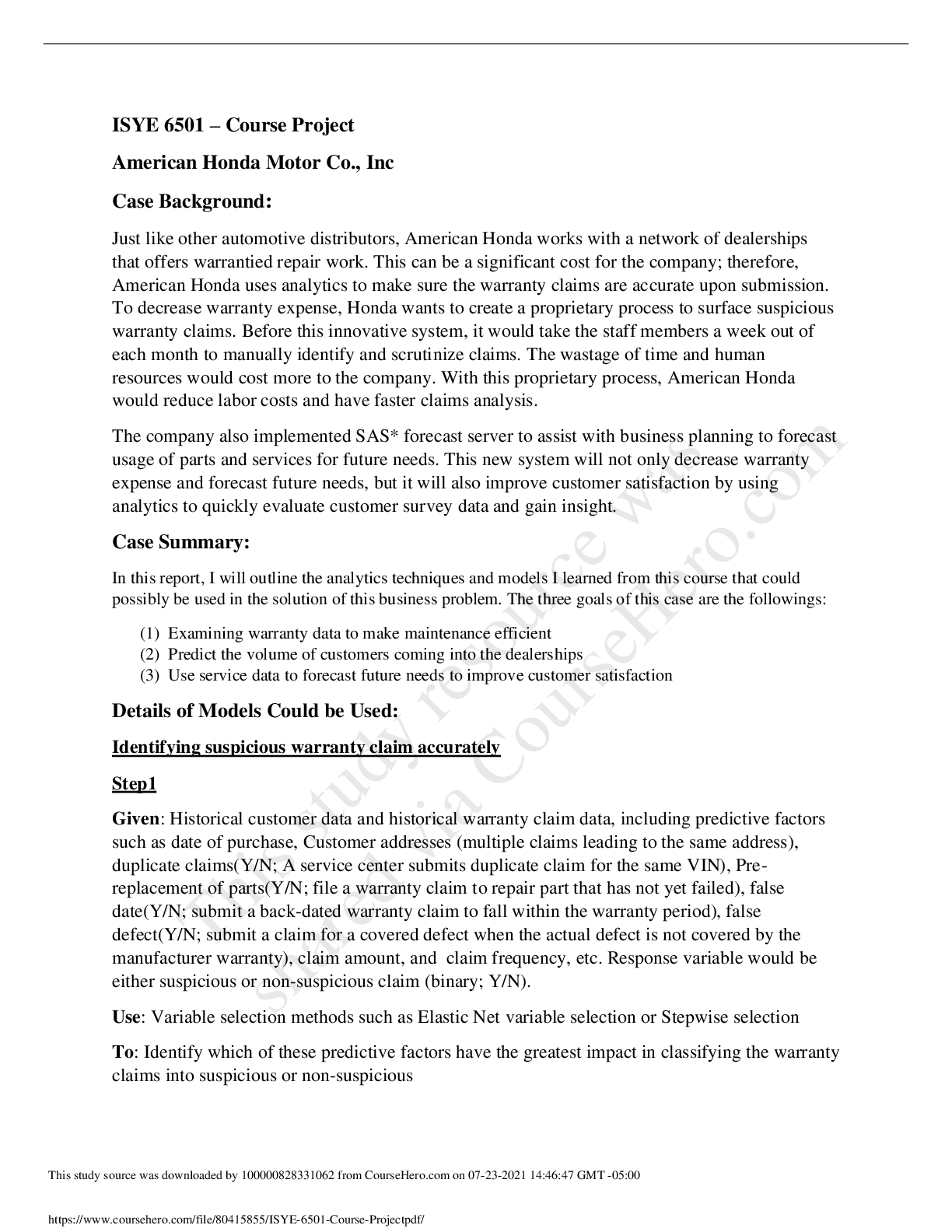
ISYE 6501 – Course Project
American Honda Motor Co., Inc
Case Background:
Just like other automotive distributors, American Honda works with a network of dealerships
that offers warrantied repair work. This can be a significant cost for the company; therefore,
American Honda uses analytics to make sure the warranty claims are accurate upon submission.
To decrease warranty expense, Honda wants to create a proprietary process to surface suspicious
warranty claims. Before this innovative system, it would take the staff members a week out of
each month to manually identify and scrutinize claims. The wastage of time and human
resources would cost more to the company. With this proprietary process, American Honda
would reduce labor costs and have faster claims analysis.
The company also implemented SAS* forecast server to assist with business planning to forecast
usage of parts and services for future needs. This new system will not only decrease warranty
expense and forecast future needs, but it will also improve customer satisfaction by using
analytics to quickly evaluate customer survey data and gain insight.
Case Summary:
In this report, I will outline the analytics techniques and models I learned from this course that could
possibly be used in the solution of this business problem. The three goals of this case are the followings:
(1) Examining warranty data to make maintenance efficient
(2) Predict the volume of customers coming into the dealerships
(3) Use service data to forecast future needs to improve customer satisfaction
Details of Models Could be Used:
Identifying suspicious warranty claim accurately
Step1
Given: Historical customer data and historical warranty claim data, including predictive factors
such as date of purchase, Customer addresses (multiple claims leading to the same address),
duplicate claims(Y/N; A service center submits duplicate claim for the same VIN), Prereplacement of parts(Y/N; file a warranty claim to repair part that has not yet failed), false
date(Y/N; submit a back-dated warranty claim to fall within the warranty period), false
defect(Y/N; submit a claim for a covered defect when the actual defect is not covered by the
manufacturer warranty), claim amount, and claim frequency, etc. Response variable would be
either suspicious or non-suspicious claim (binary; Y/N).
Use: Variable selection methods such as Elastic Net variable selection or Stepwise selection
To: Identify which of these predictive factors have the greatest impact in classifying the warranty
claims into suspicious or non-susp
[Show More]