(TCO 2) A company received cash in exchange for issuing stock. This transaction increased
assets and
Student Answer:
increased expenses.
increased revenues.
increased liabilities.
increased equity.
Question 2. (TC
...
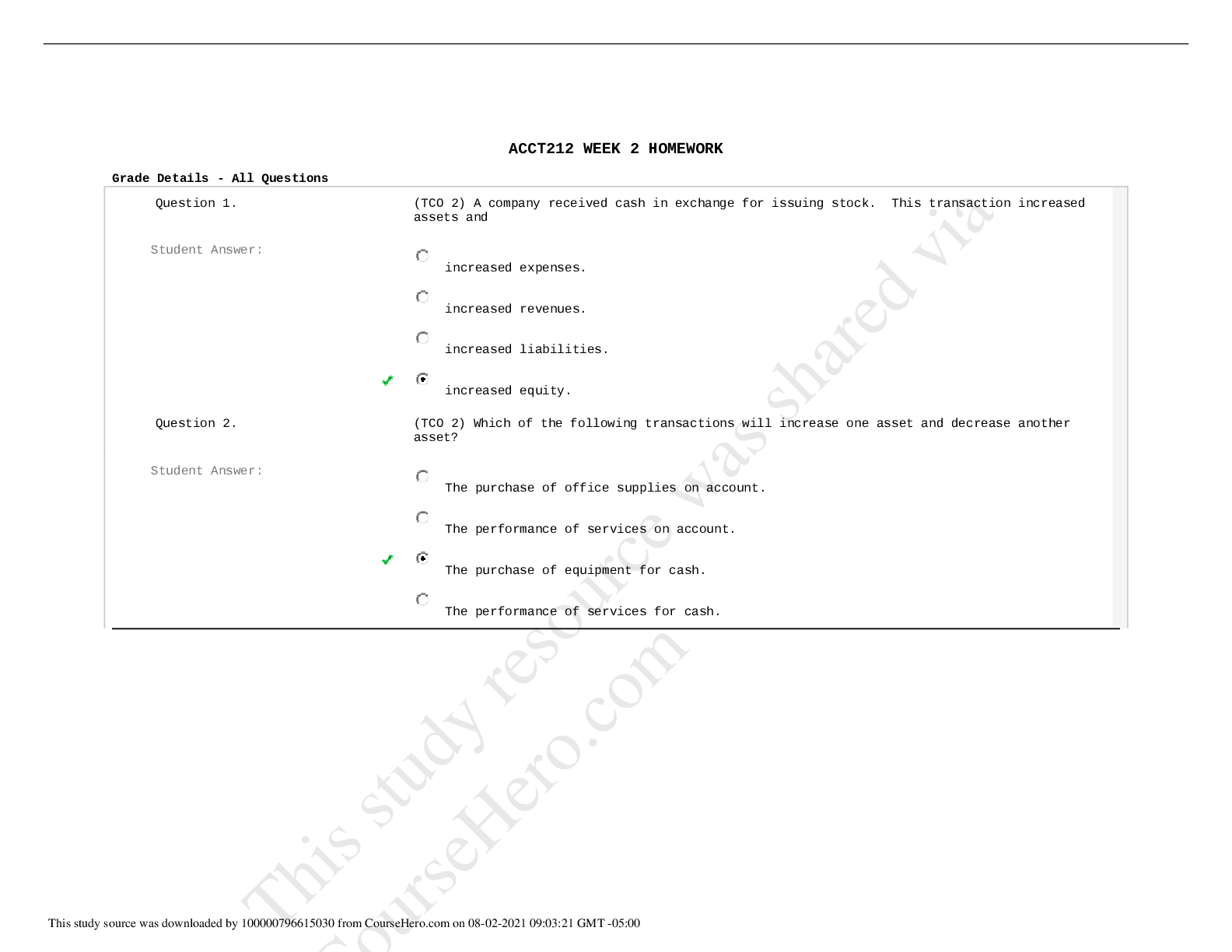
(TCO 2) A company received cash in exchange for issuing stock. This transaction increased
assets and
Student Answer:
increased expenses.
increased revenues.
increased liabilities.
increased equity.
Question 2. (TCO 2) Which of the following transactions will increase one asset and decrease another
asset?
Student Answer:
The purchase of office supplies on account.
The performance of services on account.
The purchase of equipment for cash.
The performance of services for cash.
This study source was downloaded by 100000796615030 from CourseHero.com on 08-02-2021 09:03:21 GMT -05:00
https://www.coursehero.com/file/33497607/ACCT212-WEEK-2-HOMEWORKdoc/
This study resource was shared via
CourseHero.com
Question 3. (TCO 2) When a company pays an amount it owes a creditor
Student Answer:
assets are decreased and net income is decreased.
assets are decreased and liabilities are increased.
liabilities are decreased and net income is increased.
assets are decreased and liabilities are decreased.
Question 4. (TCO 2) The left side of a T-account is always the
Student Answer:
increase side.
decrease side.
debit side.
credit side.
Question 5. (TCO 2) An account is increased by a credit and has a debit balance. This account is
Student Answer:
an expense account.
a liability account.
an asset account.
both an expense account and an asset account.
This study source was downloaded by 100000796615030 from CourseHero.com on 08-02-2021 09:03:21 GMT -05:00
https://www.coursehero.com/file/33497607/ACCT212-WEEK-2-HOMEWORKdoc/
This study resource was shared via
CourseHero.com
Question 6. (TCO 2) When journalizing and posting transactions in books
Student Answer:
the rules of debit and credit are followed to increase or decrease each account.
the credit side of the transaction is entered on the left margin.
it is not necessary to use both the journal and the ledger.
debits in the journal can be posted as credits in the ledger.
Question 7. (TCO 2) Under accrual accounting, revenue is recorded
Student Answer:
when the cash is collected, regardless of when the services are performed.
when the services are performed, regardless of when cash is received.
either when the cash is received or the sale is made.
only if the cash is received at the same time the services are preformed.
Question 8. (TCO 2) The revenue principle governs two things:
Student Answer:
when record revenue and where to record this revenue.
where to record revenue and the amount of revenue to record.
when to record revenue and the amount of revenue to record.
when to record revenue and in which journal to record the revenue.
This study source was downloaded by 100000796615030 from CourseHero.com on 08-02-2021 09:03:21 GMT -05:00
https://www.coursehero.com/file/33497607/ACCT212-WEEK-2-HOMEWORKdoc/
This study resource was shared via
CourseHero.com
Question 9. (TCO 2) In what order are financial statements generally prepared?
Student Answer:
Balance sheet, income statement, and statement of retaining earnings.
Income statement, statement of retaining earnings, and balance sheet.
Income statement, balance sheet, and statement or retained earnings.
Statement of retained earnings, balance sheet, and income statement.
Question 10. (TCO 2) To close the books of a company, you should
Student Answer:
debit each revenue account, credit each expense account, and debit the dividends account.
credit each revenue account, debit each expense account, and debit the dividends account.
debit each revenue account, credit each expense account, and credit the dividends
account.
debit each revenue account, debit each expense account, and credit the dividends account.
[Show More]