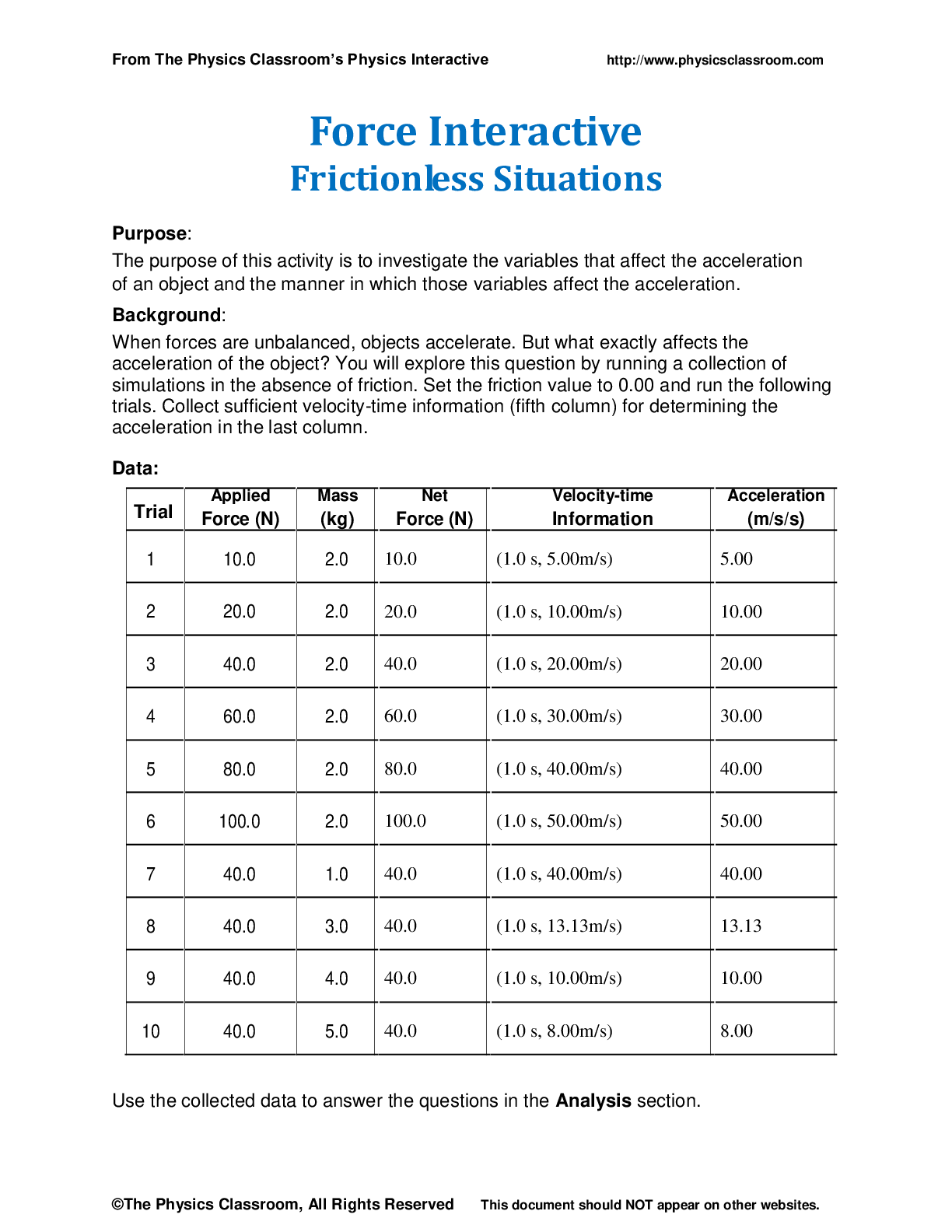
Force Interactive
Frictionless Situations
Purpose:
The purpose of this activity is to investigate the variables that affect the acceleration of an object and the manner in which those variables affect the accele
...
Force Interactive
Frictionless Situations
Purpose:
The purpose of this activity is to investigate the variables that affect the acceleration of an object and the manner in which those variables affect the acceleration.
Background:
When forces are unbalanced, objects accelerate. But what exactly affects the acceleration of the object? You will explore this question by running a collection of simulations in the absence of friction. Set the friction value to 0.00 and run the following trials. Collect sufficient velocity-time information (fifth column) for determining the acceleration in the last column.
Use the collected data to answer the questions in the Analysis section.
Analysis:
1. What affect does a doubling of the net force have upon the acceleration of the object? Be quantitative.
The acceleration of the object doubles when net force is doubled
Identify a set of two trials that support your answer above:
2. What affect does a tripling of the net force have upon the acceleration of the object?
The acceleration of the object triples when net force is tripled
3. What affect does a doubling of the mass have upon the acceleration of the object?
Doubling the mass of objects halves its acceleration
4. What affect does a quadrupling of the mass have upon the acceleration of the object?
Quadrupling the mass of the object divides the acceleration of the object 4
These two trials cannot be used to show the effect of force upon acceleration, because the two trials 5 and 8 have different factors that act upon the acceleration with trial fives acceleration being affected by applied force and trial 8s acceleration is affected by mass
Conclusion:
Consider the original question that prompted this investigation:
What variables affect the acceleration of an object and in what manner do they affect the acceleration?
Make a claim in which you attempt to answer this question. Then support the claim with evidence (specific references to trials of data) and reasoning in which you explain how the data support the claim that you have made.
[Show More]