N5315 Advanced Pathophysiology
Neurologic System
Core Knowledge Objectives with Advanced Organizers
Examine the anatomy and physiology of the Central Nervous System.
1. Discuss the anatomy and physiology of the brain
...
N5315 Advanced Pathophysiology
Neurologic System
Core Knowledge Objectives with Advanced Organizers
Examine the anatomy and physiology of the Central Nervous System.
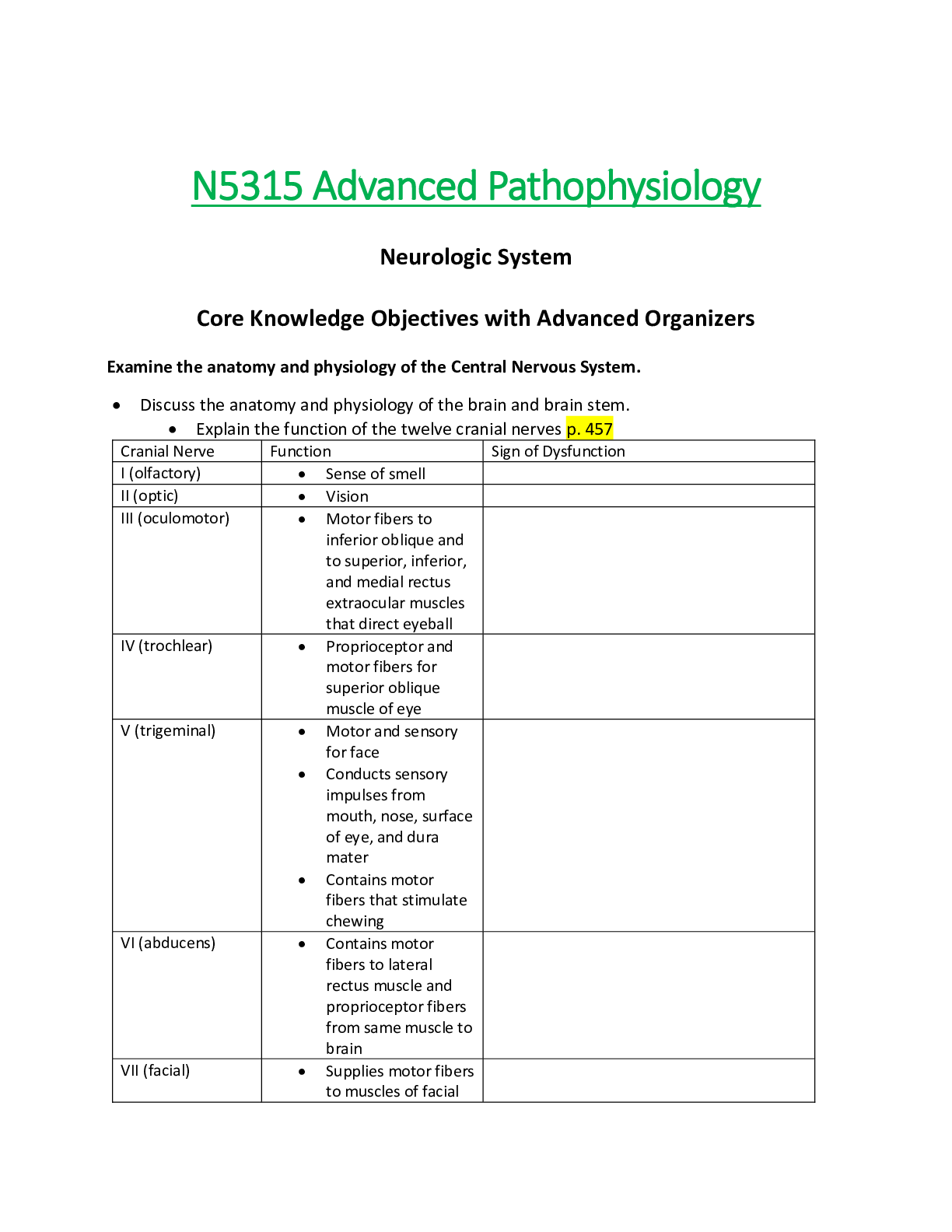
1. Discuss the anatomy and physiology of the brain and brain stem.
a. Explain the function of the twelve cranial nerves
Crani
al
Nerv
e
Function Sign of Dysfunction
I Olfactory: sensory, carries impulses for sense and smell Loss or disturbance in the sense of
smell.
II Optic: Sensory, carries impulses for vision decreased visual acuity and contrast
sensitivity, impaired color vision, and
an afferent pupillary defect. (blindness)
III Oculomotor: Contains motor fibers to interior oblique and to
superior, inferior, ad medial rectus extraocular muscles that
direct eye ball; levator muscles of eyelid; smooth muscles of iris
and ciliary body; and proprioception (sensory) to brain from
extraocular muscles
Drooping of the eyelid, eyeball moves
outward, dilation of the pupil, double
vision.
IV Trochlear: Propioceptor and motor fibers for superior oblique
muscle of eye (extraocular muscles)
Rotation of eyeball upward and
outward, double vision
V Trigenimal: (facial muscles including chewing, facial sensation)
This is the largest cranial nerve
Both motor and sensory for face; conducts sensory
impulses from mouth, nose, surface of eye, and dura mater;
also contains motor fibers that stimulate chewing muscles
Sensory root – Pain or loss of sensation
in the face, forehead, temple and eyes.
Motor root – affecting the jaw, trouble
chewing
VI Abducems: Moves the eyeballs outwards by sending nerve
impulses to the lateral rectus muscles
Deviation of the eyes outward; double
vision
VII Facial: (taste, tears, saliva and facial expressions); Mixed: 1.
Supplies motor fibers to muscles of facial expression and to the
lacrimal and salivary glands. 2. Carries sensory fibers from taste
buds of anterior part of tongue
Paralysis of all the muscles in one side
of the face, inability to wrinkle the
forehead, close the eye, whistle,
deviation of the mouth. Bell’s Palsy
VIII Vestibulocochlear: (acoustic) auditory: Purely sensory;
vestibular branch transmits impulses for sense of equilibrium,
cochlear branch transmits impulses for sense of hearing
Deafness or ringing in the ears,
dizziness, nausea and vomiting
IX Glossopharyngeal: (swallowing, saliva, taste) Mixed: 1. Motor
fibers serve pharynx and salivary glands. 2. Sensory fibers carry
impulses from, pharynx, posterior tongue, and pressure
receptor of carotid artery (blood pressure)
Disturbance of taste; Difficulty in
swallowing
X Vagus: (control of PNS: smooth muscles of GI tract); Sensory and
motor impulses for pharynx; a large part of this nerve is
parasympathetic motor fibers, which supply smooth muscles of
abdominal organs
Hoarseness and difficulty
swallowing and talking.
This nerve also regulates the heart,
blood vessels and digestion
resulting in irregular heartbeat and
lowered blood pressure. It regulates
the stomach telling it to move food
through the digestive system, thus
damage can result in decreased
digestion and thus nausea, bloating
and vomiting.
XI Spinal Accessory: (Moving head & shoulders, swallowing); provides
sensory and motor fibers for sternocleidomastoid and trapezius
muscles (movement of head and shoulders) and muscles of soft
palate, pharynx, and larynx (swallowing)
Dropping of the shoulder; inability to
rotate the head away from affected area.
XII Hypoglossal: (tounge muscles, speech, swallowing);Carries motor
fibers to muscles of tongue and sensory impulses from tongue to
brain.
Paralysis of one side of the tongue;
deviation of tongue toward paralyzed
side; thick speech.
b. Explain the function of the cerebrum, cerebellum, parietal lobe, frontal lobe, occipital lobe,
temporal lobe, brain stem, reticular formation reticular activating system, and limbic system.
Lobe Location Function Sign of Injury/Lesion /
Disorder
Cerebrum forebrain
Largest part of the bain.
Derived from the
telencephalon, characterized
by numerous convolutions
called gyri. Comprised of two
hemispheres
Contain- cerebral cortex,
basal ganglia, epithalamus,
thalamus, hypothalamus,
subthalamus.
Prefrontal lobe- goal-oriented
behavior/concentration, shortterm memory, elaboration of
thought and inhibition on the
limbic areas of the CNS.
Prefrontal (Brodmann 6)
programming motor movements.
Basal ganglia systemextrapyramidal system- efferent
pathways outside the pyramids
of the medulla. Frontal eye fields
(lower portion of Brodmann 8)
controlling eye movement in the
[Show More]