N5315 Advanced Pathophysiology
Neurologic System
Core Knowledge Objectives with Advanced Organizers
Examine the anatomy and physiology of the Central Nervous System.
1. Discuss the anatomy and physiology of the brain
...
N5315 Advanced Pathophysiology
Neurologic System
Core Knowledge Objectives with Advanced Organizers
Examine the anatomy and physiology of the Central Nervous System.
1. Discuss the anatomy and physiology of the brain and brain stem.
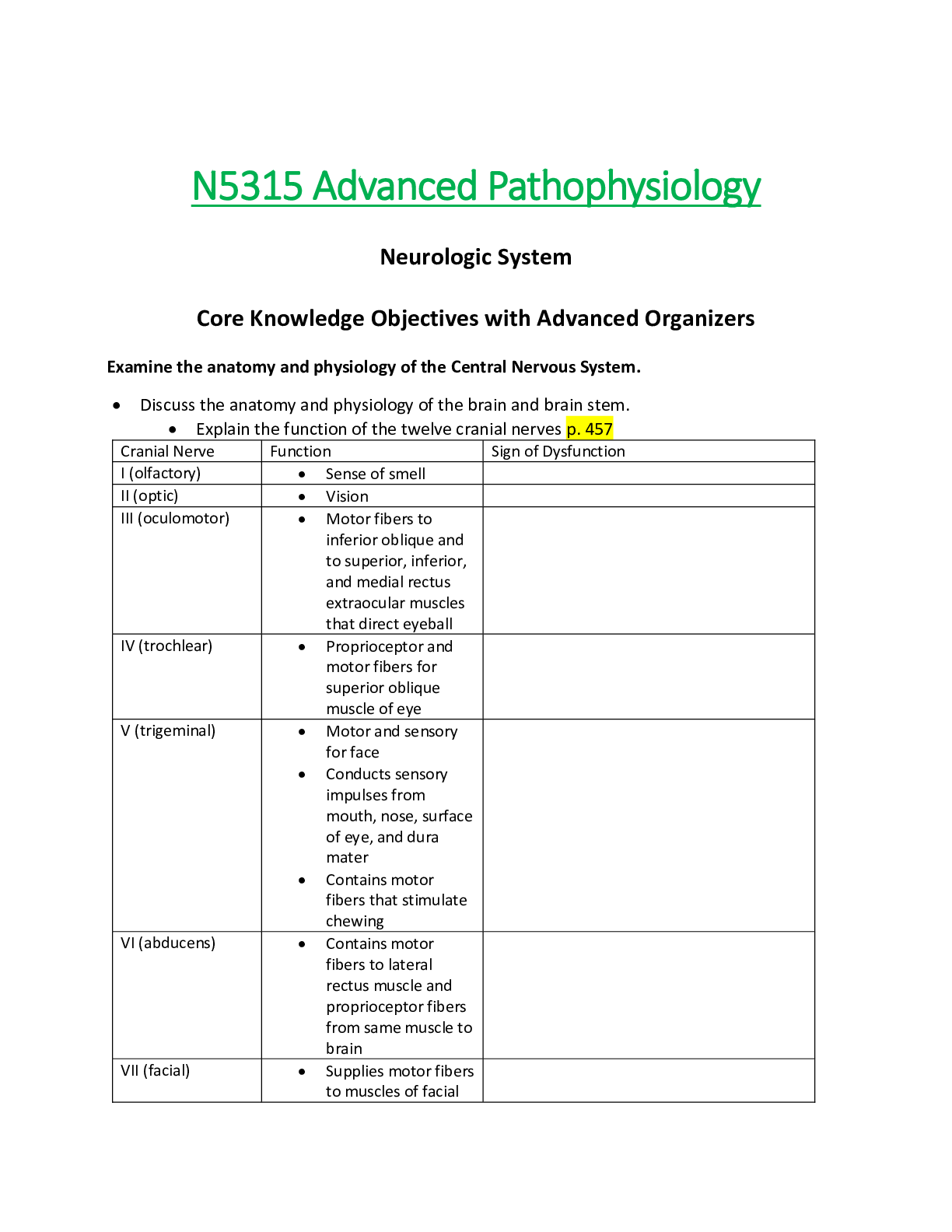
a. Explain the function of the twelve cranial nerves
Cranial
Nerve
Function Sign of Dysfunction
I Olfactory; carries impulses for sense of
smell, purely sensory
Inability to smell (anosmia)
Distortion in sense of smell
(parosmia)
Distortion or lack of taste
II Optic; carries impulses for vision, purely
sensory
Depends on location of damage;
inability to see objects on left or
right side or difficulty seeing
objects in the periphery, blind
III
*works
with CN
IV & VI
Oculomotor; moves eyelid and moves
eyeball in different directions (superior,
inferior, and medial rectus and inferior
oblique), adjusts lens for near vision,
constricts pupil; mixed, primarily motor
Double vision (diplopia)
Eyelid drooping (ptosis)
Pupil dilation (mydriasis)
Inability to coordinate
movement of both eyes
Inability to open eyes
IV
*works
with CN III
& VI
Trochlear; movement of eyeballs upward,
downward, and outward; rotates eyeball in
eye socket; mixed, mainly motor
Diplopia
Inability to move eye
downwards
V Trigeminal; motor fibers that stimulate
chewing, sensory fibers that conduct
impulses from mouth, nose, surface of
eye, and dura mater (convey sensations of
touch, pain, and temp); mixed
ipsilateral damage or paralysis
resulting in difficulty chewing,
swallowing, or articulation.
Inability to feel different
portions of face or they may
feel pain
VI
*works
with CN III
& IV
Abducens; lateral movement of eyeballs
(moves eyes outward)
Diplopia
VII Facial; motor fibers control secretion of
tears and saliva as well as facial
expression, sensory fibers are concerned
with taste on front of tongue; mixed
Facial palsy
Bell’s Palsy
Difficulty chewing
VIII Vestibulocochlear; Vestibular: transmits
impulses for sense of equilibrium
(posture, movement, and balance)
Cochlear: transmits impulses for sense of
hearing
Purely sensory
Dizziness
Sensation of spinning
Hearing loss/deafness
Nystagmus
IX Glossopharyngeal; motor fibers serve
pharynx (throat) and salivary glands
stimulating swallowing and secretion of
saliva, sensory fibers carry impulses from
pharynx, posterior tongue, and pressure
receptors in carotid arteries (monitors BP,
O2/CO2 levels, coordination of some
muscles involved in swallowing, and
sensations of taste, touch, pain, and temp
from posterior tongue and tissues of soft
palate); mixed
Loss of gag reflex
Dysphagia
Loss of bitter and sour taste
*similar and overlapping fxn as
CN X, damage can occur
simultaneously with these 2
nerves, S/S can be similar,
damage to this nerve may be
asymptomatic as CN X will
pick up slack
X Vagus; large part is parasympathetic
motor fibers for smooth muscle of abd
organs, sensory & motor fibers carry
impulses for pharynx, receives sensory
impulses from viscera; (sensory: monitors
BP & O2/CO2 levels, sensation of touch,
pain, and temp from pharynx and
sensations from visceral organs in thorax
and abd; motor: stimulates voluntary
muscles affecting swallowing, coughing,
and speech, stimulates contraction and
relaxation of smooth muscle in GI tract
and secretion of digestive fluids, can slow
[Show More]