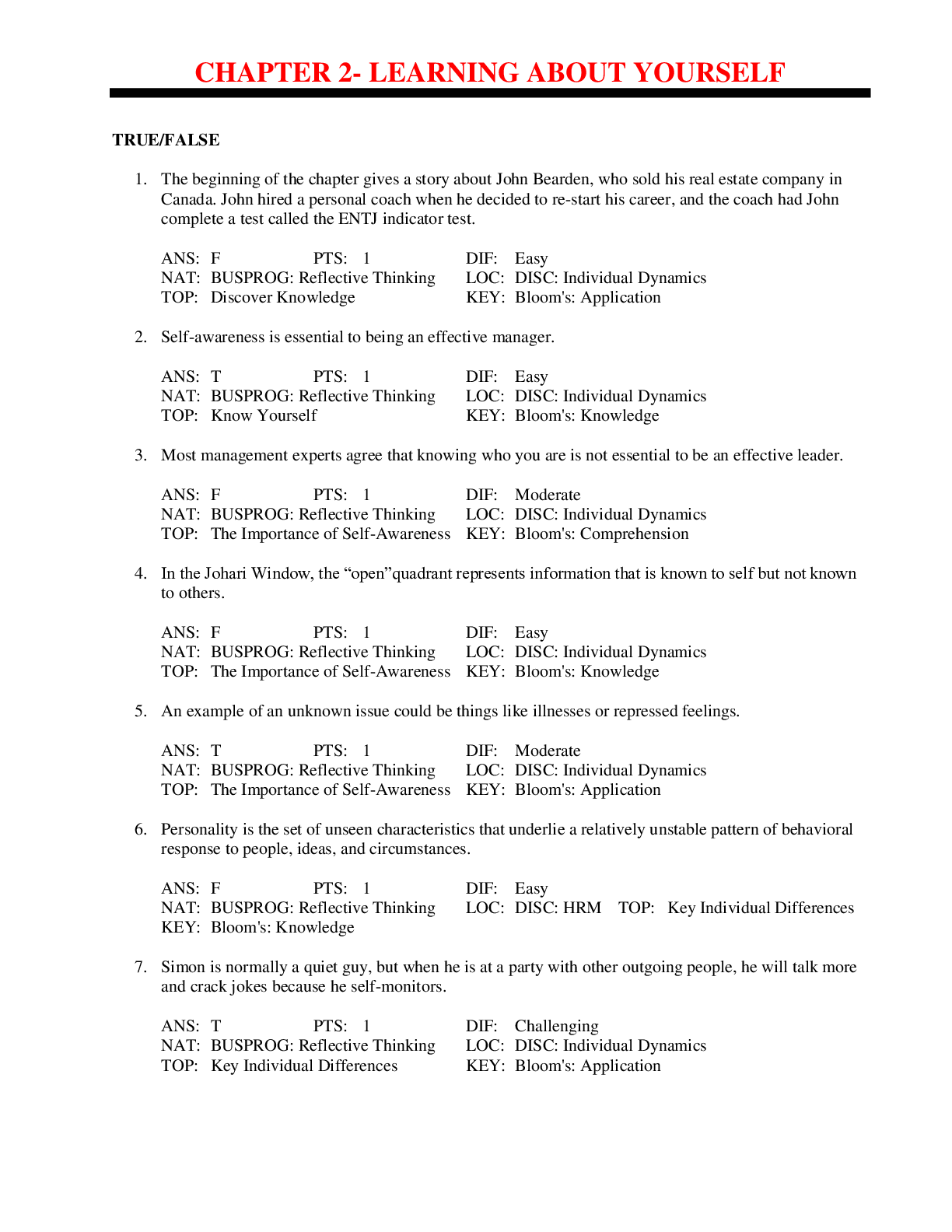
TRUE/FALSE
1. The beginning of the chapter gives a story about John Bearden, who sold his real estate company in Canada. John hired a personal coach when he decided to re-start his career, and the coach had John comp
...
TRUE/FALSE
1. The beginning of the chapter gives a story about John Bearden, who sold his real estate company in Canada. John hired a personal coach when he decided to re-start his career, and the coach had John complete a test called the ENTJ indicator test.
F PTS: 1 DIF: Easy
NAT: BUSPROG: Reflective Thinking LOC: DISC: Individual Dynamics
TOP: Discover Knowledge KEY: Bloom's: Application
2. Self-awareness is essential to being an effective manager.
T PTS: 1 DIF: Easy
NAT: BUSPROG: Reflective Thinking LOC: DISC: Individual Dynamics
TOP: Know Yourself KEY: Bloom's: Knowledge
3. Most management experts agree that knowing who you are is not essential to be an effective leader.
F PTS: 1 DIF: Moderate
NAT: BUSPROG: Reflective Thinking LOC: DISC: Individual Dynamics
TOP: The Importance of Self-Awareness KEY: Bloom's: Comprehension
4. In the Johari Window, the “open”quadrant represents information that is known to self but not known to others.
F PTS: 1 DIF: Easy
NAT: BUSPROG: Reflective Thinking LOC: DISC: Individual Dynamics
TOP: The Importance of Self-Awareness KEY: Bloom's: Knowledge
5. An example of an unknown issue could be things like illnesses or repressed feelings.
T PTS: 1 DIF: Moderate
NAT: BUSPROG: Reflective Thinking LOC: DISC: Individual Dynamics
TOP: The Importance of Self-Awareness KEY: Bloom's: Application
6. Personality is the set of unseen characteristics that underlie a relatively unstable pattern of behavioral response to people, ideas, and circumstances.
F PTS: 1 DIF: Easy
NAT: BUSPROG: Reflective Thinking LOC: DISC: HRM TOP: Key Individual Differences
KEY: Bloom's: Knowledge
7. Simon is normally a quiet guy, but when he is at a party with other outgoing people, he will talk more and crack jokes because he self-monitors.
T PTS: 1 DIF: Challenging
NAT: BUSPROG: Reflective Thinking LOC: DISC: Individual Dynamics
TOP: Key Individual Differences KEY: Bloom's: Application
8. Extroverts gain energy from being around people and interacting with others whereas introverts gain energy when away from other people.
T PTS: 1 DIF: Easy
NAT: BUSPROG: Reflective Thinking LOC: DISC: Individual Dynamics
TOP: Key Individual Differences KEY: Bloom's: Comprehension
9. Instrumental values are sometimes called terminal values.
F PTS: 1 DIF: Easy
NAT: BUSPROG: Reflective Thinking LOC: DISC: Individual Dynamics
TOP: Underlying Values KEY: Bloom's: Knowledge
10. Abraham Maslow refers to the mastery of any skill as conscious competence.
F PTS: 1 DIF: Moderate
NAT: BUSPROG: Reflective Thinking LOC: DISC: Individual Dynamics
TOP: Using Self-Awareness to Build Management Skills KEY: Bloom's: Knowledge
MULTIPLE CHOICE
1. In the introduction story about John Bearden, what enabled John to discover the productive and nonproductive patterns and preferences of which he was not aware?
a. therapy with his personal coach c. worked on his weaknesses
b. systematic self-inquiry d. working more hours
B PTS: 1 DIF: Moderate NAT: BUSPROG: Communication
LOC: DISC: Leadership Principles TOP: Discover Knowledge
KEY: Bloom's: Analysis
2. It is difficult to see one’s own characteristics ____.
a. objectively c. clearly
b. subjectively d. all of these
A PTS: 1 DIF: Easy
NAT: BUSPROG: Reflective Thinking LOC: DISC: Individual Dynamics
TOP: Know Yourself KEY: Bloom's: Knowledge
3. ___ means being aware of the internal aspects of one’s nature.
a. Objectivity c. Self-thought
b. Internal awareness d. Self-awareness
D PTS: 1 DIF: Easy
NAT: BUSPROG: Reflective Thinking LOC: DISC: Individual Dynamics
TOP: Know Yourself KEY: Bloom's: Knowledge
4. If you are a natural at math and dislike counseling people, which career would be best for you?
a. Bus driver c. Therapist
b. Financial analyst d. Dentist
B PTS: 1 DIF: Moderate
NAT: BUSPROG: Reflective Thinking LOC: DISC: Individual Dynamics
TOP: Know Yourself KEY: Bloom's: Application
5. Numerous philosophers and behavioral scientists have pointed to the importance of ___ for living a full, rewarding life.
a. education c. self-knowledge
b. relationships d. money
C PTS: 1 DIF: Moderate
NAT: BUSPROG: Reflective Thinking LOC: DISC: Leadership Principles
TOP: The Importance of Self-Awareness KEY: Bloom's: Comprehension
6. Studies show that people would much rather follow someone they ____, even when they disagree with that person’s viewpoint, than someone who frequently shifts her ideas.
a. think is powerful c. believe in
b. look up to d. can count on
D PTS: 1 DIF: Easy
NAT: BUSPROG: Reflective Thinking LOC: DISC: Leadership Principles
TOP: The Importance of Self-Awareness KEY: Bloom's: Knowledge
7. How can you enhance your self-awareness?
a. solicit feedback c. self-disclose
b. self-diagnose d. all of these
D PTS: 1 DIF: Moderate
NAT: BUSPROG: Reflective Thinking LOC: DISC: Leadership Principles
TOP: The Importance of Self-Awareness KEY: Bloom's: Application
8. What term means “our perceptions of ourselves are shaped partly by how others perceive us”?
a. social mirror c. person mirror
b. self-diagnose d. mirror diagnosis
A PTS: 1 DIF: Easy
NAT: BUSPROG: Reflective Thinking LOC: DISC: Leadership Principles
TOP: The Importance of Self-Awareness KEY: Bloom's: Knowledge
9. What term means “using self-inquiry and reflection to gain insights into yourself from self-assessment results”?
a. soliciting feedback c. self-disclosure
b. self-diagnosis d. social mirror
B PTS: 1 DIF: Easy
NAT: BUSPROG: Reflective Thinking LOC: DISC: Leadership Principles
TOP: The Importance of Self-Awareness KEY: Bloom's: Knowledge
10. Sarah writes daily in a journal to record her thoughts of what is going well in her life. What method of self-awareness is Sarah using?
a. soliciting feedback c. self-disclosure
b. self-diagnose d. all of these
B PTS: 1 DIF: Challenging
NAT: BUSPROG: Reflective Thinking LOC: DISC: Leadership Principles
TOP: The Importance of Self-Awareness KEY: Bloom's: Application
11. ____ means sharing your fears, thoughts, emotions and concepts of yourself with others.
a. Soliciting feedback c. Self-disclosure
b. Self-diagnose d. all of these
C PTS: 1 DIF: Easy
NAT: BUSPROG: Reflective Thinking LOC: DISC: Leadership Principles
TOP: The Importance of Self-Awareness KEY: Bloom's: Knowledge
12. People who practice ____ to others are emotionally healthier and happier than people who don’t tell others about their life.
a. soliciting feedback c. self-disclosure
b. self-diagnosis d. self-infliction
C PTS: 1 DIF: Easy
NAT: BUSPROG: Reflective Thinking LOC: DISC: Leadership Principles
TOP: The Importance of Self-Awareness KEY: Bloom's: Comprehension
13. ____ is a tool managers can use to move toward greater transparency and alignment with others.
a. Luham Window c. Joseph Luft Window
b. Harry Ingham Window d. Johari Window
D PTS: 1 DIF: Easy
NAT: BUSPROG: Reflective Thinking LOC: DISC: Leadership Principles
TOP: The Importance of Self-Awareness KEY: Bloom's: Knowledge
14. Which quadrant of the Johari Window includes things that are known about an individual by others but are unknown to the individual himself?
a. I c. III
b. II d. IV
B PTS: 1 DIF: Easy
NAT: BUSPROG: Reflective Thinking LOC: DISC: Leadership Principles
TOP: The Importance of Self-Awareness KEY: Bloom's: Knowledge
15. Which quadrant of the Johari Window is know as the “blind” quadrant?
a. I c. III
b. II d. IV
B PTS: 1 DIF: Easy
NAT: BUSPROG: Reflective Thinking LOC: DISC: Leadership Principles
TOP: The Importance of Self-Awareness KEY: Bloom's: Knowledge
16. Which quadrant of the Johari Window represents things that an individual knows about himself but keeps hidden from others?
a. open c. hidden
b. blind d. unknown
C PTS: 1 DIF: Easy
NAT: BUSPROG: Reflective Thinking LOC: DISC: Leadership Principles
TOP: The Importance of Self-Awareness KEY: Bloom's: Knowledge
17. How can people shrink the unknown quadrant of the Johari Window?
a. seeking feedback from others c. neither of these
b. disclosing more about themselves d. both of these
D PTS: 1 DIF: Moderate
NAT: BUSPROG: Reflective Thinking LOC: DISC: Leadership Principles
TOP: The Importance of Self-Awareness KEY: Bloom's: Analysis
18. Which of the following are not one of the four keys to self-awareness?
a. motivation c. thinking style
b. personality d. interaction with the world
A PTS: 1 DIF: Challenging
NAT: BUSPROG: Reflective Thinking LOC: DISC: Leadership Principles
TOP: Key Individual Differences KEY: Bloom's: Synthesis
19. ____ is the set of unseen characteristics and thought processes that underlie a relatively stable pattern of behavioral response to people, ideas, and circumstances.
a. Motivation c. Thinking style
b. Personality d. Interaction with the world
B PTS: 1 DIF: Easy
NAT: BUSPROG: Reflective Thinking LOC: DISC: Leadership Principles
TOP: Key Individual Differences KEY: Bloom's: Knowledge
20. What model of personality groups the myriad of personality traits into the main key dimensions?
a. Four Key Model c. Big Four Model
b. Johari Window Model d. Big Five Model
D PTS: 1 DIF: Easy
NAT: BUSPROG: Reflective Thinking LOC: DISC: Leadership Principles
TOP: Key Individual Differences KEY: Bloom's: Knowledge
21. Someone low on ____ might come across as withdrawn and quiet.
a. conscientiousness c. extraversion
b. agreeableness d. introversion
C PTS: 1 DIF: Moderate
NAT: BUSPROG: Reflective Thinking LOC: DISC: Leadership Principles
TOP: Key Individual Differences KEY: Bloom's: Comprehension
22. Sidd is a good natured, likeable, and cooperative person. Sidd is high in ____.
a. conscientiousness c. extraversion
b. agreeableness d. emotional stability
B PTS: 1 DIF: Moderate
NAT: BUSPROG: Reflective Thinking LOC: DISC: Leadership Principles
TOP: Key Individual Differences KEY: Bloom's: Application
23. A person low in ____ is disorganized, unreliable, and easily distracted.
a. conscientiousness c. extraversion
b. agreeableness d. emotional stability
A PTS: 1 DIF: Easy
NAT: BUSPROG: Reflective Thinking LOC: DISC: Leadership Principles
TOP: Key Individual Differences KEY: Bloom's: Knowledge
24. _____ is the degree to which a person has a broad range of interests and is curious.
a. Openness to experience c. Extraversion
b. Agreeableness d. Emotional stability
A PTS: 1 DIF: Easy
NAT: BUSPROG: Reflective Thinking LOC: DISC: Leadership Principles
TOP: Key Individual Differences KEY: Bloom's: Knowledge
25. Which trait(s) would benefit a sales manager most?
a. Openness to experience c. Conscientiousness, Extraversion
b. Agreeableness, Extraversion d. Emotional stability
B PTS: 1 DIF: Challenging
NAT: BUSPROG: Reflective Thinking LOC: DISC: Leadership Principles
TOP: Key Individual Differences KEY: Bloom's: Evaluation
26. The ability to adjust behavior relative to shifting demands of work or social situations is called _____.
a. Herrmann monitoring c. self-monitoring
b. behavior adjustability d. emotional stability
C PTS: 1 DIF: Easy
NAT: BUSPROG: Reflective Thinking LOC: DISC: Leadership Principles
TOP: Key Individual Differences KEY: Bloom's: Knowledge
27. A person’s ____ is how they perceive, process and use information, which affects how they solve problems and make decisions.
a. cognitive style c. self-monitoring
b. behavior adjustability d. thinking style
D PTS: 1 DIF: Easy
NAT: BUSPROG: Reflective Thinking LOC: DISC: Leadership Principles
TOP: Key Individual Differences KEY: Bloom's: Knowledge
28. The left side of the brain processes ____ and the right side processes ____.
a. logical thoughts; creative thoughts c. details; quantitative thoughts
b. creative thoughts; logical thoughts d. visual images; written language
A PTS: 1 DIF: Easy
NAT: BUSPROG: Reflective Thinking LOC: DISC: Leadership Principles
TOP: Key Individual Differences KEY: Bloom's: Comprehension
29. What model breaks down a person’s thinking style into four quadrants?
a. Four Key Model c. Whole Brain Model
b. Johari Window Model d. Big Five Model
C PTS: 1 DIF: Easy
NAT: BUSPROG: Reflective Thinking LOC: DISC: Leadership Principles
TOP: Key Individual Differences KEY: Bloom's: Knowledge
30. According to Herrmann’s Whole Brain Model, which quadrant deals with planning, organizing facts and reviewing details?
a. Quadrant A c. Quadrant C
b. Quadrant B d. Quadrant D
B PTS: 1 DIF: Easy
NAT: BUSPROG: Reflective Thinking LOC: DISC: Leadership Principles
TOP: Key Individual Differences KEY: Bloom's: Comprehension
31. According to Herrmann’s Whole Brain Model, a person with a ____ preference is imaginative and likes to take risks.
a. Quadrant A c. Quadrant C
b. Quadrant B d. Quadrant D
D PTS: 1 DIF: Easy
NAT: BUSPROG: Reflective Thinking LOC: DISC: Leadership Principles
TOP: Key Individual Differences KEY: Bloom's: Knowledge
32. Vanessa is a high level manager in her company. Which brain quadrant should most of her thoughts come from?
a. Quadrant A
b. she should have a balanced thinking style
c. Quadrant C
d. she should not follow any of the 4 quadrants
B PTS: 1 DIF: Moderate
NAT: BUSPROG: Reflective Thinking LOC: DISC: Leadership Principles
TOP: Key Individual Differences KEY: Bloom's: Application
33. The ____ provides a way of measuring differences among individuals in their psychological preferences for how they interact with others and perceive the world.
a. Johari Window c. MITB
b. Big 5 Model d. MBTI
D PTS: 1 DIF: Moderate
NAT: BUSPROG: Reflective Thinking LOC: DISC: Leadership Principles
TOP: Key Individual Differences KEY: Bloom's: Knowledge
34. According to the Myers-Briggs Type Indicator assessment, ____ identifies how a person absorbs information.
a. introversion versus extraversion c. thinking versus feeling
b. sensing versus intuition d. judging verses perceiving
B PTS: 1 DIF: Easy
NAT: BUSPROG: Reflective Thinking LOC: DISC: Leadership Principles
TOP: Key Individual Differences KEY: Bloom's: Knowledge
35. According to the Myers-Briggs Type Indicator assessment, ____ relates to how a person makes decisions, especially whether emotions play a role.
a. introversion versus extraversion c. thinking versus feeling
b. sensing versus intuition d. judging verses perceiving
C PTS: 1 DIF: Easy
NAT: BUSPROG: Reflective Thinking LOC: DISC: Leadership Principles
TOP: Key Individual Differences KEY: Bloom's: Knowledge
36. ____ type people are in the majority in fields where the focus is on the immediate and tangible.
a. Perceiving c. Intuition
b. Judging d. Sensing
D PTS: 1 DIF: Easy
NAT: BUSPROG: Reflective Thinking LOC: DISC: Leadership Principles
TOP: Key Individual Differences KEY: Bloom's: Comprehension
37. What preference(s) seem to be most strongly associated with successful management?
a. Thinking c. Thinking and Judging
b. Judging d. Sensing and Extraversion
C PTS: 1 DIF: Challenging
NAT: BUSPROG: Reflective Thinking LOC: DISC: Leadership Principles
TOP: Key Individual Differences KEY: Bloom's: Analysis
38. ____ are fundamental beliefs that individual considers to be important, that are stable over time, and that influence behavior.
a. Values c. Instrumental values
b. End values d. Attitudes
A PTS: 1 DIF: Easy
NAT: BUSPROG: Reflective Thinking LOC: DISC: Leadership Principles
TOP: Underlying Values KEY: Bloom's: Knowledge
39. End values are sometimes called ____.
a. behavioral values c. instrumental values
b. beliefs d. terminal values
D PTS: 1 DIF: Easy
NAT: BUSPROG: Reflective Thinking LOC: DISC: Leadership Principles
TOP: Underlying Values KEY: Bloom's: Knowledge
40. In the United States, ____ is highly valued and reinforced by many institutions.
a. wisdom c. self-control
b. independence d. salvation
B PTS: 1 DIF: Easy
NAT: BUSPROG: Reflective Thinking LOC: DISC: Leadership Principles
TOP: Underlying Values KEY: Bloom's: Knowledge
41. ___ means management that provides a shared foundation of ethical values and beliefs that guide individual behavior and organizational actions.
a. Values-based management
b. Ethics-based management
c. Self-oriented values management
d. Community-oriented values management
A PTS: 1 DIF: Easy
NAT: BUSPROG: Reflective Thinking LOC: DISC: Ethical Responsibilities
TOP: Underlying Values KEY: Bloom's: Knowledge
42. Which of the following is NOT one of the four fundamental values for ethical organizations?
a. accountability c. trust
b. caring d. independence
D PTS: 1 DIF: Challenging
NAT: BUSPROG: Reflective Thinking LOC: DISC: Ethical Responsibilities
TOP: Underlying Values KEY: Bloom's: Analysis
43. What term means putting the interests of other’s ahead of one’s own?
a. accountability c. trust
b. caring d. independence
B PTS: 1 DIF: Easy
NAT: BUSPROG: Reflective Thinking LOC: DISC: Ethical Responsibilities
TOP: Underlying Values KEY: Bloom's: Knowledge
44. As a manager, you communicate the values you want to guide employees primarily by your ____.
a. words c. emotions
b. thoughts d. actions
D PTS: 1 DIF: Easy
NAT: BUSPROG: Reflective Thinking LOC: DISC: Ethical Responsibilities
TOP: Underlying Values KEY: Bloom's: Knowledge
45. What product did CEO of Steelcase, Jim Hackett, recall due to potential safety issues?
a. panels for cubicles or floor-to-ceiling walls
b. structural steel
c. carpeting
d. none of these
A PTS: 1 DIF: Easy
NAT: BUSPROG: Reflective Thinking LOC: DISC: Ethical Responsibilities
TOP: Underlying Values KEY: Bloom's: Knowledge
46. Learning ____ is where self-awareness really pays off.
a. conscious competence c. soft skills
b. hard skills d. unconscious competence
C PTS: 1 DIF: Easy
NAT: BUSPROG: Reflective Thinking LOC: DISC: Leadership Principles
TOP: Using Self-Awareness to Build Management Skills KEY: Bloom's: Knowledge
47. When you are so practiced at doing something well that it occurs correctly without thinking, you have ____.
a. conscious competence c. soft skills
b. hard skills d. unconscious competence
D PTS: 1 DIF: Easy
NAT: BUSPROG: Reflective Thinking LOC: DISC: Leadership Principles
TOP: Using Self-Awareness to Build Management Skills KEY: Bloom's: Knowledge
48. Mr. Smith is just starting to learn how to drive a car. At this time, he is ____.
a. consciously incompetent c. unconsciously incompetent
b. competent d. unconsciously competent
C PTS: 1 DIF: Moderate
NAT: BUSPROG: Reflective Thinking LOC: DISC: Leadership Principles
TOP: Using Self-Awareness to Build Management Skills KEY: Bloom's: Application
49. When you discover that you need help to improve a skill, you have reached which stage of a new skill?
a. consciously incompetent c. unconsciously incompetent
b. competent d. unconsciously competent
A PTS: 1 DIF: Moderate
NAT: BUSPROG: Reflective Thinking LOC: DISC: Leadership Principles
TOP: Using Self-Awareness to Build Management Skills KEY: Bloom's: Comprehension
50. How often do people typically skip the first the stages of a new skill before reaching stage 4?
a. extremely rarely c. often
b. sometimes d. never
A PTS: 1 DIF: Moderate
NAT: BUSPROG: Reflective Thinking LOC: DISC: Leadership Principles
TOP: Using Self-Awareness to Build Management Skills KEY: Bloom's: Knowledge
SHORT ANSWER
1. Why is self-awareness essential to being an effective manager?
2. In a short summary, what is the Whole Brain Model and who developed it?
3. What would someone who has an ESTJ personality be like?
4. What did CEO of Steelcase, Jim Hackett, do that showed his integrity, and what was the result of his actions?
ESSAY
1. Explain what the Johari Window is.
2. Explain the Big Five Model of Personality.
3. Explain the Myers-Briggs Type Indicator Assessment.
[Show More]
.png)
















.png)

.png)
.png)









.png)





, 1e by Richard Busulwa.png)






.png)
.png)
.png)