Employment Law -☑☑ is a patchwork of federal, state, and local laws.
Whether and how laws apply depends on: -☑☑ Whether employees work for the government or a
private employer, whether they have union representation, a
...
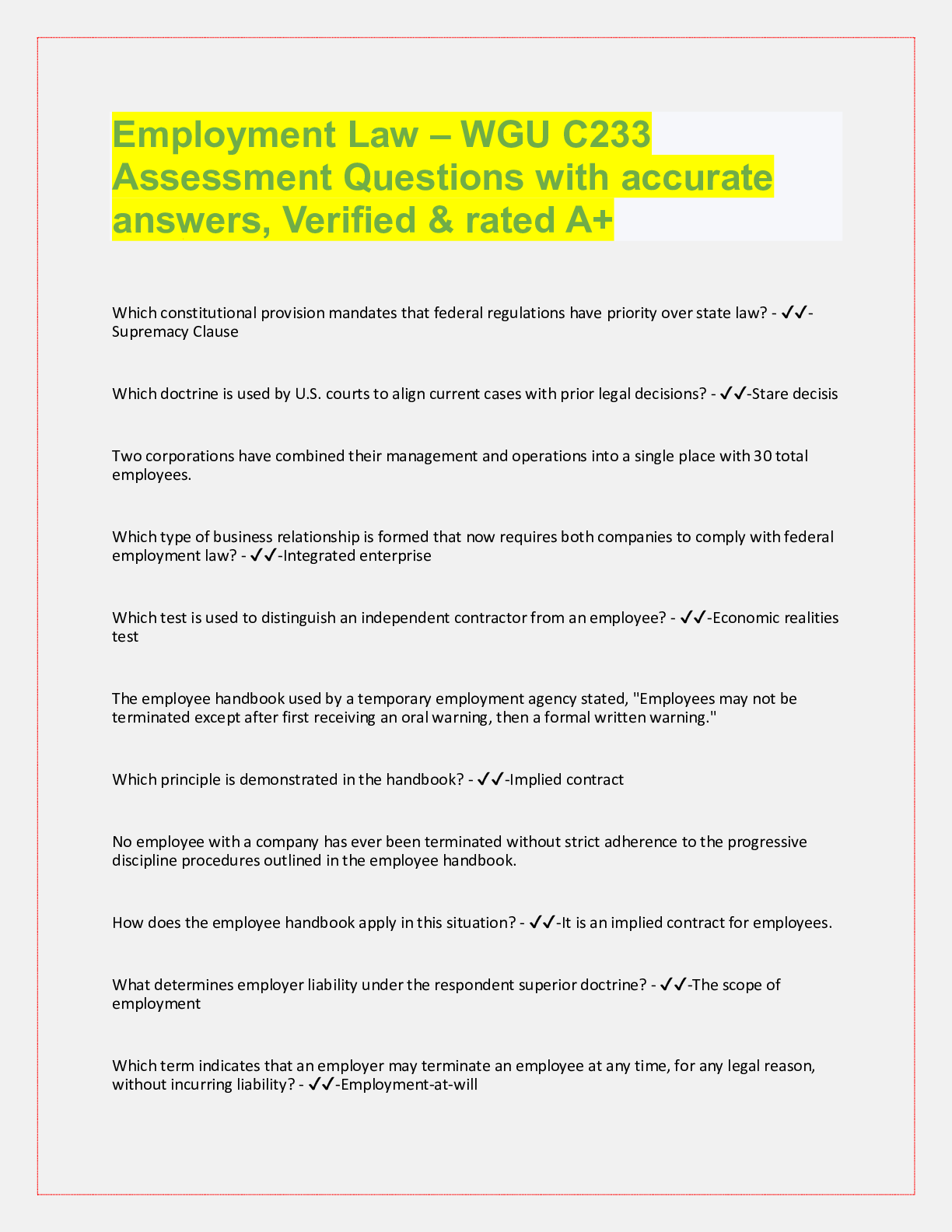
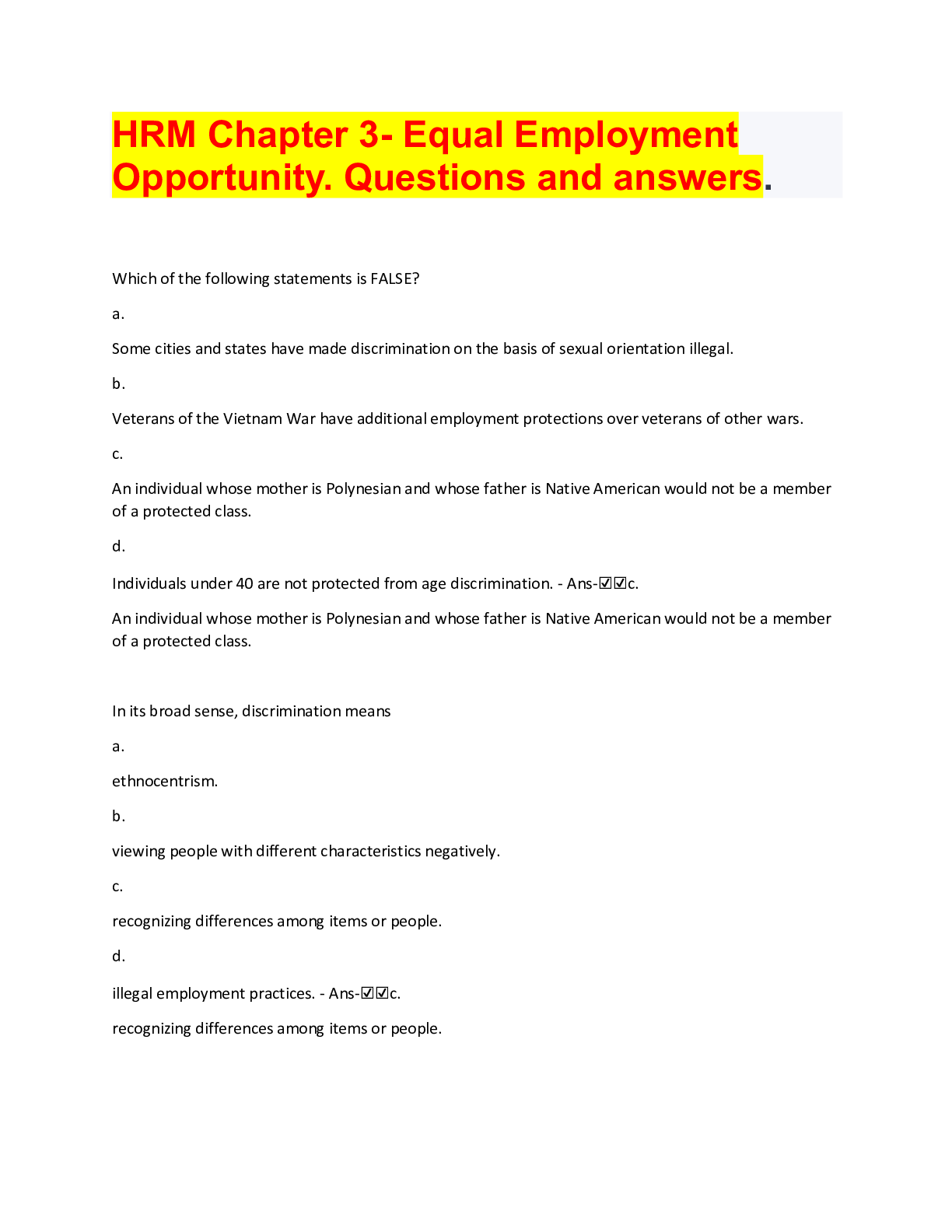
Employment Law -☑☑ is a patchwork of federal, state, and local laws.
Whether and how laws apply depends on: -☑☑ Whether employees work for the government or a
private employer, whether they have union representation, and the size of their employer
5 sources of employment law -☑☑ Constitutions, Statutes, Executive Orders, Regulations, and Common
Law
Casias v. Wal-Mart Stores -☑☑ court rejected plaintiff's request for a new category of protected
employees - those who use medical marijuana
Substantive Rights -☑☑ Many people mistakenly believe that they cannot be fired as long as they are
doing a good job, but this is not true.
Employment at Will -☑☑ An employee can quit at any time for any reason or no reason at all. An
employer can fire an employee at any time for any reason or no reason at all, except for reasons
prohibited by law.
Substantive Rights -☑☑ Freedom to Engage in Concerted Activity and Collective Bargaining
Terms and Conditions of Employment that Meet Minimum Standards Ex: Fair Labor Standards Act
Protection of Fundamental Rights
Ex: privacy torts
Compensation for Certain Types of Harm
Ex: Employer defames employee
Determining which laws apply -☑☑ Public Sector or Private Sector EmploymentUnionized or Nonunion Workplace
Employer Size
Calculated by the payroll method
Geographic Location
Government Contracts
Industry and Occupation
First employment legislation -☑☑ State workers' compensation laws to deal with severe problem of
injured workers, 1930s, National Labor Relations Act (Most employment laws reflect the work of social
movements.)
Enforcement procedures -☑☑ exist for bringing and resolving claims.
Lilly Ledbetter Fair Pay Act -☑☑ provides that each discriminatory low paycheck is a separate violation
which starts the limitations period anew.
Can a Lawsuit be Brought? -☑☑ 1)Suits may be brought in state or federal court.
2)If federal, the trial is held in the district court.
3)Many cases are dismissed by summary judgment.
4)The employee who is suing is the plaintiff.
By Whom? -☑☑ 1)At trial, plaintiff bears the burden of proof.
2)Either party may appeal to the appeals court.
3)Rarely does a case appealed from the appeals court get to the U.S. Supreme Court; if accepted, the
Supreme Court issues a writ of certiorari.
4)Consistency & stability are provided by stare decisis
Is There an Administrative Prerequisite to a Lawsuit? -☑☑ Some employment laws require that a charge
be filed with the EEOC or Department of Labor. The agency tries to reach conciliation with the parties.
Failing that, the agency issues a right-to-sue letter.Mandatory arbitration agreements -☑☑ requiring employees to submit their employment disputes to
arbitration (not mediation), rather than bring suit in court, are generally enforceable.
Federal Arbitration Act (FAA) -☑☑ requires courts to enforce most written arbitration agreements. (But
like other contracts, arbitration agreements are subject to contract defenses.)
In some states, arbitration agreements will not be enforced if they are _________? -☑☑
"unconscionable" (both procedurally and substantively.)
A contract is "procedurally unconscionable" if -☑☑ drafted by the party with greater bargaining power
and presented on a "take it or leave it" basis without opportunity for negotiation or modification.
A contract is "substantively unconscionable" if -☑☑ its terms are markedly unfair to the less powerful
party, particularly by imposing limits and burdens on the less powerful party which are not shared by
the other.
Nino v. The Jewelry Exchange -☑☑ holding that arbitration agreement was unenforceable because it
contained unconscionable terms, such as a five-day time period within which to complain, a
requirement that each side bear its own legal costs, and method of selecting arbitrators that favored
employer
If your firm decides to use arbitration agreements, avoid provisions like these: -☑☑ No selection of a
neutral arbitrator
Employee pays excessive fees
Remedies inferior to those granted by court
No minimum discovery process
Many restrictions placed on the employee, but few on the employer
Employer reserves the right to change the agreement at any time
If your firm decides to use mandatory arbitration agreements, make certain that: -☑☑ They are in
writing.They clearly notify employees that they are waiving their right to sue.
The employee understands the terms.
The employee signs in writing to indicate acceptance of the agreement.
Because employment decisions can have consequences months or years after the events, HR managers
should be careful to document decisions and the reasons for them -☑☑ at the time they occur.
EEOC remedies for violations may include: -☑☑ Attorneys' fees, Court orders, Back pay, Front pay,
Reinstatement, Hiring, Liquidated damages, Compensatory damages, and Punitive damages
Arbitration clauses in collective bargaining agreements (CBAs) do not -☑☑ bar those employees from
going to court.
Arbitration agreements do not -☑☑ prevent employees from bringing complaints to government
agencies like the EEOC, which may bring suit.
The Role of Managers
in Legal Compliance is -☑☑ To recognize, analyze and deal effectively with employment law issues.
To put in place sound policies and practices that PREVENT legal problems from arising in first place.
To enforce compliance with established law and develop strategies for dealing with legal issues that are
not clear.
To know when to seek legal advice.
Ways to determine if employment relationship exists -☑☑ Compliance with tax laws
Social Security and Medicare taxes
Workers' Compensation and Unemployment Insurance
employee -☑☑ "An individual employed by an employer"Narayan v EGL, Inc. -☑☑ using hybrid test to conclude that there was an employment relationship
between supply chain management company and its workers who provided freight pick up and delivery
services
Independent contractor -☑☑ provide tools, etc., and pays its own business expenses, hire its own
assistants, should be paid a flat fee for the work.
Long-term ICs; don't assign new projects without renewing the agreement, Don't have ICs doing same
work as employees, Don't provide benefits, even time off, and may offer services to others
right-of-control -☑☑ Most relevant issue is whether hiring party has authority to control where, when,
and how the work gets done, even if the hiring party does not fully exercise its authority.
hybrid test -☑☑ combining both Economic Realities Test and Common Law Test
Temporary workers rule -☑☑ Employers must not arbitrarily exclude from the benefits of employment
long-term temps, doing the same work as regular employees, who meet legal criteria of employees.
NLRB's conflicting rulings -☑☑ Graduate students & teaching assistants at private universities are
primarily students, not workers.
Medical interns and residents are employees with the right to unionize.
Grant-in-aid scholarship football players at Northwestern University are NOT employees with right to
unionize.
Glatt v Fox Searchlight Pictures -☑☑ holding that interns were improperly not classified as employees,
because they provided immediate advantage to the company and their program was not uniquely
educational
Volunteers rule -☑☑ Whether benefits received by volunteers constitute "significant remuneration" or
"inconsequential incidents of an otherwise gratuitous relationship", and some courts also consider other
factors
Employer -☑☑ status determines who will be held liable if an employee's rights are
[Show More]