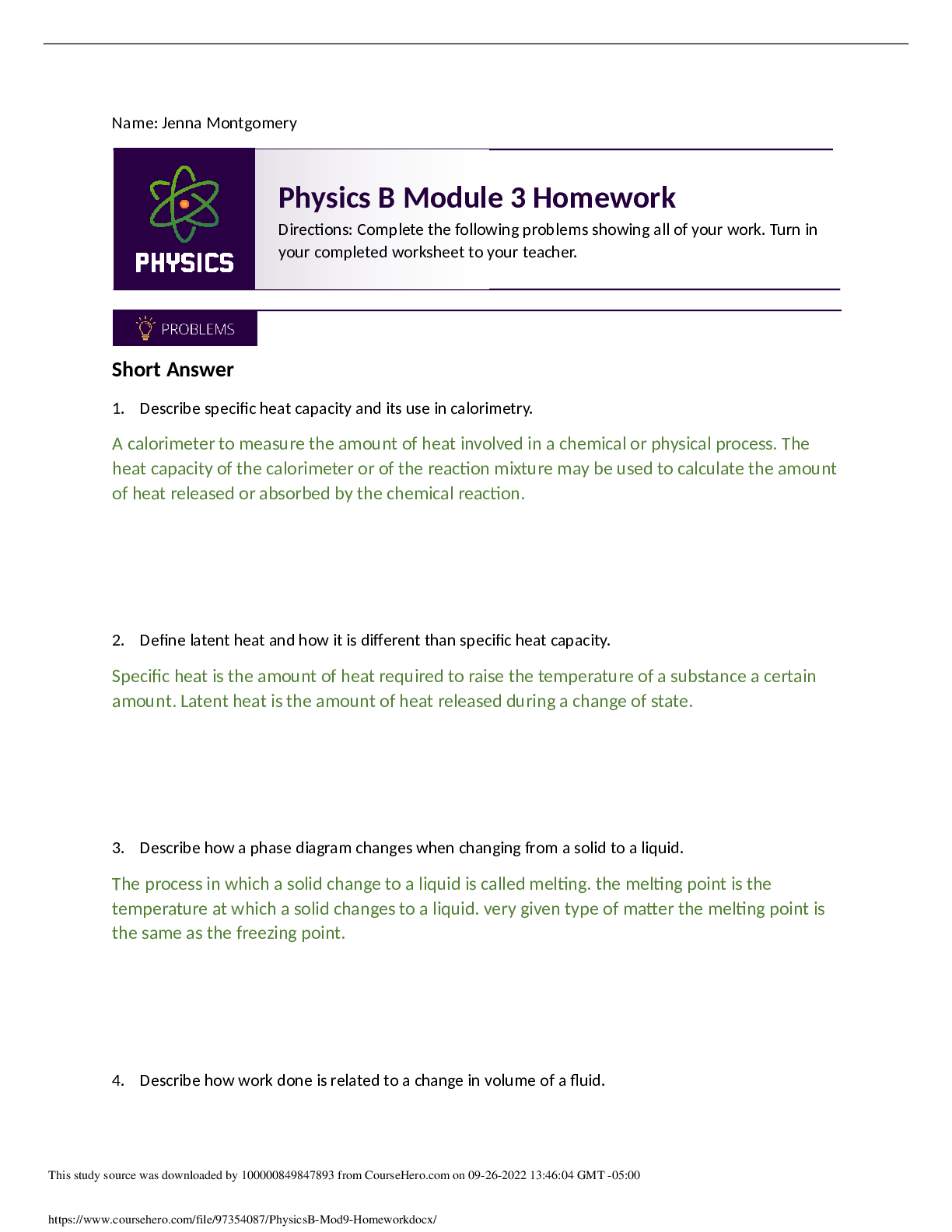
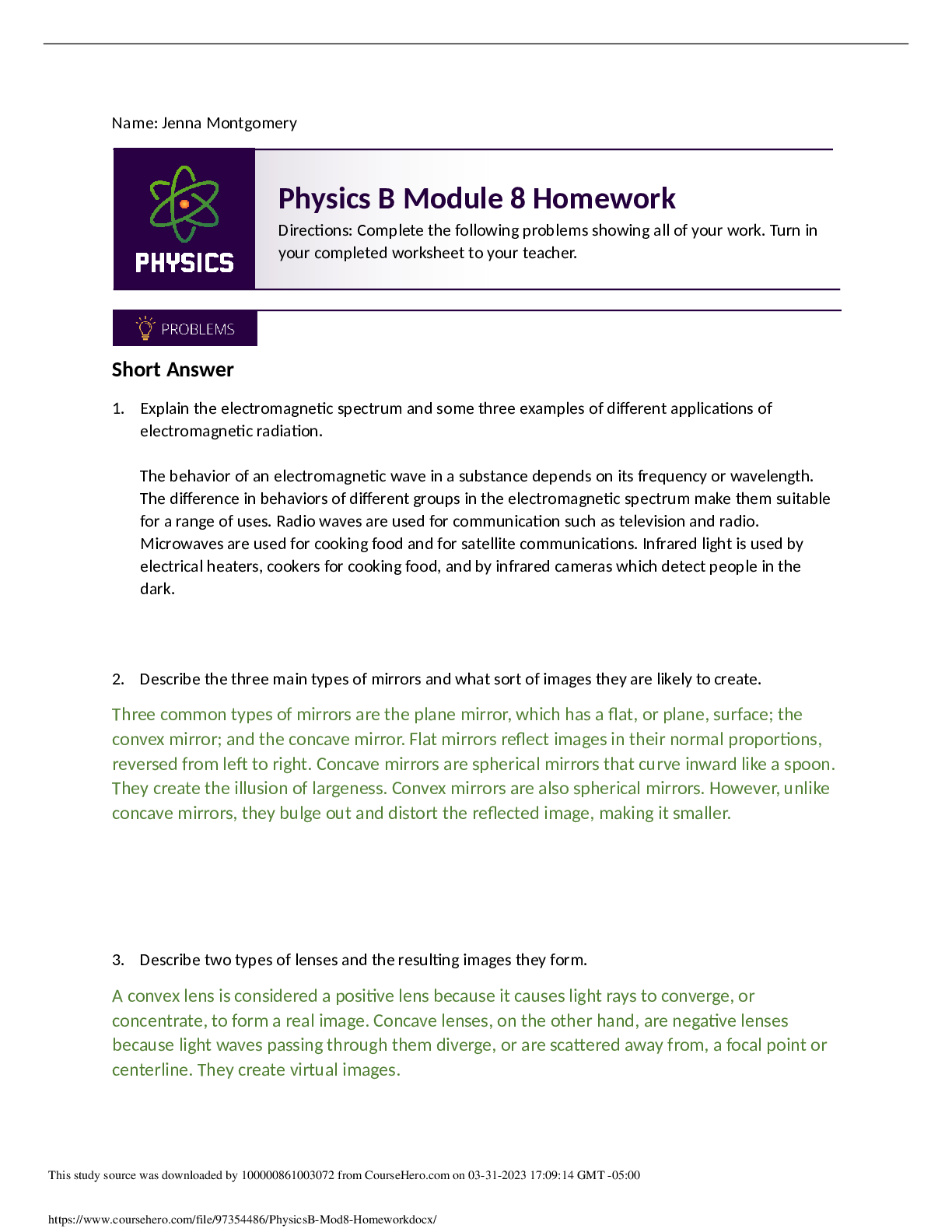
1. Describe specific heat capacity and its use in calorimetry.
2. Define latent heat and how it is different than specific heat capacity.
3. Describe how a phase diagram changes when changing from a solid to a liqu
...
1. Describe specific heat capacity and its use in calorimetry.
2. Define latent heat and how it is different than specific heat capacity.
3. Describe how a phase diagram changes when changing from a solid to a liquid.
4. Describe how work done is related to a change in volume of a fluid.
Physics B Module 3 Homework
Directions: Complete the following problems showing all of your work. Turn in
your completed worksheet to your teacher.
—Continue on the next page—
5. What is the relationship of change in internal energy, work, and heat? Explain the significance in
terms of energy.
6. As succinctly as possible, explain why it is impossible to have an engine which is 100% efficient.
7. Describe the application of Archimedes principle in every day terms.
Practice
8. 50 grams of a substance increases it’s temperature by 10 degrees when 100 J of heat is added. What
is the specific heat capacity of the substance?
9. Ten kilograms of a substance has a latent heat of 1000 J/kg. How much energy does it take to
change the phase of this substance?
0.1 kJ
—Continue on the next page—
10. The work done by a piston is measured to be 1000 J. If the pressure is a constant 1000 Pa, what is
the change in volume of the piston?
11. Is the process described in #10 isovolumetric? Explain.
12. Is it possible for a substance to change temperature in an isovolumetric and adiabatic process?
Explain.
13. A substance is heated with 1000 J and does 700 J of work on the atmosphere. What is the change in
internal energy of the substance?
14. An engine causes a car to move 10 meters with a force of 100 N. The engine produces 10,000 J of
energy. What is the efficiency of this engine?
—Continue on the next page—
15. If a ball of radius 0.1 m is suspended in water, density = 997 kg/m^3, what is the volume of water
displaced and the buoyant force?
16. A 10 kg ball of volume = 0.005 m3 is set on a lake. Describe what will happen to the ball.
Application
A group of physics students heat a vial of water, which has a balloon at the top that traps the water
vapor and air.
17. Describe how much the internal energy is changed by, if the students are adding heat to the water
via a Bunsen burner. No need to calculate anything.
18. If 50 grams of water start to boil, then how much heat must be added to completely boil off the
water? The latent heat of vaporization is 2,260,000 J/kg
—Continue on the next page—
19. Assume this process is 10% efficient, how much work is done by the gas expanding into the
atmosphere?
20. Assuming the atmospheric pressure to be constant at 101,325 Pa, by what amount does the volume
of the balloon change?
[Show More]