Ethical decision making
■ ANA (2015) provides specific guidance for ethical decision making
via its Code of Ethics for Nurses with Interpretive Statements
● Respect for human dignity
● Respect for the individual righ
...
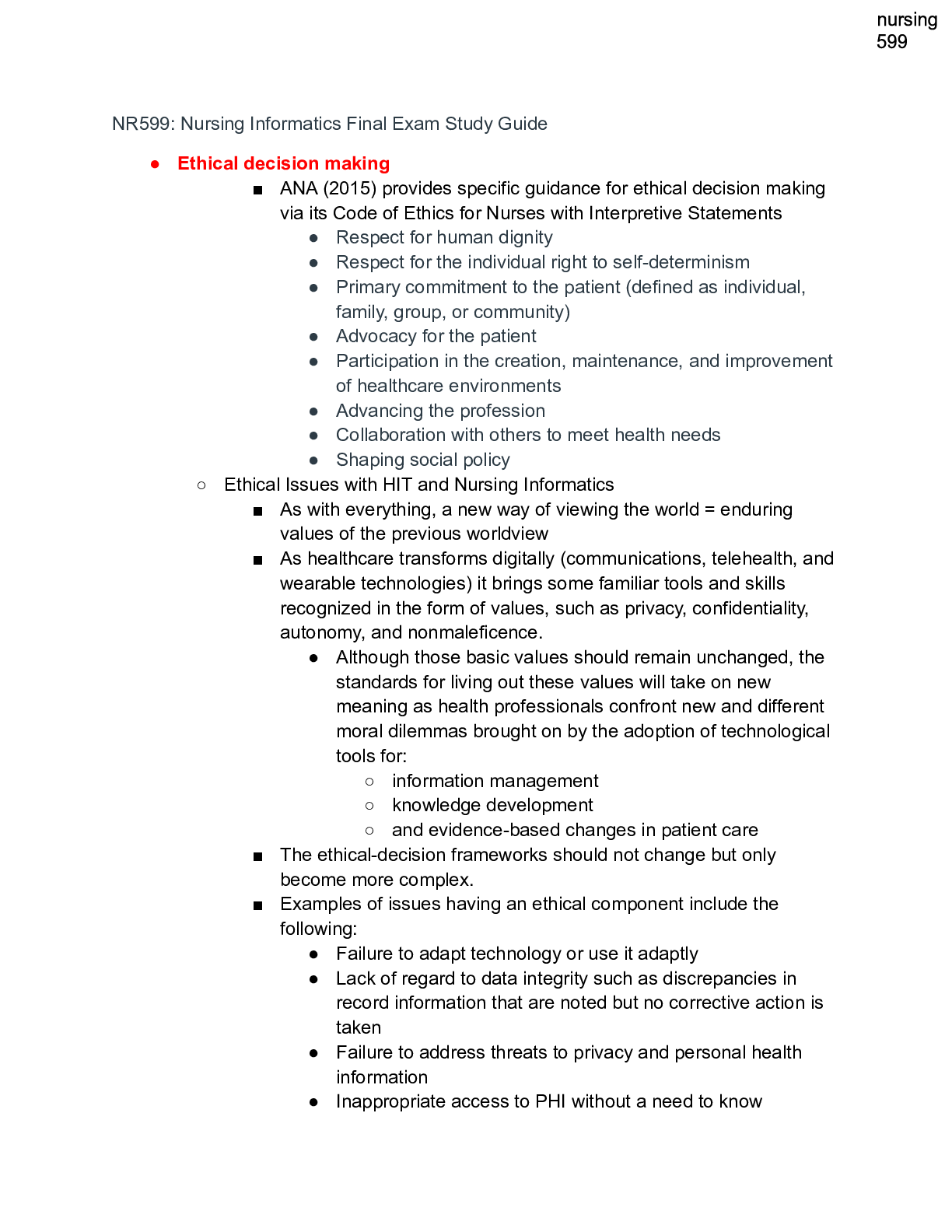
Ethical decision making
■ ANA (2015) provides specific guidance for ethical decision making
via its Code of Ethics for Nurses with Interpretive Statements
● Respect for human dignity
● Respect for the individual right to self-determinism
● Primary commitment to the patient (defined as individual,
family, group, or community)
● Advocacy for the patient
● Participation in the creation, maintenance, and improvement
of healthcare environments
● Advancing the profession
● Collaboration with others to meet health needs
● Shaping social policy
○ Ethical Issues with HIT and Nursing Informatics
■ As with everything, a new way of viewing the world = enduring
values of the previous worldview
■ As healthcare transforms digitally (communications, telehealth, and
wearable technologies) it brings some familiar tools and skills
recognized in the form of values, such as privacy, confidentiality,
autonomy, and nonmaleficence.
● Although those basic values should remain unchanged, the
standards for living out these values will take on new
meaning as health professionals confront new and different
moral dilemmas brought on by the adoption of technological
tools for:
○ information management
○ knowledge development
○ and evidence-based changes in patient care
■ The ethical-decision frameworks should not change but only
become more complex.
■ Examples of issues having an ethical component include the
following:
● Failure to adapt technology or use it adaptly
● Lack of regard to data integrity such as discrepancies in
record information that are noted but no corrective action is
taken
● Failure to address threats to privacy and personal health
information
● Inappropriate access to PHI without a need to know
● Failure to recall that the patient is their primary focus
● Failure to engage in policy discussions that impact
healthcare delivery
● Failure to recognize and use technology to advance the
profession
● Failure to keep informed of emerging developments and
issues
■ Protecting health information, the privacy and security of patient
information is a top priority for patients and their families, health
care providers and professionals, and the government.
■ HIPAA: “key persons and organizations that handle health
information to have policies and security safeguards in place to
protect your PHI whether it is stored on paper or electronically.”
■ Ethical issues can result in patient harm:
● Reputation
● Physical safety
● Discrepancies in recording information and not correcting is
irresponsible
● Example: APNs continue to use written documentation when
digital is the new expectation
○ Creation of a fragmented record
■ Increasing the likelihood that important
information will be lost → in unstructured data
and is invisible for data analysis
■ APNs have an integral role not only in the proper collection of
Meaningful Use criteria but also in defining further criteria, which
will collect information that will better determine and support
population-health needs and services.
● Perhaps the biggest ethical challenge comes when nurses
fail to embrace their roles in shaping health policy and social
change.
● Nurses need to be aware of the facts related to features of
HIT legislation, particularly the Patient Protection and
Affordable Care Act (ACA).
● ACA was intended to improve care and reduce disparities
and help reform healthcare. Lachman (2012) noted
distributive justice as the major ethical principle underlying
health-reform initiatives.
■ Emerging technology will introduce new issues and dilemmas.
■ In addition to the use of EHRs, there is a growing use of social
media to market provider services and provide support.
● Many organizations struggle with questions surrounding the
proper use of social media.
● Genomics, or personalized medicine targeted to one's
specific genetic make-up, is an area within our grasp but still
not widely known.
● And, technological advancements and miniaturization are
quickly making nanotechnology an area that we will need to
address.
● Nanotechnology is science, engineering, and technology that
is conducted at the level of the nanoscale (nano.gov, n.d.).
For reference purposes, a nanometer is equal to one
billionth of a meter.
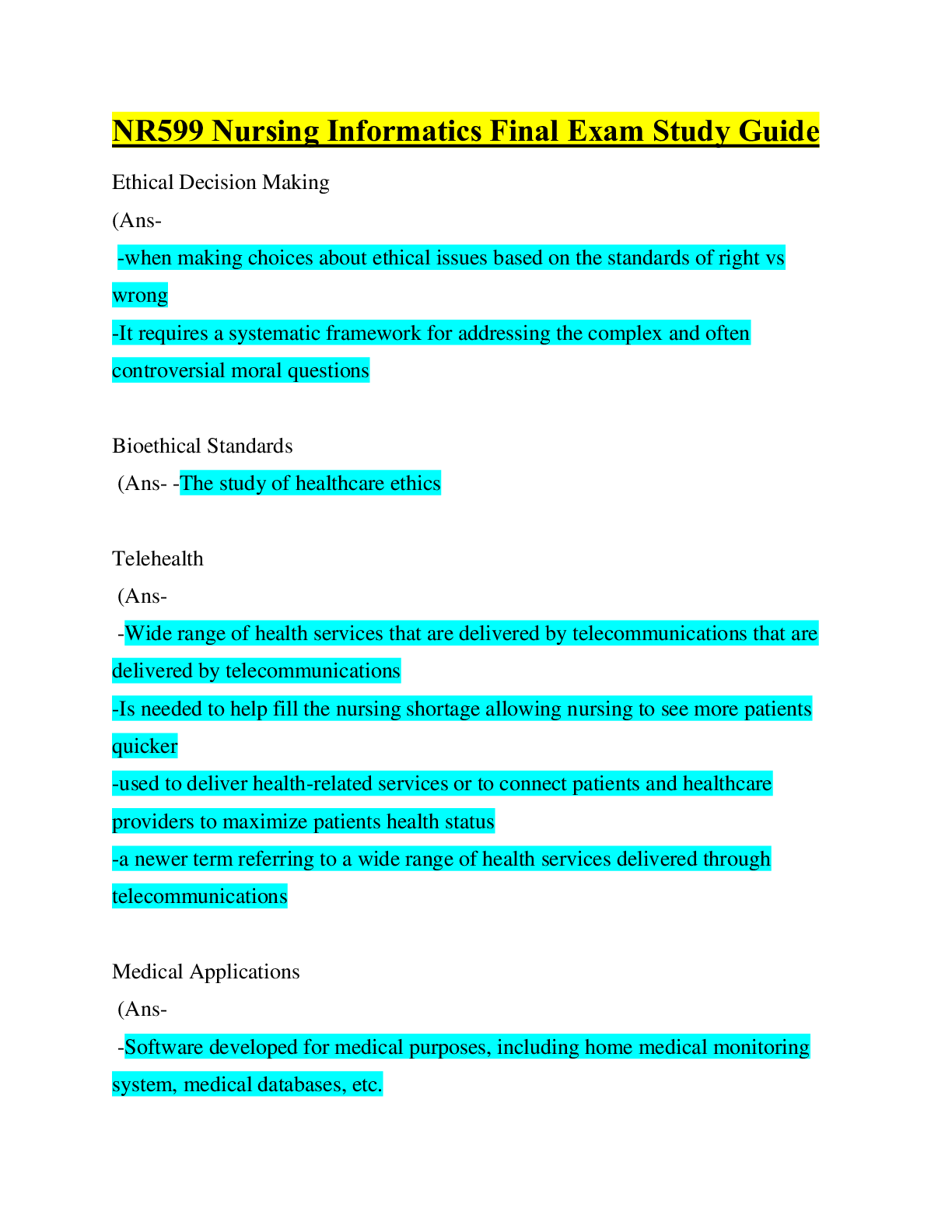
● Bioethical standards
○ The study of healthcare ethics
○ Study and formulation of healthcare ethics.
○ Bioethics takes on relevant ethical problems experienced by healthcare
providers in the provision of care to individuals and groups.
● Telehealth and Point-of-Care (POC) Technologies
○ Many mHealth technologies are being used to broaden access to care,
either by extending the reach of providers through remote monitoring of
patients or by giving advice when users otherwise would not visit a
medical professional.
○ Apps like Pocket Doctor and iTriage, which suggest possible diagnoses on
the basis of inputs from patients, are proliferating.
○ Making medical advice available beyond traditional settings could broaden
access to care for the uninsured, those living in rural areas, immigrants,
and perhaps even elderly patients. Tremendous strides have been made
in deploying mHealth technologies to expand access to care in less
developed countries.
○ Telehealth is still an evolving technology; while the offsite interventions or
contacts often lead to less time being wasted on non-care-oriented tasks
because of the efficiencies offered by the technology applications, its use
must never be associated with less care. It is also important to note that
nursing activity in telehealth still follows the same best-practice standards
as those espoused in conventional care.
○ Clinical Uses for Telehealth
■ Transmitting images for assessment or diagnosis
● Wounds for assessments and treatment consults
■ Transmitting clinical data for assessment, diagnosis, or disease
management
● Remote patient monitoring and transmitting patients’
objective or subjective clinical data, such as monitoring of
vital signs and answers to disease management questions.
■ Providing disease prevention and promotion of good health
● Case management is provided via telephone or smartphone
app and patient education is provided through asthma and
weight management programs conducted in schools.
■ Using telephonic or video interactive technologies to provide health
advice in emergent cases
● Performing teletriage in call centers or real-time stroke
consultation between a rural health center and an academic
medical center.
■ Using real-time video
● Exchange health services or education
○ POC testing
■ Point-of-care (POC) testing allows for testing and diagnosis at the
patient's side and can be conducted anywhere the patient is, such
as the home, physician’s office, ambulance, or hospital bedside
(National Institutes of Health, 2010).
■ This technology allows for quick, on-the-spot testing, with
immediately available results.
● Additionally, these results can be downloaded directly into
the EHR through interface engines.
● This decreases the risk of error in manually entered results,
and the results are immediately available to caregivers for
making treatment decisions.
■ There are many innovative devices emerging, particularly those
that engage the patient in his or her own care to monitor and
maintain health and well-being, including such things as fitness
measuring devices, scales, biometric devices, as well as
FDA-approved medical devices, such as insulin pumps,
pacemakers, defibrillators, and so forth, which can be interfaced
with EHRs and patient portals.
■ The potential for advancement in POC devices is one of the most
rapidly growing areas in the health care industry with tremendous
potential for improvement in patient safety, quality, and population
health.
● Medical (Mobile) Applications
○ Mobile health is also known as mHealth, is defined as the use of wireless
communication to support efficiency in public health and clinical practice
(Yetisen et al., 2014).
○ Facilitation of mHealth = mobile apps which can be executed either on a
mobile platform or a web-based software application that is tailored to a
mobile platform but is executed on a server.
■ Mobile medical apps = accessory → smartphones, tablets,
smartwatches, and POC devices
○ Major areas for mHealth growth are:
■ Preventive medicine and health promotion can be leveraged
through education and awareness applications;
■ Portable diagnostic devices that allow monitoring of human
conditions in clinical settings or offsite locations;
■ Applications for data management, training medical personnel, and
mobile payments.
[Show More]







![Preview of AORN PERIOP 101 FINAL EXAM 2026 QUESTIONS AND VERIFIED ANSWERS [LATEST UPDATE]](https://browseimages.nyc3.digitaloceanspaces.com/paper-images/2026/04/07/sGJvJ3aH2026-04-07-04-5869d464cbba16f.png)