ACSM Certified Exercise Physiologist,
Questions with accurate answers, 100%
Accurate, rated A+
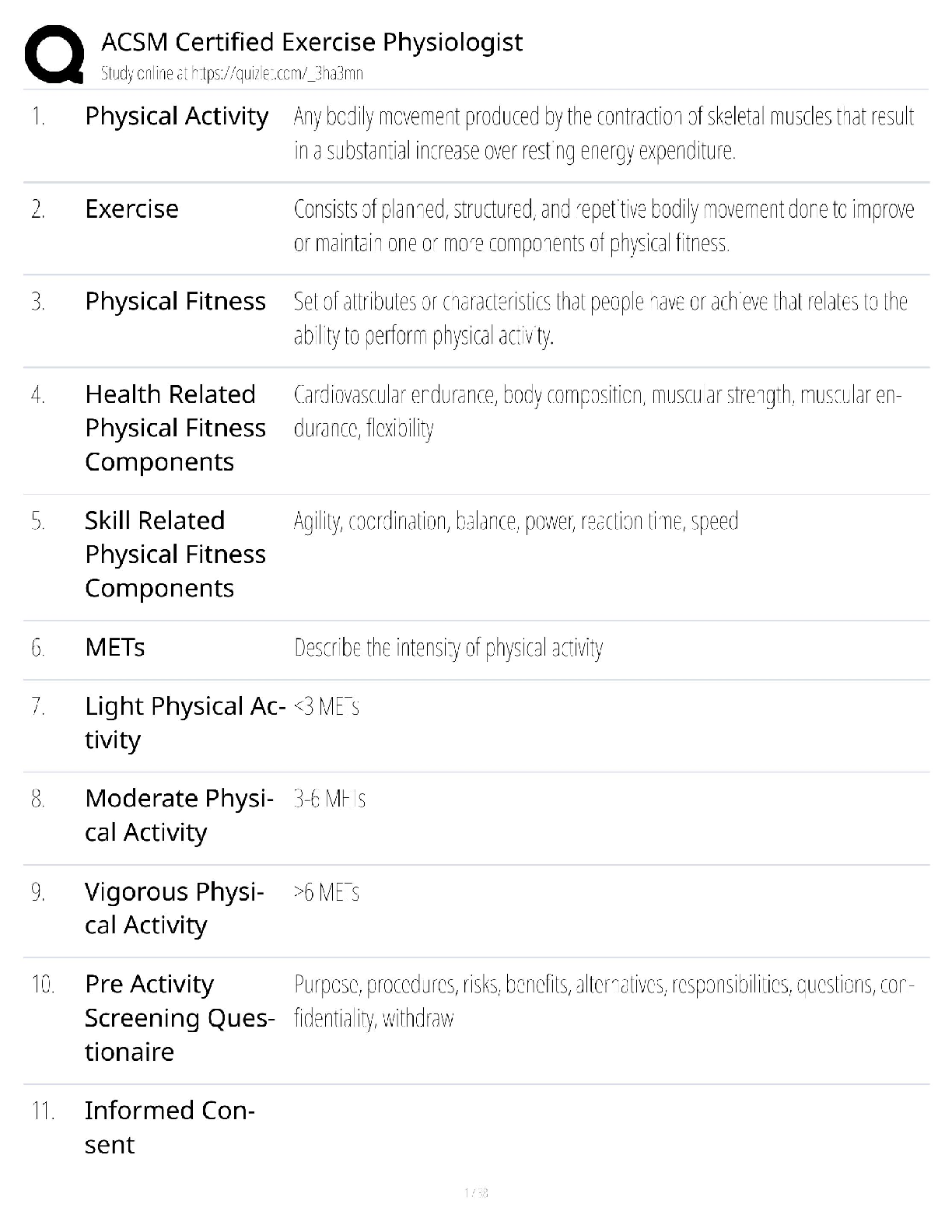
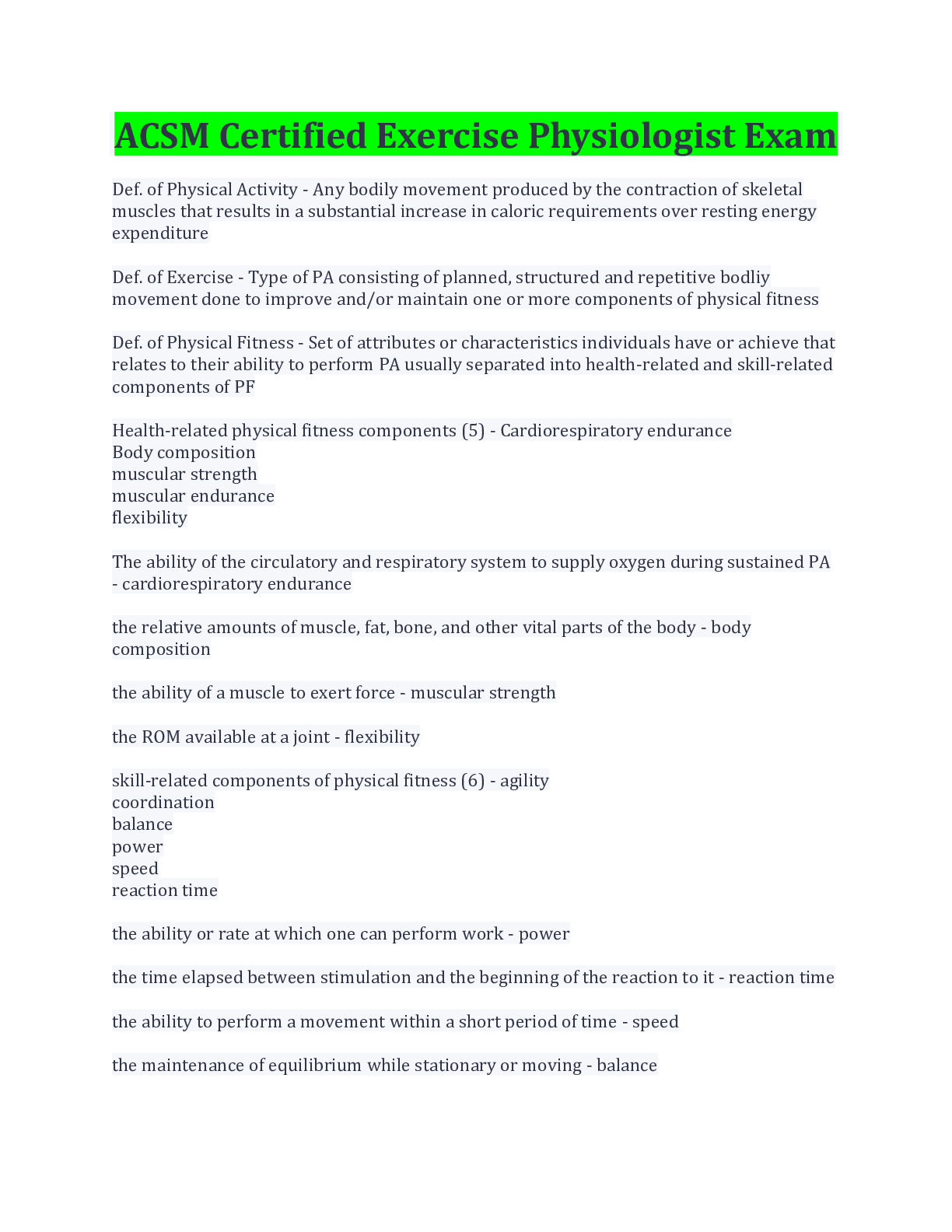
Physical Activity - ✔✔Any bodily movement produced by contracting skeletal muscles, with an increase
in energy expendi
...
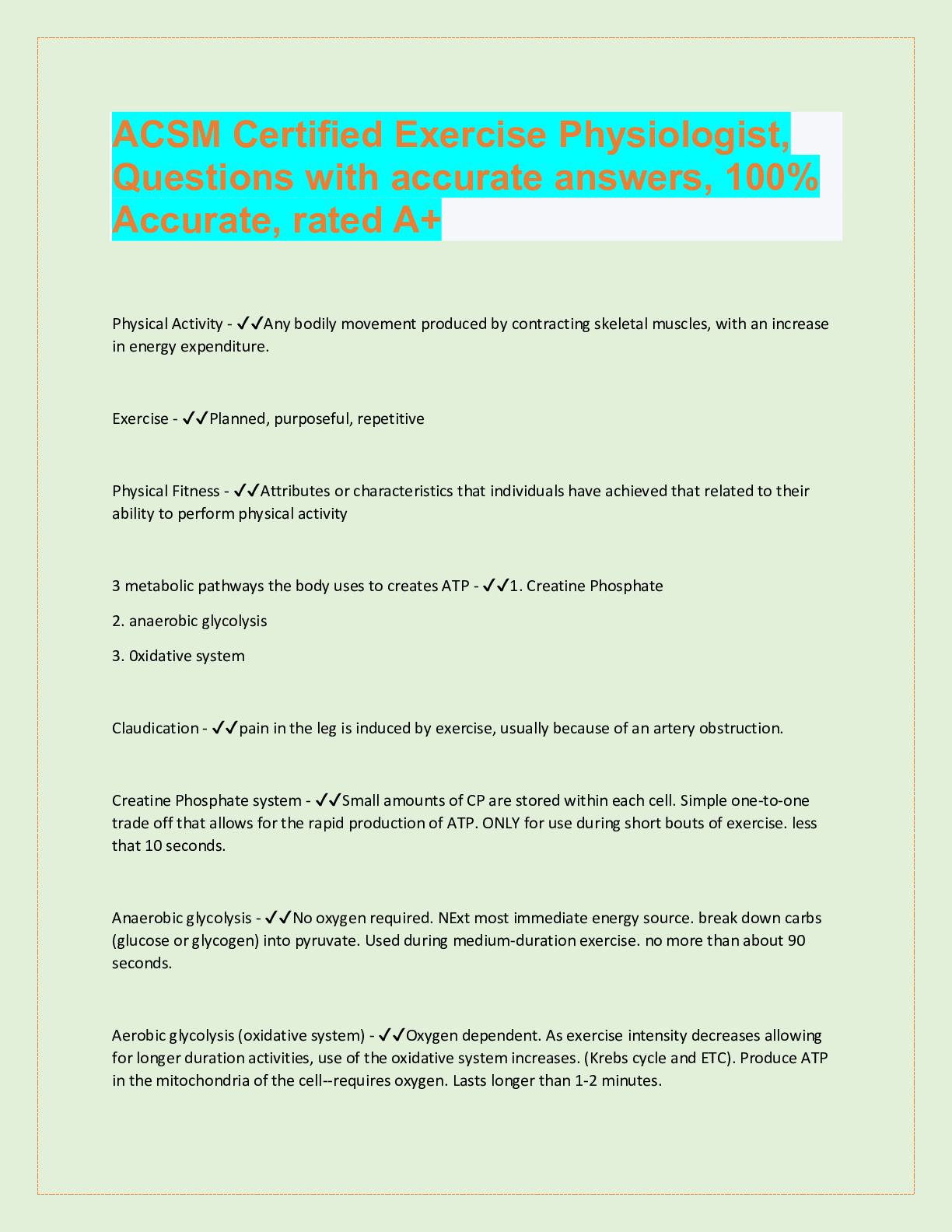
ACSM Certified Exercise Physiologist,
Questions with accurate answers, 100%
Accurate, rated A+
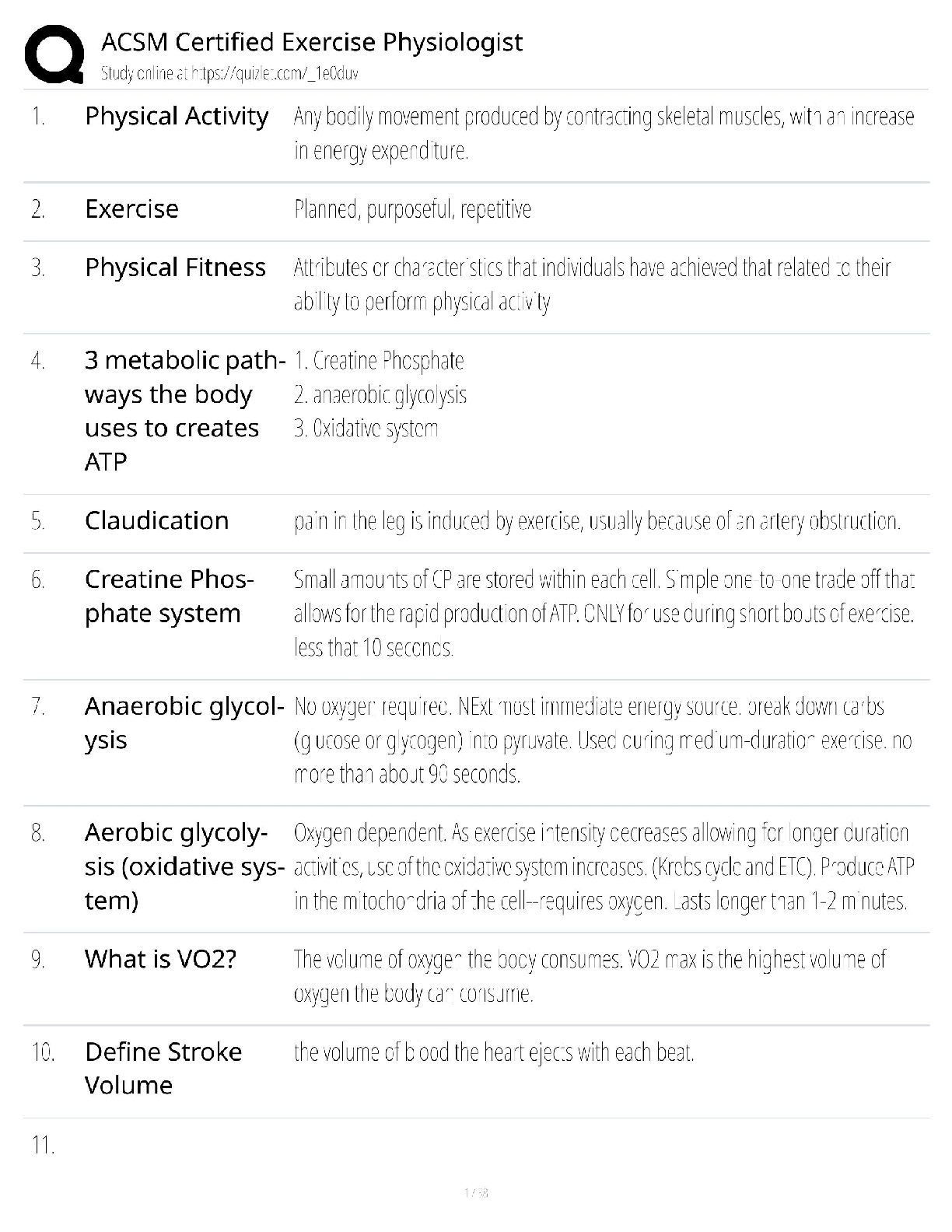
Physical Activity - ✔✔Any bodily movement produced by contracting skeletal muscles, with an increase
in energy expenditure.
Exercise - ✔✔Planned, purposeful, repetitive
Physical Fitness - ✔✔Attributes or characteristics that individuals have achieved that related to their
ability to perform physical activity
3 metabolic pathways the body uses to creates ATP - ✔✔1. Creatine Phosphate
2. anaerobic glycolysis
3. 0xidative system
Claudication - ✔✔pain in the leg is induced by exercise, usually because of an artery obstruction.
Creatine Phosphate system - ✔✔Small amounts of CP are stored within each cell. Simple one-to-one
trade off that allows for the rapid production of ATP. ONLY for use during short bouts of exercise. less
that 10 seconds.
Anaerobic glycolysis - ✔✔No oxygen required. NExt most immediate energy source. break down carbs
(glucose or glycogen) into pyruvate. Used during medium-duration exercise. no more than about 90
seconds.
Aerobic glycolysis (oxidative system) - ✔✔Oxygen dependent. As exercise intensity decreases allowing
for longer duration activities, use of the oxidative system increases. (Krebs cycle and ETC). Produce ATP
in the mitochondria of the cell--requires oxygen. Lasts longer than 1-2 minutes.
What is VO2? - ✔✔The volume of oxygen the body consumes. VO2 max is the highest volume of oxygen
the body can consume.
Define Stroke Volume - ✔✔the volume of blood the heart ejects with each beat.
How does SV increase with workload? - ✔✔Similar to HR, it increases as workload increases but only up
to ~40% to 60% of VO2max. The percentages can be decreases in sedentary individuals and increased
with training.
What happens to resting HR as stroke volume increases? - ✔✔it decreases, as more blood being
pumped per beat allows the heart to beat less often.
What is cardiac output? - ✔✔a measure of blood pumped per minute. The product of stroke volume and
heart rate.
What does Diastolic Blood pressure do during exercise? - ✔✔Remains stable or decreases slightly.
What is rate pressure product? - ✔✔serves as an estimate of myocardial oxygen demand. Product of HR
and Systolic BP. HR X SBP
What is the Fick equation used to determine VO2 max? - ✔✔VO2max = HRmax X SVmax X a-VO2
difference max (arteriovenous oxygen difference)
What is the gold standard to measure Cardiorespiratory fitness? - ✔✔VO2 max during open circuit
spirometry.
How does a submaximal exercise test work? - ✔✔It estimates VO2 max from the HR response to
submaximal single stage or graded exercise.
absolute oxygen consumption vs. relative oxygen consumption - ✔✔absolute is the raw volume of O2
consumed by the body. Relative is the volume of O2 consumed relative to body weight. Useful to
compare fitness levels between individuals.
What is one of the largest components of PA-related energy expenditure? - ✔✔Occupational Physical
Ativity
5 Health related physical fitness components - ✔✔Cardiorespiratory endurance, body composition,
muscular strength, muscular endurance, and flexibility
6 Skill (performance) related physical fitness components - ✔✔Agility, coordination, balance, power,
reaction time, and speed
cardiorespiratory endurance - ✔✔ability of circulatory system and respiratory system to supply o2
during sustained physical activity
Body composition - ✔✔relative amounts of muscle, fat, bone, and other vital parts of the body
Muscular strength - ✔✔Ability of muscle to exert force
muscular endurance - ✔✔ability of muscle to continue to perform without fatigue
flexibility - ✔✔ROM at a joint. as per the skeletal muscles and not any external forces.
Agility - ✔✔ability to change position of the body in space with speed and accuracy
coordination - ✔✔ability to use the senses together with body parts to perform tasks smoothly and
accurately
balance - ✔✔maintenance of equilibrium while stationary OR moving
reaction time - ✔✔time elapsed between stimulation and the beginning of the reaction to said stimulus
speed - ✔✔ability to perform a movement within a short period of time
ACSM's weekly/daily physical activity recommendations - ✔✔150 minutes Moderate PA per week (30
min or more most days of the week), 75 minutes of vigorous intensity
Can most sedentary individuals safely begin a low-to moderate intensity PA Program without the need
for baseline testing or medical clearance? - ✔✔Yes indeed
Most common musculoskeletal injuries occur in what area of the body? - ✔✔lower body- particularly
the knee or foot
Who is most at risk for sudden cardiac death? - ✔✔Sedentary individuals performing infrequent exercise
Light PA is defined as - ✔✔<3 MET's
Moderate PA is defined as - ✔✔3 to <6 MET's
Vigorous PA is defined as - ✔✔>/=6 MET's
What is 1 MET? Why do we use METs? - ✔✔1 MET = the relative oxygen consumption at rest. or, 3.5 mL
per kg per minute. It is an easy way for the general public to gauge their exercise intensity. Also used to
calculate energy expenditure over time.
What is a kilocalorie? what is it also known as? - ✔✔AKA: Calorie. estimate of energy cost that can be
directly related to physical activity and exercise. Weight gain, loss and maintenance can be estimated
remembering that 3,500kcal =1 lb of fat.
Is the ACSM's weekly recommended PA sufficient to prevent weight gain in the typical american
lifestyle? - ✔✔Hell na! They must go beyond these recommendations.
Two types of pre-participation self-guided screenings - ✔✔1. PAR-Q (physical Activity Readiness
Questionnaire)
2.Fitness Facility Pre-participation screening questionnaire
What is the PAR-Q? Limitation? - ✔✔A minimal standard for entry into Moderate-intensity exercise
programs. allows individuals to gauge their own medical readiness to participate . does not screen well
for those at low to moderate risk.
What is a pre-participation screening questionnaire? - ✔✔Also useful for clients to assess their health
readiness. More comprehensive and recognizes signs and symptoms of CVD and other risk-factor
thresholds.
What are the ACSM Coronary Artery Risk factors? - ✔✔Age (Men 45 and older women 55 and older),
Family History (MI, coronary revascularization or sudden death before 55 in father and 65 in mother or
first degree relative), Smoker (current or quit within the last 6 months), Sedentary (no PA in at least 30
minutes of MPA at least 3 days per week for the last 3 months), Obesity (BMI 30 or over, or waist girth
>40in for men and >35in for women), Hypertension (SBP 140 or more and/or DBP 90 or more confirmed
on 2 seperate occasions), Dyslipidemia (LDL 130 or more OR HDL <40. OR on lipid lowering meds),
Prediabetes (Impaired FBG between 100 and 125.)
What is the negative risk factor? - ✔✔HDL value of greater than or equal to 60. (this is reverse
cholesterol transport and reduces the risk of CVD)
Dyspnea - ✔✔Shortness of breath
Orthopnea - ✔✔trouble breathing while lying down
paroxysmal nocturnal dyspnea - ✔✔difficulty breathing while asleep
What classifies as low, moderate, and high risk clients? - ✔✔Low: <2 risk factors and asymptomatic
Moderate: 2 or more risk factors and Asymptomatic
High: Symptomatic OR known CVD, CPD, renal or metabolic disease
What is the exception to missing risk factor information? - ✔✔Prediabetes is counted as a positive risk
factor ONLY if the person is 45 or older OR The BMI is 25 or more (and have additional risk factor for
prediabetes)
What is a contraindication - ✔✔individual's characteristic that make PA more risky
Absolute contraindications to exercise - ✔✔Absolute cannot participate in andy PA program and/or
assessment and should consult with their doctor first.
Relative contraindications to exercise - ✔✔the benefit of exercise outweighs the risk of testing.
Left main coronary stenosis, moderate stenotic valvular heart disease, Electrolyte abnormalities, severe
atrial hypertension, tachy or bradydysrhythmia, hypertrophic myopathy, most disorders exacerbated by
exercise, uncontrolled metabolic disease, chronic infectious disease, Mental impairment, AV block.
Exercise testing is recommended for individuals at ____ risk - ✔✔High risk.
What is prehypertension? - ✔✔120-139 SBP and/or 80-89 DBP
Normal BP? - ✔✔<120 and <80
Stage 1 hypertension? - ✔✔140-159 SBP and 90-99 DBP
Stage 2 hypertension? - ✔✔160 + SBP 100+ DBP
Optimal LDL, total cholesterol, HDL, and triglyceride levels? - ✔✔LDL: <100
HDL: <40
Triglyceride: <150
TOTAL: <200
3 assesments for muscular endurance - ✔✔1. Bench press
2. Curl up
3. push up
twitch - ✔✔When a motor unit is stimulated by a single nerve impulse
tetanus - ✔✔motor unit stimulated constantly
summation - ✔✔motor unit has more than 1 stimulus
What is the SAID principle? What is it dependent on? - ✔✔The specificity principle. Specific exercise
elicits specific adaptations, creating specific training effects. (Specific Adaptations to Imposed Demands).
Dependent on the TYPE and MODE of exercise. Example: a client wants to improve their time in an
endurance run, you select training stimulus that is appropriate. (eg. endurance activities, not swimming.
7 ways of determining exercise intensity - ✔✔1. Heart rate reserve method.
2. Peak HR method
3. Peak VO2. method
4. Peak METs method
5. VO2 reserve method
6. Talk test method
7. RPE method
(HRR) Heart rate reserve method KARVONEN FORMULA - ✔✔The difference between max HR and
resting HR.
Target HR = [(max HR -resting HR) X %intensity desired] + Resting HR.
Peak HR method - ✔✔220-age = max HR. (SD of 12-15 BPM)
Target HR = max HR X % intensity desired
Peak VO2 method - ✔✔must have measured or estimated VO2max.
Target VO2 = VO2max X intensity desired
Peak METs method - ✔✔Target METs = (%intensity desired)(VO2max in METS -1) +1
VO2 reserve method
What is VO2 reserve? - ✔✔VO2 reserve is the difference between VO2 max and VO2 rest. (determined
in a lab setting)
Target VO2 reserve = [(VO2max - VO2 rest) x %intensity desired] + VO2rest
Talk test method - ✔✔differentiates between moderate and vigorous activity. If they can talk, but not
sing it is moderate. If they are unable to say more than a few words without pausing for a breath it is
vigourous.
Borg's RPE scale. What level is recommended to improve cardiorespiratory fitness? - ✔✔ranges from 6
to 20. from no exertion at all to maximal exertion. 11 to 16 to improve CRF.
What is the CR-10 scale of exertion? (Borg's category ratio scale) - ✔✔scale of 0 to 10. in which 0 is
sitting and 10 is max effort possible. 5-6 is mod. 7-8 is vig.
Symptoms identified during an exercise test in which the test should be stopped. - ✔✔Drop in SBP 10 or
below.
Rise in BP above 250 and/or 115.
Failure of HR to increase
failure of test equipment
Do individuals with cardiac, respiratory, metabolic, or musculoskeletal disorders need to be supervised
by trained personnel? - ✔✔Yes, when beginning an exercise program
What is target heart rate? How do you determine it? - ✔✔Must consider the habitual PA, exercise level,
and goals to determine the % intensity desired.
Common musculoskeletal injuries signs and symptoms. - ✔✔Point tenderness
Pain when body part is at rest
Joint pain
Pain that continues after warming up.
Swelling or discoloration
Increased pain with weight bearing activities
changes in normal bodily functions
Intrinsic risk factors to injury - ✔✔History of previous injury
Inadequate fitness/conditioning
Body composition
Bony alignment abnormalities
Flexibility/strength imbalances
Joint laxity
Musculoskeletal disease
Extrinsic risk factors to injury - ✔✔Excessive load on the body
Type or speed of movement
number of reps
footwear
surface
training errors
excessive distances
fast progression
high intensity
running on hills
poor technique
fatigue
environment conditions
Exercise in heat yields? (relate to HR as well) - ✔✔Dehydration risk, increased blood flow to the skin
(away from working muscles), HIGHER HR values.
Exercise in the cold yields? - ✔✔Vasoconstriction of blood vessels in the skin, HR and cardiac output are
similar to thermoneutral environment, wearing bulky clothing is a barrier, Respiratory rate is higher and
VO2 max may be slightly lower. Some individuals may perceive exercise to be more difficult in the cold
Exercise in high altitude - ✔✔"thin air"
[Show More]


.png)

.png)