C724 (Information Systems
Management) – WGU, Exam Section
Questions with accurate answers, rated
A+
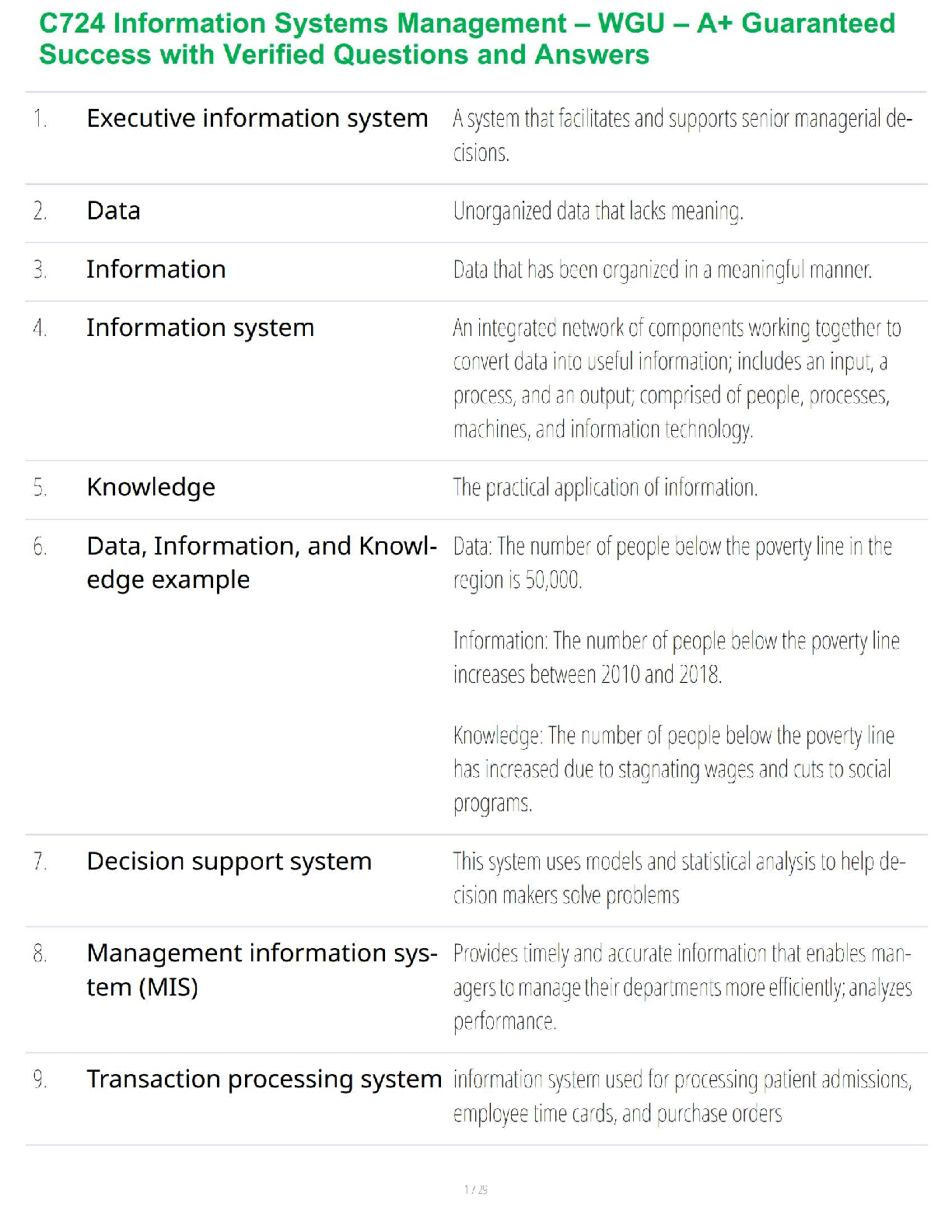
Executive information system - ✔✔-A system that facilitates and supports senior managerial decisions.
Data - ✔✔-
...
C724 (Information Systems
Management) – WGU, Exam Section
Questions with accurate answers, rated
A+
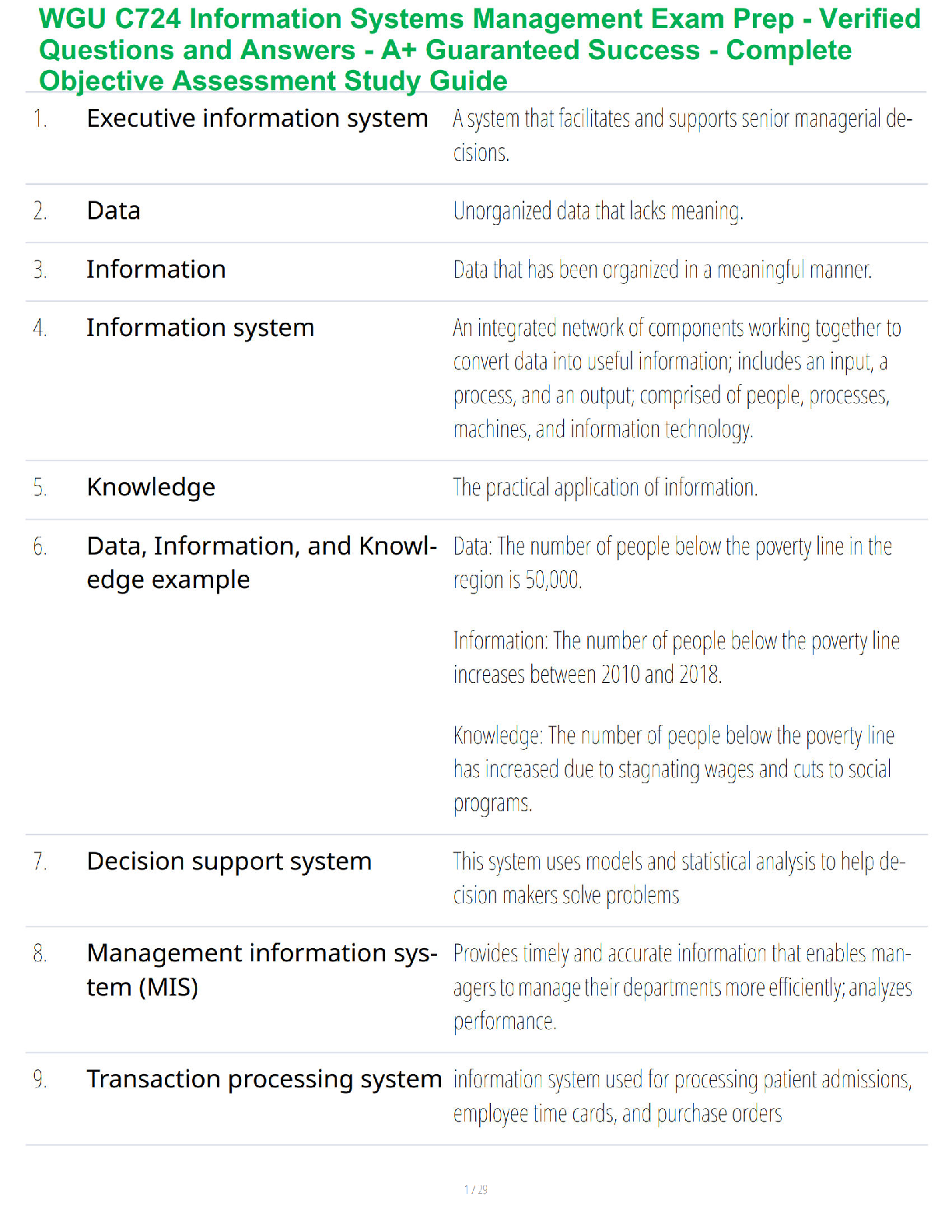
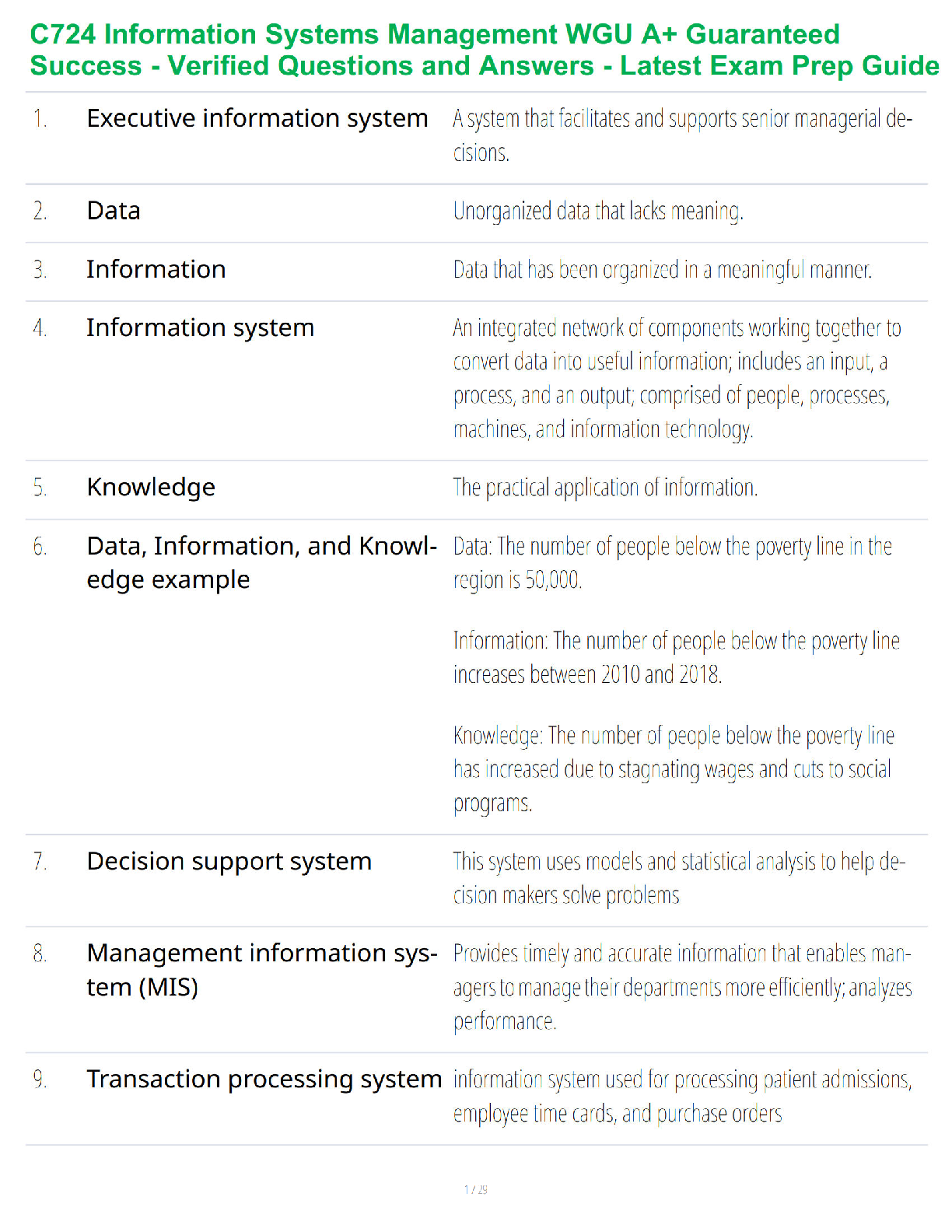
Executive information system - ✔✔-A system that facilitates and supports senior managerial decisions.
Data - ✔✔-Unorganized data that lacks meaning.
Information - ✔✔-Data that has been organized in a meaningful manner.
Information system - ✔✔-An integrated network of components working together to convert data into
useful information; includes an input, a process, and an output; comprised of people, processes,
machines, and information technology.
Knowledge - ✔✔-The practical application of information.
Data, Information, and Knowledge example - ✔✔-Data: The number of people below the poverty line in
the region is 50,000.
Information: The number of people below the poverty line increases between 2010 and 2018.
Knowledge: The number of people below the poverty line has increased due to stagnating wages and
cuts to social programs.
Decision support system - ✔✔-This system uses models and statistical analysis to help decision makers
solve problems
Management information system (MIS) - ✔✔-Provides timely and accurate information that enables
managers to manage their departments more efficiently; analyzes performance.
Transaction processing system - ✔✔-information system used for processing patient admissions,
employee time cards, and purchase orders
Information management - ✔✔-The management of organizational processes and systems; helps the
organization reduce costs and adds value to products; helps the organization make better managerial
decisions; stores and processes data.
Information technology - ✔✔-The use of computer and telecommunications systems for storing,
retrieving, and sending information; comprised of hardware, software, data, and networks.
information technology management - ✔✔-the management of hardware, software, data, networks,
and people that facilitate access to information and allow the organization to achieve business
objectives.
Strategic information system - ✔✔-provide tools used by an organization to accomplish specific tasks to
gain competitive advantage.
Social Networking and interpersonal skills. - ✔✔-Enhances interpersonal and relationship-forming skills.
Porters 5 competitive forces - ✔✔-Intensity competitive rivalry
bargaining power of customers
bargaining power of suppliers
threat of new entrants
threat of substitutes
Network economics (network-based strategy) - ✔✔-the cost of adding another business participant to a
business venture is small, the potential gain is great.
Business ecosystems - ✔✔-Network of businesses involved in delivering a product through mutual
cooperation.
Product differentiation (business strategy) - ✔✔-offering a higher quality product to differentiate from
others in the market
growth (business strategy) - ✔✔-adding new products or new enhancements to existing products
Enterprise Resource Planning (ERP) - ✔✔-Involves utilizing computer technology to link various aspects
of a business; a very complex resource planning system that spans the entire business; companies often
have difficulty implementing the system.
Customer Relationship Management (CRM) - ✔✔-Allows for personalized communication to customers.
Knowledge Management (KM) - ✔✔-These systems provide tools to help manage organizational
knowledge and create value to meet business requirements and strategic goals.
chief executive officer (CEO) - ✔✔-also called president or managing director, is responsible for the
success or failure of the company, creating the company culture, selecting the senior management
team, setting strategy and vision, and selecting projects to fund.
chief operations officer (COO) - ✔✔-is the director of operations, responsible for the oversight of
internal operations on a day-to-day basis and for monitoring production quotas
chief financial officer (CFO) - ✔✔-manages the company's cash flow and evaluates and communicates
financial risks.
chief information officer (CIO) - ✔✔-a business leader who analyzes internal business processes such as
payroll and billing, reshapes the physical infrastructure and network purchases to meet business goals,
and leads the workforce to implement critical IT internal projects; responsible for information systems
strategic thinking and planning.
chief technology officer (CTO) - ✔✔-has ultimate responsibility for all technology implementation,
maintaining technology compliance regulations, and identifying technology risks for the company.
chief security officer (CSO) - ✔✔-is the highest level executive concerned with the overall security
functions and policies of a business.
Systems Analyst - ✔✔-A change agent who uses design and analysis techniques to solve organizational
problems using information technology; they report about system development and keep others
informed; should understand overall business processes; focuses on analysis, design, and
implementation
Information Security Analyst - ✔✔-Their goal is to ensure that data and systems are secure to prevent
breaches.
Information Security - ✔✔-The concept of protecting valuable information assets.
Project Manager - ✔✔-They deliver quality systems on time, manage the budget, and plan for the
unexpected (they do not train new users).
Gantt chart - ✔✔-A visual view of tasks scheduled over time; used for planning projects.
Dashboard - ✔✔-A system that is the culmination of information from many data sources, allowing
management to perform a thorough analysis.
Cultural Particularism - ✔✔-A societal norm that emotionally ties people to local brands or habits.
Network Engineer - ✔✔-Responsible for the layout, installation, and maintenance of all information
technology network components.
Success of strategic information systems projects - ✔✔-A majority fail to meet schedule or budget
Organizational features that can change the company direction - ✔✔-Processes, politics, culture, and
environment
Global Business Strategies that form their organizational and information systems structure - ✔✔-
transnational, multinational, franchisers, domestic exporter
Transnational - ✔✔-a commercial enterprise that operates substantial facilities, does business in more
than one country and does not consider any particular country its national home.
Multinational - ✔✔-an organization that owns or controls production of goods or services in one or
more countries other than their home country.
Database Management System (DBMS) - ✔✔-Allows multiple departments to access, analyze, and
modify data that is stored in one central location.
Total Cost of Ownership (TCO) - ✔✔-Helps establish feasibility.
Platform as a Service (PaaS) - ✔✔-service provider provides server space, the server, virtualization,
operating system, database, and development environment in a platform that can be used for
application development. An example would be Amazon Web Services.
Infrastructure as a Service (IaaS) - ✔✔-A service provider provides a cloud fabric, or pooled services,
including server space, servers, storage, and all other aspects of the computing platform, with the
exception of the operating system and applications, which the client organization would install and
manage.
Analytics as a Service (AaaS) - ✔✔-A cloud software service
Software as a Service (SaaS) - ✔✔-Software licensed and hosted on centralized or distributed servers
that belong to a service provider. Users access this software using a connection to the Internet and a
web browser.
Agile software development methodology - ✔✔-an operational method by which software developers
iteratively gather requirements, plan, design, develop, test, and implement software.
Information Technology Infrastructure Library (ITIL) - ✔✔-common set of best practices widely used by
businesses to give guidance to companies on how to use IT as a tool for implementing change
Pseudocode - ✔✔-an informal high-level description of the operating principle of a computer program
or other algorithm. Used for human reading, rather than machine reading, and it can be used to
translate into any programming language.
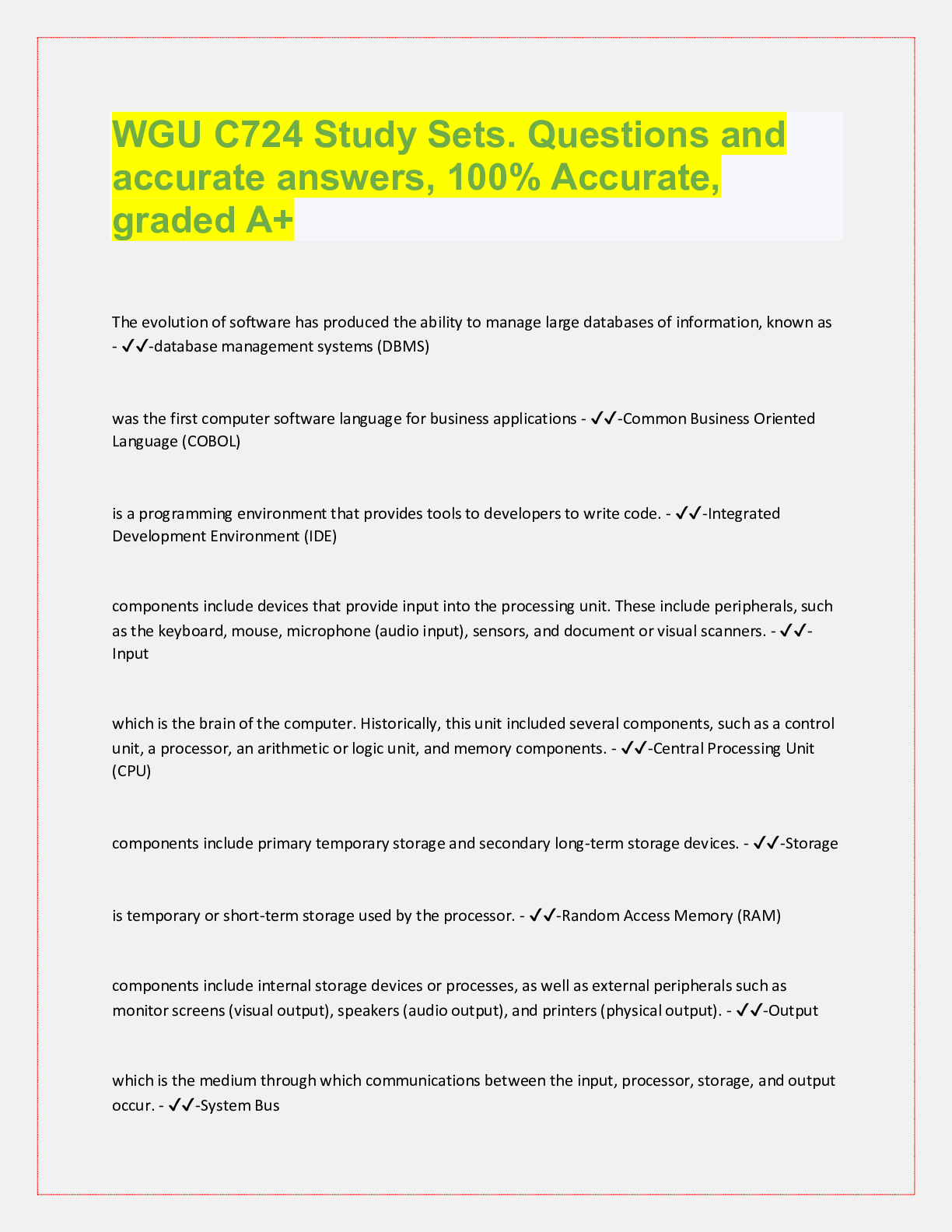
Input - ✔✔-components include devices that provide input into the processing unit. These include
peripherals, such as the keyboard, mouse, microphone (audio input), sensors, and document or visual
scanners.
Central Processing Unit (CPU) - ✔✔-the brain/microprocessor of the computer.
Output - ✔✔-Components include internal storage devices or processes, as well as external peripherals
such as monitor screens (visual output), speakers (audio output), and printers (physical output).
system bus - ✔✔-connection between the CPU, memory, storage, expansion slots, and other
motherboard components
primary storage - ✔✔-flash memory chips, such as shown below, plugged into memory slots on the
motherboard.
Secondary storage - ✔✔-accessed only through a system's input/output bus and is generally several
orders of magnitude slower than primary storage technologies
Removable media, such as magnetic floppy disks, optical discs (CDs & DVDs), and USB flash drives
Tertiary storage - ✔✔-consists of an automated robotic mechanism to mount and dismount magnetic
tape or optical discs.
First and second-generation computer languages - ✔✔-were specific to the computer manufacturer
(1GL) or to a specific processor or environment (2GL).
Third generation computer languages (3GLs) - ✔✔-high-level programming languages such as FORTRAN,
COBOL, C, Java, C++, and C#
Java - ✔✔-An open-standard software language used for client-server internal applications.
COBOL - ✔✔-The first computer language; developed in the 1950s; still used today.
Fourth generation computer languages (4GL) - ✔✔-software tools that help reduce the amount of
procedural knowledge that is needed about how computers operate and lets end users create programs
as needed; SQL is a 4GL.
Structured Query Language (SQL) - ✔✔-A computing language that is used with relational databases.
Dynamic Random-Access Memory (DRAM) - ✔✔-The main memory of a computer system; requires
constant refreshing.
Static Random-Access Memory (SRAM) - ✔✔-Retains memory for as long as power is being supplied;
does not need to be constantly refreshed; used to access the most frequently used data, as it is faster.
Horizontal Application - ✔✔-Software that provides solutions based upon the common needs of many
businesses.
Vertical Application - ✔✔-Software that designed for a specific business.
Software - ✔✔-Provides instructions to computers to perform tasks.
Low-Level Programming Language - ✔✔-Basic programming languages that used machine language
instruction; they are specific to the hardware and lack portability.
Dumb Terminal/Thin Client - ✔✔-A terminal that depends on the host computer for its processing
power
optical character recognition (OCR) - ✔✔-Reads machine printed text; used for time cards.
Intelligent Character Recognition (ICR) - ✔✔-Reads handwritten text; more advanced form of optical
character recognition (OCR).
UNIX - ✔✔-An operating system designed to code computer instructions in a mainframe environment.
Workstation - ✔✔-A powerful computer system that can handle intensive mathematical operations;
often used by engineers.
Mashup - ✔✔-Occurs when software is mixed and matched to develop a customized application
Field - ✔✔-An attribute of an entity, such as name, address, or student ID.
Tuple/Record - ✔✔-A record of data set in a row.
Query Language - ✔✔-Provides instructions and procedures to retrieve data from a database.
Primary Key - ✔✔-A field that uniquely identifies a record, such as customer ID or student ID.
Foreign Key - ✔✔-Field that is a primary key to another table.
Schema - ✔✔-The complete description of the database.
Variable - ✔✔-a data type or simply type is a classification of data which tells the compiler or interpreter
how the programmer intends to use the data; can become incompatible with data warehouse design.
Flat File Database - ✔✔-Stores data in plain text, holding one record; cannot contain multiple tables like
a relational database.
Online Analytical processing (OLAP) - ✔✔-analyze transaction data used for making decisions;
multidimensional (cubical) data; requires a lengthy, complex loading and updating phase.
Online transaction processing (OLTP) - ✔✔-database design used for browsing and manipulating
business transaction activity.
Processing of information into the database.
Don't perform analyses on these databases because it could affect performance.
relational database - ✔✔-type of database in which multiple information files are combined into one
database in one location, where data are stored in two-dimensional tables known as relations and
contain multiple entities and attributes
Object-Oriented Database - ✔✔-A database that is designed to store mixed media, as opposed to tables
in relational databases.
Conceptual Data Model - ✔✔-a map of concepts and their relationships used for databases.
Logical Data Model - ✔✔-Provides foundation for designing a database
Physical Data Model - ✔✔-a representation of a data design as implemented, or intended to be
implemented, in a database management system
Pointers - ✔✔-Used to show the relationship between data fields and tables.
Referential Integrity - ✔✔-Table relationships must always be consistent; for an entity or object to exist
in a table, an equal value must exist in the referenced table; the primary and foreign keys must be equal.
Types of relationships in a relational database model - ✔✔-One-to-One, One-to-Many, and Many-to�Many
Data Manipulation Language - ✔✔-A language that allows users to easily modify the data in a database.
Data Warehousing - ✔✔-a system used for reporting and data analysis, and is considered a core
component of business intelligence; data is stored in one place.
data mart - ✔✔-smaller subset database from a data warehouse typically focused on a single area or
function.
Extraction, transformation, and loading (ETL) - ✔✔-a process in which data is extracted from a
computer, transformed (or cleansed) into a format appropriate for the data warehouse, and then
transferred to the data warehouse.
Direct Move - ✔✔-Data that does not need to be transformed being transferred to a data warehouse.
Data mining - ✔✔-process of identifying hidden patterns and relationships in structured databases and
applying rules to that data in order to predict future behavior.
Web Mining - ✔✔-process of identifying hidden patterns and relationships in non-structured databases,
such as the Internet, and applying rules to that data in order to predict future behavior.
Text mining - ✔✔-High-quality information is typically derived through the devising of patterns and
trends through means such as statistical pattern learning.
Partitioning - ✔✔-Dividing a database into more manageable segments.
Master Data - ✔✔-Objects shared across the enterprise; it is key to accurate business reporting and
analysis
Data Governance - ✔✔-Concerned with the management of data, including maximizing quality through
effective utilization, availability, and protection.
Entity-Relationship Diagram (ERD) - ✔✔-Illustrates the relationships among all of the tables in a
database.
Database Administrator - ✔✔-Responsible for the creation and management of the entire database
management system (DBMS).
Data Administrator - ✔✔-Responsible for determining and monitoring employees' access to the
company's database management system (DBMS).
Information Policy Administrator - ✔✔-Responsible for acquiring, organizing, and distributing
organizational information internally.
Data Dictionary - ✔✔-Stores and manages all of the information about the database, or the metadata.
Three V's of Big Data - ✔✔-Volume, Variety, and Velocity; Volume refers to the amount of data, variety
refers to the number of types of data, and velocity refers to the speed of data processing (real-time
analytics).
Health Analytics Tools - ✔✔-through smartphone sensors or wearable peripheral devices. Data from
these devices is collected, analyzed, and used to help a user to understand, improve, and maintain, or
automatically report, their health to their health professionals.
Geographic Information Systems (GIS) - ✔✔-Using connections to numerous databases containing data
concerning locations, crimes, taxes, traffic, votes, and environmental and life science data, geospatial
analysis can help government administrators to understand demographic trends, population density
changes, attribute concentrations
wide area network (WAN) - ✔✔-connection b/w small networks that create a large network that
typically connects business campuses consisting of computer systems across large distances
Voice over Internet Protocol (VoIP) - ✔✔-VoIP is a type of broadband application, similar to video, in
which voice calls are transmitted over the Internet.
Public Switch Telephone Network (PSTN) - ✔✔-The entire interconnected voice telephone network
around the world. It is switched based.
Protocols - ✔✔-used to ensure the quality and accuracy of the transmission, and that the transmission is
understood by the receiving device.
Bridge - ✔✔-a device that connects and passes packets between two network segments that use the
same communications protocol; can be used to boost Wi-Fi strength in areas of low signal quality.
router - ✔✔-used to connect multiple networks together and forward data packets between those
separate networks to the destination host.
Core Router - ✔✔-A more powerful router that is used to optimize high volume transmissions;
aggregate data from business and transmit the data directly to the Internet backbone.
Digital Signal - ✔✔-a signal that is being used to represent data as a sequence of discrete values
Simple Mail Transfer Protocol (SMTP) - ✔✔-Used to manage and monitor emails that we receive.
Packet Switching - ✔✔-a mode of data transmission in which a message is broken into a number of
discrete, parsed parts that are sent independently in encapsulated packets, over whatever route is
optimum for each packet, and reassembled at the destination; what is used when accessing the
Internet;
Circuit Switching - ✔✔-ideal for communications that require data to be transmitted in real-time; a
constant connection is required before transmission
[Show More]





.png)

.png)
.png)









