C235 Study Guide, Top Exam Questions
and answers, graded A+, rated A+
Analyze how training and development is strategically important in an organization. - ✔✔-The basic aim
of training and development programs is to
...
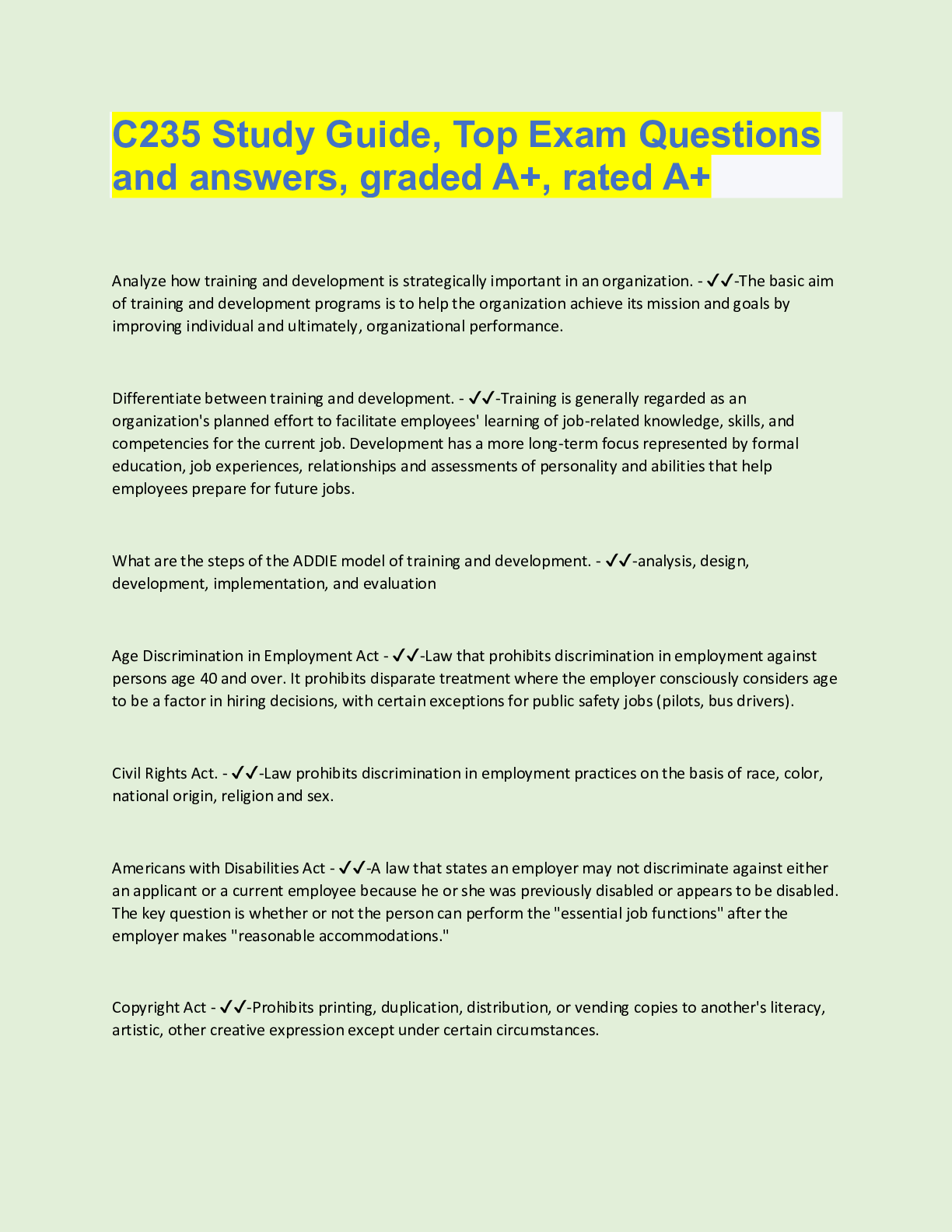
C235 Study Guide, Top Exam Questions
and answers, graded A+, rated A+
Analyze how training and development is strategically important in an organization. - ✔✔-The basic aim
of training and development programs is to help the organization achieve its mission and goals by
improving individual and ultimately, organizational performance.
Differentiate between training and development. - ✔✔-Training is generally regarded as an
organization's planned effort to facilitate employees' learning of job-related knowledge, skills, and
competencies for the current job. Development has a more long-term focus represented by formal
education, job experiences, relationships and assessments of personality and abilities that help
employees prepare for future jobs.
What are the steps of the ADDIE model of training and development. - ✔✔-analysis, design,
development, implementation, and evaluation
Age Discrimination in Employment Act - ✔✔-Law that prohibits discrimination in employment against
persons age 40 and over. It prohibits disparate treatment where the employer consciously considers age
to be a factor in hiring decisions, with certain exceptions for public safety jobs (pilots, bus drivers).
Civil Rights Act. - ✔✔-Law prohibits discrimination in employment practices on the basis of race, color,
national origin, religion and sex.
Americans with Disabilities Act - ✔✔-A law that states an employer may not discriminate against either
an applicant or a current employee because he or she was previously disabled or appears to be disabled.
The key question is whether or not the person can perform the "essential job functions" after the
employer makes "reasonable accommodations."
Copyright Act - ✔✔-Prohibits printing, duplication, distribution, or vending copies to another's literacy,
artistic, other creative expression except under certain circumstances.
What are the two traditional approaches to the development of competency models? - ✔✔-Trainers
have focused on the development of skills and educators have focused on the transmission of
knowledge.
What are the limiations with each of these approaches? - ✔✔-Competency models suggest that both of
these approaches are too narrow in that effective behavior in any job requires a combination of skills,
knowledge, and other characteristics.
What are the 4 competency stages? - ✔✔-Acquiring, applying, mastering and influencing
What two actions are performed to develop a competency model? - ✔✔-(1) Determining traits of
employees who hold that positions(2) Identify the organizations top-performing performers (in that
role)
What are the competencies a trainer must possess. (see topic 5.6) - ✔✔-1) Training expert (2) SME(3)
Consultant (4) Communications expert
What are the three levels of needs assessment. - ✔✔-Organization analysis, task level and person level
What main goal of conducting an organizational level needs assessment - ✔✔-The main goal is to look at
the vision and future direction and determine the workforce needs of the future.
What main goal of conducting an task level needs assessment - ✔✔-Analysts are concerned with what
needs to be taught in a training program and how certain skills and knowledge translate into task
performance.
What main goal of conducting an person level needs assessment - ✔✔-Here the focus is on individual
employees and how well they perform their jobs.
What is the best method to determine the effectiveness of a training program - ✔✔-Assign some
trainees randomly to an experimental group and leave the rest in a control group that will receive no
training
What are the five principles for the design of training for adult learners - ✔✔-1. Need to know "the why"
for any training they are asked to undertake2. Need to be self-directed in their learning3. Bring
extensive work-related experiences into the training, which needs to be acknowledged4. Enter the
training with a problem-centered approach to learning and seek immediate application5. Learn best
through "Praxis," a Greek word meaning "action with reflection". This suggests that actual member of
repetitions may be less important for adult's learners than the opportunity to reflect back and analyze
the impact of actions taken.
Descirbe each of the 4 learning styles - ✔✔-Diverger, Assimilator, Converger & Accommodator
Diverger - ✔✔-Concrete experience & reflective observation. (A person who learns by feeling or
observing)
Assimilator - ✔✔-Reflective observation & abstract conceptualization. (A person who learns by
observing and thinking)
Converger - ✔✔-Abstract conceptualization & active experimentation. (thinking and doing)
Accommodator - ✔✔-Active experimentation & concrete experience (doing & feeling)
How does the Gestalt learning" theory influence the design of training - ✔✔-The Gestalt learning theory
influence the design of training because trainees need to know "the why" of the training. Adults learn
best when they can see the big picture (the Gestalt) before being introduced to the details. They need to
know how the training connect with the business, its strategic success and overall goals and mission.
They also need to see that something is in it for them (WIIFM). Both these goals may be met with the
articulation of behavioral learning objectives to be obtained from the training side-by-side comparison
with business goals.
Describe when each of the following types of training are approprate for a given situation. - ✔✔-
Lecture, role playing, case study, discussion & simulations**TYPES OF TRAININGS!
Lecture - ✔✔-This is the traditional "stand-and-deliver" mode of training. It is helpful for introducing
trainees to new information or new models and frameworks. It is economical in the sense that a large
number of trainees can be exposed to new information in this way.
Role Play - ✔✔-is an active learning technique in which employees act out situations under the guidance
of a trainer. In each scenario, employees take on a role and act out the scene as though it were real.
Case Study - ✔✔-Provides a realistic situation for trainees who must put themselves in the shoes of the
decision maker in the case and try to resolve a problem using materials or frameworks learned in the
training.
Discussion - ✔✔-Group discussion provides a forum for the exchange of the information wherein the
facilitator is not the expert, but rather the participants are. Group discussion can occur with groups of
various sizes, from two ("pair and share") to much larger.
Simulations - ✔✔-All trainees to learn by doing in realistic circumstances, but without the penalties of
making mistakes on the job. Both simulations and structured exercises typically involve a facilitator and
allow participants to practice skills and app
[Show More]


.png)


.png)