WGU C955 All Terms and Formulas.
Graded A+, Verified.
Basic probability - ✔✔-#of total come\# of total outcome in the sample space
P(B | A) - ✔✔-conditional probability
P(A and B)=P(A) • P(B) - ✔✔-multiplication rul
...
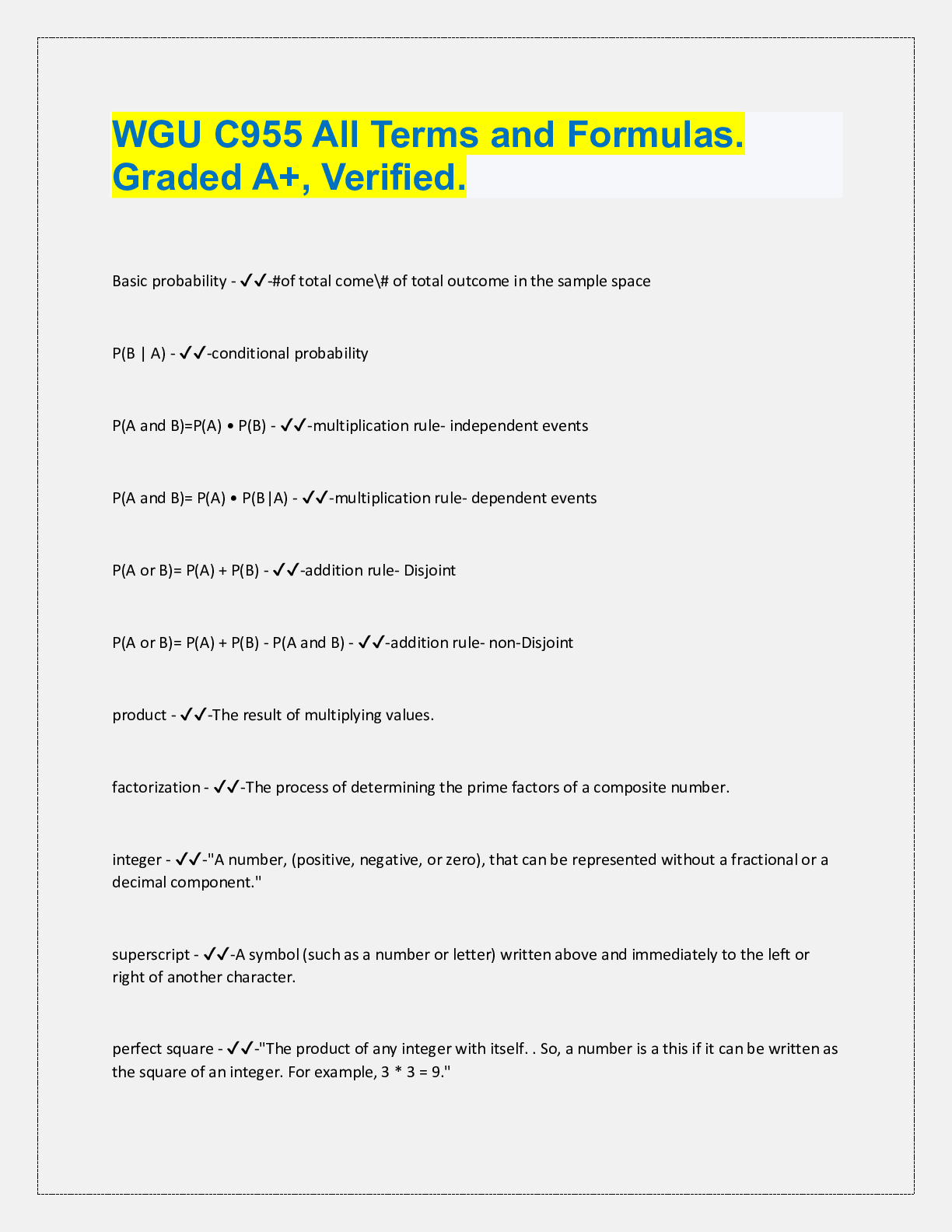
WGU C955 All Terms and Formulas.
Graded A+, Verified.
Basic probability - ✔✔-#of total come\# of total outcome in the sample space
P(B | A) - ✔✔-conditional probability
P(A and B)=P(A) • P(B) - ✔✔-multiplication rule- independent events
P(A and B)= P(A) • P(B|A) - ✔✔-multiplication rule- dependent events
P(A or B)= P(A) + P(B) - ✔✔-addition rule- Disjoint
P(A or B)= P(A) + P(B) - P(A and B) - ✔✔-addition rule- non-Disjoint
product - ✔✔-The result of multiplying values.
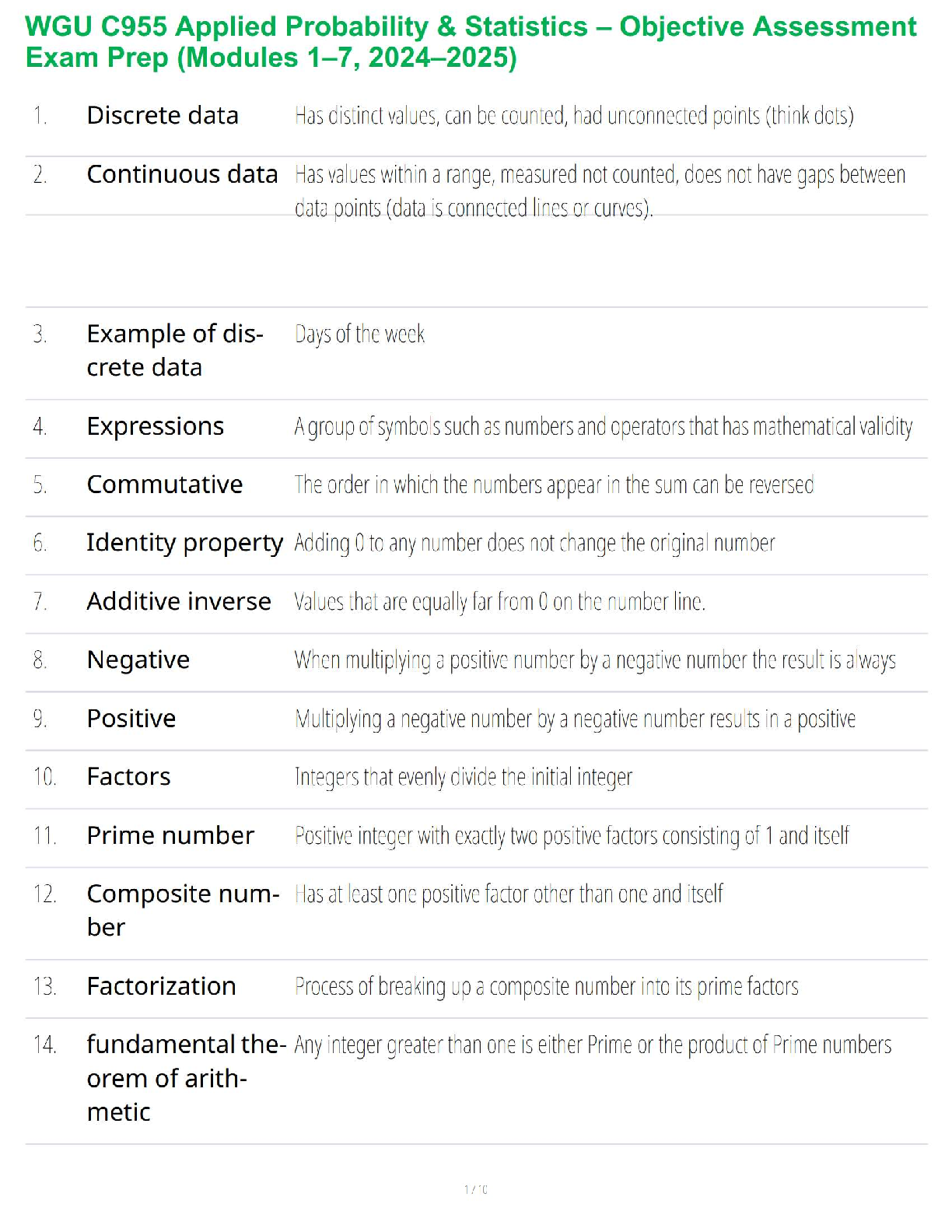
factorization - ✔✔-The process of determining the prime factors of a composite number.
integer - ✔✔-"A number, (positive, negative, or zero), that can be represented without a fractional or a
decimal component."
superscript - ✔✔-A symbol (such as a number or letter) written above and immediately to the left or
right of another character.
perfect square - ✔✔-"The product of any integer with itself. . So, a number is a this if it can be written as
the square of an integer. For example, 3 * 3 = 9."
expression - ✔✔-"A string of terms that are connected by division, addition, and subtraction
operations."
addition - ✔✔-Finding the total of two or more values.
interval - ✔✔-A set of numbers between two specified values.
difference - ✔✔-The result of one number being subtracted from another number.
multi-step expression - ✔✔-An expression or equation with more than two values and two or more
operators that requires multiple steps to be solved.
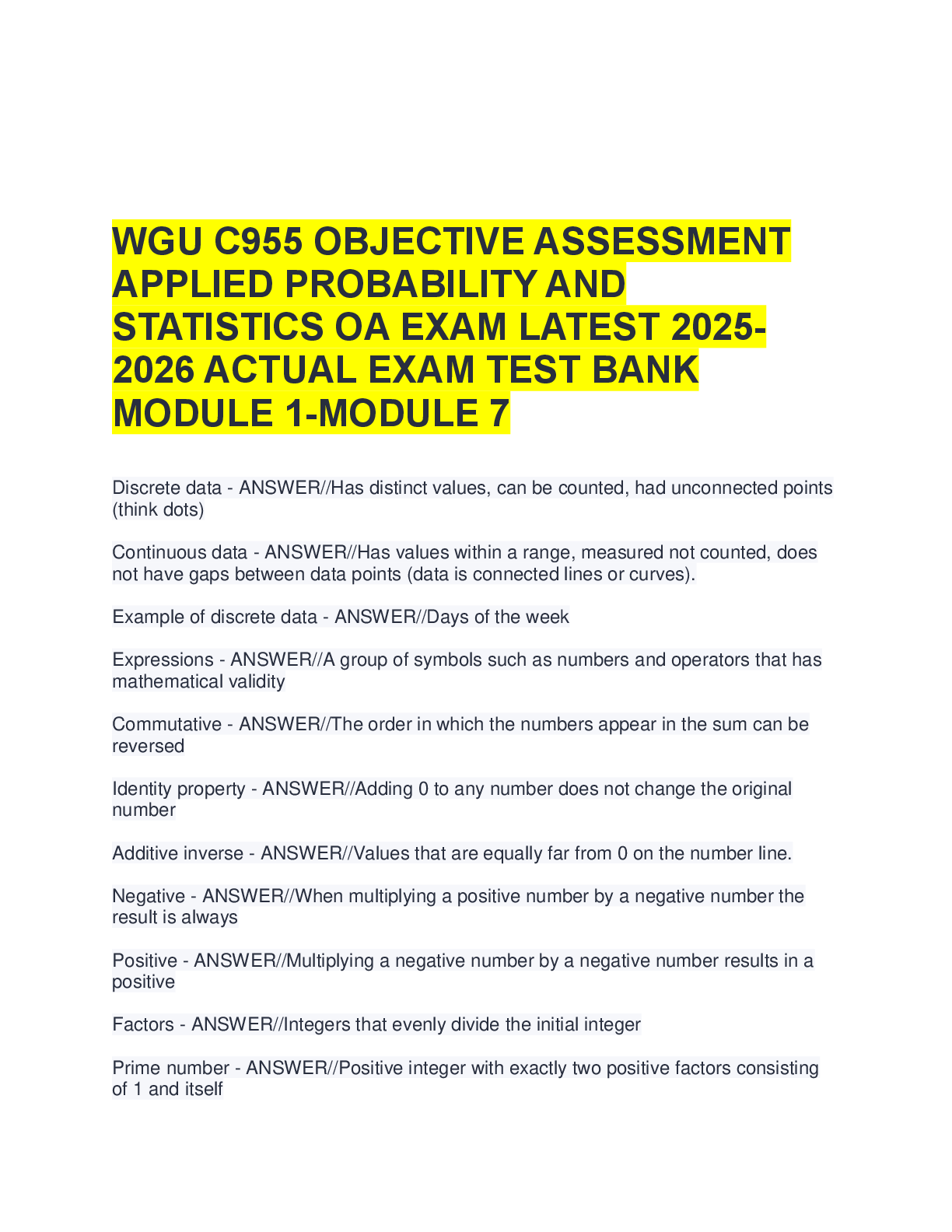
discrete - ✔✔-"A collection of numbers whose values are distinct, separate, and unconnected."
negative number - ✔✔-"A number whose value is less than zero. On the number line, they are to the left
of zero."
division - ✔✔-Splitting values into equal parts or groups.
estimation - ✔✔-Approximating a value for a calculation
radical sign - ✔✔-The symbol which indicates to take the square root of the number that follows.
numbers - ✔✔-A word or symbol (such as 'five' or '16') that represents a specific amount or quantity.
exponents - ✔✔-"Sometimes called a power, it is a quantity that represents repeated multiplication."
parentheses - ✔✔-"In mathematics, these () are used to separate operations within an expression. Any
operations that lie within parentheses should be performed first."
real number - ✔✔-"Any numbers on the number line. They include zero, negative and positive integers,
fractions, and decimals."
sum - ✔✔-The result of multiple numbers being added together.
square root - ✔✔-A number that produces a specified number when it is multiplied by itself.
Fundamental Theorem of Arithmetic - ✔✔-A concept which states that any integer greater than 1 is
either prime or is the product of a unique set of prime numbers.
prime number - ✔✔-A number with only two factors: one and itself.
operator - ✔✔-A word or symbol (such as + or -) that indicates an operation between values.
principal square root - ✔✔-"The positive square root of a number. For example, the principal square
root of 36 is 6."
whole number - ✔✔-A number whose value is 0 or greater (negative numbers are not considered this),
and can be represented without a fractional or a decimal component.
positive number - ✔✔-"A number whose value is greater than zero. On the number line, these numbers
are to the right of zero."
additive inverse - ✔✔-"Two numbers equidistant from 0 on a number line whose sum is 0. For example,
3 and -3
commutative - ✔✔-The property that the order of the numbers under the operation does not change
the result. Addition and multiplication are this: a + b = b + a and ab = ba.
multiplicative inverse - ✔✔-"opposite of a number x is the number you must multiply x by to get 1. For
example, 5 and 1/5 are this."
negative square root - ✔✔-"The negative compliment of a perfect square. For example, -6 is the this of
36."
operation - ✔✔-"In mathematics, this is a procedure which generates a new value from one or more
operands, or mathematical values."
identity property - ✔✔-"The property that 0 can be added to any number without changing the value of
the number. Likewise, 1 can be multiplied by any number without changing the value of that number."
rational number - ✔✔-"This type of number is a number that can be written as a ratio of integers, which
means it can be written as a fraction."
order of operations - ✔✔-A set of rules that defines the order in which mathematical operations should
be performed
associative property - ✔✔-"This property holds that under certain operations in a multi-step expression,
the computations may be done in any order. Commonly represented as (a + b) + c = a + (b + c). Addition
and multiplication follow this property"
prime factorization - ✔✔-Determining the set of prime numbers whose product is the original integer.
continuous - ✔✔-A collection of numbers whose values are not dividable into distinct units.
composite number - ✔✔-A number with more factors than just one and itself.
multiplication - ✔✔-"In mathematics, this is the act of adding the same number multiple times. It is
often denoted by the dot sign, ·."
base number - ✔✔-"The number multiplied by itself when paired with an exponent. For example, in 8 to
the third power, 8 would be this number."
radicand - ✔✔-The number within the radical sign whose square root is to be taken.
factor tree - ✔✔-A graphical method used to identify the prime factorization of an integer.
subtraction - ✔✔-Taking one or more values away from another.
set - ✔✔-In mathematics: a collection of numbers.
factor - ✔✔-"An integer that divides another integer. We say an integer, x, is a this of another integer, y,
if the quotient y/x is also equal to an integer."
quotient - ✔✔-The result of a division expression.
greatest common factor (GCF) - ✔✔-This is, of any two integers a and b, the greatest number that is
both a factor of a and a factor of b.
cross products - ✔✔-The results produced from cross multiplication.
equivalent fractions - ✔✔-Different fractions that represent the same value.
multiple - ✔✔-"An integer that is that integer multiplied by another integer. For example, 28 is a this of
7 because 28 = 7*4."
numerator - ✔✔-"The number that is written before the slash, or above the fraction bar, in a fraction."
ratio - ✔✔-Measures one quantity in relation to another quantity.
reciprocal - ✔✔-"This is that number which, when multiplied by the original number, equals 1. It is the
same as the multiplicative inverse."
proportion - ✔✔-A true statement in which two ratios are equal to each other.
unit multiplier - ✔✔-"A fraction that contains two equivalent quantities but in two different units, used
in order to convert units."
fractions - ✔✔-The representation of a number as a division of one integer by another through the use
of a slash or division bar.
percent proportion - ✔✔-Proportion that is equivalent to the given ratio but has a denominator of 100.
So such proportion of 3/5 is 60/100.
rounding - ✔✔-A method of estimating in order to make working with a number easier.
butterfly method - ✔✔-Cross-multiplication method used to determine whether two fractions are equal.
The numerator of one fraction is multiplied by the denominator of the opposite fraction on both sides.
unit cancellation - ✔✔-"The act of a unit being crossed out when the unit is in a numerator, and the
same unit is in the denominator of a fraction or a product of fractions."
unit conversion - ✔✔-A method used to change between measurement systems.
place value - ✔✔-Describes what part of the whole the decimal represents.
repeating decimal - ✔✔-"A decimal number that has either a digit, or sequence of digits, that continue
forever. A bar is written over the top of the part of the decimal that repeats."
rate - ✔✔-A ratio that compares two quantities having different units of measure.
percent sign - ✔✔-A symbol used to denote percentages.
percentages - ✔✔-"Like fractions, they denote something that is not necessarily whole, but rather could
be a part of a whole number. 100% represents the number one."
terminal decimal - ✔✔-A decimal number that has a finite number of digits.
least common multiple (LCM) - ✔✔-The smallest number in value that is a multiple of two or more
number
[Show More]





.png)